
What if the most important Part 107 decision happens before your drone leaves the ground? The Part 107 rules and regulations can feel dense, especially when it’s unclear whether a flight falls under recreational rules or Part 107. They become easier to apply when you connect each requirement to a decision in your flight plan.
This guide explains the main categories of FAA requirements and how they affect common operations. You’ll learn how pilot qualifications, aircraft requirements, airspace, and operating limits fit together, and where to verify current details for a specific flight.
Use the guidance here to plan practical checks, such as confirming airspace, maintaining visual line of sight, and reviewing aircraft requirements. Because rules and operation-specific requirements can change, consult current FAA and eCFR sources before flying. AINautics University’s Part 107 Training and Drone Simulator can support your study and decision-making practice. The FAA remains the authority for current requirements and certification.
Key Takeaways
- Start by identifying whether your operation falls under Part 107. The purpose of the flight and any applicable exception help determine which rules apply.
- Group the Part 107 rules and regulations into pilot qualifications, aircraft responsibilities, and flight limits. This makes it easier to connect each requirement to a practical decision.
- For controlled airspace, night flights, and operations over people, identify the specific rule that applies and verify current details with official FAA sources.
- Use the same preflight review each time to assess your mission, airspace, aircraft, and operating conditions.
- Build practical judgment alongside regulatory knowledge through structured study and scenario-based learning.
What Part 107 Covers, and When Its Rules Apply
Part 107 is the Federal Aviation Administration’s (FAA) rule framework for many civil operations of small unmanned aircraft. It appears in Title 14 of the Code of Federal Regulations, Part 107, and sets requirements for the people responsible for flights as well as how those flights are conducted. Start by considering the operation’s purpose and circumstances, rather than asking only whether the flight is paid. Then verify which rules apply using current FAA guidance.
Who and what does Part 107 regulate?
Three concepts help explain the framework. A small unmanned aircraft is the aircraft itself, commonly called a drone. An unmanned aircraft system (UAS) includes the aircraft and the associated elements needed to operate it. The remote pilot in command is responsible for the flight’s safe conduct and for meeting applicable requirements. More than one person may have a role in an operation, so don’t assume the person holding the controls is the only one with responsibilities.
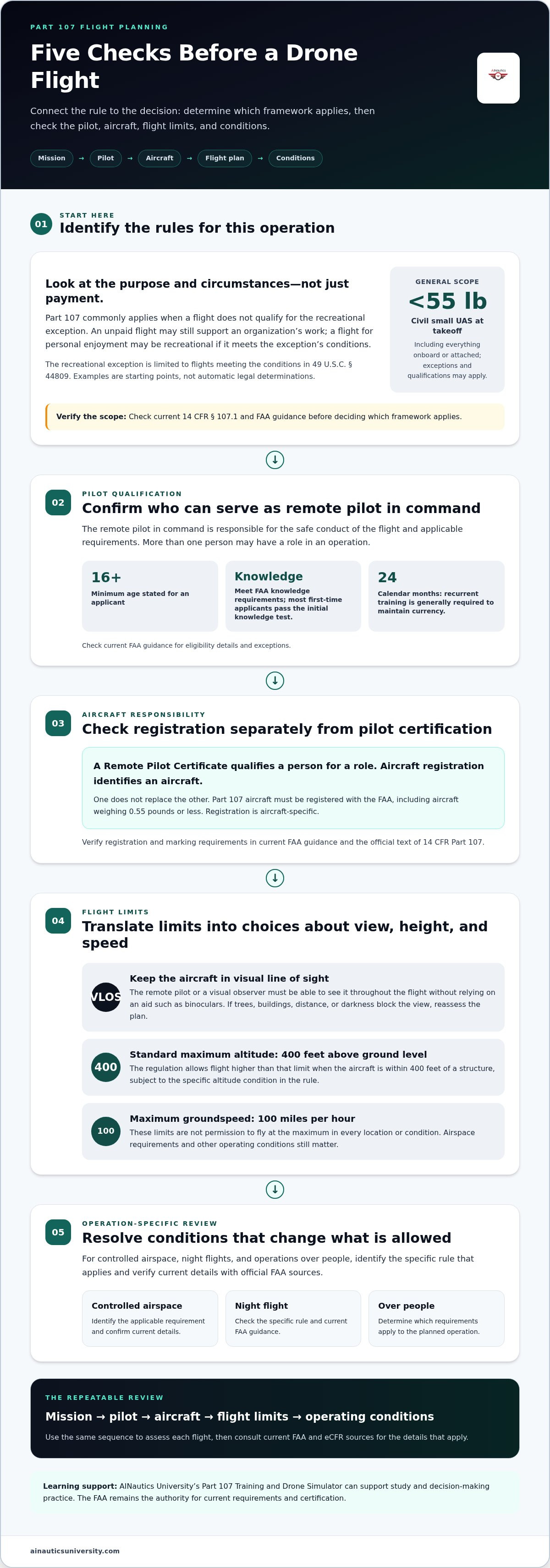
Part 107 generally applies to civil small UAS weighing less than 55 pounds at takeoff, including everything onboard or attached. The regulation includes exceptions and qualifications. Before relying on a weight threshold or deciding that a particular operation is covered, check the current text of 14 CFR § 107.1 and related FAA guidance.
A classroom, school project, nonprofit, or business setting doesn’t automatically replace the applicable FAA framework. The aircraft, operation, and purpose still matter. Educational goals can shape a mission, but they don’t create a blanket exemption from aviation requirements.
How do you tell whether an operation falls under Part 107?
Distinguish recreational flying from other operations by looking beyond payment. The FAA’s recreational exception is limited to flights that meet the conditions in 49 U.S.C. § 44809. Part 107 commonly governs operations that don’t qualify for that exception, including flights conducted for business purposes. Whether money changes hands isn’t the only factor. An unpaid flight may still support an organization’s work, while a flight for personal enjoyment may be recreational if it meets the exception’s requirements.
Consider two examples. A pilot flying solely for enjoyment may be able to operate under the recreational exception if the flight meets its conditions. A student gathering aerial images for a company project may need to consider Part 107, even if the student isn’t paid. These examples are starting points, not automatic legal determinations. The mission’s details can change the analysis.
Use the FAA’s guidance on Part 107 and limited recreational operations, along with current statutes and regulations, to assess your flight. If Part 107 applies, understand its pilot and operating requirements before flying. For focused preparation and certification study, explore this Part 107 training guide.
The Core Part 107 Requirements: Pilot, Aircraft, and Flight
Once an operation falls under Part 107, plan around three connected areas: who may act as pilot in command, what requirements apply to the aircraft, and how the flight will be conducted. These areas work together. Even a qualified pilot needs to check the aircraft and flight conditions before launch.
What does the Remote Pilot Certificate establish?
The FAA Remote Pilot Certificate with a small unmanned aircraft rating establishes that its holder has met the applicable requirements to serve as a remote pilot in command under Part 107. An applicant must be at least 16 years old and meet the FAA’s knowledge requirements. For most first-time applicants, that includes passing the initial aeronautical knowledge test. The FAA also requires recurrent training to maintain currency, generally every 24 calendar months. Check current FAA guidance for eligibility details and exceptions.
A Remote Pilot Certificate qualifies a person for a role. Aircraft registration identifies an aircraft, so one does not replace the other. Part 107 aircraft must be registered with the FAA, including aircraft weighing 0.55 pounds or less. Part 107 registration is aircraft-specific. Verify registration and marking requirements in current FAA guidance and the official text of 14 CFR Part 107.
Certification is one part of a pilot’s responsibilities. The remote pilot in command must assess the planned operation, decide whether conditions allow a safe flight, and follow applicable rules. A structured beginner drone training guide can help learners build foundational knowledge, but it doesn’t replace FAA requirements or the FAA-issued certificate.
Which flight limits shape a routine operation?
Before takeoff, translate flight limits into decisions about where you’ll stand, how high the aircraft will fly, and how fast it will travel. Under Part 107, the remote pilot or a visual observer must be able to see the aircraft throughout the flight without relying on an aid such as binoculars. This is called visual line of sight. If trees, buildings, distance, or darkness block that view, reassess the plan.
The standard maximum altitude is 400 feet above ground level. The regulation allows flight higher than that limit when the aircraft is within 400 feet of a structure, subject to the specific altitude condition in the rule. Part 107 also sets a maximum groundspeed of 100 miles per hour. These limits aren’t permission to fly at the maximum in every location or condition. Airspace requirements and other operating rules still apply.
Use a three-part review: confirm the pilot is qualified and current, check the aircraft’s registration and applicable requirements, then review the planned altitude, visibility, speed, and operating conditions. Yield to manned aircraft. Don’t assume an exception applies without verifying its terms or obtaining any required authorization. AINautics University’s Part 107 Training can help you study these requirements and develop sound flight-planning habits.
Airspace, Night Flights, and Operations Over People: What Changes?
A routine flight can become more complex in controlled airspace, at night, or over people. Flight context can change which requirements apply, so assess the location, timing, and potential exposure before choosing a flight plan. The table below pairs each scenario with the decision to resolve and the rule or source to check.
| Flight scenario | Question to resolve | Rule area and source to check |
|---|---|---|
| Controlled airspace | Does this location require prior authorization, and what limits apply? | 14 CFR § 107.41; current FAA airspace resources and LAANC information |
| Night operations | Has the remote pilot met the training requirement, and does the aircraft have the required lighting? | 14 CFR § 107.29 and current FAA guidance |
| Operations over people | Does the aircraft and operation meet an applicable category, or is another authorization needed? | 14 CFR Part 107, Subpart D, and current FAA guidance |
How should pilots approach airspace requirements?
Start by identifying the airspace at the planned location and whether Part 107 requires FAA authorization before flight. Controlled airspace does not automatically prohibit a drone operation, but the remote pilot must obtain authorization when required and follow its terms. The Low Altitude Authorization and Notification Capability (LAANC) can provide airspace authorization in eligible areas through participating providers. Availability and limits depend on the location and request. Use current FAA airspace resources and LAANC information to check the precise site. An authorization does not waive other operating rules.
What should you check before night or over-people operations?
Part 107 permits night operations without a waiver when the remote pilot has completed the required updated training and the aircraft meets the lighting requirement. The aircraft must have anti-collision lighting visible for at least three statute miles. Verify the current wording in 14 CFR Part 107, including § 107.29, and review FAA guidance before planning the flight.
Flying over people is not automatically allowed just because the pilot holds a Remote Pilot Certificate. The aircraft and operation must meet the conditions of an applicable category under Subpart D, or the pilot must have an applicable waiver. Category requirements differ, so check the specific aircraft and operating conditions instead of relying on a general rule of thumb. Operations over moving vehicles also have specific conditions. A waiver authorizes relief from specified provisions under stated terms, not a general exemption from Part 107.
For each scenario, confirm the current rule and any authorization before launch. The Part 107 rules and regulations provide the framework, while the flight plan determines which details need close attention.
A Repeatable Part 107 Compliance Review Before Every Flight
A consistent review turns regulations into clear go, adjust, or stop decisions. Use these steps as an educational planning aid, not as legal advice or a substitute for current Federal Aviation Administration (FAA) requirements. If a mission doesn’t fit a routine scenario, pause and verify the applicable rule before proceeding.
- 1. Define the mission. Write down what the flight is intended to accomplish, who it serves, and how the footage or data will be used. Revisit whether Part 107 applies based on the purpose and circumstances. Don’t assume an unpaid or school-related flight is automatically recreational.
- 2. Identify the aircraft and responsible pilot. Confirm which drone will fly and who will serve as the remote pilot in command. Check that the pilot meets current certificate and currency requirements. Review the aircraft’s registration and any applicable identification requirements. For an unusual aircraft or configuration, verify how the relevant FAA rules apply.
- 3. Check the exact location and airspace. Pinpoint the planned operating area, then use current FAA airspace resources to identify controlled airspace or other restrictions. If authorization is required, obtain it before operating and understand its limits. Don’t assume permission for one location, altitude, or time applies to another.
- 4. Assess people, property, and conditions. Identify people who may be near or beneath the aircraft, moving vehicles, obstacles, and places where the drone could create risk. Consider visibility, weather, lighting, and whether the remote pilot can maintain visual line of sight. For night operations or flight over people, confirm the specific training, equipment, category, operating conditions, or waiver requirements that apply.
- 5. Compare the plan with operating limits. Check the intended altitude, speed, route, and duration against current Part 107 requirements. Plan how the flight will avoid hazards and yield to manned aircraft. If the mission depends on an exception or waiver, verify that it covers the planned operation and that everyone involved can follow its conditions.
- 6. Make a go, adjust, or no-go decision. Brief everyone involved on roles, communication, the planned area, and what would prompt a pause or landing. Resolve unanswered regulatory questions using current FAA guidance and the eCFR text. If a required authorization is missing or conditions no longer match the plan, delay or revise the flight.
- 7. Close out the operation. After landing, note useful details such as the date, location, aircraft, purpose, and any changes or issues encountered. Keep records appropriate to the operation and any applicable authorization or organizational process. This suggested practice is not a universal retention requirement, so verify any specific recordkeeping duties that apply.
Repeating this review builds a practical habit: identify the mission, verify the rules, and pause when the facts change. AINautics University’s Part 107 Training can support structured study as you develop that decision-making foundation.
Build Part 107 Knowledge Into Practical Drone Skills
Knowing a rule is only the starting point. Responsible UAS operation also means understanding how a rule affects a specific mission, noticing when conditions change, and making a sound decision before takeoff. Continued study and practice help develop that judgment. Check current Federal Aviation Administration (FAA) requirements for each operation.
How can structured learning support regulatory understanding?
The Part 107 rules and regulations cover connected topics, and it can be difficult to see how they fit together when studying them in isolation. Guided lessons can help learners group concepts, revisit areas that need attention, and establish a consistent study routine. Pair each topic with a practical question: What would I check before this flight, and what would make me pause?
Scenario-based practice offers another way to learn. A learner can work through a simulated mission and consider how a change in location, visibility, or flight objective affects the plan. The AINautics Drone Simulator provides a learning environment for practicing decisions and flight scenarios. Simulation supports skill development, but it doesn’t grant permission to fly, replace required FAA credentials, or determine whether a real operation is authorized.
Keep the distinction clear: training helps you understand and apply concepts, while the FAA’s current rules govern actual operations. Use official FAA guidance and current regulatory text whenever a question affects a planned flight. If a scenario falls outside what you’ve studied or practiced, pause and verify rather than relying on an assumption.
Where can learners continue their Part 107 preparation?
Choose a learning approach that helps organize study and connect regulatory topics to operational thinking. AINautics University’s Part 107 Training and Self-Paced Certification options support structured learning. They are educational resources, not FAA-issued certificates or substitutes for completing applicable FAA requirements. Learners looking for a broader starting point can also use this professional Part 107 training guide to explore preparation.
As you study, keep a simple learning log. Note the topic, the question you’re working through, and the official source you used to resolve it. Revisit your notes before practice sessions and update them when FAA guidance changes. This habit helps students, educators, and future operators connect knowledge with responsible decision-making.
If you’re ready to continue at your own pace, explore AINautics University’s drone learning options and choose a resource that fits your next step.
Turn Your Next Step Into Flight-Ready Judgment
Strong UAS skills grow through steady learning. Choose one area of the Part 107 rules and regulations to understand more deeply, then check it against current FAA guidance. As your goals develop, revisit your study approach and look for ways to connect what you learn with responsible decision-making.
That ongoing effort can help students build a foundation for future UAS work and help educators guide learners with confidence. Keep asking practical questions: What would I need to verify for a new mission? Which decision would make me pause? A thoughtful answer is often more valuable than trying to memorize every detail at once.
AINautics University offers learning resources for people preparing to build their knowledge and skills. Explore Part 107 learning options at AINautics University and choose a next step that fits your goals. Each focused study session can help you build sound judgment and prepare for responsible operations.
Frequently Asked Questions
Does Part 107 apply if I am not paid to fly a drone?
Yes, an unpaid flight may still need to follow Part 107. To assess a borderline mission, write down who benefits from the flight, why you’re collecting data or images, and how the results will be used. Be especially clear about the purpose when a personal project also supports a school, organization, or client. Payment is one consideration, not a reliable shortcut for classifying the operation.
Can a student operate a drone under Part 107?
Yes, but the student’s role matters. A person manipulating the controls may do so under the direct supervision of a remote pilot in command who can immediately take control. To hold a Remote Pilot Certificate, an applicant must be at least 16 years old. Before a lesson, educators can define who supervises, who handles the controls, and how control will be transferred.
How do I check whether a planned drone flight needs airspace authorization?
Check more than the airspace classification. For the planned date and location, also look for temporary flight restrictions and current notices that could affect the operation. Use precise coordinates rather than relying on a nearby landmark, and compare the planned flight area with the exact limits shown in FAA tools. Resolve unclear maps or notices before treating the location as suitable for flight.
Can a drone fly at night under Part 107?
Yes, when the operation meets the applicable night-flight conditions. Don’t use sunset alone to decide when night rules begin. FAA definitions use civil twilight, so check the applicable twilight times for the date and location, particularly for flights scheduled around dawn or dusk. Build time into the plan for delays, and reassess if the operation could extend into the defined night period.
What should I do if my planned operation does not fit standard Part 107 rules?
Consider whether you can redesign the mission to fit standard operating conditions. Depending on the objective, you might change the route, choose a different launch site, adjust the schedule, or divide the work into separate flights. Then reassess the revised plan against applicable rules. If the mission still depends on relief from a requirement, identify the specific provision and plan around the authorization process before committing to the operation.
Does completing a Part 107 training course issue a Remote Pilot Certificate?
No. A course supports learning, but the FAA issues the Remote Pilot Certificate. After meeting the applicable testing requirements, applicants complete the FAA’s application process using the Integrated Airman Certification and Rating Application (IACRA) system. Keep course records and FAA application information distinct so you can track study progress without mistaking a training completion document for an FAA credential.
Where can I find the current official text of Part 107?
Use the Electronic Code of Federal Regulations (eCFR) for the regulation’s current wording. Its contents list organizes Part 107 into sections, so you can go directly to a cited provision instead of scanning the full part. Use the section number named in an FAA explanation to find the corresponding text, then read the surrounding provisions to understand how the rule fits into the operation.

Article by
AINautics University Team
The team behind AINautics University, dedicated to drone education and FAA Part 107 certification prep, VR flight simulation, and STEM training programs for students and educators.


