
What if a drone curriculum could begin before students ever take off? A strong STEM curriculum with drones starts with clear learning goals, then builds toward application through concepts, simulation, coding, and guided activities. That progression helps connect classroom lessons to practical skills and makes the curriculum easier to plan and assess.
If you’re unsure how to turn drone activities into measurable STEM learning, or how to make flight sessions purposeful, you’re not alone. Introduce skills in stages, with each lesson preparing students for the next. A well-sequenced program can reflect your school’s priorities, whether you want to strengthen STEM learning, support a CTE pathway, or introduce future UAS careers.
This guide lays out a practical path from foundational concepts to applied projects. You’ll learn how to set objectives, combine simulation with coding and supervised activities, and build educator confidence. AINautics University’s Drone Simulator, VR Trailer Mobile Lab, and Train-the-Teacher Program can support different stages. Part 107 Training, Self-Paced Certification, and UAS Student Scholars can also help connect learning to future opportunities.
Key Takeaways
- Build a STEM curriculum with drones around connected learning goals, not flight time alone.
- Sequence lessons from core concepts to simulation, applied activities, and reflection, adjusting complexity to learner readiness.
- Choose a concept-led, simulation-first, hands-on, or blended approach based on your goals, educator readiness, learner access, and available time.
- Plan each lesson around an objective, concept, activity, evidence of learning, and reflection. Assess student thinking and design work as well as practical skills.
- Start with a focused pilot, review what students learn, and refine the program with educator support and standards alignment.
Why a STEM Curriculum with Drones Needs More Than Flight Time
A drone taking off can capture attention, but flight alone doesn’t show what students have learned. A strong STEM curriculum with drones ties each activity to a learning goal, then gives students opportunities to apply, explain, and extend their knowledge. The drone is a teaching tool, not the curriculum itself.
A drone activity is a single experience; a drone curriculum is a sequenced plan that turns related experiences into measurable learning. Students might move from exploring how flight works to writing code, testing a plan, and interpreting observations. Each stage gives them a reason to revisit ideas and apply them in a new context.
This distinction makes hands-on lessons more purposeful. Instead of asking only, “Did the drone fly?” ask what students should understand, practice, or communicate. A lesson can meet its objective without a flight: students might plan a route, predict an outcome, or use a simulator to test an idea before applying it in a practical activity.
Start with learning outcomes, not equipment
Choose the concept first, then decide whether a drone, simulator, coding exercise, or design task is the right teaching tool. Make the objective observable. For example, students might explain how a change affects motion, write a sequence of commands, compare test results, or justify a design decision. This keeps attention on what learners can demonstrate, not simply on the equipment they use.
Connect drone concepts to classroom STEM
Use flight to explore forces and motion: ask students to predict how a controlled change may affect movement, then compare the result with their prediction. Coding and mission planning bring in logic, sequencing, and problem-solving. Measuring distances or comparing planned and observed routes gives students a reason to organize information, look for patterns, and explain what the evidence suggests.
A connected challenge can draw on several subjects while keeping a clear focus. Students could plan a route through a simple course, describe the steps, test the plan in a simulator, and record where the result differed from their prediction. They can then revise the sequence and explain their reasoning. The main objective might be computational thinking, with measurement and communication supporting the investigation.
Before selecting an activity, write down:
- Concept: What STEM idea should learners explore?
- Action: What will they test, design, explain, or interpret?
- Evidence: What work or explanation will show their learning?
These decisions make it easier to adapt a lesson to different ages, readiness levels, and school priorities. They also help educators decide what to teach next. With learning outcomes in place, flight becomes one purposeful part of a broader sequence rather than the only measure of progress.
Sequencing Drone STEM: From Foundations to Application
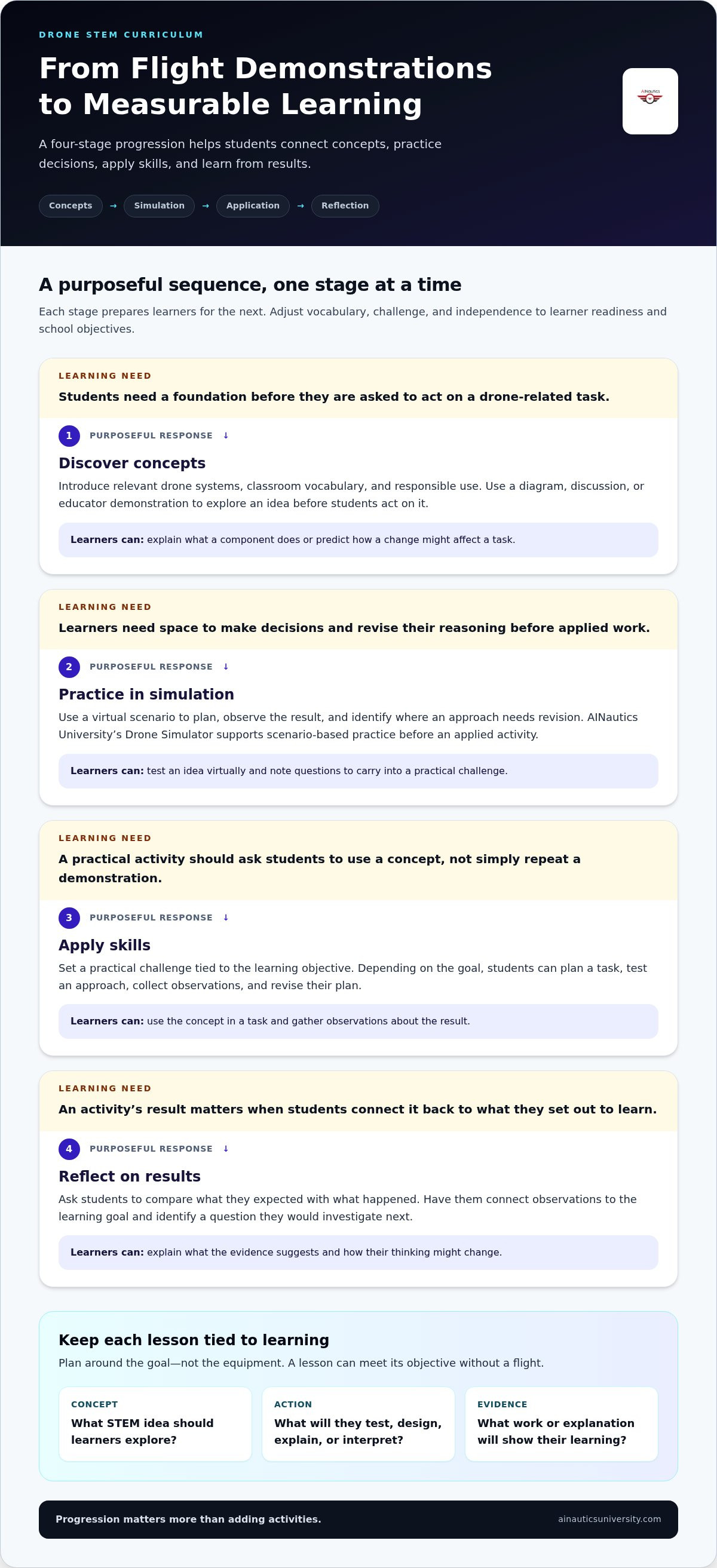
A thoughtful sequence helps students connect one lesson to the next. Instead of stringing together unrelated demonstrations, build a progression from understanding concepts to practicing decisions, applying skills, and learning from results.
Progression matters more than adding activities: each new task should give learners a reason to use and extend what they already know. A four-stage structure is a flexible starting point for a STEM curriculum with drones. Adjust the vocabulary, challenge, and level of independence to match learner readiness and school objectives.
- Discover concepts. Introduce relevant drone systems, classroom vocabulary, and responsible use. Use a diagram, discussion, or educator demonstration to explore an idea before asking learners to act on it. Invite students to explain what a component does or predict how a change might affect a task.
- Practice in simulation. Let learners make decisions in a virtual scenario before moving into applied work. They can consider a plan, observe the result, and identify where their reasoning needs revision.
- Apply skills. Set a practical challenge that asks students to use the concept, not simply repeat a demonstration. Depending on the objective, learners might plan a task, test an approach, collect observations, and revise their plan.
- Reflect on results. Ask students to compare what they expected with what happened. Have them connect their observations to the learning goal and identify a question they would investigate next.
Build foundations before introducing flight tasks
Start with ideas students can explain in their own words. A class might label components on a diagram, discuss what information a pilot needs to plan a task, or examine how a system responds to an input. Keep vocabulary accessible and introduce technical terms when they clarify the concept. Short predictions and design questions can show whether learners are ready to move on.
Move from simulation to applied challenges
AINautics University’s Drone Simulator supports scenario-based practice, giving educators a way to introduce decision-making before an applied activity. Students might plan a virtual task, note where their approach needs adjustment, then carry those questions into a supervised classroom challenge. Close the loop with reflection: What did the evidence show, and how does it relate to the lesson objective?
Keep the sequence consistent while adjusting its complexity. Newer learners may identify system parts and explain a simple plan. More experienced students can compare alternative plans, justify design choices, or analyze patterns in their observations. The U.S. Department of Education STEM initiatives offer broader context for connecting classroom learning with STEM education goals.
Educators who want to strengthen classroom readiness can build their skills through AINautics University’s Train-the-Teacher Program.
Which Drone Curriculum Approach Fits Your School’s Learning Goals?
The right delivery model depends on what students need to learn, what educators are prepared to teach, what learners can access, and how much instructional time is available. A concept-led lesson may be enough to build understanding, while an objective focused on skill practice may call for simulation or practical application. A blended approach connects these methods instead of treating them as alternatives.
Use this comparison to choose a starting point for your STEM curriculum with drones. These are planning prompts, not fixed rules. A school can combine approaches or shift between them as objectives change.
Concept-led lessons
Strength: Focus attention on explaining ideas such as flight, design, or data. Consider: Learners may need a follow-up task to apply what they understand. Fits: Introducing vocabulary, discussing a design question, or analyzing observations when time or equipment access is limited.
Simulation-first learning
Strength: Gives learners a setting for scenario-based decisions and practice. Consider: Connect the simulated task to the intended concept instead of treating screen time as the goal. Fits: Objectives involving planning, sequencing, observation, and revision.
Hands-on projects
Strength: Let learners apply ideas through structured practical experience. Consider: Activities need clear roles, preparation, and a manageable scope. Fits: Objectives focused on testing a plan, making design choices, or interpreting results from an applied task.
Blended sequences
Strength: Combine explanation, simulation, and practical work to support learning across stages. Consider: Plan transitions so each learning mode advances the same objective. Fits: Goals that ask students to understand a concept, practice decisions, and then apply or explain their learning.
When simulation-first learning is a strong fit
Choose simulation first when learners need to practice a scenario before a physical flight activity. A task might ask students to arrange steps in a mission plan, observe the outcome, and revise their approach. AINautics University’s Drone Simulator supports scenario-based learning. Match the scenario to a specific objective, such as planning or problem-solving, and decide what student work will demonstrate understanding.
When hands-on or blended learning adds value
Use practical activities when learners need to apply a concept through a structured experience. Teacher-led instruction can establish context, simulation can provide practice, and hands-on work can give students another way to apply their thinking. AINautics University’s VR Trailer Mobile Lab offers an immersive learning resource within a broader curriculum. Choose the mix that fits your goals, educator readiness, learner access, and available time.
AINautics University’s Train-the-Teacher Program helps educators prepare to make these instructional choices.
How to Plan Lessons, Assess Learning, and Prepare Educators
A repeatable lesson structure makes drone learning easier to teach and assess. Start with one objective, then choose the concept, activity, evidence, and reflection that support it. This keeps the lesson focused and helps educators separate what students are learning from the tool they use.
Planning principle: Collect evidence that directly shows whether students met the learning objective, not just whether they completed the activity. A successful flight may be engaging, but by itself it doesn’t show that a learner can explain a concept, plan a task, or interpret results.
Turn a STEM objective into a teachable drone lesson
Suppose the objective is for students to create and explain a logical sequence of instructions. They might examine a sample sequence, work through a guided activity, and then create their own instructions for a defined challenge. The lesson can use a simulator or another classroom format, depending on the objective and available resources.
Plan the lesson in five steps:
- Objective: State what learners should know or be able to do.
- Concept: Identify the STEM idea behind the objective.
- Activity: Choose a guided task and a learner challenge that let students use that idea.
- Evidence: Decide what students will produce or explain to demonstrate learning.
- Reflection: Ask learners to connect their choices and results back to the objective.
Evidence might include a written explanation, plan, code, annotated design, or reflection. Learners can work individually, in pairs, or in teams. Set expectations for each format, such as asking every learner to explain one decision, so collaboration doesn’t obscure individual understanding.
Build educator readiness and classroom continuity
Before teaching, identify where you would benefit from more preparation. You might want to strengthen your understanding of UAS concepts, practice guiding a simulation, or create a consistent routine for transitions and student roles. Clear directions, defined responsibilities, and a shared way to pause and review work help keep attention on the learning goal.
AINautics University’s Train-the-Teacher Program supports educator preparation. As you plan, use this guide’s lesson structure to connect drone activities to classroom learning goals and assessment.
Build confidence through preparation and supported practice, then revisit the lesson. Which evidence showed learning? Where did students need more guidance? What should change next time? Explore educator training options from AINautics University to develop classroom readiness.
How to Launch and Sustain a Drone STEM Curriculum
A sustainable program grows from a focused start. Rather than introducing a long list of activities at once, pilot a short sequence tied to clear school priorities. Gather evidence of what students understand, note where educators need support, then refine the lessons before expanding to more classes or pathways.
Create a practical launch plan
Map the rollout before choosing activities. Define the program’s learning objectives, identify the learners it will serve, and connect the sequence to relevant district or state standards, STEM/STEAM initiatives, or CTE pathways. Then plan educator preparation, decide where simulation or hands-on learning fits, and determine what student work will show progress.
- Set the scope. Choose focused learning goals and the learner group the pilot will serve.
- Prepare educators. Identify the curriculum, simulation, or UAS concepts teachers need to guide learning with confidence.
- Plan activities and evidence. Match each lesson to an objective and decide what student work will help you assess it.
- Review and refine. Use learner work and educator feedback to adjust the sequence before broader adoption.
During the pilot, look beyond whether activities ran smoothly. Review student explanations, plans, design choices, and reflections. Ask educators which instructions were clear, where learners needed more guidance, and whether the pace fit the available teaching time. Use those observations to update lesson materials and classroom routines. Schedule regular reviews to keep the program connected to school priorities.
AINautics University’s Launch a Drone Program in 90 Days offers schools a structured implementation path. Treat launch as the beginning of ongoing work: continued educator support and curriculum updates help keep learning relevant as student goals and school needs evolve.
Connect learning to further UAS opportunities
As learners build foundational knowledge, introduce further UAS learning that reflects their readiness and interests. Advanced students can explore appropriate certification pathways and workforce topics, while the UAS Student Scholars program offers an additional learning opportunity. Keep these options connected to curriculum objectives rather than presenting certification as the only measure of success.
Simulation and immersive learning can form part of broader instruction. To move forward, define one focused pilot sequence, identify the evidence you’ll review, and explore drone program implementation support from AINautics University.
Turn Your Curriculum Plan into a Lasting Opportunity
A STEM curriculum with drones can become a lasting part of learning when it grows with your students and school. Set a clear starting point, learn from the first lessons, and make thoughtful adjustments as educators and learners build confidence. The goal isn’t to add technology for its own sake. It’s to give students meaningful opportunities to develop skills they can carry into further study and UAS careers.
AINautics University’s Train-the-Teacher Program supports educator development, while the Drone Simulator and VR Trailer Mobile Lab provide learning resources for different stages of a program. Curriculum can also align with state and district standards, CTE pathways, and STEM/STEAM initiatives, connecting drone learning to broader school priorities.
Choose a practical next step: refine a pilot lesson, identify the educator support your team needs, or map program goals to existing priorities. Then build from there. Explore AINautics University’s drone education programs for resources to support your school’s next stage. With a clear purpose and room to grow, your program can help learners move from curiosity toward confident, future-ready skills.
Frequently Asked Questions
Can students learn about drones without flying one?
Yes. Students can learn about drones without flying one. They can trace how a command leads to movement using a paper sequence, label components on a diagram, or interpret a sample mission map. A simulator can also let them explore decisions in a virtual setting. These activities build technical vocabulary and planning habits, while reserving physical operation for lessons where direct application supports the learning goal.
What subjects can a drone STEM curriculum teach?
A drone STEM curriculum can connect science, technology, engineering, and mathematics through a shared investigation. Students might represent a route on a grid, use coordinate reasoning to plan it, test the sequence in a simulator, then compare intended and observed outcomes. The task can prompt discussion of motion, system design, coding logic, and evidence-based conclusions, with each subject assessed against its own learning objective.
How can educators assess student learning in drone activities?
Use an assessment rubric that identifies expected evidence before the activity begins. For a route-planning task, criteria might include whether a plan follows the stated constraints, whether a student can explain a choice with evidence, and whether a revision responds to the result. Include a brief individual check, such as an exit response, even after group work. This helps distinguish each learner’s understanding from the team’s finished product.
Is FAA Part 107 certification the same as a school drone curriculum?
No. FAA Part 107 certification is a credential for remote pilots operating under Part 107, not a school curriculum. A curriculum teaches knowledge and skills, and professional certification may be one future pathway. For qualifying K-12 or higher-education educational and research operations, federal law provides a recreational exception, and operators must pass TRUST. Schools should review current FAA guidance and the activity’s purpose before planning student flights.
Can teachers use a drone curriculum if they are new to UAS?
Yes. Teachers can start with classroom learning goals and scenarios rather than advanced piloting knowledge. Build preparation around the concepts to teach, the tools to facilitate, and routines for guiding student work. AINautics University’s Train-the-Teacher Program supports educator development. Begin with an activity that uses simulation or analysis, then expand as instructor confidence and program needs develop.
How can a school connect drone lessons to career pathways?
Drone learning can introduce students to UAS roles beyond piloting. A classroom project involving route planning or data interpretation can prompt exploration of data-focused work, operations, maintenance, safety, and program coordination. As students’ interests develop, AINautics University’s UAS Student Scholars program offers a learning opportunity, while Part 107 Training and Self-Paced Certification can support learners pursuing a professional certification pathway when appropriate.
What should a school consider before launching a drone STEM program?
Clarify the program’s instructional purpose, learner groups, staff roles, available learning tools, and place in the schedule. Plan meaningful ways for students to participate if they don’t take part in flight activities, and account for school policies and applicable FAA guidance. Decide who will review student work, maintain lesson materials, and coordinate updates. These choices help keep the program manageable beyond its first unit.

Article by
AINautics University Team
The team behind AINautics University, dedicated to drone education and FAA Part 107 certification prep, VR flight simulation, and STEM training programs for students and educators.


