
What if a high school drone racing club could do more than put students behind the controls? Starting a high school drone program can turn the excitement of racing into a structured pathway for STEM learning, teamwork, and careers in unmanned aircraft systems (UAS). To make that happen, build the learning and safety plan alongside the flight time.
It’s natural to wonder where to begin, who should lead, and what the school needs to approve before students fly. A successful club doesn’t need to start with a full fleet or a packed competition schedule. It needs prepared adult leadership, clear procedures, and a manageable first step, such as simulator practice before flight activities.
This guide lays out a phased plan for launching and sustaining a club, from securing school support and preparing instructors to connecting racing with STEM and UAS skills. You’ll learn how to research current FAA guidance and school policies, set responsible supervision practices, and create room for students to progress. AINautics University’s Train-the-Teacher Program and Drone Simulator can support those early foundations, while broader UAS learning helps students explore where their skills could lead.
Key Takeaways
- Define what students should learn from racing before choosing activities or setting a first race date.
- Compare simulator-first, indoor, and outdoor formats against your school’s space, supervision, and learning goals.
- Use a practical setup sequence to align the club with school priorities and plan its first term.
- When starting a high school drone program, separate current FAA guidance from school-level decisions and verify both before flight activities.
- Prepare educators to guide consistent instruction and connect club participation with wider UAS learning pathways.
Why Start a High School Drone Racing Club, and What Should It Teach?
A school drone racing club is more than a place to practice flying. It’s a supervised learning environment where students use structured flight challenges to build technical, communication, and problem-solving skills. That definition gives the club a clear purpose: racing is the activity, while learning is the outcome.
Unlike informal flying, a school club plans activities around educational goals, adult guidance, and school expectations. Students can study a course, choose an approach, practice, and reflect on what happened. The Drone Racing Overview offers background on the sport’s history and competitive side. A school program can build on that excitement with lessons that value thoughtful decisions as much as speed.
For educators considering starting a high school drone program, the central question is not only who can pilot. It’s what every participant can learn and contribute.
What can students learn through drone racing?
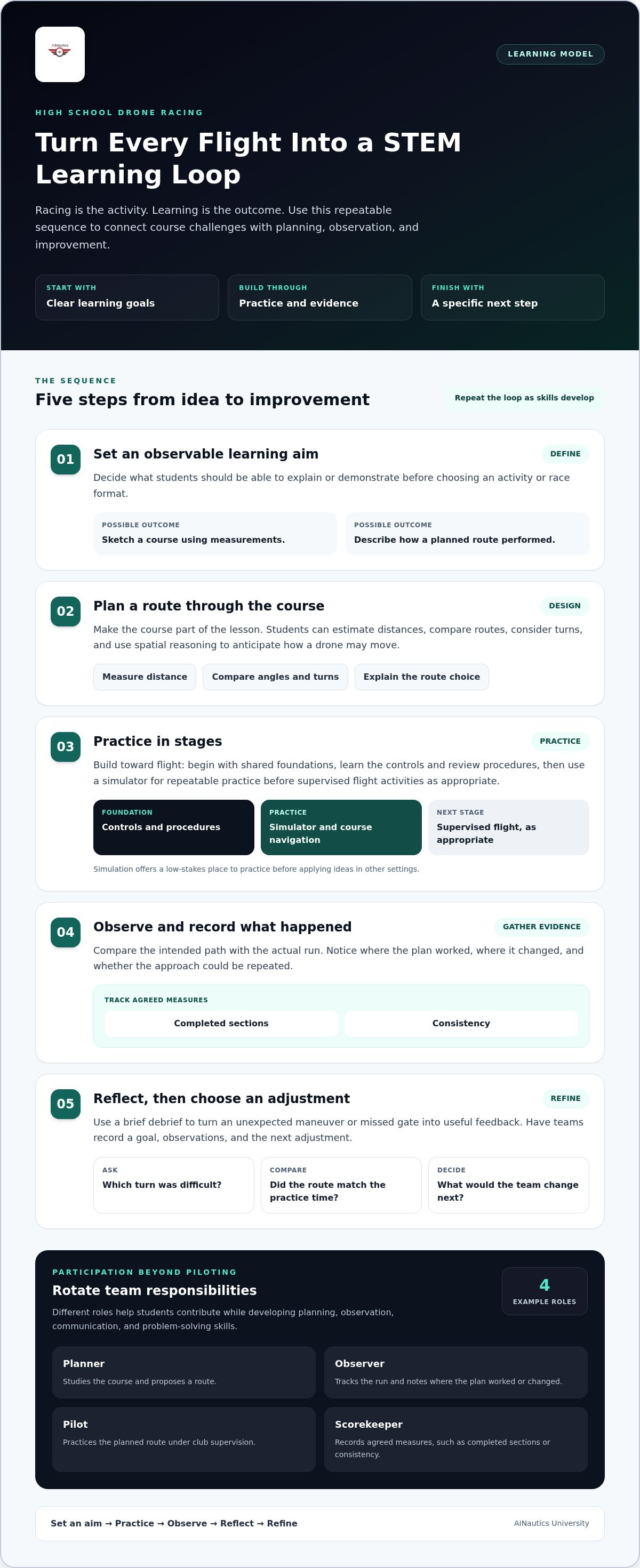
Course planning brings abstract concepts into view. Students can estimate distances, compare routes, consider turns, and use spatial reasoning to anticipate how a drone will move through a course. Flight practice lets them test an idea and adjust it based on what they observe. This cycle connects applied math and problem-solving to a visible result.
Give students rotating responsibilities so participation doesn’t depend on piloting experience. For example, a team might assign:
- Planner: Studies the course and proposes a route.
- Observer: Tracks the run and notes where the plan worked or changed.
- Pilot: Practices the planned route under the club’s supervision.
- Scorekeeper: Records agreed measures, such as completed sections or consistency.
After each run, ask students to compare their plan with the outcome. Which turn was difficult? Did the route match the available practice time? What would they change next? A brief debrief turns a missed gate or unexpected maneuver into useful feedback. It also gives students practice explaining evidence and listening to teammates.
Who should lead and participate in the club?
An educator or adult sponsor coordinates instruction, organizes activities, and works with school staff to establish appropriate supervision. Teacher preparation can help the sponsor guide learning with confidence. AINautics University’s Train-the-Teacher Program helps educators build their capacity to integrate autonomous systems into instruction.
Invite students with varied interests and experience. Newcomers can plan routes, document practice, or track results as they get familiar with the activity. Students who already fly can share observations and model thoughtful practice while developing their own communication and collaboration skills. Family members can reinforce expectations and encourage participation; administrators can help align the club with school priorities, space, and approval processes. Shared support makes the club’s educational purpose clear to everyone involved.
Build the Club’s Learning Model Before Planning Its First Race
A race can be exciting, but it shouldn’t be the club’s curriculum. Before choosing activities or an event format, decide what students should be able to explain or demonstrate. Keep the goals observable: students might sketch a course using measurements, describe how a planned route performed, or use observations to set a practice goal. Clear outcomes help the educator choose activities that fit the students, available space, and level of supervision.
Build toward flight in stages. Begin with shared foundations, such as learning the controls, reviewing procedures, and discussing how to approach a course. Then use a simulator for repeatable practice before moving to supervised flight activities as appropriate. AINautics University’s Drone Simulator supports this early practice, giving students a way to work on control and course navigation before applying those ideas in other settings.
Turn racing activities into STEM learning objectives
Make the course part of the lesson. Students can draw a route, measure distances, compare angles and turns, then explain how the design may affect a run. After practice, ask them to distinguish control from consistency: Did the drone follow the intended path, and could the student repeat the approach? Have teams record their goal, observations, and next adjustment. That record makes improvement visible without making speed the only measure of success.
Simulation offers a low-stakes place to practice, while debriefs help students turn each attempt into a specific next step. The learning loop is straightforward: set an aim, practice, observe, reflect, and refine. It develops problem-solving alongside piloting skills.
Structure inclusive practice sessions
Use progressive challenges so students can join at different experience levels. A beginner might practice holding a steady path in the simulator, while a more experienced student works on a planned sequence of turns. Both can contribute to the same learning goal by tracking observations, discussing the course, or identifying a useful adjustment. Rotate responsibilities over time so piloting is one meaningful contribution, not the only way to participate.
Give each meeting a familiar rhythm. It helps students understand what they’re working toward and gives the educator a practical way to connect activities with the club’s goals:
- Briefing: State the learning goal, activity, and relevant procedures.
- Practice: Work on the skill through simulation or supervised activity, as appropriate.
- Challenge: Apply the skill to a defined course or task.
- Debrief: Compare the plan with observations and discuss what students learned.
- Next-step goal: Record one adjustment or skill to focus on next time.
This repeatable structure makes starting a high school drone program more manageable: each session has a purpose without requiring a formal race. Educators developing a school learning model can explore AINautics University’s drone education resources for support in connecting practice with instruction.
Compare High School Drone Racing Club Formats Before Choosing One
The right starting format depends on the club’s learning goals, available supervision, school-approved space, and capacity to plan activities. A simulator-first approach can build familiarity before flight practice. Indoor and outdoor formats add real-world experience, but each calls for its own site planning and review. No format is automatically permitted: before any flight activity, verify current FAA guidance and applicable school policies.
| Format | Strengths | Planning needs | Learning emphasis |
|---|---|---|---|
| Simulator-first | Supports repeatable practice without beginning with a physical flight activity. | Choose learning scenarios, access, instructor guidance, and a way to reflect on practice. | Control concepts, route planning, decision-making, and review. |
| Supervised indoor practice | Can bring flight activities into a school setting when a suitable space is approved. | Review the space, school procedures, supervision, and applicable operating guidance. | Applying planned skills in a managed school environment. |
| Supervised outdoor practice | Offers a different setting for applying course plans and observing flight activity. | Plan around the proposed location, supervision, school approval, and current operating guidance. | Connecting preparation with real-world observation and practice. |
When does a simulator-first club make sense?
Simulation is a practical starting point when students need time to learn controls, rehearse a route, or discuss decisions before flight activities. An educator can set a scenario, ask students to plan an approach, then guide a debrief about what they noticed and what they might change. AINautics University’s Drone Simulator supports this kind of structured practice. Simulation is a learning resource, not a substitute for any supervision, authorization, or real-world instruction that may apply.
It can also give students who aren’t ready to pilot a meaningful role. One student can plan, another can observe performance, and a teammate can record reflections. The group can compare intended and actual outcomes, creating a bridge between practice and later activities.
How should schools weigh indoor and outdoor practice?
Start with the learning objective, then assess the setting. Indoor practice may suit a school-approved space and activities that benefit from a defined environment. Outdoor practice may offer different conditions to observe, but requires planning for the chosen location and its operating context. Neither is automatically the better option; the school’s space, supervision capacity, procedures, and current guidance should shape the decision.
For educators starting a high school drone program, a manageable progression could begin with simulation, then move to a supervised indoor or outdoor activity when the educational plan and reviews support it. Keep the decision focused on learning and responsible operations, not equipment purchasing. AINautics University’s drone education resources can help schools consider how simulation and instruction fit into a broader learning plan.
Follow a Practical Setup Sequence for the First Club Term
A clear setup sequence helps turn student interest into a club the school can support. Keep two kinds of decisions distinct: verify current FAA guidance for the planned activities, then work through school-level choices such as approval, space, supervision, and learning goals. Planning recommendations can help organize meetings, but they don’t replace either review.
Prepare the school, instructor, and club plan
Start by identifying an adult sponsor, the students the club will serve, and the learning outcomes that will shape activities. Then follow the school’s approval process and align the plan with relevant district standards, CTE pathways, or STEM/STEAM initiatives. Prepare the instructor to lead both learning and supervision. AINautics University’s Train-the-Teacher Program supports educator development for integrating autonomous systems into instruction.
- Define the goals. Choose a few outcomes students can demonstrate, such as planning a course, describing practice observations, or setting a next-step goal.
- Secure school alignment. Establish the sponsor, student audience, approval pathway, suitable space, and how families and administrators will be informed.
- Prepare the instructor. Identify the knowledge and support needed to coordinate instruction and supervision. Review current FAA guidance relevant to the planned activities.
- Plan the activities. Map learning goals to briefings, simulator exercises, and appropriate supervised practice. Set out procedures and responsibilities before activities begin.
- Review and adapt. Decide how the club will record participation, student learning, questions, and any changes needed for the next practice cycle.
Plan the first practice cycle and measure progress
Organize the term by stages rather than assuming a fixed meeting schedule. An opening phase can introduce goals and procedures; a practice phase can use simulator activities and structured roles; a later phase can build toward appropriate supervised activities. Close the cycle by reviewing student work and deciding what to adjust. This framework leaves timing to the school.
Make progress visible with simple records: the session goal, each student’s role, observations from practice, and a brief reflection. Look for evidence that students can explain their decisions, apply feedback, and take part in team tasks, not only whether they complete a course. These are practical indicators for educators, not regulatory standards. If students are ready for a next step, plan it only after reviewing the relevant guidance and school procedures.
Starting a high school drone program is more manageable when planning, instruction, practice, and review work as one pathway. AINautics University offers a structured “Launch a Drone Program in 90 Days” pathway for schools moving from planning toward flight operations. Explore support for launching a school drone program to connect educator preparation and student learning in your implementation plan.
Grow the Club with Teacher Preparation and a Clear UAS Learning Pathway
A racing club is more likely to become a lasting school program when learning doesn’t depend on one enthusiastic student or a single race day. Educators need a workable way to guide instruction, connect activities to school priorities, and help students see how club skills relate to wider UAS learning. That foundation turns initial interest into a program students can build on.
Prepare educators to guide safe, purposeful learning
Teacher preparation helps an adult sponsor move from coordinating activities to leading purposeful instruction. AINautics University’s Train-the-Teacher Program helps educators integrate autonomous systems into teaching. It can support educators as they plan how student activities meet learning goals and fit within a school program, while school policies and current FAA guidance inform operational decisions.
Educators who want a deeper grounding in aviation rules and responsibilities can also explore Part 107 Training. It’s a relevant learning path for teachers interested in UAS certification, but it isn’t a blanket requirement for every student or club member. The right training depends on the educator’s goals and the activities the school plans.
For lesson planning, the Drone Curriculum for Educators guide can help educators consider how drone activities connect with instruction. Use it as a starting point for mapping club practice to relevant STEM/STEAM or CTE goals, then adapt activities to the school’s students, curriculum, and program plan.
Connect club participation with broader UAS opportunities
Students can build on racing through broader opportunities to explore UAS skills and careers. AINautics University’s UAS Student Scholars program offers a student learning opportunity. For learners interested in a structured certification pathway, Self-Paced Certification is another option to consider alongside club participation.
Simulation can support continued practice and preparation, while the VR Trailer Mobile Lab offers an immersive educational experience for UAS learning. These options help educators provide varied learning experiences without making competition the program’s only focus. The UAS Scholarship 2026: High School Career Pathway Guide is another resource for exploring how student learning may connect with future pathways.
To take a practical next step, bring the adult sponsor and school stakeholders together to identify a learning goal, educator-development needs, and relevant student opportunities. Then outline how those pieces could fit into the school’s curriculum and approval process. For anyone starting a high school drone program, this planning creates a clear bridge from a club’s first activities to sustained UAS education.
Turn Club Interest into a Lasting Learning Pathway
The next step doesn’t have to be a full competition schedule. Bring together the educator sponsor and school stakeholders to agree on what students should learn and how the program can grow responsibly. A focused first phase gives the school room to learn, adjust, and build support before expanding activities.
That same planning can help students see drone racing as an entry point to wider UAS learning. As they gain experience, invite them to consider how their skills connect with future study and career interests. For educators, starting a high school drone program is an opportunity to create a learning pathway that develops alongside students and school priorities.
AINautics University supports school-based UAS education through educator development and student learning opportunities. Explore educator training and UAS learning programs to consider how those resources could support your school’s next step. A thoughtful beginning gives students a strong foundation to build on.
Frequently Asked Questions
How do you start a drone racing club at a high school?
Begin with a short club proposal that identifies the adult sponsor, intended student audience, educational purpose, and school approval route. Ask a small group of interested students what roles and activities would engage them, including opportunities beyond piloting. Their input can help shape a club charter and an initial plan for recruiting participants. Keep the proposal focused enough for administrators to review and revise before the school commits space or resources.
Does a high school drone club need a teacher or adult sponsor?
An adult sponsor is a practical anchor for a school club. The sponsor coordinates with school staff, communicates the club’s purpose, and helps ensure student activities follow school procedures. They don’t need to do every task: students can help document activities, organize sign-ups, or share learning with classmates. AINautics University’s Train-the-Teacher Program supports educators who want to develop their ability to guide drone learning.
Can students practice drone racing indoors at school?
Indoor practice may be possible, but a school’s approval of a room doesn’t by itself settle whether a particular drone operation is appropriate. For a proposed activity, record the location, who will oversee it, and what students will do, then review those details against current FAA guidance and school procedures. If the activity can’t proceed as planned, students can still work on course design, event roles, or simulator-based assignments.
Do high school students need FAA Part 107 certification to fly drones?
No, not every student in an educational club needs Part 107 certification. A K-12 school may conduct educational or research flights under the recreational exception in 49 U.S.C. § 44809 when the activity meets that exception. Flyers using this path, including students and teachers, must pass TRUST, carry proof of completion, and follow the safety guidelines of an FAA-recognized community-based organization. Part 107 may apply to business operations; verify current FAA guidance for the planned activity.
Is a drone simulator useful for starting a school racing club?
Yes. A simulator can help an educator observe how students approach a task and identify concepts to revisit before planning later activities. For instance, students can keep a brief practice log of the scenario, their intended approach, and what they would change. Comparing those notes over time gives the instructor a basis for discussing progress without treating a single performance as a final measure of ability.
How can a drone racing club connect to STEM and CTE learning?
Use student work from the club as evidence of learning. A team could create a scale drawing of a proposed course, explain the measurements it used, and present how its design changed after review. Students might also research UAS-related career roles and compare the skills those roles involve with tasks they’ve undertaken in the club. Connect these projects to relevant classroom or CTE objectives set by the school.
What should a school consider before planning its first drone racing event?
Before setting a date, decide what the event is meant to demonstrate and how students and visitors will take part. Review the current rules for any competition format the school plans to use, since formats may have specific conditions. Prepare a written event plan covering the activity, oversight, site arrangements, communications, and a way to gather feedback afterward. Verify FAA guidance and school approval for the proposed operation before confirming the event.

Article by
AINautics University Team
The team behind AINautics University, dedicated to drone education and FAA Part 107 certification prep, VR flight simulation, and STEM training programs for students and educators.


