

A drone program proposal is strongest when it asks decision-makers to invest in student learning, not just aircraft. If you’re figuring out how to write a drone program proposal for school, connect a specific student need to clear learning outcomes and a practical plan for delivering them.
Administrators may focus on equipment costs unless the educational case is easy to see. A decision-ready proposal explains who the program will serve, what students will learn, how educators will prepare, how activities will be managed, what resources are needed, and how progress will be measured.
This guide shows you how to organize those pieces into a request school leaders can evaluate. You’ll learn how to describe program goals, outline staffing and implementation, build a transparent budget, and define measures of student learning. You can also consider how AINautics University’s Train-the-Teacher Program, Drone Simulator, VR Trailer Mobile Lab, and UAS Student Scholars program may support your plan. The aim is to present drones as a platform for purposeful, measurable education.
Key Takeaways
- Learn how to write a drone program proposal for school by linking a defined student need to learning outcomes and a clear decision request.
- Shape the curriculum around observable skills and show how drone learning connects with existing subjects and career preparation.
- Make each budget request easier to evaluate by explaining its educational purpose and connection to student outcomes.
- Plan for safety, staffing, rollout, and evaluation, while identifying FAA and district requirements for review.
- Use a concise summary and focused appendix to give school leaders the evidence and planning details they need to consider next steps.
Start the school drone proposal with a clear educational need
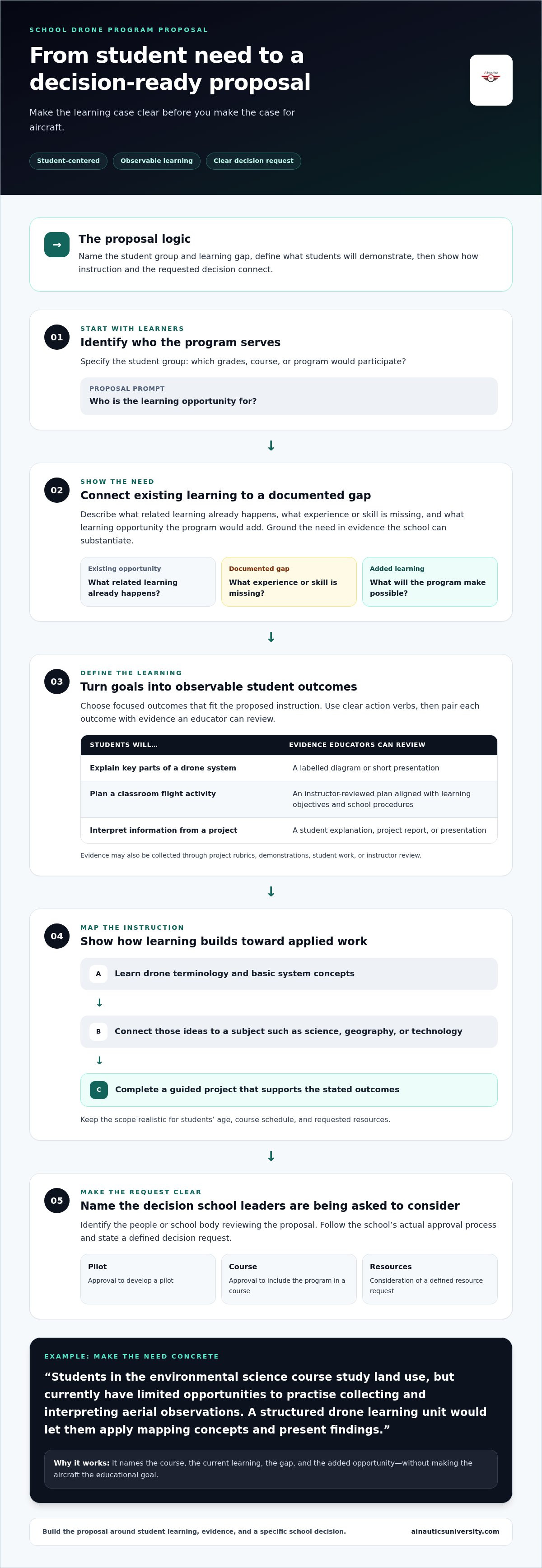
A school drone program proposal is a decision document. It explains which student learning need the program addresses, how learning will take place, what resources are required, and how the school can evaluate progress. Open with students, not aircraft. State who the program is for, what learning opportunity already exists, and what gap remains.
For example, a school might teach mapping concepts in science but lack a hands-on way for students to collect and interpret aerial data. That is a more assessable need than “students need drones.” A drone is a tool; the educational case is the skill students will practise and demonstrate with it. The Unmanned Aerial Vehicle (Drone) Overview can help readers unfamiliar with the technology, but your proposal should focus on the learning experience planned for your school.
Write a need statement administrators can assess
Build the need statement from evidence your school can substantiate. Use approved sources such as curriculum priorities, program goals, documented student interest, or a stated workforce-learning objective. Connect the proposal to STEM, career and technical education (CTE), or another established priority only when that connection genuinely fits. Avoid broad claims about industry growth unless you have a reliable source and can explain why it matters to the students named in the proposal.
A practical statement might read: “Students in the environmental science course study land use, but currently have limited opportunities to practise collecting and interpreting aerial observations. A structured drone learning unit would let them apply mapping concepts and present findings.” Adapt the wording to your school’s documented situation. Identify the student group and specific gap, then name the learning opportunity the program would add.
- Student group: Which grades, course, or program would participate?
- Existing opportunity: What related learning already happens?
- Documented gap: What experience or skill is currently missing?
This evidence-led approach makes how to write a drone program proposal for school less about selling a new technology and more about showing how instruction can respond to a real educational need.
Match the proposal to its decision-making audience
Identify the people or school body reviewing the request, and state the decision you’re seeking. That might be approval to develop a pilot, include the program in a course, or consider a defined resource request. Follow the school’s actual approval process rather than assuming who has authority. Educators can plan student learning alongside their own preparation. AINAutics University’s Train-the-Teacher Program supports educators who are integrating autonomous systems into curriculum.
Write for nontechnical readers. Explain what students will learn and what they can show as evidence, such as interpreting a map, explaining a flight-planning decision, or presenting project findings. Keep those examples aligned with the proposed curriculum. Avoid making the aircraft itself the headline. A concise opening should help administrators understand the student benefit, the decision before them, and why the proposal fits school priorities.
Build the proposal around outcomes, curriculum, and FAA learning
A curriculum plan turns the educational need into a sequence of learning students can demonstrate. Keep the scope realistic for the students’ age, course schedule, and requested resources. Avoid broad promises such as “teach drone technology.” Name the knowledge and skills students will practise, then show how instruction will build toward them.
Turn program goals into measurable student outcomes
Choose a focused set of observable outcomes. Start each with an action verb such as explain, plan, interpret, or demonstrate. For example, students might explain how a drone collects information, plan a classroom mapping activity, or interpret a map created as part of a project. Pair every outcome with evidence an educator can review. That makes it possible to assess learning, not just participation.
- Outcome: Explain key parts of a drone system. Evidence: A labelled diagram or short presentation.
- Outcome: Plan a classroom flight activity. Evidence: An instructor-reviewed plan that follows the school’s learning objectives and procedures.
- Outcome: Interpret information from a project. Evidence: A student explanation, project report, or presentation.
Use only outcomes that fit the proposed instruction. An outcome should be specific enough that an educator can decide whether a student has met it, without implying that one course guarantees a particular credential or career result. State how evidence will be collected, such as through project rubrics, demonstrations, student work, or instructor review.
Explain the curriculum and certification pathway
Organize the curriculum from foundational concepts to applied work. Students might first learn drone terminology and basic system concepts, then connect those ideas to a subject such as science, geography, or technology before completing a guided project. Describe the sequence in plain language and show which outcome each activity supports. A visit to the AINAutics University website can help you explore its educational programs as you plan instruction around classroom goals.
Keep classroom learning objectives distinct from FAA Part 107 certification preparation. A school may teach aviation, flight planning, or drone applications without presenting those lessons as certification. If the proposal includes Part 107 training, describe it as preparation for the Part 107 pathway, and make clear that training alone is not the same as earning a certificate. Review current FAA and school requirements for the planned activities before finalizing the curriculum.
AINAutics University’s Drone/UAS Student Scholars Remote Pilot Certification For High Schools may be considered as one curriculum component. The program has 16 modules, and pricing is available upon request. Present it in context: identify the learning objectives it supports and how educators will gather evidence of student progress. For educator preparation, the Train-the-Teacher Program supports integrating autonomous systems into curriculum. Planning educator readiness alongside student instruction helps make the proposed sequence practical to deliver.
For a clear proposal, how to write a drone program proposal for school means mapping each goal to instruction and evidence. A simple table with columns for outcome, lesson or activity, assessment, and responsible educator gives reviewers a direct view of how the plan will work.
Justify the school drone program’s resources with a transparent budget
A budget is easier to assess when every request has a clear instructional purpose. Organize resources by function, such as educator preparation, curriculum, student learning activities, and learning tools. For each item, explain who will use it, how the quantity was determined, and which learning outcome it supports. This turns the budget from a shopping list into an implementation plan.
Make every requested resource easy to evaluate
Use school estimates where available, and label each amount as confirmed or estimated. State assumptions reviewers may need to assess, such as the number of classes the resource would serve or whether it would be used across courses. Separate one-time requests from recurring needs only when the school’s estimates support that distinction. Don’t present possible grants, savings, or funding eligibility as established facts.
| Resource | Educational purpose and users | Outcome connection | Budget basis |
|---|---|---|---|
| Educator training | Prepares participating educators to deliver planned instruction. | Supports consistent teaching and assessment. | Identify educators or instructional roles covered. |
| Curriculum or certification learning | Provides structured content for the intended student group. | Connects lessons to course outcomes. | Record the school’s estimate and assumptions. |
| Simulation or mobile-lab experience | Supports planned learning activities for students. | Links applied activities to stated skills. | Specify the proposed use and quantity basis. |
Adapt the categories to the actual request. If an item doesn’t support a named activity or outcome, explain why it’s necessary or reconsider whether it belongs in the proposal. That discipline helps administrators compare the request with other priorities and see what each resource makes possible.
Compare training and learning-resource options
Compare formats by instructional access, staffing, and implementation needs, not by unsupported claims of savings. Educator training, self-paced learning, simulation, and mobile-lab experiences serve different roles. Explain which students or educators each option reaches, how it fits the teaching sequence, and what coordination the school would need to plan. AINAutics University’s Train-the-Teacher Program supports educators integrating autonomous systems into curriculum. Its Drone Simulator and VR Trailer Mobile Lab are learning-resource options to consider. The phrase Immersive Drone Training Technology describes an area to explore when weighing simulation and VR in a learning plan.
The Drone/UAS Student Scholars Remote Pilot Certification For High Schools has 16 modules, and pricing is available upon request. In the budget, identify how the proposed certification component connects to instruction and student outcomes. Use the program’s stated pricing approach rather than inserting an assumed amount. For any other budget item, document the cost source, estimate date, and assumptions so reviewers can distinguish known figures from planning estimates.
In short, how to write a drone program proposal for school includes showing the path from resource to instruction to evidence of learning. To explore how training and learning resources can support that planning, see AINAutics University’s drone education resources.
Address safety, staffing, rollout, and evaluation in the proposal
A decision-ready plan shows how the school will move from approval to instruction while keeping responsibilities clear. Describe who coordinates the program, prepares educators, supervises student activities, and reviews progress. Assign roles based on the school’s structure, and distinguish proposed procedures from requirements administrators must review against current FAA guidance and district policies.
Describe safety and responsibility without overclaiming
Explain how the school intends to document procedures before activities begin. The plan might identify who reviews the activity, who supervises students, how participation is organized, and where staff record completion of required preparation. These are planning prompts, not a claim that every school follows the same process. Review current FAA and district requirements for the specific activities proposed, and update the plan if those requirements affect supervision or student access.
Be precise about what the proposal covers. A classroom discussion, simulator activity, and outdoor flight are different learning experiences, so describe which are planned and how each will be overseen. Avoid promising that a general safety statement covers every operation. Instead, show that the school will review relevant requirements and document procedures appropriate to its planned activities.
Create a phased implementation and evaluation plan
Turn rollout into milestones that name a responsible school role, the decision needed, and evidence of completion. This helps reviewers see how the program will be managed and gives the team clear checkpoints for refining the plan.
- Planning: The program lead confirms the student group, learning activities, resource assumptions, and applicable requirements for review. Evidence could include an approved program plan and documented decisions.
- Educator preparation: The designated school lead coordinates educator readiness before instruction starts. Record completed preparation and any curriculum adjustments needed for the planned lessons.
- Learning activities: The instructor delivers the approved sequence and collects evidence of student learning, such as project work, demonstrations, or reviewed assignments.
- Program review: The program lead and relevant school reviewers compare implementation records with the proposal’s intended outcomes. They can identify what worked, what needs revision, and whether resource assumptions remain appropriate.
Set evaluation checkpoints at meaningful moments, such as after educator preparation, during instruction, and after the learning sequence. Review both implementation and student evidence. If a planned activity proves difficult to deliver, note the barrier and adjust instruction or resource assumptions rather than treating completion alone as success. A clear record of decisions and findings helps leaders assess progress and consider next steps.
For educator preparation that supports curriculum integration, explore AINAutics University’s Train-the-Teacher Program as you plan staff readiness alongside student activities.
This structure makes how to write a drone program proposal for school practical for administrators: each phase has an owner, a decision point, and evidence that the program is ready to proceed or needs adjustment.
Present a decision-ready school drone proposal and clear next steps
End with a clear decision request, not a broad appeal to “support drone education.” Your executive summary should let a reviewer quickly see the student need, intended learning outcomes, resources requested, and action you want the school to take. Keep it concise, then use the supporting sections to explain evidence and implementation details.
Prepare the summary and supporting materials
Write the summary for the person reviewing the request. A principal may need to understand the instructional fit and staffing plan. A district reviewer may focus on alignment with school priorities, budget assumptions, or requirements for review. Educators may want the curriculum sequence and preparation needs. Families and community partners may need a plain-language explanation of what students will learn. Adapt the emphasis, but keep the underlying evidence and proposed outcomes consistent.
Attach an appendix with material that supports a specific point in the proposal. Useful items may include documented student interest, relevant school or program goals, curriculum references, budget estimates with their assumptions, and planning materials for proposed activities. Label each item and refer to it where it supports the case. An appendix should make the proposal easier to verify, not bury key information in extra pages.
If the proposal includes FAA Part 107 preparation, distinguish that training context from general classroom learning and from any certification outcome. AINAutics University’s Part 107 Training may be relevant to a school plan focused on certification preparation. Describe the role it would play in the program, and avoid implying that participation alone guarantees certification.
Choose the next step after presenting the proposal
Make the requested decision specific and manageable. Instead of asking leaders to approve an undefined program, ask them to authorize a defined next step, such as reviewing a proposed curriculum, assessing documented resource estimates, or deciding whether to develop a pilot plan. Name the role or group responsible for that step and the evidence they should review. A focused request gives decision-makers a clear route forward without asking for an open-ended commitment.
Tailor the presentation, not the facts. A family-facing version can explain student activities in accessible terms; an administrator-facing version can foreground learning evidence, staffing, and planning requirements. Both should describe the same program scope and decision sought. Keep the summary aligned with the full proposal so readers don’t encounter different promises in different versions.
For education planning, AINAutics University’s Train-the-Teacher Program and VR Trailer Mobile Lab are resources to consider alongside the school’s curriculum and implementation needs. Use the proposal to explain how each selected resource fits the learning plan, who would use it, and what decision is being requested. This keeps the focus on student experience rather than a list of offerings.
A strong close reinforces the central case: a defined student need, purposeful learning, a considered resource request, and a clear next action. That is the practical answer to how to write a drone program proposal for school. Explore AINAutics University’s educational programs as you shape your next step toward school-focused drone education.
Turn your proposal into a starting point for student growth
Your proposal can do more than secure an initial decision. It can give educators and school leaders a shared starting point for building a learning experience that evolves with student interests, course priorities, and the school’s capacity. Treat the next step as an opportunity to test assumptions, hear from the people who will deliver and participate in the program, and strengthen the plan as new information emerges.
That mindset keeps the focus on progress, not perfection. A clear request gives the school a practical way to consider how drone learning may fit its broader educational goals. As you decide how to write a drone program proposal for school, use the document to open a conversation about what students can explore next and what support educators need to guide them.
Explore AINAutics University’s school-focused drone education programs as you consider resources for your students’ next learning opportunity. A thoughtful proposal can be the first step toward meaningful learning and skill building.
Frequently Asked Questions
What should a school drone program proposal include?
A school drone proposal should explain the student need, intended participants, learning outcomes, curriculum, resources, safety approach, responsibilities, and evaluation method. Connect each requested resource to an educational purpose so reviewers can see why it belongs. Keep the executive summary focused on the decision you’re requesting. Place supporting evidence, detailed estimates, and supplemental planning materials in clearly labelled sections or appendices for readers who need more detail.
How can I justify the budget for a school drone program?
Link every budget item to a learning activity or outcome, then explain how you developed its estimate. Mark confirmed figures separately from projections and state assumptions, such as the number of courses or activities the resource is intended to support. Explain why the chosen delivery approach suits the school’s instructional goals and capacity. Have the school review estimates and verify funding requirements before submitting. Avoid unsupported savings or price comparisons.
How should a school proposal address drone safety?
Describe the proposed supervision plan, educator preparation, operating procedures, and roles responsible for carrying them out. For example, clarify who oversees a planned activity and how staff will document that preparation is complete. Identify relevant FAA and district requirements for review rather than assuming a single approach applies to every school. Explain how the safety plan fits the proposed activities, and don’t claim unverified permissions, insurance rules, or legal duties.
Which student outcomes should a drone program proposal measure?
Choose outcomes that fit the students and the course, then decide what evidence would show progress. For example, a class studying geography might have students explain how aerial observations relate to a map, while a technology course could assess a student’s project presentation. Match each outcome with a suitable assessment, such as a rubric, demonstration, or instructor review. Identify who will assess the evidence, and avoid promising credentials or career results.
Can a school include FAA Part 107 preparation in its drone proposal?
Yes. A proposal can include Part 107 preparation when it supports the program’s goals, but describe the instruction’s scope and assessment separately from whether learners pursue a certificate. For example, specify whether students will study aviation concepts, practise applying course material, or complete a project linked to the curriculum. AINAutics University’s Drone/UAS Student Scholars Remote Pilot Certification For High Schools is one possible program component. It has 16 modules, and pricing is available upon request. Don’t imply that participation guarantees certification.
How can a school show that its drone proposal aligns with STEM or CTE goals?
Identify the school or district priority the program is intended to support, then map relevant lessons and student work to it. For example, a project might connect data interpretation with a science unit or technical problem-solving with a CTE objective, if those priorities apply locally. Include documentation reviewers can assess, such as curriculum references or program goals. Confirm local alignment expectations before describing them as formal commitments.
Who should review a school drone program proposal before submission?
Include reviewers responsible for the proposal’s instructional plan, budget, safety planning, and implementation, following the school’s local process. Educators can check whether activities fit the course, while relevant school or district decision-makers can review resource assumptions and approval steps. Ask reviewers to compare responsibilities, estimates, timelines, and assessment methods across sections. Confirm referenced FAA guidance, district requirements, and funding conditions are current before submitting the final version.

Article by
AINautics University Team
The team behind AINautics University, dedicated to drone education and FAA Part 107 certification prep, VR flight simulation, and STEM training programs for students and educators.


