
At 40, a move into drone work can build on the experience you already have. For paid drone work in the United States, the FAA says a Part 107 certificate is needed, but the time it takes to prepare depends on your study pace and career goals. A career change to drone pilot at 40 is a different path from training to fly for an airline.
It’s reasonable to want a clear timeline before changing careers, especially if you need to keep earning while you train. Your existing skills can also matter: planning, communication, technical experience, and knowledge of a particular industry may help shape the drone work you pursue.
This article explains what affects training duration, how to fit preparation around a job, and how age and previous experience can influence career prospects. You’ll also see how Part 107 training fits into the transition, so you can assess the next step with a practical view of the work ahead.
Key Takeaways
- Separate the timeline for earning a drone credential from the longer training path to an airline pilot career.
- See how part-time study and consistent practice can help you plan training around work and other commitments.
- Identify experience from your current career that could transfer to drone operations and strengthen your professional profile.
- Compare career possibilities with your goals, including the different demands of drone work and airline flying.
- Explore how AINautics University’s Drone Simulator and Part 107 Training can support your next step into UAS learning.
Can you work while training?
Yes, you can keep working while preparing for drone work, but your study schedule needs to fit your job and responsibilities. In the United States, the Federal Aviation Administration says paid drone work requires a Part 107 certificate. A career change to drone pilot at 40 doesn’t require following the same training route as an airline pilot.
For paid drone work, the timeline depends on how quickly you prepare for the relevant certification. There’s no single duration that fits every learner. Rules also depend on the operation: federal FAA requirements and applicable local rules can shape how a flight is conducted, while the type of work affects what each assignment involves.
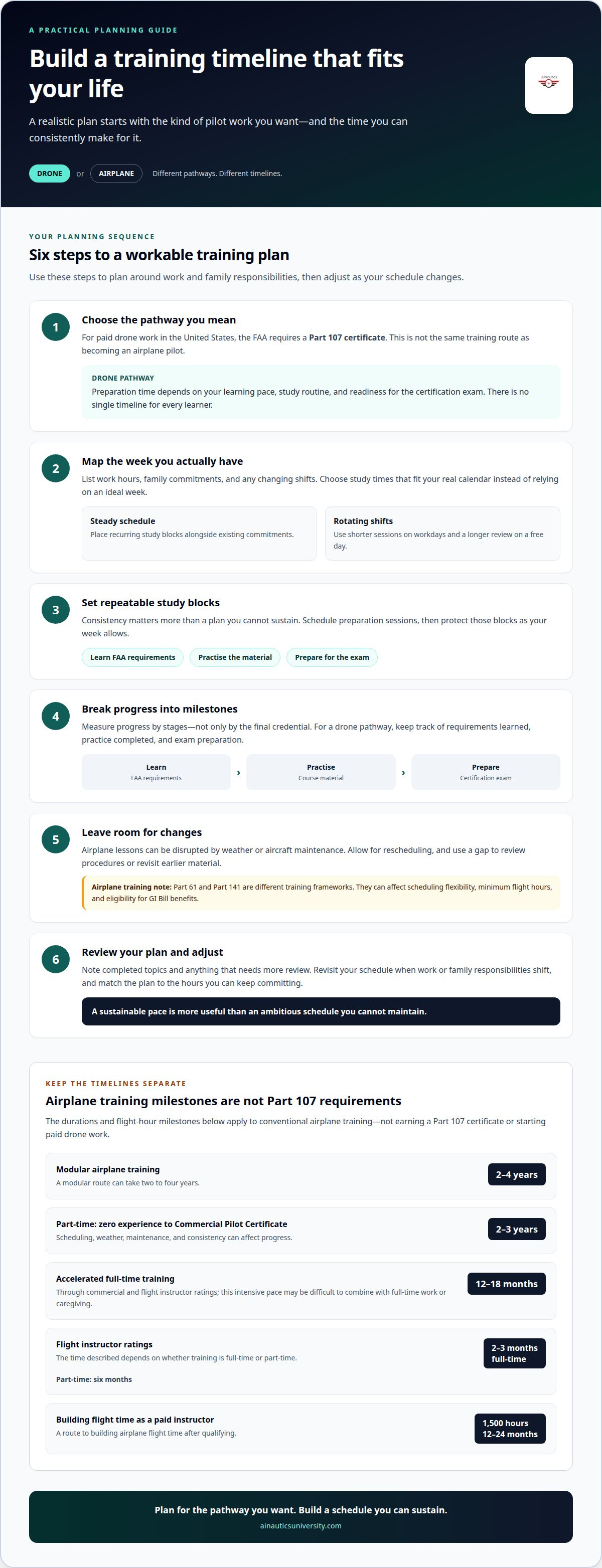
Keep the two career paths distinct. The longer timelines and flight-hour milestones below apply to conventional airplane training, not to earning a Part 107 certificate. They matter if you’re considering becoming an airplane pilot as well as, or instead of, a drone pilot.
For airplane pilots, modular training can take two to four years. Part-time training from zero experience to a Commercial Pilot Certificate may take two to three years. Scheduling, weather, maintenance, and how consistently you can fly all affect progress. Students training part-time are advised to fly two or three times a week to maintain momentum.
Accelerated programs compress lessons into a more intensive schedule. Full-time training through commercial and flight instructor ratings may take 12 to 18 months, with little or no income during that period. That pace can be difficult to combine with a full-time job or caregiving. Part-time study may preserve earnings, but extends training and delays the next career step.
Costs also differ sharply between drone certification and airplane flight training. That range is not a price for Part 107 preparation. Before committing, map tuition, aircraft rental, exam costs, living expenses, and income changes into a realistic budget. Financing may spread payments, but borrowed money still has to be repaid.
Avoid taking on debt simply to finish faster. Compare a full-time schedule with a part-time plan, and consider what income you can maintain. If the accelerated route depends on borrowing more than you can manage, slowing down may protect your financial stability. Base your decision on the entire training plan, not just its advertised pace.
Instructor work can provide a route to building airplane flight time after qualifying. Flight instructor ratings can take two to three months full-time or six months part-time. Building flight time to 1,500 hours as a paid instructor can take 12 to 24 months. Those milestones relate to an airplane career path; they aren’t prerequisites for earning a Part 107 certificate or starting paid drone work.
Training duration and scheduling factors
Training time depends first on which pilot career you mean. A Part 107 drone pathway is different from airplane training under Part 61 or Part 141. For drone work, study time depends on your learning pace, preparation routine, and readiness for the certification exam. There isn’t one timeline that applies to every learner.
Build your plan around the demands of your current week. A full-time job, family commitments, and changing work shifts can affect when you study and how consistently you practise. Choose recurring study blocks that fit your actual calendar, then review your progress regularly. For example, someone with rotating shifts might study in shorter sessions on workdays and set aside a longer review session on a free day.
For airplane training, Part 61 and Part 141 are two training frameworks with different implications. The choice can affect scheduling flexibility, minimum flight hours, and eligibility for GI Bill benefits. That makes the school structure relevant to your timeline, not just the number of lessons on a calendar. A learner who needs a flexible schedule may weigh those factors differently from someone following a more structured course.
Weather and aircraft maintenance can disrupt airplane lessons, so a planned flight may need rescheduling. Leave room in your calendar for changes rather than treating every lesson date as fixed. When a session moves, use the gap to review procedures or revisit material from the previous lesson. That keeps your learning active while you wait for the next flight opportunity.
Break training into milestones instead of treating certification as the only measure of progress. For a drone pathway, organize preparation around learning FAA requirements, practising the material, and preparing for the exam. For an airplane pathway, classroom learning, flight lessons, and later ratings each need their own plan. This helps you see which stage is taking time and where your schedule may need adjusting.
- Set study blocks: Place preparation sessions on your calendar alongside work and family commitments.
- Track progress: Note completed topics and questions that need another review.
- Allow flexibility: Leave room for rescheduling airplane lessons affected by weather or maintenance.
- Review the framework: Compare how Part 61 or Part 141 fits your scheduling and eligibility needs.
For a career change to drone pilot at 40, a realistic schedule is more useful than an ambitious plan you can’t sustain. Match study time to your available hours, then adjust as work or family responsibilities change. If your goal includes airplane ratings, plan each stage separately and account for the training framework and flight scheduling. That approach makes progress easier to monitor without confusing drone certification with a longer airplane-pilot pathway.
Transferable skills from previous careers
Moving into drone work doesn’t erase the expertise you’ve built in another field. A teacher, construction supervisor, photographer, or facilities manager may already understand settings where UAS technology can be useful. That doesn’t guarantee employment. It does give you a way to connect drone capabilities with a real task, communicate clearly, and deliver useful work.
Start by translating your experience into specific work habits. A project manager who coordinated contractors can point to scheduling, documentation, and stakeholder communication. A teacher can highlight lesson planning, explaining technical ideas, and adapting instruction for different learners. Those examples are more persuasive than simply describing yourself as organized or a good communicator.
Industry knowledge can help you spot practical applications. Someone from construction may understand why a project team needs clear site imagery. A real estate professional may know how property visuals support a listing. An environmental worker may be familiar with field observations and careful recordkeeping. These connections help you see where drone skills can complement existing expertise, rather than treating piloting as the only value you offer.
Transferable skills also support safe, dependable operations. Attention to detail can help you catch missing information in a flight plan. Risk awareness can prompt you to consider people, equipment, and changing site conditions before a task. Clear communication matters when coordinating with a client or explaining what a deliverable shows. These habits complement technical training, but they don’t replace learning to operate within applicable requirements.
Use a simple translation exercise to make your background concrete:
- Name a task: For example, coordinating a construction project or teaching a science lesson.
- Identify the skill: Connect that task to planning, observation, communication, or documentation.
- Link it to a use case: Explain how the skill could support site imagery, educational demonstrations, or organized field records.
- Show evidence: Describe a completed project or responsibility that demonstrates the skill.
A strong professional profile connects past experience with new UAS capabilities. A former educator might describe curriculum experience alongside drone knowledge when pursuing education-focused work. A photographer might pair composition and client communication with aerial imaging. These are examples of positioning, not guarantees of a particular role. Ask yourself which problems you understand well enough to address responsibly.
For a career change to drone pilot at 40, treat your previous career as a foundation, then identify the technical knowledge you still need. Write a short introduction that names your former field, one relevant skill, and a drone-related application you want to explore. That gives employers and clients a clearer picture than a career-change story alone, while keeping your professional value grounded in specific experience.
Career prospects at airlines and other operators
Airline flying and commercial drone work are distinct career paths, with different training and hiring requirements. In the United States, the Federal Aviation Administration requires airline pilots to retire at age 65. A person starting airline training at 40 may still have time to pursue that route, but reaching an airline job requires progressing through the relevant certificates, experience, and hiring stages.
For an airline track, full-time training can bring a 40-year-old to a regional airline at about age 42 or 43. The FAA airline transport pilot experience requirement cited in the current facts is 1,500 flight hours. Reaching that milestone can involve working as a flight instructor; building the hours may take 12 to 24 months. An airline application can then take another three to six months to become a start date.
Those milestones apply to airplane-pilot training, not entry into drone work. Drone operators may work in fields such as construction imagery, property marketing, or inspection support, where clients value relevant industry knowledge alongside piloting ability. A construction professional, for example, may understand site workflows and communicate effectively with project teams. Career prospects depend on the work, client needs, and the operator’s ability to deliver useful results.
Can you make a living as a freelance drone pilot? It’s possible, but income depends on finding clients, repeat assignments, and services that meet a clear need. Startup expenses depend on the work you plan to do and may include aircraft, training, software, insurance, transport, and marketing. Build a business plan around these costs rather than assuming certification alone will create steady income.
Independent drone work also includes substantial business activity. One forum participant estimated that business tasks could take 75 to 90 percent of an independent operator’s time. That can include finding clients, preparing proposals, scheduling jobs, and delivering work. For example, someone offering property imagery needs time for client communication and editing, not only flight operations.
Compare employment routes by the work they require:
- Airline pathway: Plan for certificates, flight-hour milestones, and a hiring process before airline employment.
- Drone employment: Pair piloting skills with a specialty such as construction, photography, or inspection support.
- Freelance operation: Account for client acquisition, project delivery, and operating expenses alongside flight work.
Let your target role define your next training step. If you want an airline career, map the certificate and hour-building stages. If you want drone work, identify a service that connects your previous experience with a client’s practical needs, then plan for both skill development and business tasks.
Changing careers to become a pilot in your 40s or 50s
At 40 or 50, distinguish drone work from airline flying: each has different training, equipment, and career demands. Your previous experience can help shape which route fits your goals.
Job Prospects and Training for Career Changers
Drone work and airline flying have different entry paths and hiring considerations. In the United States, paid drone work requires a Part 107 certificate, while an airline career involves extensive airplane training and flight-hour building. A career change to drone pilot at 40 may connect more directly with your existing industry expertise. For example, construction experience may help you understand the needs of project teams seeking aerial information.
Age alone doesn’t close the door to airline training: FAA pilot certificates have no upper age limit. However, some pilot cadet programs set upper limits, typically between 32 and 36. Starting airline training later in life can still leave time for a meaningful career. The route you choose affects both preparation and the work you’ll pursue.
Equipment, Insurance, and Software Needs
A new commercial drone pilot plans equipment, insurance, and software around the work they intend to deliver. The aircraft and related gear support flight operations, while software may help with planning or producing client deliverables. Insurance needs depend on the operation and the work involved. Buying for a specific service is more practical than assembling a setup without a defined use.
For example, a pilot pursuing aerial imagery may prioritize tools that support image capture and delivery. Someone targeting inspection work may need a workflow suited to the information clients expect. Clarify the service, operating environment, and deliverable before setting a budget. This keeps equipment decisions tied to business needs instead of assumptions about what every pilot must own.
Risks and Challenges of Commercial Drone Work
Commercial drone work involves more than learning to fly: operators must manage clients, project delivery, and business responsibilities. One forum participant estimated that business tasks can take 75 to 90 percent of an independent operator’s time. That estimate highlights a practical challenge for career changers: freelance work includes finding assignments and managing client relationships, not only piloting.
Income can also depend on securing ongoing work, while equipment and operating expenses require planning. Airline training has different pressures, including flight-hour requirements and the Federal Aviation Administration’s age-65 retirement rule. A first-class medical certificate from age 40 onward is valid for six months for first-class privileges. Factor these demands into your route choice before leaving established employment.
Many people changing careers are weighing familiar responsibilities against a new professional identity. The average age of people looking to change careers to become pilots is 39. That context can help frame age as one factor among several, not the whole decision. Your industry knowledge, training plan, financial capacity, and desired work all matter.
Before committing, compare the day-to-day realities of each path. Airline flying centers on airplane training, experience milestones, and airline hiring. Independent drone work combines piloting with business development and client delivery. If UAS work appeals to you, identify a field where your previous experience gives you a useful starting point. Then build the technical skills and operating plan that fit that field.
AINautics University: Drone Simulator
AINautics University helps learners build drone knowledge through its Drone Simulator and Part 107 Training. If you’re weighing a career change, the simulator can support your learning as you explore piloting, while Part 107 Training aligns with preparation for paid drone work in the United States.
Choose a learning path that fits your goal. If you’re an educator bringing UAS into the classroom, AINautics University’s UAS Teacher Scholars program and VR Trailer Mobile Lab offer education-focused options. These resources can connect drone learning with practical career exploration, while keeping drone preparation distinct from the longer route to airline flying.
Ready to explore a learning option that fits your next step? Contact AINautics University to discuss your drone education goals.
Make your next move with purpose
A career change to drone pilot at 40 can start with a focused decision: identify the kind of work you want to explore and the strengths you’ll bring to it. Write down one practical goal, such as applying UAS knowledge in your current industry or preparing for a new role. A clear direction turns interest into a plan you can act on.
Use that goal to guide your next learning choice and consider how it fits your current responsibilities. Contact AINautics University to discuss training and explore an option aligned with your plans.
Your experience is a starting point. Build on it deliberately, and take your next step with confidence.
Frequently Asked Questions
How long does it take to become a pilot?
It depends on whether you mean a drone pilot or an airplane pilot. These are separate training paths, so first define the aircraft and work you’re aiming for. An airplane career involves flight training and experience-building stages. A drone role focuses on small UAS operations and the credential relevant to the work. A specific goal makes a timeline more useful than the word “pilot” alone.
What changes when you go from a 9-to-5 job to a career as a pilot?
Your workday may become less predictable, especially if assignments depend on access, weather, or client schedules. A drone project can also involve preparation and delivering usable results, not just operating the aircraft. Before making a transition, sketch a sample week around your current commitments. Include time for learning, client communication, travel, and project follow-up. This can reveal whether the work pattern fits your household and preferred routine.
How long can I expect this to take?
For a drone pathway, your study schedule is a major planning factor. Set a weekly routine, track the topics you’ve completed, and leave time to revisit difficult material before the knowledge test. Your pace may change around work or family commitments, so review your plan as circumstances shift. This helps you estimate progress based on your own study habits rather than a timeline designed for someone else.
What flight school will I go to?
If your goal is commercial drone work, focus on education that prepares you for drone operations rather than airplane flight lessons. If you want to fly crewed aircraft, choose an airplane-training pathway suited to that goal. Compare the learning format, subject matter, and fit with your schedule. Distinguishing drone training from airplane training helps you avoid enrolling in a program that prepares you for a different career.
What should older students check first?
Start by defining what “success” means for your career change. You might want a new full-time occupation, a specialized skill alongside your current work, or a way to apply UAS knowledge in education. Then map your available study time, household responsibilities, and tolerance for changing income. A written plan makes trade-offs visible and helps you choose a path based on your priorities rather than your age alone.
What FAA license is required to fly drones commercially in the United States?
The credential is called the FAA Part 107 Remote Pilot Certificate. It identifies the drone-specific certification pathway, distinct from certificates associated with piloting crewed aircraft. Knowing the credential’s exact name helps you look for relevant study materials and distinguish drone preparation from airplane flight training. It also gives you a clear term to use when discussing your intended commercial drone work with an employer or educator.
What are the steps to get an FAA Part 107 Remote Pilot Certificate?
Begin by choosing Part 107 as your certification goal and following a structured preparation plan. Study consistently, identify topics that need more review, and prepare for the required knowledge test. After testing, complete the FAA certification process. Keep your study notes and exam-related records organized so you can follow each stage without confusing drone certification with the separate requirements for airplane pilot careers.
Which industries hire drone pilots, and what skills or experience do they require?
Potential fields include telecommunications, utilities, agriculture, delivery, public safety, broadcasting, and education. The skills needed depend on the role: one position may emphasize field coordination, while another may value communicating findings or understanding industry-specific information. Read each job description for its actual duties, then connect those duties to evidence from your previous work. This makes your application specific without assuming every employer values the same experience.

Article by
AINautics University Team
The team behind AINautics University, dedicated to drone education and FAA Part 107 certification prep, VR flight simulation, and STEM training programs for students and educators.


