
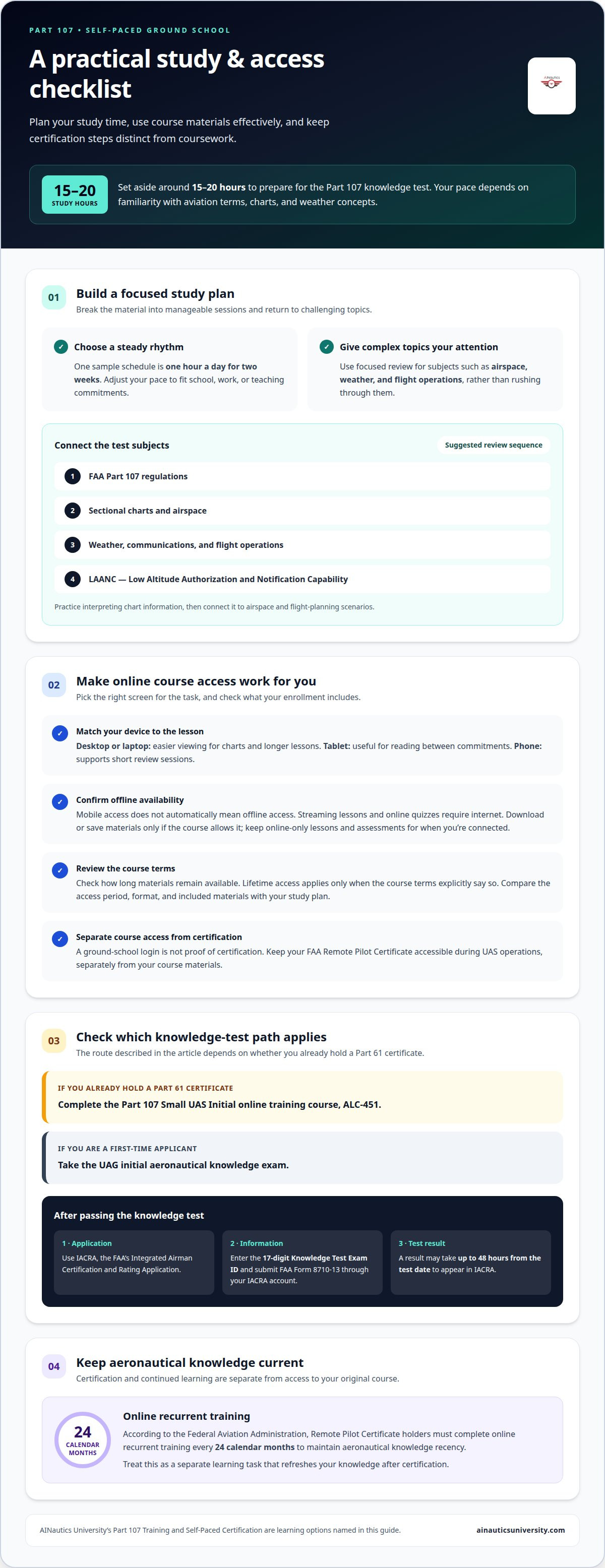
Plan for around 15-20 hours of study to prepare for the Part 107 knowledge test. Self-paced Part 107 training lets you fit that ground-school work around your schedule, while building knowledge of the rules and decisions involved in drone operations.
Planning study time can be difficult when you’re balancing school, work, or teaching. A flexible course helps divide the material into manageable sessions, but you’ll still need focused review to understand topics such as airspace, weather, and flight operations.
This guide explains what Part 107 ground school covers, how online course access works, and how to pace your study. It also clarifies who needs a Remote Pilot Certificate, so you can see whether this path fits your plans for flying drones.
Key Takeaways
- Plan your study schedule around the estimated 15-20 hours of preparation, then use focused sessions to work through the material.
- Learn how online ground school can fit into your routine and what to consider when accessing coursework on the go.
- Build a clearer picture of topics such as regulations, airspace, weather, charts, and flight operations.
- Understand who needs a Remote Pilot Certificate and the age requirement for applicants.
- Explore how AINautics University’s Part 107 Training and Self-Paced Certification can support your learning goals.
Course access and mobile/offline learning
Online ground school lets you study on a computer, tablet, or phone. A desktop or laptop makes charts and longer lessons easier to view. A tablet is useful for reading between other commitments, while a phone can support short review sessions. Whichever device you use, give complex topics such as airspace and weather your full attention.
Mobile access doesn’t necessarily mean offline access. Streaming lessons and online quizzes require an internet connection. Offline study depends on whether materials can be downloaded or saved to your device. If they can, organize them by topic before a commute or visiting a place with limited connectivity. Save online-only lessons and assessments for when you’re connected.
Course access terms also shape how you plan your study. The enrollment terms determine how long you can use course materials. Lifetime access applies only when the course terms explicitly include it. Course price depends on its format, included materials, and access period. Compare those details with your study plan before enrolling, rather than assuming every online course offers identical access.
Your certificate is separate from your study materials. The FAA Remote Pilot Certificate must be accessible to you during UAS operations. Keep a usable copy available when you fly. Course access is not proof of certification, and logging in to a ground-school account does not replace your certificate.
After passing the knowledge test, use IACRA, the FAA’s Integrated Airman Certification and Rating Application, to complete your certificate application. Enter the 17-digit Knowledge Test Exam ID and submit FAA Form 8710-13 through your IACRA account. A test result may take up to 48 hours from the test date to appear there. Once issued, keep your certificate accessible during UAS operations.
Access continues after initial certification. According to the Federal Aviation Administration, Remote Pilot Certificate holders must complete online recurrent training every 24 calendar months to maintain aeronautical knowledge recency. That training refreshes your knowledge after certification. Treat it as a separate learning task, not as continued access to your original course.
Make online learning practical by choosing a regular study spot with reliable internet for lessons and assessments. Use a larger screen for charts, then review saved notes on your phone when you’re away from your desk. Keep your course login details separate from your certificate records so you can find the right information when studying or preparing for flight.
Course subjects, including airspace and weather
A Part 107 curriculum connects aviation rules with practical flight decisions. The knowledge test covers regulations, aerodynamics, sectional charts, airspace, weather, communications, flight operations, and LAANC. LAANC means Low Altitude Authorization and Notification Capability, an FAA system for requesting authorization to fly in certain controlled airspace. Each subject supports decisions pilots make before or during a flight.
Airspace study teaches you to read sectional charts and interpret the areas they show. A chart is more than a map: its markings help pilots identify airspace boundaries and information relevant to planning. Weather lessons cover how conditions affect flight and what pilots should consider before operating. Together, these subjects help connect a planned route with its surroundings.
Self-paced lessons let you pause on challenging subjects and return to them later. Live instructor-led training follows a schedule and gives you opportunities to ask questions during instruction. The key difference is timing: self-paced learning gives you more control, while live training follows the instructor’s schedule.
The test topics include FAA Part 107 regulations, aerodynamics, sectional charts, airspace, weather, communications, flight operations, and LAANC. Use that list to organize revision. After a sectional-chart lesson, practise interpreting the information shown. Then connect chart reading to airspace and flight-planning scenarios.
FAA online training is also relevant for some applicants. Existing Part 61 certificate holders seeking a Remote Pilot Certificate must complete the Part 107 Small UAS Initial online training course, ALC-451. First-time applicants follow a different path: they take the UAG initial aeronautical knowledge exam. The correct route depends on whether you already hold a Part 61 certificate.
Course price and refund terms are separate considerations. Costs depend on factors such as curriculum, learning format, and access period. A money-back guarantee is a course policy, not an FAA requirement. Read its terms for eligibility, deadlines, and covered circumstances before enrolling. Don’t assume every course has identical refund conditions or access.
To assess whether a course reflects current FAA rules, look for clear references to Part 107 material and the subjects it teaches. Compare its listed curriculum with the required knowledge areas, including regulations, airspace, and weather. Review whether the course explains how its content is updated. A detailed syllabus makes it easier to understand what the instruction covers.
Build a study sequence that connects related subjects. Start with regulations, then move to charts and airspace. Add weather, communications, and flight operations to link the material to planning decisions. Finish by reviewing LAANC and how authorization requests relate to airspace. This sequence shows how aviation topics inform one another.
Build your foundation with self-paced certification training and work through the material at a pace that supports focused review.
Estimated study time
Plan for about 15-20 hours of study for the Part 107 knowledge test. The exact pace depends on your familiarity with aviation terms, charts, and weather concepts. Break the work into lessons, review, and practice questions. A steady schedule helps you spot difficult topics before test day, rather than rushing through them at the end.
A sample schedule is one hour of study a day for two weeks. Give each session a specific task, such as watching a lesson, reviewing notes, or answering practice questions. With self-paced video lessons, pause on chart examples and replay explanations as needed. Flag unclear topics to revisit later.
Study aids can make short sessions more focused. Create flashcards for terms, airspace symbols, and weather concepts. Audio lessons can help you revisit explanations during a commute or another task that doesn’t need your full attention. Study charts and visual examples carefully at a desk. These tools support review, but don’t replace learning the concepts.
Use FAA study documents as a reference alongside your course. They can help you revisit official terminology and compare it with your notes. After studying a sectional chart, for example, review the relevant material and explain the symbols in your own words. Keep a list of missed practice questions and revisit those topics instead of repeating familiar material.
The Part 107 knowledge test has 60 questions. Schedule the test at an FAA-approved Knowledge Testing Center. Before registering, create an IACRA profile to obtain your FAA Tracking Number. Use that number during registration. The testing center handles payment for the exam; the amount is separate from any course price.
Free resources can supplement paid instruction. FAA study documents and your notes provide material to review, while flashcards help organize terms and concepts. Try a simple sequence: review a subject, answer practice questions, then revisit your mistakes. If airspace questions are difficult, return to chart interpretation before moving on.
Once you select a testing center, follow its process for scheduling and paying for the knowledge test. Bring the identification and FAA Tracking Number required during registration. Keep your test result information afterward: you’ll need the Knowledge Test Exam ID to complete your certificate application in IACRA.
Use the 15-20-hour estimate as a planning guide, not a guarantee of readiness. Before scheduling, review the subjects that challenge you most and confirm you can explain key ideas without relying only on memorized answers. A focused final review of charts, weather, and regulations can help connect separate lessons to real drone-planning decisions.
Who needs a Part 107 license?
A Remote Pilot Certificate is required for people acting as remote pilots in command under Part 107, subject to the rule’s requirements. The Federal Aviation Administration says applicants for a Part 107 certificate must be at least 16 years old. Whether you need this certificate depends on how you plan to fly, not simply on owning or operating a drone.
People flying drones for work generally need to qualify under Part 107. Recreational flying does not require a Part 107 certificate when it remains recreational. A student considering aerial photography for a business, for example, should distinguish that purpose from flying solely for recreation. The intended operation determines which pathway applies.
First-time applicants must pass the Unmanned Aircraft General - Small initial aeronautical knowledge exam, known as UAG, according to the Federal Aviation Administration. Applicants must also be able to read, speak, write, and understand English, and be in physical and mental condition to safely fly a drone. These requirements apply alongside the minimum age.
Already hold a pilot certificate? The Part 61 pathway has separate requirements. The Federal Aviation Administration says an existing Part 61 certificate holder seeking a Remote Pilot Certificate must have completed a flight review within the previous 24 months. The applicant must hold a pilot certificate issued under 14 CFR part 61 and complete the Part 107 Small UAS Initial online training course, ALC-451.
For first-time applicants, the process follows a clear sequence:
- Create an IACRA profile to obtain an FAA Tracking Number before registering for the knowledge test.
- Schedule the UAG exam at an FAA-approved Knowledge Testing Center.
- After passing, enter the 17-digit Knowledge Test Exam ID in IACRA.
- Apply through IACRA using FAA Form 8710-13.
The result may take up to 48 hours from the test date to appear in IACRA. A passing result is needed to continue the certificate application. If you fail, wait 2 full weeks before retaking the exam. The available facts here don’t give a numerical passing score, so focus on earning a passing result and completing the application steps.
Once issued, the Remote Pilot Certificate allows eligible pilots to act as remote pilot in command, subject to applicable requirements. It doesn’t replace relevant state and local rules for the intended operating area. Simulator practice can complement knowledge study for practical drone operations, but it doesn’t replace the UAG exam or certificate application.
The Federal Aviation Administration states that, except as provided in paragraph (c), no person may act as a remote pilot in command without a Remote Pilot Certificate with a small UAS rating FAA remote pilot certificate and satisfaction of § 107.65. People who want to fly drones commercially must pass the Part 107 exam. The relevant question is whether the planned activity is commercial and whether the person will act as remote pilot in command, rather than whether a drone is simply owned.
KING says the initial aeronautical knowledge test must be taken at an FAA-approved knowledge testing center. Prospective commercial pilots should account for this testing-center requirement when completing the Part 107 exam process.
Part 107 online ground school
Online ground school organizes the knowledge needed to prepare for the Part 107 exam. Beginners benefit from a clear sequence: learn regulations, practise chart interpretation, then connect weather and flight operations. This approach builds understanding across subjects instead of treating each lesson as isolated test material.
For beginners, a useful self-paced course explains core concepts in plain language and organizes lessons by topic. Look for coverage of regulations, aerodynamics, sectional charts, airspace, weather, communications, flight operations, and LAANC. These topics help you assess whether a course offers structured preparation rather than scattered test tips.
Start with the rules, then work through examples. A sectional-chart lesson can introduce the symbols and information pilots use when planning. Follow it with airspace material to connect chart knowledge with the areas shown. Weather adds another planning consideration, while communications and flight operations extend learning into practical scenarios.
Ground school is more effective when each topic leads to an active review task. After a lesson, summarize the main idea without looking at your notes. Explain what a chart shows or how weather information could affect a planned flight. Revisit confusing terms before starting a new subject. This turns video lessons into a repeatable study routine.
Online learning gives beginners control over their pace. Pause a difficult explanation, replay it, and return to the concept later. A live class follows the instructor’s schedule; a self-paced course lets you choose when to review. The tradeoff is that you need to set your own routine and track which topics need more attention.
Practice questions can reveal gaps, but getting an answer right doesn’t necessarily show understanding. Review why the correct answer fits and why the other choices don’t. For an airspace question, return to the chart lesson; for a weather question, revisit the related concepts. Group missed questions by subject to focus your next study session.
Use a course syllabus as a map for your preparation. Confirm it covers the Part 107 subject areas, then divide lessons into manageable sessions. A strong ground-school routine combines instruction, recall, and practice. It prepares you to interpret aviation information, not simply recognize familiar wording on a practice question.
Build your foundation with self-paced certification training and work through the material at a pace that supports focused review.
AINautics University: Part 107 Training
AINautics University offers Part 107 Training for learners preparing to build knowledge for the remote pilot exam. Its Self-Paced Certification option can suit students who need flexibility to fit study around school, work, or other responsibilities. Educators seeking to bring UAS learning into their classrooms can explore the Train-the-Teacher Program, while the VR Trailer Mobile Lab offers another way to support hands-on drone education.
Choose the path that matches your next step: individual exam preparation, flexible study, or classroom integration. Contact AINautics University to discuss which training option aligns with your learning goals.
Build your next step around your goals
Passing an exam can open a new direction, but progress starts with deciding how you want to use your knowledge. You might be preparing for a professional opportunity, adding drone skills to your current work, or developing UAS learning in a classroom. Let that goal guide what you practice next and the support that fits your plans.
Use self-paced Part 107 training as one part of a broader learning path. Keep building your decision-making, connect drone knowledge to practical projects, and choose a next milestone that feels relevant to your ambitions. Your path can develop as your interests and experience grow.
Your priorities may change as projects, classroom needs, or career opportunities arise. Revisit your goals when they do. A focused next step can turn general interest into purposeful progress without requiring you to plan every stage in advance.
If you’re ready to explore your next step, contact AINautics University. Keep moving toward the work you want to do.
Frequently Asked Questions
How many hours does it take to study for the test?
Plan for about 15-20 hours of preparation, then adjust your schedule to the subjects you find challenging. Use a practice-question review to identify weak areas, such as interpreting charts or understanding weather information. Spend later sessions revisiting those topics instead of repeating familiar lessons. This makes your study time more targeted and helps connect separate ideas before test day.
How many hours does self-paced Part 107 training typically take?
Allow about 15-20 hours to study the material, though the calendar time depends on how you divide those sessions. The course itself may include lessons and review activities, so distinguish access duration from actual study time. For example, schedule short sessions around school or work, then set aside additional review time for topics that need more attention.
How much do online self-paced Part 107 training courses cost?
Online course prices vary with curriculum, learning materials, and access terms, so there isn’t one cost that applies to every course. For a specific course, the price depends on the case and is provided after a quote request. Compare what the course covers and how its access works, rather than judging value by price alone. The FAA knowledge test fee is separate from course pricing.
What are the FAA rules and eligibility requirements for Part 107 certification?
The Federal Aviation Administration requires applicants to be at least 16 years old. First-time applicants take the UAG knowledge exam and must be able to read, speak, write, and understand English, and be physically and mentally fit to fly safely. Existing Part 61 certificate holders follow a separate pathway, including a flight review within the previous 24 months. Certificate holders also complete online recurrent training every 24 calendar months.
What score is required to pass the Part 107 test, and how can I retake it?
If you fail, you must wait 2 full weeks before retaking the exam.

Article by
AINautics University Team
The team behind AINautics University, dedicated to drone education and FAA Part 107 certification prep, VR flight simulation, and STEM training programs for students and educators.


