
Passing the Part 107 exam takes more than picking a course format. The FAA recommends 20 hours of study, and a self-paced Part 107 certification course lets you work through lessons on a schedule that fits your life. The key is understanding what access you get and how much time you can commit.
It’s reasonable to weigh price, lesson access, and study time before choosing how to prepare. This guide explains how self-paced and classroom formats differ, what can shape course costs, and how long learners may spend completing course materials.
You’ll also find the eligibility requirements to review before starting. Use these details to choose a preparation path that supports steady progress toward the knowledge test.
Key Takeaways
- Plan study time around the FAA’s recommendation and choose a format that fits your schedule and learning style.
- Compare classroom and online learning by pace, structure, and how you prefer to review lessons.
- Look beyond the course price: lesson access and included study tools can shape the value you get.
- Confirm you meet the age requirement and understand the knowledge-test step before beginning your preparation.
- Explore how self-paced certification and other Part 107 training options can support your next step in UAS education.
Part 107 classes in-person vs online : which is better?
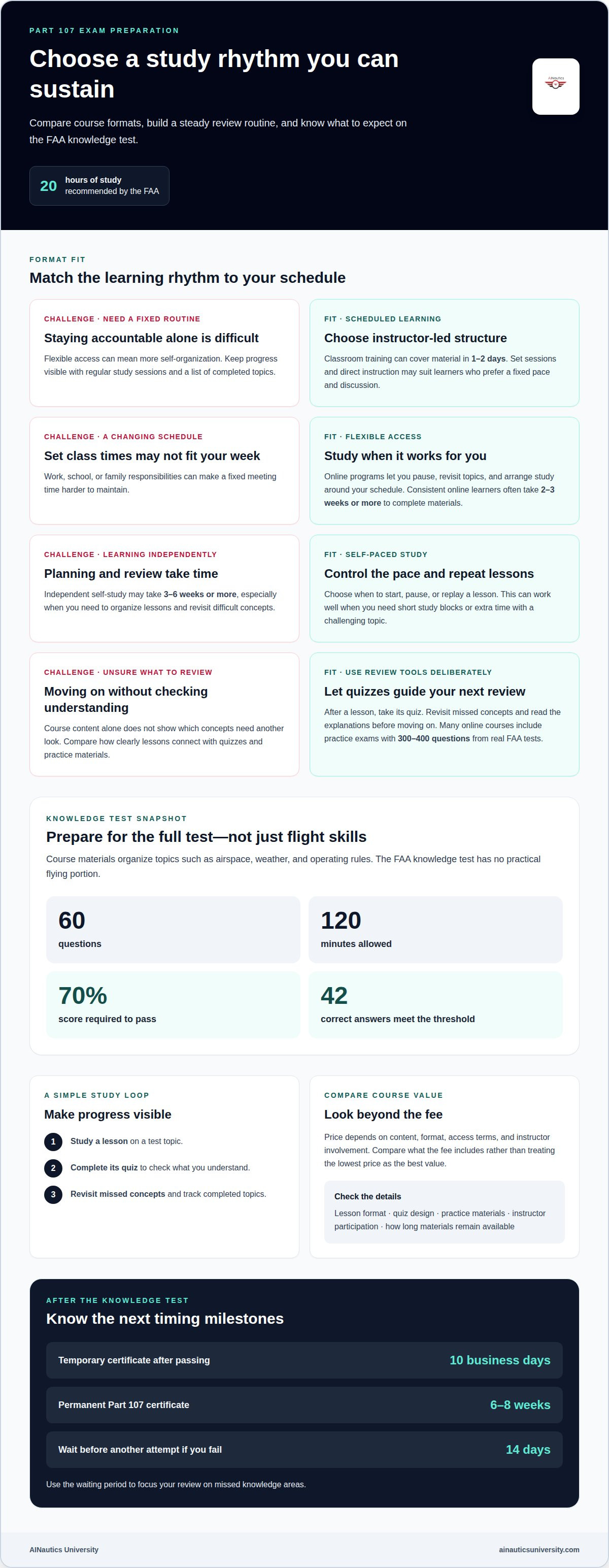
In-person and online classes can both prepare you for the FAA knowledge test, but they create different learning rhythms. Intensive classroom training can cover material in 1-2 days, giving learners a fixed schedule and direct structure. Online programs allow more flexibility, so you can pause, revisit topics, and arrange study around work or school.
Online learners often take 2-3 weeks or more to complete course materials when studying consistently. Independent self-study may take 3-6 or more weeks, especially when learners need time to organize lessons and review difficult concepts. Choose a classroom format if scheduled sessions help you stay accountable. Choose a self-paced format if you need control over when and how long you study.
The Federal Aviation Administration’s Part 107 rules govern drone operations for commercial purposes in the United States. Course materials should address the knowledge areas relevant to those rules, including the subjects listed under 14 CFR Part 107.73. The FAA knowledge test has 60 questions, allows 120 minutes, and requires a 70% score to pass. The test does not include a practical flying portion.
A score of 70% is required to pass the Part 107 knowledge test. On a 60-question test, 42 correct answers meet that threshold, so preparation should cover the full range of test topics rather than just flight skills.
A Part 107 certification course is preparation for the FAA aeronautical knowledge test. It organizes topics such as airspace, weather, and operating rules into lessons. A course itself is not a certification requirement; completing the FAA process, including passing the knowledge test, is what matters.
Self-paced learning can suit students balancing coursework, educators planning UAS lessons, and working adults with changing schedules. If airspace concepts are challenging, for example, you can replay a lesson before moving on. Learners who benefit from instructor-led discussion may prefer a classroom, where questions and explanations fit within a scheduled session.
Budget for more than the course fee. Compare the learning format, lesson access, study materials, and fit with your schedule. A lower-cost option may require more self-organization, while a structured class may suit someone who prefers a fixed pace. In either format, schedule regular study sessions and track completed topics to stay accountable.
After passing, candidates typically receive a temporary certificate in 10 business days and a permanent Part 107 certificate in 6-8 weeks. If you fail the test, the Federal Aviation Administration requires a 14-day wait before another attempt. That waiting period makes focused review of missed knowledge areas a practical part of your study plan.
Self-paced online course features and prices
Online programs vary in lesson structure, review tools, access terms, and instructor involvement. Compare those features with your schedule and study habits.
Self-Paced Course Features
A self-paced Part 107 certification course may organize instruction into lessons that learners can complete in sequence or revisit. Online courses can combine video, reading, quizzes, and practice exams. Many include practice exams with 300-400 questions from real FAA tests, giving learners a sizable question set for review.
Look at how activities support learning. A quiz after a lesson can reveal which concepts need another review before you move on. If you repeatedly miss questions about weather, for example, revisit that topic and read the explanations. Compare how clearly the course connects lessons, quizzes, and practice, rather than judging it by the amount of material alone.
Self-Paced Versus Scheduled Classes
Self-paced programs let you choose when to start, pause, or repeat a lesson. Scheduled online classes meet at set times, with an instructor guiding the group. That structure may help learners who benefit from a calendar and discussion, while flexible access can fit around school, work, or family responsibilities.
Consider how you stay accountable. If instructor-led sessions help you stay engaged, a scheduled class may provide a useful routine. If you learn best by replaying a difficult explanation or studying in short blocks, self-paced access gives you more control. Sketch a realistic weekly schedule before choosing a format you can sustain.
Course providers differ in how they package instruction and study resources. Compare lesson formats, quiz design, practice materials, instructor participation, and access terms. If you want guided discussion, prioritize instructor involvement. If you need to review material repeatedly, look for lessons you can return to.
Price depends on course content, format, access terms, and instructor involvement. Compare what each fee covers instead of treating the lowest price as the best value. A self-paced Part 107 certification course may suit learners who need schedule flexibility, while a scheduled program may better match those who want regular class meetings.
Before enrolling, review the course terms and set a study routine. For example, schedule a lesson, complete its quiz, then note which topics need another review. This sequence makes progress visible and turns flexible online learning into a consistent preparation plan.
Course price and money-back guarantees
Course fees are only one part of the cost of Part 107 preparation. Compare what the course includes, how long you can access its materials, and whether it offers practice tools.
How do free and paid Part 107 courses compare? A free course can provide a starting point, while paid programs may package lessons and practice materials into a more structured sequence. The FAA’s Part 107 Small UAS Recurrent course has no cost, but it applies to certificated remote pilots updating their aeronautical knowledge, not initial test preparation.
For initial preparation, assess the learning support rather than assuming price alone reflects course quality. Compare lesson organization, quiz access, practice exams, and access terms. A learner who needs to review material repeatedly may value lessons they can revisit, while someone already familiar with the topics may prioritize practice questions.
Read any guarantee carefully. A first-time pass guarantee may require completing lessons, taking practice exams, or submitting proof of a test result. Review the eligibility rules, claim deadline, and remedy before relying on it. A promise tied to specific steps differs from an unconditional refund, so identify exactly what the provider commits to.
Compare offers with a simple checklist:
- Included instruction: Note whether the course covers lessons, quizzes, and exam practice.
- Access terms: Record how long materials remain available and whether review access continues.
- Guarantee conditions: Identify required study steps and the stated remedy.
- Separate expenses: Keep the FAA knowledge test fee distinct from course charges.
Course providers structure their programs differently, so compare equivalent features. One program may focus on video lessons; another may emphasize reading, quizzes, or instructor guidance. Match the format to how you learn and the time you can devote to preparation. A higher fee does not automatically mean a better fit, and a free resource may serve a different purpose from a complete initial-preparation course.
Build a budget by listing course charges separately from test expenses, and review any guarantee terms before enrolling. If a company offers a refund or payment after a failed attempt, confirm which study actions trigger that commitment and what documentation it requires. Clear terms help you assess the offer’s structure, practice support, and fit with your preparation plan.
Eligibility requirements for remote pilots
Age and aeronautical knowledge are central to FAA Part 107 eligibility. The Federal Aviation Administration says applicants for an FAA Part 107 remote pilot certificate must be at least 16 years old. Meeting that age requirement is separate from preparing for and passing the required knowledge test.
The Federal Aviation Administration also requires applicants to pass an initial aeronautical knowledge test covering the areas specified in § 107.73. This test-based requirement makes focused studying relevant even for applicants who already have drone experience. Prior flying knowledge may help with some concepts, but it doesn’t replace learning the test topics.
Before starting a course, identify whether you meet the age requirement and whether you’re preparing for an initial certificate or maintaining an existing one. The distinction matters: a first-time applicant needs preparation for the initial test, while a certificated remote pilot may need recurrent training to meet knowledge recency requirements. Materials for the wrong stage may leave important learning needs unaddressed.
For initial preparation, use a course to organize aeronautical knowledge into manageable lessons. If airspace concepts are challenging, set aside a review session for that topic before moving on. Practice questions can reveal which concepts need more attention, and lesson notes can make later review more focused. A self-paced format lets you return to difficult topics.
What are the renewal requirements for a Remote Pilot Certificate? For a Part 107 remote pilot with an sUAS rating, completing the Federal Aviation Administration’s recurrent course satisfies the 24-month aeronautical knowledge recency requirement. This is a recency requirement, distinct from the initial test path for a new applicant.
Plan your studying around the specific goal. A new applicant can list the knowledge areas covered by § 107.73, then mark each topic as studied, in review, or ready for practice. A current remote pilot can focus on recurrent training instead of treating the process as another initial certification. This simple distinction helps direct your time toward the requirement that applies.
Students, parents, and educators can also use the age rule to plan a learning sequence. A learner who has not reached 16 can still build general UAS knowledge, but the FAA age requirement sets the threshold for applying for the remote pilot certificate. Educators can separate introductory drone lessons from formal certificate preparation, then align future study with the learner’s eligibility and goals.
Keep the two pathways clear: confirm the age threshold for an initial application, then prepare for the relevant knowledge requirement. For current remote pilots, the FAA recurrent course provides the stated route for meeting the 24-month recency requirement when they hold an sUAS rating.
Self-paced video lessons and course access
Video lessons can make technical ideas easier to follow when an instructor pairs explanations with diagrams or examples. But watching alone doesn’t show whether a concept has stuck. A self-paced Part 107 certification course is most useful when its videos connect to activities that help learners apply the material, such as notes, quizzes, or guided review.
Course access determines how you can use lessons over time. Review the stated access terms, whether completed videos can be replayed, and how progress is saved after a break. A student balancing school and family responsibilities, for example, may need to pause midway and return later without repeating completed work.
Make each viewing session active. Before starting, choose one lesson and a specific goal, such as understanding an airspace concept. Afterward, summarize the key idea in your own words and note what remains unclear. This routine helps distinguish material you understand from material that needs another look.
Video design also affects learning and review. Visual learners may benefit from diagrams that explain a concept, while readers may prefer written notes alongside the video. If a section remains confusing, replay it and compare your notes with the explanation. Focus on understanding, not simply reaching the final lesson.
Check that access terms fit your schedule. Exams, work, or caregiving can disrupt a study plan. Before enrolling, find out how long course materials remain available and whether your progress is saved after a pause. These details matter when you expect to spread lessons across changing commitments.
Students and educators can track progress simply: mark each lesson as started, completed, or needing review, then choose the next task. An educator planning a classroom activity, for example, can flag a concept that needs another example. A clear next step helps keep independent study moving.
Choose video instruction based on how it supports access, understanding, and review. A self-paced Part 107 certification course can fit learners who need to revisit lessons on their own schedule. To explore flexible preparation, consider self-paced certification learning and choose the next step that fits your goals.
AINautics University: Part 107 Training
AINautics University offers Part 107 Training for learners preparing to build knowledge of drone operations and certification topics. If flexible study fits your schedule, Self-Paced Certification provides a learning route to consider; educators can explore the Train-the-Teacher Program when they’re planning to bring UAS learning into their curriculum. The VR Trailer Mobile Lab offers another educational option for introducing learners to UAS concepts.
Choose a format that fits your goal, whether individual exam preparation, educator development, or a broader learning experience. A clear next step can connect course selection with your plans in the drone industry.
Contact AINautics University to discuss which learning option aligns with your goals.
Build your next step around a clear goal
Choose a learning plan that supports more than exam preparation. Decide what you want to do with your UAS knowledge next: explore a future role, strengthen an educational program, or build confidence discussing drone operations. Clarify whether your priority is understanding operational concepts, integrating UAS into instruction, or exploring technical career options. Writing down your goal can show which lessons deserve extra attention and what progress looks like beyond course completion.
A course choice is one stage in a longer learning path. As you move forward, connect new knowledge to the people, projects, or learning environments you hope to serve. Use your goal to guide the next learning opportunity, whether that means deepening a skill or applying what you’ve learned in a new setting. If you’re ready to discuss how a self-paced Part 107 certification course could fit your goals, contact AINautics University. Start with the outcome you want to pursue, and take your next step with focus and confidence.
Frequently Asked Questions
How many hours does it take to study for the test?
Use the study-time guidance above as a starting point, then adapt your plan to the topics you find difficult. Divide course material into manageable study blocks and set aside time to revisit missed practice questions. If you repeatedly confuse two airspace concepts, for example, focus your next review session on telling them apart before moving on.
How much does it cost to take the exam?
The exam fee is separate from course expenses, and its amount is covered earlier in this guide. Keep the charges distinct when budgeting so course materials don’t obscure the cost of sitting for the test. Also plan practical test-day arrangements, such as transportation to your appointment and time away from work or school.
What happens if I need help?
First, identify exactly what’s unclear. Note the lesson or concept, describe what you understand, and write down the question that remains. Then review the relevant course material and try a related practice question. This focused approach helps you use learning resources efficiently, whether you’re studying independently or learning with a teacher.
Where can I take the exam?
The exam is administered at an FAA-authorized testing center. Use your appointment information to find the assigned location and plan your trip. Before leaving, review the appointment instructions so you know what to bring and when to arrive. Keep study materials separate from test-day logistics, and allow enough time to reach the center without rushing.
Who needs a Part 107 license?
People planning drone operations for commercial purposes in the United States need to understand the applicable Part 107 requirements. Start by identifying the purpose of the planned operation and the role you’ll perform. For example, a student exploring paid drone work can use that career goal to guide their training choices and determine which certification pathway to study.
What are the best self-paced Part 107 courses in the United States?
There isn’t one best course for every learner. Choose a program that matches your preparation goal and preferred way of learning. A student who wants to study independently may prioritize flexible lesson access, while an educator building a classroom pathway may need training that supports teaching goals. Define your purpose first, then compare the course structure and materials against it.
How much do self-paced Part 107 courses cost?
Course prices vary, so compare program terms rather than assuming two courses offer the same value. Check what the listed fee covers, how access works, and whether the course is designed for initial exam preparation or another learning purpose. Keep course charges separate from the exam fee when planning your overall budget.
How long does it take to complete an online Part 107 course?
Completion time depends on how often you study, how quickly you move through lessons, and how much review you need. Build your calendar around the course modules instead of aiming to finish as quickly as possible. If a lesson raises questions, leave time to revisit it and strengthen your understanding before continuing.

Article by
AINautics University Team
The team behind AINautics University, dedicated to drone education and FAA Part 107 certification prep, VR flight simulation, and STEM training programs for students and educators.


