
The right drone training can prepare a high school educator to bring UAS learning into the classroom, but eligibility depends on the program’s entry criteria. A train-the-trainer drone program is educator-focused, while pilot certification is a separate part of the learning path.
Before choosing training, clarify who it serves, what learning resources it provides, and how students will learn safe drone operations. These details help you judge whether a program suits your classroom and goals.
This guide explains how to assess educator training, classroom resources, and ongoing support. It also outlines ways to teach drone operations and compliance, helping you plan what UAS instruction may involve.
Key Takeaways
- Understand which eligibility criteria to review before choosing an educator-training path.
- See how mentorship and peer connections can support educators as they bring drone learning into class.
- Explore how practical instruction can help teachers prepare to guide students through UAS activities.
- Identify the curriculum materials and teaching resources that can make classroom planning more manageable.
- Learn how FAA pilot testing fits into drone education and where AINautics University’s training tools may support your next step.
Eligibility requirements for instructor training
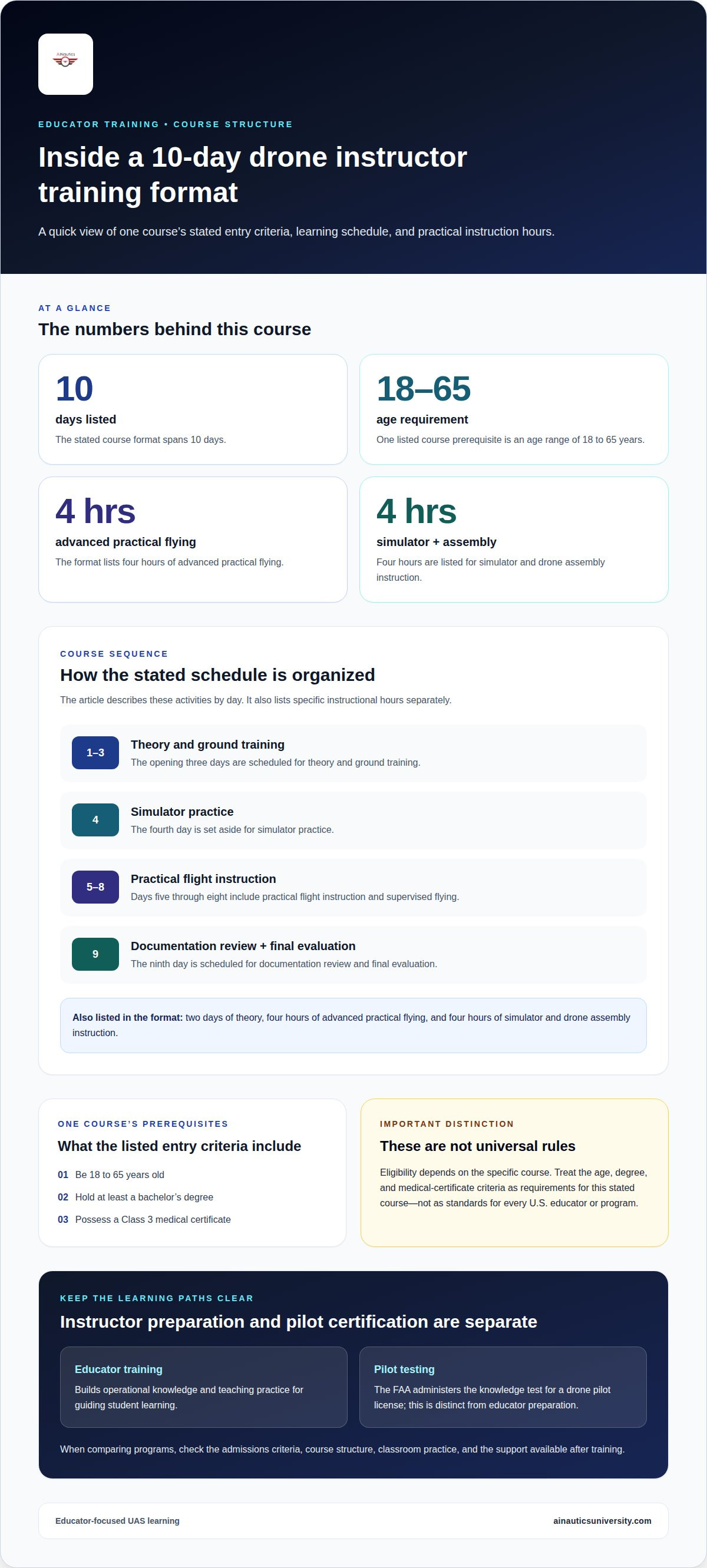
Eligibility depends on the specific course, not on a single entry rule that applies to every U.S. educator. One stated set of prerequisites requires applicants to be 18 to 65 years old, hold at least a bachelor’s degree, and possess a Class 3 medical certificate. Treat those as requirements for that course, not universal U.S. standards.
Which organizations offer drone train-the-trainer programs in the United States? Drone education organizations provide instructor training, while the FAA administers the knowledge test for a drone pilot license. Program availability and admissions criteria vary, so distinguish educator preparation from pilot certification when comparing course details.
For high school teachers, readiness involves more than flying ability. Instructors need to explain procedures clearly, guide student practice, and manage a classroom where attention shifts between the aircraft and classmates. Training coordinators may focus more on organizing lessons, equipment use, and consistent procedures. The roles can overlap, but they require different strengths.
Experience as a drone pilot can provide a useful foundation by connecting flight concepts with real piloting decisions. But flying experience alone does not show how to demonstrate a skill, assess understanding, or help a disoriented learner. Instructor training should build operational knowledge and teaching practice. Review the course requirements to identify what you may need to learn.
Safety instruction should address human performance as well as aircraft handling. A student who loses orientation, for example, may need calm, direct guidance rather than several instructions at once. Instructors can practise giving concise commands, pausing when attention is divided, and explaining what students should observe before taking control. These actions make safety procedures easier to understand and repeat.
Course structure can help applicants judge the commitment involved. One listed format runs for 10 days, with theory and ground training scheduled for days 1-3, simulator practice on day 4, and practical flight instruction with supervised flying on days 5-8. Documentation review and final evaluation are scheduled for day 9. The format also includes 2 days of theory, 4 hours of advanced practical flying, and 4 hours of simulator and drone assembly instruction.
Use these details to assess whether the course fits your role and learning goals. An interested teacher may prioritize classroom delivery and student supervision; a training coordinator may focus on lesson organization and evaluation. The aim is to master both the subject and the process of teaching it, with eligibility and course structure serving as practical starting points.
Ongoing educator support and peer community
Support matters after coursework, when educators adapt lessons for their students. A train-the-trainer course with post-training mentorship can help teachers work through practical questions as they apply what they learned.
Class Size and Personalized Support
Class size affects how much time each educator gets to practise teaching and receive feedback. Look for a course format that gives participants opportunities to ask questions, rehearse explanations, and discuss lesson challenges with an instructor.
A teacher learning to coach a student through a flight exercise benefits from feedback on the clarity and sequence of instructions. A training coordinator may need guidance on organizing materials or maintaining consistent classroom procedures. Consider whether the course makes room for both needs.
Ongoing Educator Support
Post-training mentorship gives educators a channel to discuss how they apply their learning. A teacher might ask how to explain simulator practice, while a coordinator might discuss how to structure a student activity.
Peer discussion offers another perspective. Educators can compare lesson approaches, share examples, and identify where students need clearer explanations. Look for opportunities to exchange practical ideas rather than assuming every course includes a peer community.
Post-Training Support
AINautics University’s Train-the-Teacher program includes post-training mentorship. This support can help educators connect course concepts with classroom decisions, such as introducing a flight activity or explaining a safety procedure before practice.
Before choosing a program, consider what mentorship covers and how it relates to teaching. A useful discussion might focus on adapting an explanation for students with different levels of piloting experience. Mentorship supports learning, but it is not a job-placement service or a promise of employment.
Define what career support means for your goals. An educator may want to develop classroom skills, while a training coordinator may focus on organizing activities and supporting consistent instruction. Identify which skills the course develops and whether its mentorship relates to your intended role.
For certified pilots interested in teaching, the transition involves more than demonstrating flight skills. A practical next step is to identify a lesson they could teach, then consider how they would explain each stage, observe student performance, and respond to questions. That exercise can clarify where further instructor development would help.
Assess support against a real teaching task, such as lesson planning, student practice, or classroom coordination. This makes it easier to choose training that fits your learning and career goals.
Why Would a High School Drone Instructor Need Training?
Local training and funding options depend on school district and regional education resources. A district’s professional-learning coordinator can explain how educator development is planned and whether training aligns with existing career or STEM goals.
Instructor preparation helps teachers turn flying experience into effective teaching. Students need demonstrations they can follow, practice with clear objectives, and explanations that connect piloting decisions to classroom activities. A certified drone pilot may know how to operate an aircraft, but teaching also requires breaking tasks into steps and noticing when learners need clarification.
In-person practice gives educators room to rehearse teaching skills. A teacher can demonstrate a simulator exercise, ask a colleague to act as a learner, and refine the instructions based on where confusion arises. Rehearsal helps instructors prepare before students begin practical activities.
Practical instruction also lets educators experience a lesson from the learner’s perspective. An instructor can practise explaining a control input, check understanding, and then guide a learner through the same action. This helps teachers recognize when students need a demonstration, a simpler explanation, or another practice attempt.
Course price and minimum enrollment terms depend on the provider and course arrangement. For a U.S. educator, compare the stated price and enrollment conditions with the teaching practice, assessment, and learning materials. A school arranging group training may have different enrollment needs from an individual teacher, so these terms matter during planning.
Delivery mode and language shape how educators participate. A course may offer online or in-person instruction, and its teaching language affects how easily participants can engage with technical material. For in-person learning, consider whether the format allows each educator to practise explaining a skill and receive useful feedback. Batch size can influence those opportunities, so assess how the course supports individual practice.
Flying experience gives instructors examples to draw on, but it does not automatically prepare them to supervise student learning. A pilot can use their knowledge to explain a flight task, while instructor practice helps organize the explanation and answer learner questions. The goal is to help students progress through clear, purposeful instruction.
For a school, the key question is whether training develops teaching ability alongside drone knowledge. Consider how participants practise instruction, receive feedback, and demonstrate what they have learned. These features help you judge whether the training suits classroom responsibilities and students’ needs.
A district’s professional-learning coordinator can explain educator-development resources and whether training fits existing career or STEM goals. When comparing courses, review pricing and enrollment terms.
Classroom-ready curriculum and teaching resources
A useful curriculum connects technical content with teachable activities. For high school educators, that means understanding what lessons cover, which materials support them, and what students use for practice.
What equipment and facilities are needed to teach drone operation? At a basic level, teachers need a classroom, access to a drone for practical demonstrations, and a simulator for flight exercises. Hands-on maintenance instruction also requires equipment for assembly and battery procedures.
One instructor curriculum covers advanced flight principles, meteorology, safety management, drone maintenance, and an introduction to drone data analytics. It also includes DGCA stakeholder roles and drone laws. U.S. educators should distinguish this regulatory content from instruction on FAA requirements.
These topics can support a sequence of lessons instead of one dense lecture. A teacher might introduce weather concepts, then discuss how conditions affect a planned flight exercise. Students can connect maintenance topics with an assembly demonstration, followed by simulator practice that reinforces flight principles.
Study materials and worksheets let students review concepts beyond demonstrations. A worksheet might ask learners to identify maintenance steps or explain a basic data-analysis example. Their responses can show where another explanation is needed before practical work.
Match equipment to the curriculum’s learning objectives. A drone supports demonstrations of aircraft components, while a simulator provides a setting to practise flight concepts. Maintenance instruction can include assembly and maintenance labs covering engine integration and battery procedures, connecting classroom discussion to observable tasks.
Facilities also shape lesson design. A classroom supports theory, worksheets, and group discussion; practical instruction requires a suitable space for the planned activity. Make clear whether students are observing, practising on a simulator, or working with a drone. Clear transitions keep the learning task focused.
For a remote pilot preparing to teach, ask whether the curriculum develops subject knowledge and instructional resources. Course topics and materials should be clear enough to adapt for student learning, rather than relying on technical terms alone.
Connect each topic with an activity and a resource. An educator might pair a meteorology lesson with a worksheet, then use simulator practice to reinforce flight concepts. Classroom use can reveal which materials help students learn and which explanations need refinement.
Drone training operations and regulatory compliance
An organization can set up a train-the-trainer drone program by defining its learning goals, selecting qualified instructors, and building lessons around classroom instruction, simulator practice, and supervised flight activities. It should also separate pilot certification preparation from educator training, since they develop different skills.
For U.S. operations, distinguish FAA requirements from content developed for other countries. A course may discuss DGCA roles or laws, but that material does not replace instruction on U.S. operations. Clear curriculum labels help educators teach relevant rules without blending regulatory systems.
Drone pilot licensing typically involves a knowledge test as part of the certification process. The FAA knowledge test consists of 60 multiple-choice questions. Instructors can explain this certification step, then help students understand that flight practice and classroom instruction serve different learning goals.
Operational training should connect procedures to observable actions. Before a flight exercise, explain the task, demonstrate the controls, and tell students what to observe. During practice, give focused directions and pause if a learner needs clarification. Afterward, ask students to describe what happened and identify the next skill to practise.
Specific scenarios can make safety lessons more practical. A simulator exercise lets students practise responding to disorientation or an emergency maneuver before attempting a related aircraft activity. Instructors can assess whether students follow instructions, communicate clearly, and understand each step.
Build the program around a documented sequence:
- Set learning outcomes: define what students should explain or demonstrate after each lesson.
- Teach operating concepts: connect classroom instruction with flight planning, weather, and safety management.
- Provide guided practice: use simulator activities before supervised aircraft exercises.
- Assess understanding: use written questions, oral explanations, or practical demonstrations.
Assessment should show whether an instructor can teach, not only whether they can fly. One listed Train-the-Teacher course uses continuous assessment and a final evaluation, including a written test and an oral or practical exam under DGCA guidelines. These DGCA-specific assessment details are not FAA requirements.
Institutional examples show how operations training can be structured. Fort Benning’s Infantry and Armor OSUT trainees take a 10-hour small unmanned aircraft systems familiarization course. That example describes military training, not a requirement for U.S. high schools. Schools can still use the underlying planning principle: match each activity to a clear learning objective and a suitable level of supervision.
In a U.S. classroom, keep FAA certification information, operational instruction, and educator assessment distinct. This helps students understand which knowledge supports pilot certification and which skills help them operate aircraft responsibly during training.
AINautics University: Part 107 Training
AINautics University offers Part 107 Training and Self-Paced Certification for aspiring drone pilots, plus a Train-the-Teacher Program for educators. The UAS Student Scholars program also supports students exploring the industry.
The Drone Simulator supports virtual practice, while the VR Trailer Mobile Lab brings hands-on learning to educational settings. These tools complement training but do not replace FAA testing requirements.
Consider how pilot knowledge, educator preparation, and student practice fit your goals. Contact AINautics University to discuss your educational path.
Turn Your Interest Into a Classroom Plan
Start by defining what drone learning should make possible at your school. You might aim to help students understand flight concepts, prepare for certification study, or build an educator-led UAS curriculum. A clear goal helps identify which skills to develop first.
A train-the-trainer drone program can connect your knowledge with how students learn. Plan how you’ll introduce concepts, guide hands-on activities, and make room for questions. Then teach a lesson, notice where students need support, and refine your approach for the next session.
AINautics University can help you explore a learning path that fits your educational goals. Contact AINautics University to discuss your next step. Your preparation can become the foundation for meaningful UAS learning opportunities in your school.
Frequently Asked Questions
Are there any prerequisites for participating in the program?
Prerequisites depend on the specific instructor course and its intended audience. Before enrolling, review whether it expects prior piloting experience, academic qualifications, or medical documentation. One listed course sets entry criteria at ages 18 to 65, a bachelor’s degree, and a Class 3 medical certificate. Those criteria describe that course, not a universal requirement for every U.S. educator-training program.
What is a train-the-trainer drone program?
A train-the-trainer drone program prepares participants to teach drone knowledge and skills. It combines subject learning with the ability to explain procedures, guide practice, and assess student understanding. For example, an educator might break a flight-planning concept into a short lesson, demonstrate it, and ask students to explain their decisions before an exercise.
What are the eligibility requirements for drone instructor training?
Requirements vary by course, so use the provider’s stated admissions criteria rather than assuming one national standard. A listed course requires applicants to be 18 to 65 years old, hold at least a bachelor’s degree, and have a Class 3 medical certificate. For a U.S. school setting, also consider whether your piloting background and teaching role match the course’s focus.
What topics and skills are covered in a drone train-the-trainer course?
Course content may include flight principles, weather, safety management, maintenance, and drone data analytics. Some curricula also cover stakeholder roles and laws specific to their jurisdiction. Pair each topic with a teaching task, such as asking students to interpret a weather scenario or explain a maintenance procedure in their own words.
How long does drone instructor training take, and what certification is awarded?
Duration and completion credentials depend on the course. One listed format is delivered over 10 days and includes theory, simulator work, practical instruction, and evaluation. Don’t assume that finishing instructor training awards an FAA remote pilot certificate. FAA Part 107 certification has its own knowledge-test requirement, separate from a course’s instructor assessment or completion documentation.
How much do drone train-the-trainer programs cost?
Program pricing depends on the course scope, delivery format, practical instruction, and enrollment arrangement. The price is determined for the specific case and provided after a quote request. When reviewing a quote, consider what instruction and learning resources it covers, and whether the format fits an individual educator or a school’s training plan.
What FAA Part 107 rules apply to drone instructors and training programs?
For a person seeking a drone pilot certificate, the FAA knowledge test is taken at an FAA testing center and consists of 60 multiple-choice questions. Instructor training and pilot certification are distinct: teaching students about drone operations doesn’t replace the required test. Keep certification preparation and classroom instruction clearly identified in course materials.
What safety, insurance, and liability risks should drone trainers address?
Plan for risks involving aircraft handling, student attention, equipment condition, and unclear instructions. A classroom procedure can specify who gives directions during practice and when to pause if a student becomes confused. Schools should also set expectations for equipment use and review how their insurance and liability processes apply to planned training activities.

Article by
AINautics University Team
The team behind AINautics University, dedicated to drone education and FAA Part 107 certification prep, VR flight simulation, and STEM training programs for students and educators.


