
Teachers can prepare to lead drone lessons without prior aviation experience, but they should develop basic hands-on flight skills before supervising student flights. Classroom management for drone flight lessons starts with clear safety routines, defined student roles, and activities suited to learners’ grade levels.
You may wonder whether you need a pilot background to guide students confidently. You don’t need to start as an aviation expert, but you do need to understand the flight skills and procedures you’ll teach. A structured approach helps students stay focused while making room for teamwork, practice, and responsible use of technology.
This guide explains how to organize flight areas, manage equipment and transitions, and use activities that give students meaningful roles. It also explores how drone instruction can progress from basic controls and safe takeoffs to more advanced projects, and what training can help educators prepare for the classroom.
Key Takeaways
- Build a predictable flight routine with clear safety expectations, defined roles, and purposeful transitions.
- Use team-based activities and role rotations to keep students engaged while organizing flight practice.
- Match lessons to students’ grade levels, starting with basic controls before advancing to more complex projects.
- Prepare to teach by strengthening your own flight skills and learning the regulatory basics that apply to educational drone operations.
- Plan the flight area so students know where to fly, observe, and move safely.
Workplace safety, teamwork, and career readiness
Effective flight lessons combine safety procedures, active supervision, and clearly assigned student roles. These routines help schools turn drone technology practice into structured learning about teamwork, risk management, and responsible decision-making.
Student Flight Safety and Supervision
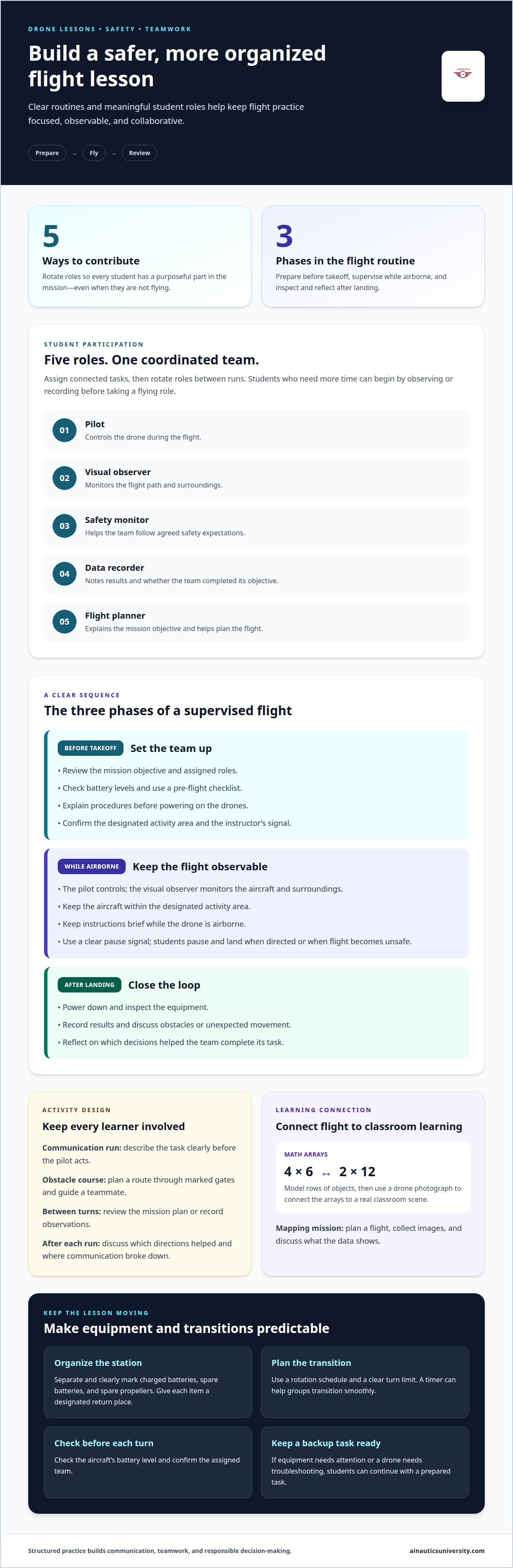
Supervising student flights means keeping every flight observable and guiding students through agreed roles. Before takeoff, review the objective, check battery levels, and use a pre-flight checklist. Explain procedures before powering on the drones, then keep instructions brief while they are airborne. Assign a pilot and a visual observer so one student controls the drone while another monitors its flight path and surroundings.
Safety Rules and Risk Management
Safety rules and risk-management routines help students identify hazards and respond consistently. Before each mission, set expectations: wait for the instructor’s signal, keep the aircraft within the designated activity area, and pause when directed. Establish a clear stop signal so students know when to land their drones. After landing, power down and inspect the equipment, record results, and discuss any obstacle or unexpected movement.
Behavior, Emergencies, and Inclusion
Predictable signals, roles, and responses help keep practice orderly. If behavior or a developing hazard makes flight unsafe, tell students to pause and land their drones. Address the issue before resuming. To manage behavior and respond to emergencies, set expectations before flight, use a clear pause signal, and have students ground the aircraft when needed.
Organize participation so everyone can contribute. Rotate students through pilot, visual observer, safety monitor, data recorder, and flight planner roles, including when they are not at the controls. A student who needs more time with a task can start by observing or recording, then take a flying role when ready. Clear role changes reduce confusion and make teamwork visible.
These routines build skills that extend beyond a classroom exercise. Students practice communicating, recording outcomes, and making careful decisions as a team. For example, a flight planner can explain the mission objective while a data recorder notes whether the team completed it. A brief post-flight reflection helps students connect decisions with results.
Career readiness grows when lessons connect safe practice with real uses of drone technology. A mapping mission can introduce planning and data collection; a photography task can prompt discussion about responsible image use. Teachers can also explain how Part 107 knowledge relates to professional drone operations and how students might continue exploring UAS learning in high school or college.
Classroom activities, quizzes, and flight exercises
Plan each activity around one learning objective, then connect discussion, teamwork, and flight practice to it. Manage batteries and turn-taking with a pre-flight readiness check, a rotation schedule, and a backup task in case equipment needs attention.
Communication and Obstacle-Course Activities
In a communication exercise, students describe a flight task clearly before the pilot acts. This builds listening and precise instruction skills alongside basic control practice. For an obstacle course, students can plan a route through marked gates and guide a teammate using agreed directions. Pause after each run so the team can discuss which instructions helped and where communication broke down.
Team Flight Roles and Turn-Taking
Assign connected tasks so every student contributes while one person pilots. Give students the roles of pilot, lookout, and mechanic, then rotate them between runs. Set a clear turn limit and use a timer if it helps groups transition smoothly. Students waiting to fly can review the mission plan or record observations instead of crowding around the controls.
Classroom and Flight-Area Setup
An organized activity station makes equipment checks and student rotations easier to follow. Place charged batteries, spare batteries, and spare propellers in separate, clearly marked spots, and give each item a designated return place. Before each turn, check the aircraft’s battery level and confirm the assigned team. If a drone needs troubleshooting, use a prepared backup task so the rest of the lesson can continue.
Science and Math Connections
Science lessons can use a mapping mission to explore how aerial images represent a place. Students can plan the flight, collect images, and discuss what the data shows. For math, ask students to model 4 × 6 by forming four rows of six, then compare it with two rows of twelve for 2 × 12. A drone photograph can help connect these arrays to a real classroom scene.
Knowledge Checks and Flight Practice
A short quiz before flying can check whether students understand the mission objective, role assignments, and agreed communication signals. After practice, ask each team to explain one decision that helped complete its task. These checks give instructors useful evidence of learning without making every activity a test. For additional rehearsal, the Drone Simulator can complement classroom flight exercises.
What training can help a new drone teacher?
New drone teachers need practical flight skills, a clear understanding of applicable rules, and experience turning aviation concepts into structured lessons. Training should help educators teach safely, select equipment that suits their objectives, and guide students from basic controls toward more advanced missions.
FAA Rules for Educational Drone Operations
In the United States, Part 107 is the primary regulation for drones weighing less than 55 pounds, according to the Federal Aviation Administration. The Federal Aviation Administration states that educational drone operations in the United States may be conducted under Part 107 or, for qualifying educational organizations under certain conditions, the limited recreational exception. The correct framework depends on how the school’s operation qualifies and is conducted.
Teachers should learn the rules that match their planned activities before leading flights. Part 107 knowledge helps educators understand the framework for operations conducted under that regulation. A lesson involving a school project should not be assumed to fall under the recreational exception simply because students are learning. Training can connect regulatory concepts to real classroom scenarios.
Educational Organization Eligibility
Eligibility matters because the recreational exception applies only to qualifying educational organizations and conditions. The Federal Aviation Administration says educational institutions, including primary and secondary schools, trade schools, colleges, and universities, are eligible to request a Flight Restriction Identification Area, or FRIA, where drones may fly without Remote ID. A FRIA is a location-based option, not a substitute for understanding which operating framework applies.
Hands-On Educator Training
Educators should develop basic hands-on flight skills before leading student activities. Start with microdrones and fundamental maneuvers, then build confidence through controlled practice before introducing more demanding aircraft. Teachers can rehearse takeoff, hovering, directional control, and landing while learning to explain each skill in student-friendly language.
Structured preparation connects aviation fundamentals with classroom instruction. A teacher might demonstrate a maneuver, ask students to describe the control input, and then guide supervised practice. A Train-the-Teacher Program can help educators build teaching readiness and develop a coherent drone curriculum.
Selecting Equipment for Learning
Choose educational equipment by matching the aircraft and learning tools to the lesson objective, student readiness, and practice environment. For an introductory course, microdrones let teachers focus on basic control skills before progressing to larger aircraft. A simulator offers another way to rehearse controls and lesson sequences before live flight.
Before choosing equipment, map each planned activity to the skills students will practice. A course on aviation fundamentals, for example, needs different learning tasks from one introducing mapping or automated missions. This alignment helps teachers plan purposeful lessons, build knowledge progressively, and lead students with greater confidence.
Drone flight instruction across grade levels
Effective drone instruction adapts to students’ age, experience, and readiness for abstract concepts. Start with basic controls, hovering, safe takeoffs, and landings, then introduce more complex missions as skills develop. This progression gives new learners time to connect explanations with flight practice. It also helps educators keep programs engaging without expecting every grade to master the same tasks.
For elementary students, connect drone lessons to familiar classroom topics and straightforward goals. Meghan Salter’s schoolwide Drone Olympics project focuses on fifth graders and runs for a year. A project-based approach can make flight activities part of ongoing learning rather than a one-day demonstration. Students might plan a simple route, describe what they observe, and explain how their team completed its task.
Middle school lessons can introduce more planning and peer collaboration. Students might sketch a flight route, predict where a drone will turn, and compare their plan with the actual flight. A photography task can connect math concepts to images, while a science activity can ask students to observe a site from above. Keep the learning objective clear: students should explain what the flight helped them notice or measure.
High school students can work toward more advanced projects, including photography or video for school organizations, automated missions, mapping, and photogrammetry. These activities introduce the work of a drone pilot while asking students to plan, collect information, and communicate results. Some high school drone courses require students to pass the Part 107 test to complete the course. That requirement can connect classroom instruction with certification preparation.
Match each challenge to demonstrated skills, not grade labels alone. A student new to flying can start with hovering and landing, while a more experienced classmate plans a route or reviews collected images. Rotating roles gives students practice with different parts of a mission. For example, one learner can explain the objective, another can plan the route, and the pilot can carry it out.
Across grade levels, assess learning through observable outcomes. Ask younger students to describe a safe landing; invite older students to explain how their mapping plan shaped the data they collected. A progression from controls to purposeful projects helps teachers see what students understand and what needs more practice. It also shows learners how drone technology can support future programs and careers.
What classroom and flight-area setup is needed for drone lessons?
Set up separate spaces for instruction, equipment, observation, and flight practice. Clear boundaries show students where to stand, where to move, and when a drone may fly.
Mark the Flight Area
Before the lesson, identify the takeoff and landing area, pilot position, observer area, and no-walk zones. Mark boundaries with floor markers, cones, or other classroom materials. Keep the route between the pilot and observer areas clear so students can watch without crossing the flight space. Assign one pilot to each defined zone to clarify control responsibilities.
Choose the layout to suit the activity. For a hovering exercise, keep the flight zone simple and the observer area easy to see. For a route-planning task, mark the course and endpoints before students begin. Explain where students should stand and how to move between stations. A visible layout makes transitions easier to manage.
Organize the Classroom
Arrange desks and work areas before flight practice. Keep lesson materials, mission plans, and recording sheets away from the takeoff and landing area. Set up a briefing space where the teacher can explain the objective while drones remain off. After the briefing, teams can move to their assigned roles and stations without crowding the flight zone.
Use a board or printed chart to display the activity sequence: briefing, equipment check, flight, landing, and review. List each team’s pilot, observer, and recorder beside the mission objective. Students can see what comes next and where they belong. This visual plan is especially useful when teams rotate through flight practice.
Prepare Equipment and Transitions
Keep drones and batteries in a designated equipment area, separate from student traffic and lesson materials. Before flight, check battery levels and confirm that the equipment suits the activity. Set aside a clear space for equipment after landing, then include powering down and inspection in the class routine. Spare batteries and propellers can help keep the lesson moving if equipment needs attention.
Signal the start and end of each flight, and explain how teams will rotate. A timer can help students track turns; assign a cleanup role so equipment returns to its designated place. If a drone needs troubleshooting, move the class to a prepared discussion or planning task while the issue is addressed.
For an additional way to rehearse flight decisions before live practice, explore guided drone flight practice.
AINautics University: Drone Simulator
AINautics University offers a Drone Simulator for educators preparing students for structured drone lessons. It can complement classroom instruction when learners need to rehearse flight concepts before live practice or introduce controls in a learning-focused setting. The Train-the-Teacher Program supports educators building drone instruction, while Part 107 Training and Self-Paced Certification options help learners study the U.S. framework for qualifying drone operations. The VR Trailer Mobile Lab and UAS Student Scholars program offer additional ways to support UAS learning.
Choose the resource that fits your next step: simulator practice, educator preparation, or Part 107 study. Contact AINautics University to discuss which option supports your learning goals.
Turn Your Drone Curriculum Into a Teaching Plan
Shape drone instruction around the learners in front of you. Choose a learning goal, decide what students should practice, and plan a progression from introductory skills to purposeful projects. Strong classroom management for drone flight lessons supports that progression and helps students see future opportunities in UAS.
Educators who want to develop their teaching approach can explore AINautics University’s Train-the-Teacher Program. Part 107 Training can support learners preparing for certification, while the VR Trailer Mobile Lab offers another resource for bringing UAS education into a learning program. Select the option that aligns with your next educational goal.
Contact AINautics University to discuss training and identify a useful next step for your students or teaching practice. With a focused plan and continued learning, you can help students build skills for the technologies shaping tomorrow’s careers.
Frequently Asked Questions
Can a Teacher Without Aviation Experience Teach a Drone Course?
Yes. Teachers can build the knowledge needed to lead a drone course without an aviation background. Start by choosing a curriculum goal, such as teaching students to interpret aerial images, then identify the flight concepts needed to support it. As a preparation exercise, explain the goal to a colleague and invite questions. This can reveal unfamiliar terms or instructions that need clearer classroom language.
What classroom management strategies work best for drone flight lessons?
Effective classroom management for drone flight lessons sets clear expectations for listening, equipment handling, and respectful teamwork. Ask students to help define what ready-to-fly behavior looks like, then refer to those shared expectations during activities. Give feedback about specific behavior, such as interrupting a teammate’s briefing, rather than labeling a student. A brief private conversation can redirect behavior while protecting the student’s dignity and the group’s focus.
How should a drone flight lesson be structured for beginners?
For beginners, connect each flight task to a learning objective and give students a clear way to demonstrate understanding. Before piloting, students might draw a route and explain where they expect the aircraft to turn. Afterward, ask them to compare their prediction with what happened. This makes it easier to identify whether a learner needs more time with the concept or the control skill.
What student-to-instructor ratio is safe for classroom drone training?
A safe group size depends on whether the instructor can give appropriate attention to each student and active task. Consider students’ experience, the activity’s complexity, and how much direct guidance it requires. A mapping discussion with aircraft grounded needs different oversight from hands-on flying. Set group size according to the instructor’s ability to monitor learning and respond promptly, rather than relying on one ratio for every lesson.
What safety rules and preflight checklist should students follow?
Use a checklist suited to the activity, and make responsibility for each item clear. For example, one student can read an item aloud while a teammate confirms it is complete. If anyone notices a damaged part or an uncertain condition, pause and tell the instructor rather than guessing. This turns the checklist into a shared communication tool and helps students practice reporting concerns clearly.
What FAA rules apply to teaching drone flight in the United States?
Educational drone operations must follow the applicable operating framework, which depends on the organization and the operation. The FAA provides Advisory Circular 91-57D for more information about educational drone operations. Teachers can use it to frame classroom discussions about how rules relate to a planned activity. For example, students can compare how a school project’s purpose and operating plan shape the questions an educator must resolve before flight.
What are common risks during drone lessons and how can they be reduced?
Risks can also arise from unclear assignments, rushed decisions, or students failing to report an unexpected event. After an interruption, ask the team to describe what they observed, what action followed, and what they would communicate sooner next time. The instructor can record the event and use it to improve the next lesson plan. This reflection builds careful reporting habits without assigning blame.
What equipment and insurance costs are typical for classroom drone flight lessons?
Costs depend on the equipment selected, the school’s existing resources, and its insurance needs. Build a budget that separates aircraft and learning tools from ongoing upkeep, replacement planning, and insurance. Match each expense to a teaching purpose, such as introductory flight practice or image-based projects. This helps a school assess its program needs before deciding how to fund it.

Article by
AINautics University Team
The team behind AINautics University, dedicated to drone education and FAA Part 107 certification prep, VR flight simulation, and STEM training programs for students and educators.


