
Part 107 certification and drone insurance address different risks. In the United States, the FAA doesn’t require drone owners to carry insurance, but schools shouldn’t assume their general liability policy covers drone-related accidents. Understanding liability and insurance for school drones means knowing what coverage may protect people and property, and what may protect the aircraft and its equipment.
When planning a school drone program, it’s easy to focus on flight rules and pilot training. Insurance is a separate part of responsible planning: coverage can depend on how a drone is used, who operates it, and what equipment is involved.
This guide explains how drone liability, hull, and equipment coverage work, what can affect premiums, and how Part 107 certification relates to insurance. You’ll also learn why schools should consider who is covered during instruction and other school activities, so educators can make informed decisions about risk before flights begin.
Key Takeaways
- Don’t assume a school’s general liability policy covers drone incidents; understand how its exclusions and endorsements affect coverage.
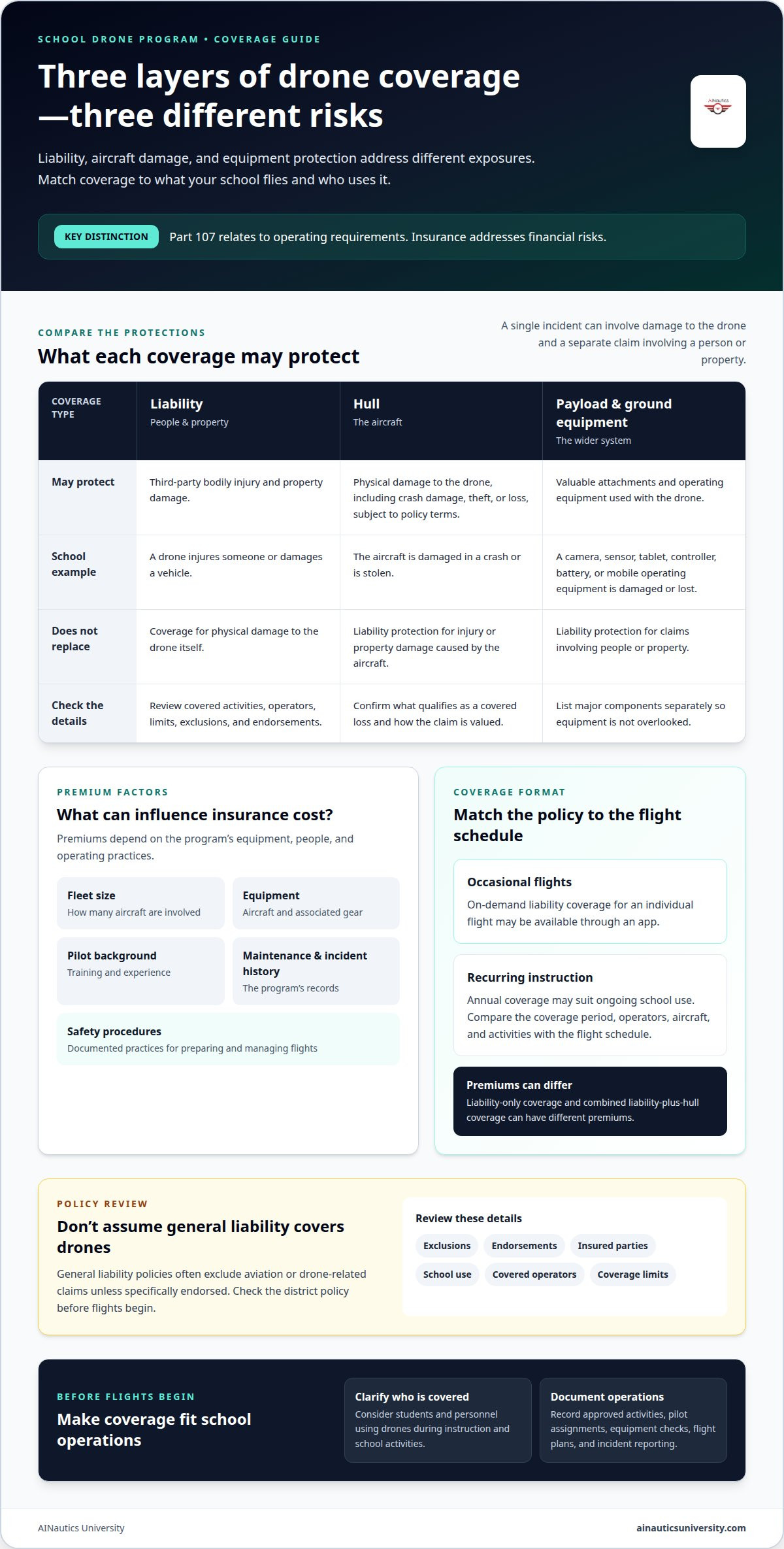
- Separate liability protection for injury or property damage from hull coverage for the drone, and consider whether operating equipment and payloads need protection too.
- Understand how fleet size, equipment, pilot experience, maintenance history, and safety procedures can influence insurance premiums.
- Distinguish FAA Part 107 certification from insurance: certification relates to operating requirements, while insurance addresses financial risks.
- Clarify who may be covered during instruction and school activities, including students and personnel, as the school develops its drone-use guidelines.
Does my general liability policy cover drones?
Don’t assume a school’s general liability policy covers drone incidents. Drone operations may require separate liability protection, as well as coverage for the aircraft and equipment.
Liability coverage for drone operations
Commercial drone liability insurance can cover third-party bodily injury and property damage. For a school, that could mean a claim if a drone injures someone or damages a vehicle. General liability policies often exclude aviation or drone-related claims unless specifically endorsed. Review the district policy’s exclusions, endorsements, insured parties, and descriptions of school use.
School coverage should include students and personnel using drones on school property, whether or not a flight supports a school project. The Federal Aviation Administration says drone users in the United States must register drones weighing more than 0.55 pounds. It also says drones in the United States cannot exceed 55 pounds under the rules described. State and district requirements can differ: the FAA doesn’t require drone owners to insure their aircraft, while districts can set internal use procedures. Commercial operators should account for applicable local, state, and federal rules.
Reduce risk by documenting who may fly, which activities are approved, and how flights are prepared. Written procedures can record pilot assignments, equipment checks, flight plans, and incident reporting. These records clarify how the school manages operations and promote consistent practices.
Physical damage to drones and payloads
Hull coverage can protect a drone and its equipment against crash damage, theft, or loss. It covers physical damage to the aircraft, not claims that the aircraft causes injury or property damage. That distinction matters when a school needs to consider damage to the drone and a separate third-party claim arising from the same incident.
Payload insurance can cover valuable attachments such as LiDAR sensors, thermal cameras, or proprietary technology. Ground equipment coverage can include tablets, controllers, batteries, and mobile equipment used to operate drones. If instruction relies on a sensor and a separate controller, the school may need to consider coverage for both.
Coverage limits and client requirements
Coverage limits set the maximum amount an insurer may pay for a covered claim. Many commercial drone operators carry at least $1 million in liability coverage, and some on-demand policies offer that amount. Some policies also include medical payments sub-limits commonly ranging from $5,000 to $25,000.
Commercial clients may require a certificate of insurance before a flight and may request additional-insured status. A school hosting a flight or working with an outside operator should identify these requirements before operations begin. Confirm that the policy’s covered activities, operators, and limits match the planned school use.
Insurance costs and on-demand coverage
Premiums depend on fleet size, equipment, pilot training and experience, maintenance and incident history, and safety procedures. Liability-only coverage and combined liability-plus-hull coverage can have different premiums.
On-demand liability coverage for an individual flight may be available through an app. This option may suit occasional flights, while recurring instruction may call for annual coverage. Compare the coverage period, operators, aircraft, and activities with the school’s flight schedule.
Hull insurance for drones and equipment
Hull coverage addresses physical loss or damage to a drone, not liability for harm to other people or property. For a school, this distinction separates an aircraft repair or replacement issue from a third-party claim. Coverage may apply to crash damage, theft, or loss, while the policy terms determine what qualifies and how a claim is valued.
Match coverage to the full drone system
A school drone may be only one part of the equipment exposed to loss. Controllers, batteries, tablets, and mobile operating equipment can also affect a program’s budget. Ground equipment coverage can insure these items, while payload coverage can protect attachments such as thermal cameras, LiDAR sensors, or proprietary technology.
Consider a classroom using a drone with a specialized camera. Damage to the aircraft and damage to the camera are separate parts of a loss. Identify each item and its role when reviewing coverage. A written inventory helps distinguish the airframe, payload, controller, batteries, and other equipment instead of treating the entire setup as one device.
Understand insured value and theft terms
That range shows why a school should account for the complete system, not just the aircraft. A policy’s payout may not equal the full purchase price, particularly after theft. Coverage terms define how the insurer values a covered loss.
Create an equipment record with purchase documentation, model details, and a separate value for major components. For example, list the drone, camera, and controller as distinct items. This gives the school a clearer basis for discussing coverage and identifying equipment that could otherwise be overlooked. Keep the inventory current with the equipment used in lessons.
Connect protection with flight preparation
Hull insurance addresses financial exposure after damage; it doesn’t prevent incidents or replace safe operating procedures. A school can pair its equipment inventory with procedures for assigning aircraft, preparing flights, and recording damage. This helps staff identify which equipment was involved if a drone returns with a damaged frame or missing payload.
For student pilots, flight practice resources can build familiarity with drone controls before school equipment is used. The same preparation supports careful handling of aircraft, cameras, and batteries during instruction. Revisit the equipment list when a school adds a payload or changes its drone system, so the record reflects what the program actually operates.
Drone insurance premiums
Drone insurance premiums vary with the aircraft, coverage selected, and the school’s operating profile. For budgeting, separate liability protection from hull coverage and compare annual policies with per-flight options.
How premium ranges differ
These ranges describe different coverage arrangements, so they shouldn’t be treated as interchangeable quotes.
Fleet policies use a different pricing structure. A school operating several aircraft may assess fleet coverage differently from a program insuring one drone. Count the aircraft and identify whether the policy covers individual drones or a fleet before comparing figures.
What can change the premium
Insurers consider fleet size, equipment, pilot training and experience, maintenance and incident history, and safety procedures. A drone with costly sensors presents a different equipment profile from a basic training aircraft. Schools should also distinguish routine instruction from specialized flights, since the work and equipment affect the exposure being insured.
Prepare a current inventory and operating summary for the insurance discussion. Include the number of drones, major payloads, who operates them, and how the school maintains its equipment. Record incident history and describe safety procedures clearly. These details connect the premium assessment to the program’s actual operations rather than a generic description of school use.
Annual coverage or per-flight protection
On-demand drone liability insurance for an individual flight may be available through an app. This format can suit occasional flights, while a recurring school program may need protection across its schedule. Compare flight frequency with the cost structure of annual coverage.
For example, a class flying on isolated occasions can consider the per-flight model alongside annual options. A program with regular lessons should account for repeated flights, equipment, and participating operators. Don’t compare only the headline premium. Match the coverage period, liability limit, covered activities, and insured equipment to the school’s planned use.
Build a useful school budget
Use the listed ranges as planning context, not as a guaranteed school quote. A precise premium depends on the school’s fleet, equipment, experience, maintenance record, incident history, and safety practices. Include both the aircraft and operating equipment in the budget discussion, then distinguish liability costs from physical-damage protection.
Review the estimate when the program changes. Adding a drone, fitting a new payload, or expanding flight activity can change the insured operation. A written record of the fleet and planned use gives the school a practical basis for comparing coverage structures and explaining how its chosen policy fits the educational program.
FAA Part 107 certification and insurance
Part 107 certification and drone insurance serve different purposes. Part 107 relates to commercial drone operation, while insurance addresses financial risks such as injury, property damage, or aircraft loss. The Federal Aviation Administration says commercial drone pilots in the United States must be at least 16 years old. That age requirement doesn’t make insurance automatic or determine what a policy covers.
Certification is not insurance
The FAA doesn’t require business or recreational drone owners in the United States to insure their drones. However, most commercial drone insurance policies require operators to hold valid FAA Part 107 certification. For a school, that means certification may affect eligibility for a policy, even though the federal insurance requirement itself doesn’t exist.
Keep the two decisions distinct: determine which operating rules apply, then assess the policy’s requirements. A certificate doesn’t replace liability coverage, and insurance doesn’t grant permission to fly. If a school flight is connected to commercial activity, the operator’s certification status may matter to both flight planning and the insurer’s terms.
Match pilot roles to policy terms
Schools should identify who will operate each aircraft, including teachers and students, and how instruction will be supervised. A policy’s operator requirements matter because a certified teacher and a student learning to use the controls may have different roles in one activity. Review whether the insured operation and covered operators match the school’s actual training model.
Recreational flyers must take the Recreational UAS Safety Test (TRUST), according to the stated guidance. This requirement doesn’t automatically apply to every educational program operating without Part 107 certification. Define the planned operation before assigning pilots or arranging coverage, and don’t treat a school setting alone as proof that every flight follows the same certification path.
Build training into the insurance plan
For each school activity, document the pilot in command, participating students, aircraft, and flight purpose. Then compare those details with the policy’s language on operators and activities. For example, an instructor-led practice session and a drone flight supporting an outside commercial project may involve different operating contexts.
Training supports consistent procedures, but it doesn’t replace the insurer’s stated conditions. A school can align preparation with the relevant certification pathway, record who completed required training, and maintain clear flight assignments. The FAA began regulating public airspace through Part 107 in the summer of 2016, making the distinction between operating rules and insurance a practical part of program planning.
Who is legally liable for drone accidents during school activities?
Responsibility after a school drone accident depends on who was involved, their roles, and what happened. The pilot, instructor, or school may face a claim, but the incident’s facts matter. For example, a collision during a teacher-led lesson raises different questions from damage during an independently managed flight.
Separate legal responsibility from insurance coverage. Educator liability insurance can protect instructors, organizations, and students from accidents during instruction, preparation, or organized events. That protection concerns covered claims; it doesn’t by itself establish who was legally responsible. Before flights begin, identify the people and activities covered by the school’s policy.
Understand the roles around each flight
Record who operated the controls, who supervised, and who organized the activity. A student may handle the controls while an instructor directs the lesson; the school may own the aircraft and set the activity’s boundaries. These roles help explain how an incident unfolded and which coverage could apply.
Consider a drone that strikes school property during a supervised practice session. The incident record should identify the operator, instructor, aircraft, location, activity, and sequence of events. For an organized event, record whether the flight was part of instruction or another school activity. Clear details help distinguish the roles of the pilot, educator, and organization.
Document decisions and incidents
Written school procedures give staff a shared reference for drone activities. Include who can authorize a flight, how pilot and supervisor roles are assigned, and how incidents are reported. Keep training records and flight plans with the incident report. These records help the school review its decisions and communicate what happened.
After an accident, preserve relevant records, including the flight plan, equipment details, participant roles, and witness accounts. Note whether the activity involved instruction, preparation, or an organized event, since those contexts relate to educator liability coverage. Avoid assumptions about fault in the initial record. A factual timeline gives the school and insurer a clearer account to assess.
Practice can help students learn controls before operating school equipment. A drone simulator gives learners a setting to build familiarity with flight controls. Pair that practice with clearly assigned supervision and documented school procedures. This supports a more deliberate learning environment while keeping responsibility, coverage, and flight roles distinct.
AINautics University: Drone Simulator
AINautics University helps students and educators build drone knowledge through its Drone Simulator and training programs. Use the simulator as an educational resource when learners need to develop familiarity with drone operation before applying classroom procedures in practice.
For educators shaping a school program, the Train-the-Teacher Program supports curriculum integration, while Part 107 Training connects learners with commercial certification preparation. The VR Trailer Mobile Lab adds another educational resource for introducing UAS concepts. These options complement, rather than replace, a school’s decisions about insurance, supervision, and operating procedures.
Choose the resource that fits your next learning goal, whether that’s preparing educators, building student skills, or exploring certification.
Build a School Drone Program With Confidence
Use what you’ve learned to shape a drone program around your school’s goals. A thoughtful approach to liability and insurance for school drones starts with clear roles, relevant training, and preparation that grows alongside students’ skills. Make coverage and safety planning part of program design, not an afterthought.
Education can help turn that plan into practical learning. AINautics University offers Part 107 Training for certification preparation, a Train-the-Teacher Program for educators developing classroom instruction, and a VR Trailer Mobile Lab for UAS learning experiences. Each can support a different stage of building knowledge and capability among students and teachers.
Choose the next learning step that fits your school, then keep developing a program where students can explore UAS with purpose. Reviewing AINautics University’s educational options may help you identify resources that fit your school’s needs. With informed planning and continued learning, your school can help students take confident steps toward future opportunities in drones.
Frequently Asked Questions
What Is Drone Insurance?
Drone insurance can protect against different financial losses associated with operating or owning an aircraft. Liability coverage addresses claims involving injury or damage to someone else’s property. Hull coverage addresses physical loss or damage to the drone, while payload or ground equipment coverage can protect other parts of the system. Consider which exposures matter for each school activity rather than assuming one policy type covers every loss.
How much coverage should I purchase?
Choose limits based on the school’s activities, equipment value, and any coverage terms set by a host organization. Many commercial drone operators carry at least $1 million in liability coverage, but that figure isn’t a universal school requirement. A district should also consider whether a client or event host requires a certificate of insurance or additional-insured status. Include those conditions in planning before scheduling a flight.
What are the risks of a commercial drone operation?
Commercial operations can expose a school to third-party injury or property-damage claims, as well as damage to the aircraft, payload, or ground equipment. For example, a collision involving a camera-equipped drone could lead to a separate privacy complaint. Some policies include personal injury protection for claims such as invasion of privacy. Cyber or privacy coverage may address data breaches and unauthorized-surveillance claims.
What FAA rules apply to drones used by U.S. schools?
The Federal Aviation Administration requires U.S. drone users to register drones weighing more than 0.55 pounds; the rules described also set a 55-pound maximum. Which operating rules apply depends on the flight’s purpose. A school planning a flight should classify its operation and identify the applicable pilot and aircraft requirements before launch. District procedures can add operational expectations for school activities.
Does school general liability insurance cover drone-related injuries or property damage?
Not automatically. General liability policies commonly exclude aviation or drone-related claims unless specifically endorsed. Review the policy for drone-use exclusions, endorsements, covered activities, and insured people. For example, coverage written for school premises may not address a student operating a drone at an off-site event. Check how the policy treats both injury claims and third-party property damage.
How much does drone liability insurance cost for a school?
These are market figures, not a school-specific quote. Fleet size, equipment, pilot experience, maintenance and incident history, and safety procedures affect premiums. Compare annual protection with per-flight coverage based on the school’s actual schedule.
What coverage limits should a school choose for drone insurance?
Set limits by considering the possible scale of third-party injury or property damage, along with host requirements. Many commercial operators carry at least $1 million in liability coverage, and some event or commercial clients request proof of insurance or additional-insured status. Some policies also have medical-payments sub-limits of $5,000 to $25,000. Review these separate limits, not only the headline liability amount.
What FAA registration, Remote ID, and pilot certification requirements apply to school drones?
The Federal Aviation Administration registration threshold is drones weighing more than 0.55 pounds; the rules described also cap drone weight at 55 pounds. Commercial pilots must be at least 16 years old and hold a remote pilot airman certificate. Remote ID is a separate consideration: registration or pilot certification alone doesn’t establish that an aircraft meets Remote ID requirements. Educational programs without Part 107 certification must take TRUST.

Article by
AINautics University Team
The team behind AINautics University, dedicated to drone education and FAA Part 107 certification prep, VR flight simulation, and STEM training programs for students and educators.


