
A drone program is more likely to earn principal approval when its purpose, costs, safeguards, and operating plan are clear. To get principal approval for a drone program, connect specific learning goals with a realistic budget, community input, and procedures for responsible use. Bring these elements together before requesting a decision.
Expect questions about student learning, staff readiness, safety, and how the program supports school priorities. Addressing these concerns directly makes the proposal easier to assess and gives the principal a clear basis for deciding whether to move forward.
This guide shows you how to build that case step by step. Define measurable goals, estimate costs, identify potential funding sources, involve families and educators, and draft practical procedures for training and drone use. The result is a focused plan that explains what the program will do, what it needs, and how the school can manage it responsibly.
Key Takeaways
- Build a budget around the program’s learning goals, training needs, equipment, and ongoing operating requirements.
- Invite families, educators, and school leaders into the planning process, and address privacy concerns with clear policies.
- Define what students will learn and how drone activities will fit the school’s curriculum and operational needs.
- Set practical procedures for training, flight approval, safety, and responsible drone use before launch.
- Explore educator training and hands-on learning tools to help prepare staff and students for the program.
Assess program costs, budget, and funding sources
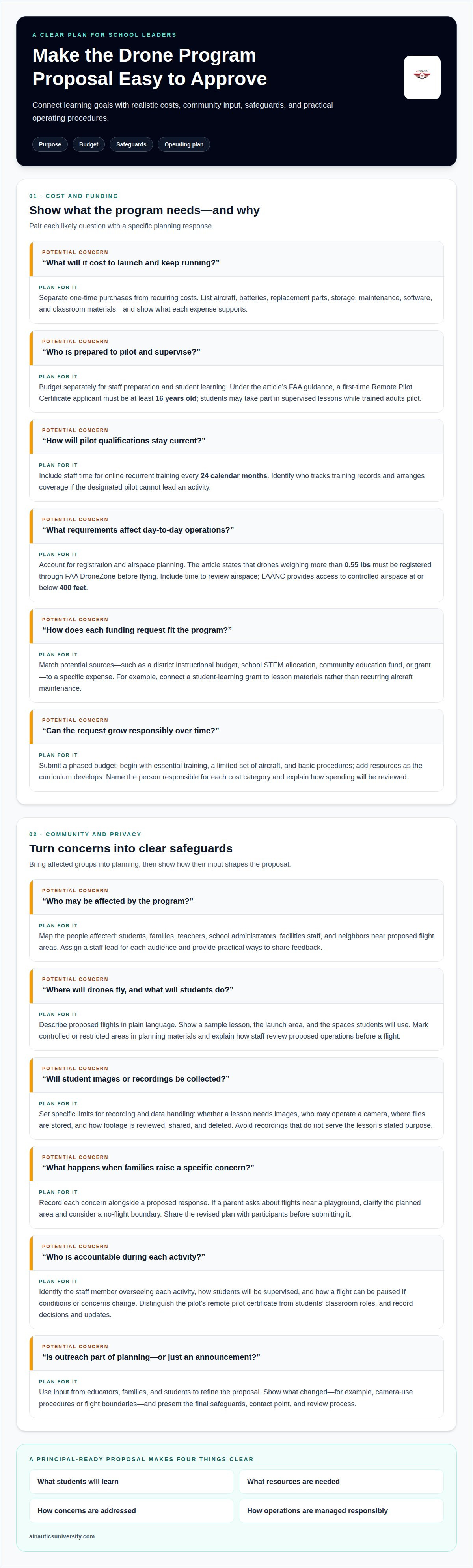
- Start with a written budget covering the program from planning through routine operations. Separate one-time purchases from recurring costs so the principal can see what launch requires and what ongoing operation involves. Include aircraft, batteries, replacement parts, storage, maintenance, software, and classroom materials. A mapping unit, for example, may need different materials from a flight-planning unit. To get principal approval for a drone program, show what each expense supports.
- Build a training line into the budget before assigning pilots. The Federal Aviation Administration requires a Remote Pilot Certificate to fly under the Small UAS Rule, Part 107. A first-time applicant for an FAA Remote Pilot Certificate must be at least 16 years old, according to the Federal Aviation Administration. Plan separately for staff preparation and student learning. The school may need trained adult pilots even when students participate in supervised lessons.
- Account for maintaining pilot qualifications, not just initial preparation. FAA Remote Pilot Certificate holders must complete online recurrent training every 24 calendar months to maintain aeronautical knowledge recency, according to the Federal Aviation Administration. Include staff time for that training in recurring costs. Identify who will monitor training records and arrange coverage if the designated drone pilot cannot lead a planned class or school event.
- List aircraft registration and airspace planning as operational requirements. A drone weighing more than 0.55 lbs must be registered through the FAA Drone Zone before flying, according to the Federal Aviation Administration. Include staff time for registration and recordkeeping. For flights near controlled airspace, LAANC provides drone pilots access to controlled airspace at or below 400 feet, according to the Federal Aviation Administration. Budget time for reviewing airspace before scheduling operations.
- Match each funding request to a specific program expense. Consider whether a district instructional budget, school STEM allocation, community education fund, or grant could support training, equipment, or curriculum materials. Tie each funding source to its intended use. For instance, a grant focused on student learning may fit lesson materials better than recurring aircraft maintenance. This distinction helps administrators assess the request and its sustainability.
- Submit a phased budget with the approval request. The first phase might cover essential training, a limited set of aircraft, and basic procedures; later phases can add resources as the curriculum develops. Name the person responsible for each cost category and explain how spending will be reviewed. This staged request shows how to get principal approval for a drone program by connecting resources to immediate priorities and a clear path for growth.
Conduct community outreach and address privacy concerns
- Map the people affected before presenting the program. Include students, families, teachers, school administrators, facilities staff, and neighbors near proposed flight areas. Assign a staff lead for each audience and choose practical ways to hear from them, such as a family meeting, staff discussion, or written feedback form. This early planning helps identify concerns before the school sets its operating procedures.
- Describe planned flights in plain language. Show a sample lesson, the aircraft’s proposed launch area, and the spaces students will use. Mark controlled or restricted areas in the school’s planning materials, and explain how staff will review proposed operations before a flight. Families can assess a concrete plan more easily than a general promise to use drones responsibly.
- Address privacy by setting specific limits on recording and data handling. Explain whether a classroom activity needs images, who may operate a camera, and where captured files would be stored. Establish a process for reviewing, sharing, and deleting student-related footage. Avoid collecting images or recordings that do not serve the lesson’s stated purpose.
- Make feedback easy to give and useful to act on. Ask families which settings or activities concern them, then record each concern alongside a proposed response. If a parent asks whether a drone will fly near a playground, clarify the planned area and consider adding a no-flight boundary to the draft procedure. Share the revised plan with participants before submitting it for approval.
- Explain who is responsible for safe, accountable operations. Identify the staff member overseeing each activity, how students will be supervised, and how the school will pause a flight if conditions or concerns change. Distinguish a pilot’s remote pilot certificate from students’ classroom roles. Explain how the administration will record questions, decisions, and updates to the program plan.
- Use outreach to refine the proposal, not merely announce it. Gather input from educators, families, and students, then show what changed in response. If community members raise concerns about recording, revise the camera-use procedure; if they question flight locations, clarify the proposed boundaries. Present the final plan with its safeguards, contact point, and review process so the principal can assess a clearly defined program.
When discussing privacy and operating limits, keep the focus on the school’s proposed activities and procedures. Record questions and explain which parts of the school’s plan they concern, including camera use, flight locations, supervision, and operational review. This helps families and staff understand how the school will address concerns and assess the proposed program.
Keep community discussions focused on the boundaries the school proposes and how it will respond to concerns. Outreach can reveal uncertainties as well as preferences; a general assurance about responsible use does not resolve questions about authority or privacy. Invite participants to raise concerns about the plan’s wording, then document any clarification or change alongside the relevant procedure. This gives families and staff a concrete basis for assessing the proposal before approval and keeps expectations aligned with the program’s safeguards.
Define mission objectives and operational needs
- Write the learning purpose before choosing aircraft or flight activities. A mapping lesson, for example, could ask students to interpret aerial images and explain land-use patterns. A design unit might focus on how an unmanned aircraft responds to controls. State the skill, student task, and evidence of learning. This keeps the proposed program tied to instruction rather than technology alone.
- Turn each purpose into an observable outcome. Specify what students will produce, such as a labeled map, flight log, or short analysis of image data. Identify the class or curriculum area responsible for the activity. A geography lesson may use mapping, while a physics lesson may examine lift and motion. Clear outcomes help the principal assess educational value.
- Describe the operating model for each lesson. State whether students will observe, plan a route, use a simulator, or handle flight controls under supervision. Name the staff member responsible for the aircraft and the person leading instruction. For a flight demonstration, specify the launch area, audience location, and how the class will pause if the activity changes.
- Map each proposed site and its airspace considerations. Record the school grounds, nearby buildings, public areas, and intended flight boundaries. Identify whether the planned airspace may require authorization before an operation. Treat that approval as a planning dependency, not an assumption. These details show the administration how aviation requirements shape the lesson plan.
- Match operational needs to the mission instead of choosing equipment first. A classroom focused on route planning may need maps, lesson materials, and a simulator. A supervised outdoor exercise also needs a suitable aircraft, a trained remote pilot, and a defined site. Explain how each resource supports the stated purpose, then remove items without a clear instructional role.
- Set practical limits for the initial operating plan. Define which classes may participate, where activities can occur, and who can approve a proposed flight. For example, the school could begin with indoor planning lessons before considering outdoor operations. State how staff will record each activity and review whether it met its learning objective.
- Connect the plan to federal aviation considerations without making broad promises. List the intended operation, location, aircraft role, and responsible pilot for each activity. Identify questions about airspace, authorization, or operating restrictions that must be resolved before scheduling. Presenting these details alongside the educational purpose gives the principal a specific, reviewable plan for the drone program.
Write internal policies and deployment procedures
Permissions for flying near a school depend on the location and proposed operation. Set school or district approval procedures, then resolve any applicable airspace authorization, exceptions, exemptions, or waivers before flight.
-
Draft Internal Drone Policies
Write a policy identifying who may operate an unmanned aircraft, who supervises students, and which activities require prior approval. Make it specific to school operations, not merely a summary of aviation regulations. San Bernardino City Unified School District requires Environmental Compliance & Safety Office approval before pilots follow FAA regulations and any additional district flight precautions and restrictions.
- Name the staff member responsible for approving each planned activity, maintaining records, and communicating decisions to school administration. Explain how a teacher submits a proposed flight, including its purpose, location, participants, aircraft, and operating plan. A consistent application process gives reviewers the details they need to assess each activity.
- Set boundaries for student participation, supervision, and equipment access. For example, specify whether students may plan a route, observe a demonstration, or handle controls under direct staff supervision. Explain how staff will pause an activity if the planned location, conditions, or supervision changes.
- Include a process for recording pilot credentials and each operation. A remote pilot certificate must be easily accessible to the remote pilot during all UAS operations. State who maintains program records and how staff document approvals, flight details, and incidents.
-
Define Deployment Procedures and Needed Permissions
Create a deployment process that begins with the proposed site and operation. Use the FAA’s DroneZone portal to submit an airspace authorization request when a planned flight is in controlled airspace; the FAA reviews the request to determine whether the operation can be authorized and what conditions apply. Do not treat school approval alone as authorization for every flight.
- Require the responsible staff member to identify the proposed location, purpose, aircraft, pilot, and airspace considerations before scheduling. These details help reviewers determine which permissions apply. Keep local school or district approval separate from any federal aviation authorization that may be needed.
- Set a clear decision point before equipment leaves storage: staff must have the required school approval and any applicable operating authorization. If a proposed operation needs a waiver or other permission, record its status and conditions in the deployment plan. Do not treat a submitted application as approval to fly.
- Give staff a simple preflight release process. Confirm that the approved location and activity match the plan, the assigned pilot is present, and school restrictions are being followed. If a key detail changes, pause deployment and route the revised plan through the same approval process.
What are the benefits of drones in K-12 education?
- Connect drone activities to a learning objective students can demonstrate. In a geography lesson, students might study an aerial image, identify visible land features, and explain their observations. This makes a drone a tool for inquiry rather than a standalone attraction. Ask teachers to identify the subject, task, and student work that will show what the lesson achieved.
- Use flight planning to make math concepts tangible. Students can sketch a route on a classroom map, estimate distances using its scale, and compare planned paths. Teachers can discuss measurement, spatial reasoning, and how small planning changes affect a route. A clear worksheet or annotated map gives students a concrete product to explain and educators evidence of learning.
- Bring physics vocabulary into an applied activity. Students can describe how a drone changes direction, discuss forces affecting motion, and record observations from a supervised demonstration. The teacher can ask learners to predict what will happen before a control input, then compare their prediction with what they observe. This sequence connects abstract terms to a visible example without requiring every student to pilot.
- Build collaboration through defined classroom roles. During a mapping exercise, one student can track the route, another record observations, and a third organize the resulting information. Rotate roles in later lessons so students practice communicating and taking responsibility. A shared task also gives quieter learners meaningful ways to contribute without operating the aircraft.
- Introduce students to aviation and technology career pathways through real classroom tasks. Ask learners to identify the planning, communication, and technical skills used during a drone activity. Then connect those skills to fields such as mapping, engineering, environmental study, or aviation. Keep the discussion exploratory: students can investigate how a skill applies across careers without treating a lesson as career certification.
- Use reflection to make learning visible after each activity. Have students compare their planned route with the demonstration, explain a difference, and suggest an improvement. In a data-focused lesson, learners might organize observations into a table and present a conclusion. These outputs help teachers assess reasoning and communication, not just whether students enjoyed seeing a drone fly.
- Start with a lesson that fits existing classroom goals and available supervision. A teacher might begin with route planning, image interpretation, or a simulated flight before proposing outdoor aircraft use. Choose the format that supports the objective and gives students a clear task. To explore practical classroom drone learning, review learning options for educators.
AINautics University: Train-the-Teacher Program
AINautics University’s Train-the-Teacher Program can help educators bring drone learning into their curriculum. Turn to it when your teaching team needs support connecting UAS concepts with classroom instruction. A Drone Simulator supports practice and lesson planning, while Part 107 Training and Self-Paced Certification options help educators build remote pilot knowledge. The VR Trailer Mobile Lab offers hands-on drone education for students, and the UAS Student Scholars program is another resource for students to explore.
Choose the support that fits your school’s next step, whether that’s teacher preparation, pilot knowledge, or student engagement. Contact AINautics University to discuss your drone education goals.
Move from approval to classroom readiness
Principal approval is a starting point, not a finished program. Turn the decision into a practical next phase by choosing who will lead instruction, how educators will build their knowledge, and what students should experience first. That is where a well-structured plan becomes meaningful learning.
Knowing how to get principal approval for a drone program also means preparing for the work that follows the decision. AINautics University’s Train-the-Teacher Program supports educators planning to integrate UAS into their curriculum. Part 107 Training can support teachers preparing for remote pilot certification, while the VR Trailer Mobile Lab offers another way to bring drone learning into an educational setting. Select the resource that aligns with your school’s goals and educator needs.
Start a conversation about your school’s next steps and the learning approach you want to develop. Contact AINautics University to explore how its educational programs may fit your plans. With focused preparation and a clear purpose, you can help students take their first steps toward understanding the possibilities of drone technology.
Frequently Asked Questions
What information should a school drone program proposal include?
Give the principal a concise decision brief stating what approval is requested and who will lead the program. Attach a sample lesson, draft schedule, and method for reviewing student work. Explain how educators will gather feedback after initial classroom use and how that feedback could shape future lessons. This makes the proposal useful for both the immediate decision and later program planning.
How do I get a principal to approve a new school program?
Connect the request to a recognized school priority, such as applied STEM learning or career exploration. Bring a focused proposal to a decision meeting and be ready to explain exactly what the principal is being asked to approve. A small, clearly defined first activity can be easier to assess than a broad commitment to a full program from the outset.
What school and district policies apply to student drone use?
Policies vary by district, so review the rules governing student activities, technology, and campus use. Pay particular attention to student supervision, recording and handling images, equipment storage, and incident reporting. For example, a school may need to align a drone lesson with existing rules for student media or classroom devices. Record relevant policy decisions in the program materials for staff.
What FAA rules apply to drones used at school in the United States?
Applicable FAA rules depend on the planned operation, not simply on whether it takes place at school. Before scheduling a flight, describe its purpose, setting, aircraft, and operator role, then identify the federal aviation requirements relevant to those details. Keep this assessment with the activity plan and revisit it whenever the proposed operation changes. This helps distinguish school approval from federal aviation compliance.

Article by
AINautics University Team
The team behind AINautics University, dedicated to drone education and FAA Part 107 certification prep, VR flight simulation, and STEM training programs for students and educators.


