
Yes, you can complete Part 107 recurrent training online. The FAA requires remote pilot certificate holders to complete it every 24 calendar months to maintain aeronautical knowledge recency. For continuing education for commercial drone pilots, this means staying current is an online training step, not a return to the initial knowledge test.
Renewal is only part of staying ready to fly. Keep your knowledge current and build skills for the work you want to do. A focused learning plan can support initial exam preparation, help maintain recency, and build confidence with more advanced operations.
This guide explains how online recurrent training works, what Part 107 exam preparation involves, and how advanced-operation study and hands-on instruction can support your development. You’ll be able to distinguish the FAA’s currency requirement from broader professional learning and identify which kind of training fits your next step.
Key Takeaways
- According to the Federal Aviation Administration, remote pilot certificate holders must complete online recurrent training every 24 calendar months to maintain aeronautical knowledge recency.
- Separate initial Part 107 exam preparation from recurrent training so you can choose learning that fits your certification stage.
- Explore how advanced operations training can build on regulatory knowledge and prepare you for more specialized UAS work.
- Use hands-on instruction to develop practical skills alongside the knowledge needed to operate with confidence.
- Consider self-paced or educator-focused training to match your learning goals and teaching context.
FAA Part 107 exam preparation
Begin by identifying which route fits your aviation background. First-time applicants generally prepare for the Unmanned Aircraft General - Small (UAG) initial aeronautical knowledge test. The Part 107 exam covers the knowledge needed to act as a remote pilot, including airspace, weather, operating rules, and safe flight planning. Applicants for a U.S. remote pilot certificate must be at least 16 years old, according to the Federal Aviation Administration.
Part 107 certification requires more than learning drone controls. The FAA requires applicants to pass the applicable knowledge test, and applicants must obtain an FAA Tracking Number before registering. For the initial UAG test, schedule through the FAA’s Airman Certificate Testing Service process and take the exam at an FAA-Approved Knowledge Testing Center. The test contains 60 questions, so preparation should build accurate understanding, not just memorized answers.
Use a repeatable study process that connects each lesson to an operational decision:
- Review Part 107 rules and identify what each rule means during a flight.
- Study airspace charts, then practise deciding whether a planned location needs authorization.
- Work through weather examples and consider how conditions affect a flight plan.
- Take practice testing, record missed topics, and revisit the relevant lesson before another attempt.
A 20-hour study plan provides a concrete preparation benchmark. Divide that time among regulations, airspace, weather, and practice questions, then spend extra review time on recurring errors. For example, a learner who misses airspace questions should return to chart interpretation before taking another practice test. If you fail the official exam, wait two full weeks before retaking it. Use that interval to target weak subjects rather than repeat the same study routine.
Applicants using the Part 61 pathway have distinct requirements. They must hold a pilot certificate issued under 14 CFR part 61 and complete a flight review within the previous 24 months, according to the Federal Aviation Administration. The FAA offers the Part 107 Small Unmanned Aircraft Systems Initial course, ALC-451, to current Part 61 certificate holders. Don’t confuse that initial course with ALC-515, which is recurrent training for Part 107 remote pilots who are also certificated and current under Part 61.
After passing, complete the certificate application steps in IACRA and enter the 17-digit Knowledge Test Exam ID. Allow for the test result to take up to 48 hours from the test date to appear there. This final sequence connects exam testing to the remote pilot certificate. Keep the applicable rules, study records, and application details organized as you prepare to operate under Part 107.
Can I renew my Part 107 online?
Yes. The Federal Aviation Administration requires remote pilot certificate holders to complete online recurrent training every 24 calendar months to maintain aeronautical knowledge recency.
Recurrent Training and Certificate Maintenance
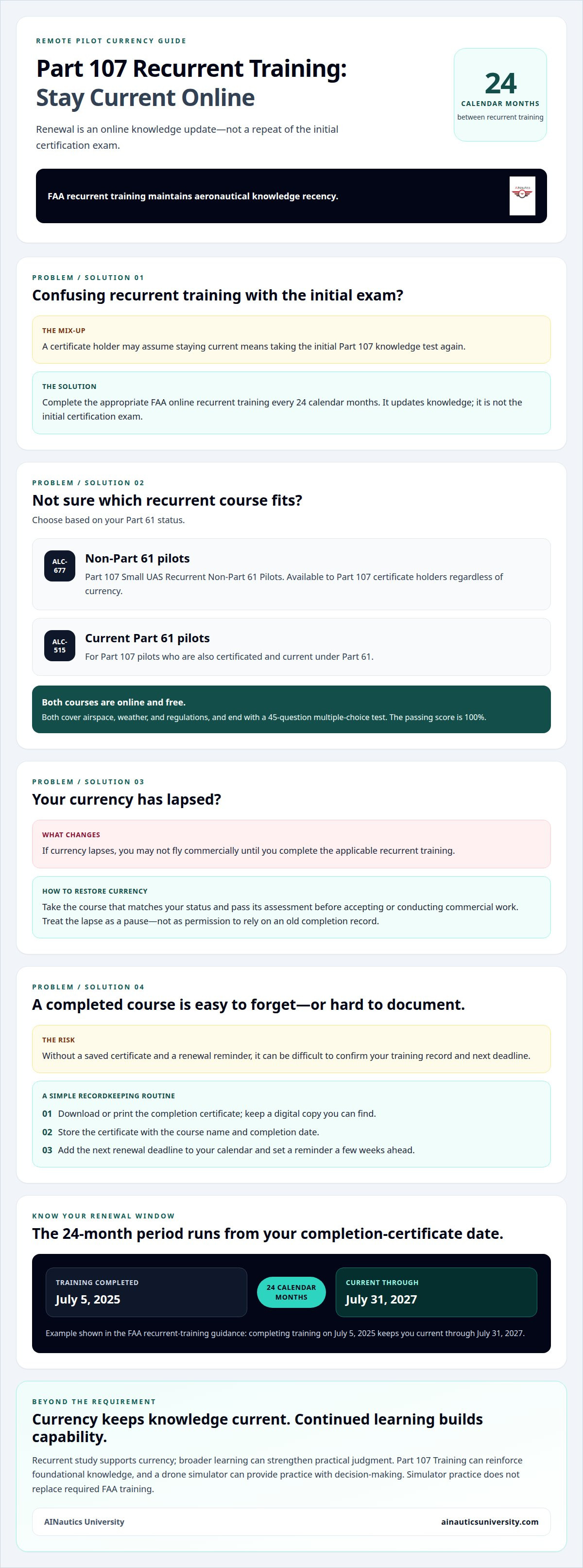
FAA recurrent training updates your knowledge; it isn’t the same as taking the initial certification exam again. Most Part 107 pilots use the Part 107 Small UAS Recurrent Non-Part 61 Pilots course, ALC-677. Current Part 61 pilots may use ALC-515. The online training is free, and completing the appropriate course gives you a completion certificate to document your training.
Use the course that matches your certificate and aviation status. ALC-677 is available to Part 107 certificate holders regardless of currency. ALC-515 is for Part 107 pilots who are also certificated and current under Part 61. Both courses cover knowledge relevant to operating an aircraft, including airspace, weather, and regulations. The course ends with a 45-question multiple-choice test, and the passing score is 100%.
After completing recurrent training, save the completion certificate. Download or print it, then store a digital copy where you can find it before planning a flight. Add the completion date and the next renewal deadline to your calendar. FAA recurrent training remains valid for 24 calendar months from the completion-certificate date. For example, completing the training on July 5, 2025, keeps you current through July 31, 2027.
Lapsed Certificate Currency
If your currency lapses, you may not fly commercially until you complete the applicable recurrent training. Take the relevant online course and pass its assessment before accepting or conducting commercial work. Treat a lapse as a pause in flying privileges, not a reason to rely on an old completion record. Keep your certificate date on file so you can distinguish completed training from current aeronautical knowledge.
Build a simple recordkeeping routine for each renewal. Store the completion certificate, course name, and date together. Set a calendar reminder a few weeks before your next renewal date, then schedule time to finish the training before the deadline. This gives you time to complete the course and save the certificate before a planned operation.
Online recurrent study handles currency; broader continuing education can deepen practical judgment. Part 107 lessons can reinforce how airspace and weather affect flight planning, while a drone simulator lets learners practise decision-making without treating practice as a substitute for required FAA training. For students who want structured preparation alongside recurrent learning, explore Part 107 training as a way to strengthen foundational knowledge.
Advanced UAS industry applications and operations
Advanced work starts with matching the mission to the applicable operating rules. In the United States, FAA Part 107 governs commercial drone operations, so pilots should connect each job’s location, purpose, and operating conditions to its requirements.
Commercial drone work can include aerial imaging, site observation, and inspections. Define the mission objective before launch. For a roof inspection, for example, plan the area to inspect, the images you need, and how the pilot will respond if conditions change. Put those decisions in a written workflow, then review the relevant regulations before flight. This makes training useful beyond exam preparation: you practise applying rules to a specific task rather than memorizing isolated terms. For pilots applying their flight skills within the building trades, pairing aviation credentials with trade qualifications—such as preparing for contractor licensing exams through Casaflex—can expand commercial opportunities on project sites.
Operations over people illustrate why advanced study matters. The FAA’s Operations Over People rule became effective on April 21, 2021. A pilot planning this kind of work should study the rule’s applicable conditions and determine whether the proposed aircraft and operation meet them. Don’t treat a video or a past mission as proof that a new flight is covered. Revisit the details when the location, aircraft, or operation changes, and document the basis for the flight plan.
Planning near an airport requires careful attention to airspace and nearby activity. Before a mission, identify the operating location, review relevant airspace information, and decide how the team will pause or adjust work if circumstances change. A crew working near an airport, for example, should include a clear stop-work process in its briefing. Discuss right of way as well: yield operational priority to crewed aircraft and do not continue a flight if a conflict develops. Reassess the situation, communicate with the team, and choose a safe response.
International and non-U.S. operators need a separate regulatory review for each country of operation. FAA Part 107 describes U.S. commercial operations; don’t assume its requirements transfer to another jurisdiction. Identify the local aviation authority, applicable pilot qualifications, airspace procedures, and operating limits before planning the mission. A U.S. certificate alone doesn’t explain the rules for a project abroad. Record the destination, local requirements, and operational approvals in the project plan.
Turn advanced learning into a repeatable preparation sequence:
- Define the mission, location, aircraft, and planned outcome.
- Identify the applicable regulations and airspace considerations.
- Review training lessons or videos, then connect each rule to a flight decision.
- Brief the crew on communication, right of way, and when to pause operations.
- Reassess the plan whenever the location or operating conditions change.
This process helps pilots build disciplined operational judgment on top of their initial knowledge. The goal is not simply to complete training, but to apply regulations consistently across different UAS missions.
FAA online recurrent training
The FAA’s online courses provide structured digital learning for refreshing aeronautical knowledge. Choose the course that matches your certificate pathway, work through its lessons, and complete the course assessment.
The recurrent courses became available online on April 8, 2021. Part 107 pilots use the course designed for their status: ALC-677 serves non-Part 61 pilots, while ALC-515 applies to eligible current Part 61 pilots. These are recurrent courses, not substitutes for the initial knowledge test required for first-time certification. Selecting the right course first helps keep your training record aligned with your pilot status.
Self-paced study works best as active review, not background material. Break lessons into focused sessions, connect each rule to an operational decision, and note topics to revisit. After a lesson on controlled airspace, for example, write down what information you would need before planning a flight near an airport. This simple exercise turns online learning into practical preparation.
Build a clear sequence for completing the FAA training:
- Confirm which recurrent course applies to your certificate pathway.
- Set aside study time and complete the course lessons in order.
- Review difficult aviation concepts before starting the course assessment.
- Finish the assessment, then save the completion record with your pilot documents.
Because the FAA course ends with a knowledge assessment, prepare by reviewing the material rather than relying on remembered answers. Revisit subjects that affect real operations, including airspace, weather, and remote-pilot responsibilities. Keep concise notes explaining each rule and the flight decision it informs, so you can practise applying what you have learned.
Online access can also bring practical interruptions. If technical difficulties prevent access to the FAA training, try again outside regular business days. Keep track of where you stopped, so a return session can resume with the next lesson instead of repeating completed material. Saving your progress notes separately also helps you maintain a focused learning plan if a browser session closes unexpectedly.
Use the course as a foundation for continuing education, not as the sole measure of operational readiness. FAA recurrent training refreshes aeronautical knowledge; mission-specific practice develops judgment for particular unmanned aircraft tasks. After the online course, choose a work scenario that challenges your understanding, such as interpreting airspace information or responding to changing weather. Review the relevant lesson, then explain your decision process in plain language. This makes recurrent learning easier to apply in future operations.
Instructor experience and hands-on flight training
An instructor can connect aeronautical concepts with decisions made during flight. Hands-on practice gives pilots a chance to rehearse planning, communication, and responses to changing conditions.
Choose instruction that ties each exercise to a clear operational goal. A practice flight might focus on a controlled takeoff, steady positioning, and a deliberate landing. The instructor can explain what to observe and give feedback on your decisions. This structure helps you identify specific skills to strengthen instead of treating flight time as an unstructured demonstration. Instructor-led practice makes continuing education for commercial drone pilots practical by turning feedback into skills you can apply.
Flight Operations and Emergency Procedures
Useful training covers the operation from preflight planning through landing and post-flight review. You might practise responding to a lost video feed or an unexpected obstacle, then discuss your response with the instructor. Focus on recognizing the issue, communicating with the team, and choosing a controlled next step. A debrief turns each exercise into a practical lesson.
Before flying, rehearse a short briefing: define the mission, review the site, identify people and obstacles, and agree on communication. During the exercise, the instructor can observe how you maintain awareness and follow the plan. After landing, discuss what changed and why. A drone simulator can help you rehearse decisions before a live flight, particularly when a scenario is difficult to repeat consistently.
An instructor’s experience is most useful when it leads to clear feedback. A good instructor explains why a maneuver needs adjustment, demonstrates the technique, and gives you another chance to apply it. If a pilot drifts while holding position, for example, feedback can focus on control inputs and visual references. Leave each session knowing which skill you practised and what to work on next. Guided practice keeps continuing education for commercial drone pilots connected to real operational decisions.
Local Classes and Workshops
Commercial drone pilots can pursue continuing-education classes and workshops through community schools and educator-led UAS programs. Look for clear learning goals, guided practice, and lessons connected to real flight operations.
Before choosing a workshop, compare its format with your learning need. A classroom session may suit regulatory discussion, while a simulator activity can focus on flight decisions. Ask what learners will practise and how instructors provide feedback. For educators building UAS lessons into a school program, a structured drone learning program can support classroom preparation alongside practical skill development.
After each class, record the exercise, instructor feedback, and one skill to practise next. After a site-assessment session, for example, note how you identified obstacles and adjusted the flight plan. This turns occasional workshops into a connected development path. Pair instructor feedback with simulator practice to revisit decisions before future operations.
AINautics University: Part 107 Training
AINautics University offers Part 107 Training for learners preparing for certification or strengthening their foundation in drone operations. Choose Self-Paced Certification when independent study fits your schedule, or explore the Train-the-Teacher Program if you’re an educator integrating UAS learning into your curriculum. The VR Trailer Mobile Lab can bring an immersive learning environment to educational settings.
These options suit different goals: individual exam preparation, educator development, or hands-on learning experiences. Consider them when you’re ready to build on FAA knowledge with structured instruction, or when your school wants to introduce students to UAS concepts. AINautics University can help connect your learning goals with an appropriate educational path.
To explore the training options or discuss your learning goals, visit ainauticsuniversity.com.
Build your next step into a learning plan
Your development can also shape opportunities for students and educators. If you’re building your own aviation skills, supporting a classroom program, or exploring drone education for learners, choose instruction that fits that purpose. AINautics University provides educational pathways to support those goals. Contact AINautics University to discuss a suitable next step for your learning or teaching plans. Keep building with curiosity and purpose, and let each new skill move you toward the work you want to do.
Frequently Asked Questions
How many hours does it take to study for the test?
A 20-hour study plan is the FAA exam-preparation benchmark cited in the guidance for this article. Use that time to identify weak areas, not simply reread every lesson. For example, track missed practice questions by subject, then dedicate later sessions to those gaps. Your prior aviation knowledge and familiarity with charts can affect how you use the study time. Focus on understanding why each answer fits.
How much time a week should I dedicate to class?
Set weekly study time by working backward from your planned test date and available schedule. Divide lessons into manageable sessions, leaving time to revisit difficult material rather than cramming. If chart interpretation takes longer than expected, devote more time to it in your next study block. A steady calendar routine also helps you balance certification preparation with school, work, and other responsibilities.
What happens if I let my renewal lapse?
If your Part 107 currency lapses, you may not fly commercially until completing recurrent training. Before accepting a job or launching an aircraft, finish the applicable FAA course and assessment, then save its completion certificate. For example, if you notice a lapse while preparing a project, pause commercial operations and complete the renewal steps first. Keep the certificate with your pilot records so you can document your completed training.
What continuing education is required for FAA Part 107 commercial drone pilots?
For maintaining aeronautical knowledge recency, the FAA requirement is online recurrent training every 24 calendar months. This is distinct from initial certification preparation, which applies to a first-time applicant. Beyond that FAA requirement, pilots may pursue additional learning to strengthen mission-specific skills. For example, a pilot moving into agricultural work may study procedures relevant to that work, while an educator may focus on teaching UAS concepts.
How often must commercial drone pilots renew their FAA Part 107 Remote Pilot Certificate?
Remote pilot certificate holders must complete recurrent training every 24 calendar months to maintain aeronautical knowledge recency. Keep your course completion certificate handy when planning your next renewal. Don’t rely only on an old exam result or a remembered renewal date. Keeping a copy of the certificate with your operating documents makes the completion date easier to locate.
What is the FAA recurrent training course for Part 107 pilots, and how do pilots complete it?
The FAA provides online recurrent courses for Part 107 pilots. ALC-677 serves Part 107 holders regardless of currency, while ALC-515 is for pilots who are also certificated and current under Part 61. Select the course that fits your status, complete its lessons, and pass the assessment. The course concludes with a 45-question multiple-choice test, and the required passing score is 100%.
What topics should commercial drone pilots study to stay current on FAA rules and safety?
Review airspace interpretation, weather decisions, right of way, and the operating rules relevant to your planned missions. Turn each topic into a scenario: decide how a change in visibility affects your plan, or how your crew should respond if a crewed aircraft appears nearby. Revisit procedures that apply to your aircraft and work setting. This connects FAA knowledge with decisions pilots make before and during flight.
Are there continuing education requirements for commercial drone pilots beyond FAA recurrent training?
The FAA recurrent-training requirement addresses aeronautical knowledge recency. Additional learning can help you prepare for specialized work, but it is not a substitute for that requirement. A company, school, or project may also set its own training expectations. An educator preparing a classroom activity, for example, may need to learn how to teach students, while a pilot entering a new field may benefit from focused operational practice.

Article by
AINautics University Team
The team behind AINautics University, dedicated to drone education and FAA Part 107 certification prep, VR flight simulation, and STEM training programs for students and educators.


