
LiDAR mapping specialists typically earn $90,000 to $120,000 annually, showing how technical expertise can shape earning potential. In the United States, Part 107 is the baseline certification for commercial drone operations.
A strong salary is appealing, but a job title alone won’t tell you what a drone pilot earns. Specialty, experience, employer, and work arrangement all affect pay. Freelance income also works differently from a staff salary.
Explore which industries hire drone pilots, how pay varies by specialty, and how FAA rules and employment models shape career options. You’ll get a clearer view of potential paths and the skills that can help you prepare for them.
Key Takeaways
- Compare drone roles by specialty and industry to spot where technical skills can strengthen earning potential.
- Assess salary offers by experience, location, responsibilities, and whether the role is staff or freelance.
- Account for FAA requirements: Part 107 remote pilots must take an online recurrent test every 24 months, according to the Federal Aviation Administration.
- Understand how freelance, staff, and business-owner income models differ before choosing a career path.
- Explore aerial media and event work alongside mapping, inspection, agriculture, and other active drone fields.
FAA certifications and operating rules
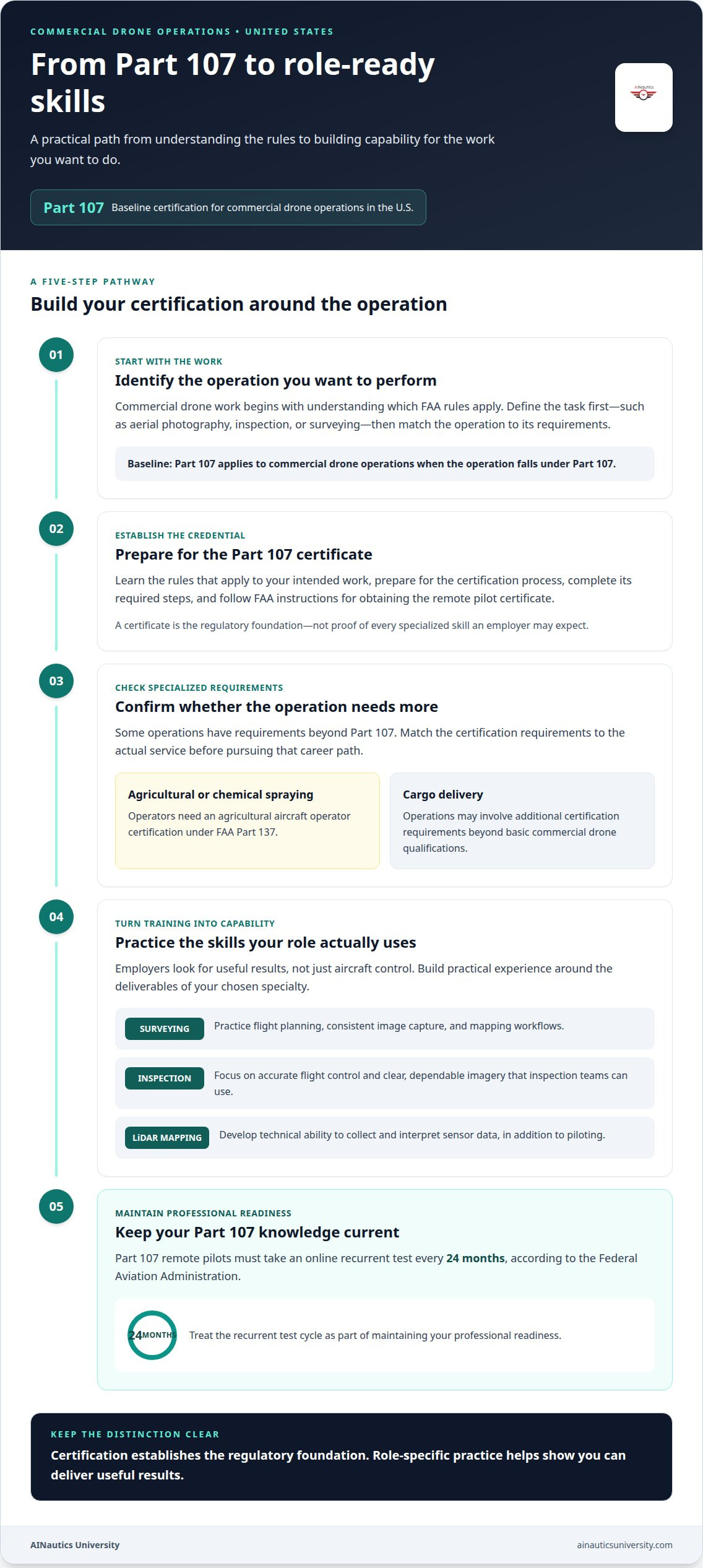
Commercial drone work in the United States starts with understanding which FAA rules apply to the operation. Part 107 certification is the baseline for commercial drone operations.
Certifications and Specialized Skills
Certification establishes a regulatory foundation, while job-specific skills determine the work you can perform. A surveying role may call for careful flight planning, consistent image capture, and familiarity with mapping workflows. LiDAR mapping requires technical skills beyond piloting, including collecting and interpreting sensor data. Employers assess whether you can deliver useful results, not just control an aircraft.
Some operations have requirements beyond Part 107. Operators spraying agricultural or chemical products need an agricultural aircraft operator certification under FAA Part 137. Cargo delivery operations may involve additional certification requirements beyond basic commercial drone qualifications. Match the role’s actual operation to its certification needs.
Part 107 Certification Requirement
For commercial drone services, Part 107 is the baseline certification requirement in the United States. It is relevant to work such as aerial photography, inspection, and surveying when the operation falls under Part 107. A credential alone doesn’t establish every specialized skill an employer may expect. Pair certification with evidence of relevant experience, such as mapping practice for surveying roles.
Certification also involves staying current. FAA Part 107 remote pilots must take an online recurrent test every 24 months, according to the Federal Aviation Administration. Treat that recurring requirement as part of maintaining your professional readiness. For a job involving agricultural spraying or cargo transport, identify the additional certification requirements before pursuing that path.
Getting an FAA Remote Pilot Certificate
How do you get an FAA Part 107 remote pilot certificate? Prepare for the Part 107 certification process, complete its required steps, and follow FAA instructions for obtaining the certificate. Start by learning the rules that apply to the work you want, then build practical skills for its specific tasks, such as surveying or inspection.
As you prepare, connect the credential to a defined career direction. For surveying, practice planning flights and capturing data consistently; for inspection, focus on producing clear, usable imagery. These examples help translate certification into job-relevant capability. If you already hold Part 107, track the online recurrent test cycle and consider which specialized skills align with your next role.
Drone Pilot Salary: How Much Does a Drone Pilot Make in 2026?
U.S. drone pilot pay varies widely by role, experience, and how compensation is reported. Compare the duties and pay structure before treating any salary estimate as a career benchmark.
Factors Influencing Salary
Experience, specialization, location, and employment type all shape earning potential. Entry-level jobs typically pay $35,000 to $50,000 annually, while pilots with five or more years of experience average $88,000 or more. Employers may also value industry knowledge, data-processing skills, and the ability to turn a flight into useful deliverables.
Location matters, too: drone pilots in the West earn more than those in the South. Compare roles with similar duties and experience rather than assuming a higher advertised salary reflects piloting alone.
Salary Estimates
Published U.S. estimates differ substantially. The average salary is $54,128, with estimated additional pay of $31,031 and median total pay of $85,159.
These figures aren’t interchangeable. Some estimates include additional compensation, while others describe average salary or base pay. Check the measure, date, and job definition before comparing them.
Salary Ranges
Early-career pilots with less than one year of experience average $42,000 annually; pilots with five or more years average at least $88,000. These benchmarks suggest experience can shift earnings, but responsibilities and specialty still matter.
Hourly compensation offers another basis for comparison. A real estate role, for example, may combine flight work with image delivery, while another position centers on inspection data.
Use salary estimates as comparison points, not promised outcomes. Check each job description for core deliverables, required experience, and whether the stated amount is base pay or total compensation. A role involving specialized analysis may value skills beyond piloting, while one focused on routine image capture may emphasize flight execution and dependable delivery.
To assess an offer, compare the annual amount with the expected work schedule and responsibilities. For freelance or hourly roles, consider how much paid work the arrangement provides. For staff positions, distinguish base salary from additional pay. A Part 107 certificate can support commercial work, but salary estimates show that credentials alone don’t explain the wide differences in reported earnings.
Industries with active drone work
Drone pilots work across industries that need aerial data, inspection imagery, or visual content. Compare each field’s deliverables and specialized skills, not just its job title.
Industrial Inspection Pilot Jobs
Industrial inspection roles use drone flights to capture detailed visual information about assets and facilities. Pilots may plan flights, record consistent imagery, and organize files for review. Employers may value pilots who understand how inspection teams use those images. For example, infrastructure inspection differs from general aerial photography.
Focus your preparation on the task. Candidates seeking inspection work should be ready to demonstrate accurate flight control and dependable image capture. The job description can also reveal whether the pilot is expected to interpret data or primarily collect it.
Salary by Industry and Specialty
Specialty can substantially affect earning potential. Mapping and surveying pilots are described as higher earners than pilots working in film and video.
Other industries show distinct benchmarks. Construction drone pilots earn around $95,000 per year, and agricultural pilots typically earn $60,000 to $90,000. These figures describe different roles, so compare their duties and required expertise before drawing conclusions.
Technical specialization can change the work beyond flying. LiDAR mapping combines flight operations with collecting detailed spatial data, while thermal inspection uses specialized imagery to support inspections. High-demand specialties such as LiDAR mapping or thermal inspections can command $100 per hour or more. That rate reflects a specialty, not a universal hourly wage for every drone pilot.
To assess a career path, match your interests to the output each industry needs. Surveying emphasizes mapping deliverables; construction projects may use drone data for site documentation; agricultural work can involve monitoring fields. Then compare the salary benchmark, technical expectations, and whether the role requires piloting alone or additional analysis.
Drone work also includes real estate photography, inspection, mapping, and emergency response. Use these comparisons as starting points: titles can cover different duties, and specialty skills often distinguish one role from another.
Build a portfolio around the field you want to enter. For mapping, show organized survey outputs; for inspection, present clear, consistent imagery. A drone simulator can help you practice flight procedures before applying those skills in the field.
Aerial media and event work
Aerial media and event work turns drone flights into visual content or coordinated experiences. Roles may involve filming promotional videos, capturing event coverage, or supporting drone light shows. Each path calls for a different portfolio: a filmmaker can showcase edited aerial sequences, while an event pilot can demonstrate precise coordination with a production team.
That figure applies to team members, not every aerial media pilot. Compare the stated pay with the actual responsibilities. A role may focus on flying, preparing visual content, or supporting a coordinated show, and those duties shape the workday.
For aerial video work, plan each deliverable before flying. Identify the subject, the views needed, and the final format, such as a short promotional video or a wide establishing shot. Capture a deliberate range of perspectives instead of repeating similar passes. This workflow helps create usable footage and shows clients a clear production process.
Event assignments require different preparation. When covering gatherings or marketing shoots at scenic hospitality venues like Hatton Court Hotel, for example, a pilot may need to capture the venue, crowd, and key moments as distinct visual sequences. Coordinate the shot list with the event’s production plan, then organize footage by scene. A focused portfolio can show how you manage these steps and deliver coherent coverage.
Mapping and media both rely on aerial flight, but their outputs differ. Mapping prioritizes consistent data capture for a defined area; video prioritizes composition and visual continuity. Make that distinction clear in your portfolio. Label each sample by project type and explain your role, whether you planned the flight, captured footage, or assembled the final video.
Build experience through deliberate practice. Choose a familiar location, plan a short sequence, and review the footage for framing and continuity. Refine the shot list and repeat the exercise. This gives aspiring pilots a practical way to develop camera judgment before pursuing paid media work, while helping students connect flight skills with creative production.
Compare job descriptions by deliverable, not just title. One aerial media role may emphasize filming and editing, while another focuses on event coordination or light-show operations. Note whether the employer expects a finished video, raw footage, or support for a live production. This comparison helps you target the right career path and prepare relevant work samples.
For a first portfolio, select a few examples that demonstrate different skills: a smooth tracking shot, a wide venue view, and a short edited sequence. Add a brief description of the assignment and your contribution to each. These examples help employers assess your judgment, preparation, and ability to turn a flight into useful media.
Freelance, staff, and entrepreneurial income models
Your work arrangement affects how drone income arrives and what you manage day to day. Freelancers pursue individual assignments, staff pilots work within an employer’s structure, and entrepreneurs build a business around services such as aerial photography.
Freelance drone pilots typically earn $40,000 to $75,000 annually, while reported hourly rates range from $25 to $150. Those figures describe different measures, so don’t treat an hourly rate as a guaranteed yearly income. Project volume, paid work time, and specialty affect what a freelancer earns across the year.
For freelance work, turn your skills into a clear offer. A mapping assignment, for example, should define the area, data deliverable, and handoff. A focused portfolio helps prospective clients understand your capabilities. Building a professional network can reveal opportunities, while regional service platforms like Capy demonstrate how independent providers and local clients increasingly connect for on-demand projects.
Staff employment offers a different structure: an employer assigns responsibilities, and compensation is generally presented as a salary or hourly wage. Compare the role’s duties with its compensation measure. A position involving engineering or data interpretation may expect more than flying, while another may focus on collecting imagery for an internal team.
Entrepreneurship adds business planning to piloting. That estimate concerns startup costs, not expected income. Business owners also need to define services, organize client work, and build a dependable pipeline of assignments.
Choose a model by weighing your preferred work pattern. Freelancing can suit pilots seeking varied projects; staff roles offer assigned duties within an organization; entrepreneurship combines flight work with running a business. For example, a pilot who enjoys mapping and client development may pursue independent projects, while someone drawn to engineering teams may prefer an organizational role.
Before deciding, compare the compensation basis, expected deliverables, and time spent on non-flight tasks. For freelance work, track booked assignments and completed projects. For staff openings, distinguish salary from hourly pay. For a business, assess whether your service offer and network can support a steady flow of opportunities. These steps make income models easier to compare.
AINautics University: Part 107 Training
AINautics University offers Part 107 Training for learners preparing to pursue commercial drone work. If you’re building toward a specific specialty, start by strengthening your regulatory foundation, then develop the skills that field requires. Self-Paced Certification gives learners a flexible study option, while educators can explore the Train-the-Teacher Program or VR Trailer Mobile Lab to support UAS learning in their programs.
Choose the learning path that fits your next step, whether you’re preparing for certification or bringing drone education into a classroom. Visit ainauticsuniversity.com to explore AINautics University’s training options or contact the university with your questions.
Build your next step into a career plan
Turn your interest in high-paying drone pilot jobs into a practical development plan. Choose a specialty that matches your strengths, identify the capabilities it calls for, and set a clear learning goal. A focused plan can help you move from learning to practice, then build work samples that demonstrate your readiness.
AINautics University offers Part 107 Training for learners building their foundation, the Train-the-Teacher Program for educators, and the VR Trailer Mobile Lab as a hands-on learning resource. Consider which option fits your path, whether you’re preparing for commercial drone work or bringing UAS education into a classroom.
Your next move can be straightforward: define what you want to learn and take one step toward it. Contact AINautics University to discuss your learning goals and explore a suitable direction. With a clear focus and steady preparation, you can keep building toward a drone career that fits your ambitions.
Frequently Asked Questions
How Much Money Does a Professional Drone Pilot Make?
Reported U.S. pay estimates range widely, with Glassdoor reporting an average annual salary of $130,986. Treat this as one benchmark, not a guaranteed offer: salary estimates use different methods and may include different compensation components. For a useful comparison, check whether a job lists base salary, total pay, or an hourly rate, then compare those terms with the role’s duties and expected schedule.
What it takes to command a high salary?
High earning potential generally depends on combining piloting with specialized capabilities employers need. Develop a portfolio that demonstrates reliable flight planning, clear deliverables, and relevant technical expertise. For example, a candidate seeking engineering work can show how drone-collected information supports an inspection or mapping task. Applying skills in a specific industry can help distinguish your application from one that demonstrates flight ability alone.
Which drone pilot jobs pay the most?
Aerospace and defense drone pilots have one of the highest listed averages, at $215,663 annually. These roles involve specialized operations or data work. Compare responsibilities and qualifications alongside salary, since similar job titles can describe different work.
How much do drone pilots earn in oil and gas, construction, utilities, and public safety?
Pay varies by specialty and responsibilities across these fields. Oil and gas or utility positions may center on asset inspection, monitoring, or data capture, so evaluate the specific duties and compensation measure in each posting. Public-safety roles also vary depending on whether pilots support emergency response, training, or operational planning.
What qualifications and certifications are required for high-paying drone pilot jobs?
For commercial drone operations, Part 107 is the U.S. baseline certification. Specialized work may add requirements: agricultural operators spraying products need an agricultural aircraft operator certification under Part 137. Companies transporting cargo by drone must be certified as Part 135 air carriers, and remote pilots in those operations need a commercial pilot certificate. Build the technical skills each target role requires alongside the applicable credential.
Which industries are hiring drone pilots in the United States?
U.S. drone work spans construction, agriculture, real estate, mapping and surveying, inspection, aerospace and defense, and search and rescue. Roles may involve capturing imagery, documenting sites, monitoring assets, or collecting mapping data. To focus your search, identify the output an industry needs, then look for positions that mention it. A surveying employer, for instance, may prioritize mapping expertise over media production skills.
Where in the United States are drone pilot salaries and job openings highest?
Drone pilots in the West earn more than those in the South, according to the reported regional comparison. Job openings depend on where employers need aerial data, inspections, mapping, or media work. Compare postings by specialty and responsibilities rather than relying on location alone. A region with relevant infrastructure, construction activity, or public-safety operations may offer roles aligned with your skills, even when salary levels differ.
How much experience do high-paying drone pilot jobs require?
Experience expectations vary by employer and specialty. Pilots with less than one year of experience average $42,000 annually, while those with five or more years average $88,000 or more. To build relevant experience, document projects that show your role, the work completed, and the final deliverable. A focused portfolio can help demonstrate readiness for specialized positions, including applicants transitioning from related technical or engineering fields.

Article by
AINautics University Team
The team behind AINautics University, dedicated to drone education and FAA Part 107 certification prep, VR flight simulation, and STEM training programs for students and educators.


