
A drone certificate can open a door, but it doesn’t build a career on its own. The answer to “Is being a drone pilot a good career?” is yes for people who pair flying skills with a useful specialty and take on the responsibilities of professional work. The FAA reported more than 480,000 certified remote pilots in the United States as of November 2025, so certification is a starting point, not a complete career plan.
It’s easy to see the appeal: drones offer a fresh perspective across industries, from construction and agriculture to mapping and creative production. But the work involves more than piloting. Your prospects also depend on the services you can deliver, the clients or employers you serve, and your ability to meet operational requirements.
This article explains what drone pilots do, how freelancers, employees, and business owners earn money, and which commercial roles offer opportunities. You’ll also learn what to consider when assessing the career outlook, the challenges of fieldwork, and how training can help you build a practical path forward.
Key Takeaways
- Drone pilots work across industries, combining flight skills with tasks such as inspections, mapping, construction monitoring, and agricultural support.
- Compare freelance, staff, and business models to see how income, stability, and responsibility can differ.
- Explore commercial roles and pay ranges, then identify the specialties that best fit your interests and skills.
- Build a clearer view of career prospects by weighing industry demand against competition and the need for specialized expertise.
- Understand how FAA Part 107 certification and ongoing operational responsibilities shape commercial drone work, and where focused training can help you prepare.
What Is a Drone Pilot?
A drone pilot remotely operates an unmanned aircraft system and uses its camera or sensors to complete a task. A construction team might need progress images, while a public safety agency may use aerial views to assess an incident. The pilot’s work includes planning the flight, controlling the aircraft, and delivering useful results.
How much do drone pilots spend on equipment, insurance, and training? Costs depend on the work they plan to do, the aircraft and sensors it requires, and the coverage and instruction suited to the operation. A basic imaging setup has different needs from specialized mapping equipment, so career goals shape these expenses.
That distinction defines the profession. Employers value pilots who combine safe flight skills with industry knowledge, such as interpreting maps or documenting a site. Aerial images alone may not solve a client’s problem. Organized data, clear reporting, and reliable project communication make the work more useful.
Demand and competition are both part of the picture. The Federal Aviation Administration reported more than 480,000 certified remote pilots in the United States as of November 2025. Drone Industry Insights projected that the drone industry would reach $57.8 billion by 2030, with a 7.9% compound annual growth rate. Those figures point to a growing market, not a guarantee of work for every pilot.
Equipment and software vary by industry. A real estate photographer working with property marketing firms like CURB360 may use a camera-equipped aircraft and editing software. A survey team may need mapping software and sensors that collect location data. For infrastructure inspections, pilots may capture detailed images of bridges or utility assets. Agricultural work can involve aerial imagery that helps teams assess crop conditions.
- Construction: Capture progress images and monitor site activity.
- Mapping and surveying: Collect aerial data and turn it into usable maps.
- Agriculture: Gather field imagery to support operational decisions.
- Public safety: Provide aerial views that help teams assess incidents.
- Creative production: Film aerial footage for advertising or media projects.
These opportunities require more than learning to steer. Pilots may need to understand the data their equipment collects, choose software suited to the client’s task, and communicate findings clearly. A mapping assignment, for example, calls for organized location data, while a film shoot prioritizes camera control and composition.
To assess whether this career suits you, start with a field that interests you, then identify the equipment, software, and deliverables its employers use. Commercial and public safety applications offer varied paths, but specialization helps connect piloting ability to a specific workplace need.
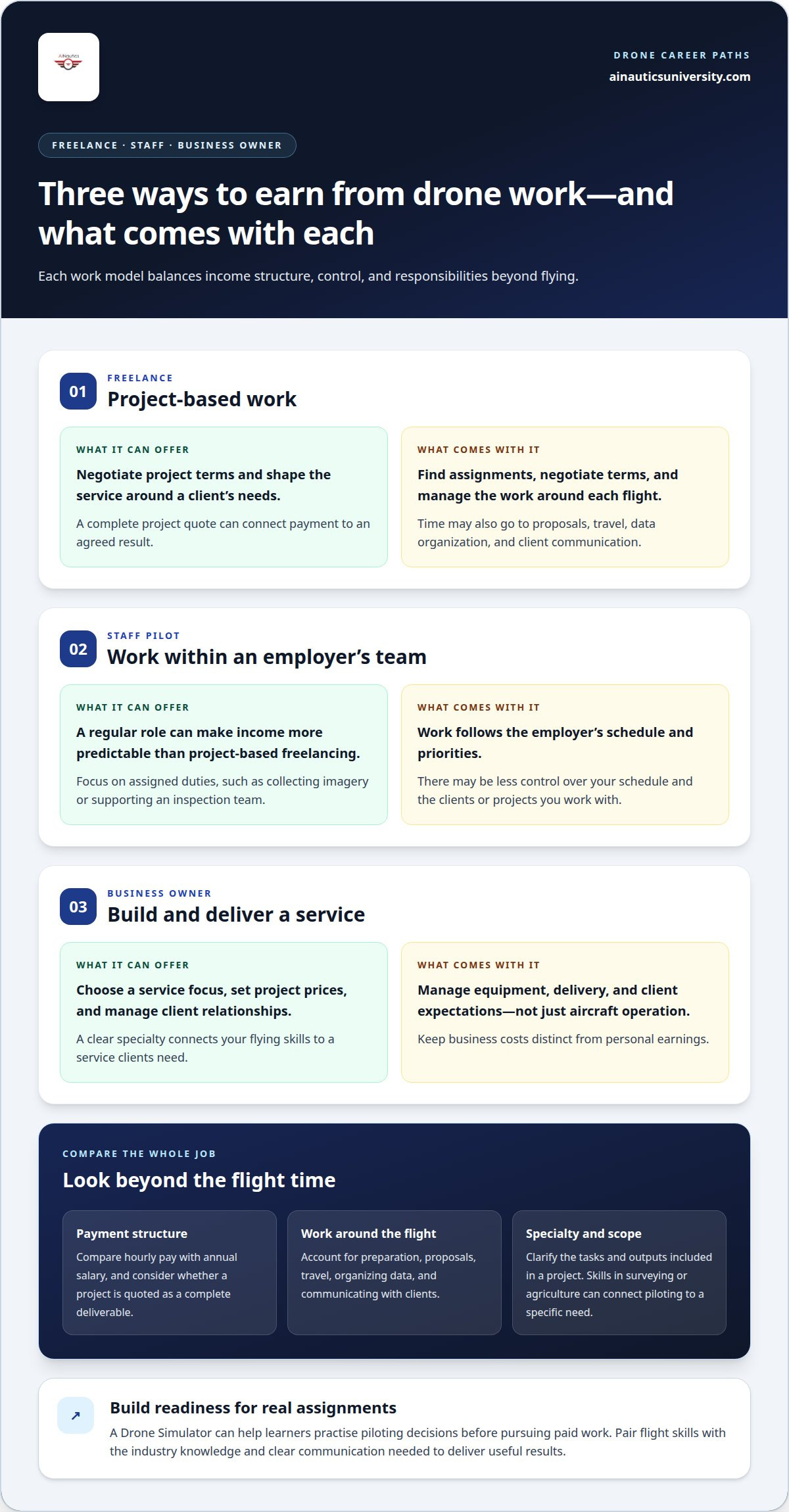
Freelance, staff, and business earning models
Drone pilots can work as freelancers, employees, or business owners. Each path affects how income arrives and what responsibilities extend beyond flying. Freelancers find assignments and negotiate project terms. Staff pilots work within an employer’s schedule and priorities. Business owners define and sell a service, then manage client relationships, equipment, and delivery.
Freelance rates vary with the work. A mapping assignment, for example, can involve more than flight time: the pilot may need to plan data capture and prepare usable outputs. The scope of the service shapes the rate, so compare the complete deliverable rather than just the time spent operating the aircraft.
An hourly rate isn’t the same as take-home income. Freelancers also account for time spent finding work, preparing proposals, traveling, organizing data, and communicating with clients. A surveying specialist may quote a complete project instead of an hourly flight rate. That approach ties payment to an agreed result, while clarifying which tasks and deliverables the fee covers.
Staff employment offers a different tradeoff. An employee typically focuses on assigned duties, such as supporting an inspection team or collecting imagery for an employer’s operations. A regular role can make income more predictable than project-based freelancing, but offers less control over schedule and client mix.
Specialized teams may have distinct pay structures. Their work combines aircraft operation with coordinated activity, so the role differs from a solo commercial assignment. When comparing options, consider whether the day-to-day duties match your strengths, not just which rate looks highest.
Running a drone business adds planning responsibilities. The owner chooses a service focus, prices projects, manages client expectations, and separates business costs from personal earnings. An agriculture-focused operator, for example, may offer repeat field-imaging projects, while a freelance photographer may rely on separate bookings. The customer’s needs and the service delivered shape the business model.
Use these distinctions to assess opportunities realistically. Compare hourly pay with annual salary, then account for workload, project preparation, and business responsibilities. A Drone Simulator can also help learners practise piloting decisions before pursuing paid assignments. Developing a clear specialty, such as surveying or agriculture, helps connect flying skills to a service employers or clients need.
Career outlook and demand for drone pilots
Career demand depends on organizations using aerial data to complete real tasks. The Federal Aviation Administration reported more than 450,000 drones registered for commercial use in the United States as of November 2025. That registration figure signals commercial activity, but it doesn’t tell you how many paid pilot positions are available.
Employers need a clear reason to hire a drone pilot. A utility may use aerial images to document infrastructure, while a construction company may need site records for project teams. In both cases, the value comes from useful information, not simply launching a drone. This helps explain why prospects vary by industry.
Government agencies may also need aerial support for specific operations. Emergency-management teams, for example, may use imagery to assess a scene, while public-works departments may document assets. These roles can involve coordination, data organization, and communication with colleagues. Anyone asking, “Is being a drone pilot a good career?” should consider whether those responsibilities sound appealing.
Opportunities vary by specialty and local employer needs. Construction activity may create demand for progress documentation, while agricultural operations may seek field imagery. Work can also follow seasonal or project cycles. Researching employers in your chosen sector can show whether they need occasional flights, recurring services, or staff dedicated to drone operations.
The workforce is growing too. The Federal Aviation Administration projected 472,000 remote pilots by 2028. That projection points to more certified pilots, which can make it important to bring additional value. Relevant experience, clear communication, and knowledge of an employer’s field can help distinguish candidates beyond basic flight capability.
To evaluate your prospects, review job descriptions and note the skills employers request. Look for recurring references to mapping, inspections, reporting, data processing, or industry experience. Compare those requirements with your current abilities, then choose a specialty to develop. For a career changer, “Is being a drone pilot a good career?” is best answered by matching personal strengths to real roles.
- Check the work itself: Identify the deliverable employers need, such as imagery, maps, or inspection records.
- Compare role requirements: Separate flight tasks from data, communication, and field responsibilities.
- Choose a direction: Focus on an industry where your existing skills can support drone operations.
Industry demand and individual prospects are related, but they’re not identical. A large registered fleet doesn’t guarantee steady employment for every pilot. A focused specialty gives you a practical way to connect your skills with an employer’s needs and assess whether this career path suits your goals.
Commercial drone job types and pay
Commercial drone careers span field operations, technical specialties, and instruction. Pay and stability differ by role, so compare the work itself as well as compensation.
Commercial Drone Job Types
Commercial drone jobs use unmanned aircraft systems for industry tasks, making each specialty distinct. Employers may hire pilots for inspections, construction monitoring, agriculture, mapping, or flight instruction. LiDAR corridor mapping, for example, combines aircraft operations with specialized data collection. Identify the work products each role requires to focus your training and experience on a relevant career path.
Pay snapshots span several roles:
These figures represent different specialties and experience levels, not a standard salary ladder. An industrial position may require technical expertise alongside piloting, while an instructor needs to teach flight concepts clearly. A Part 107 certificate supports commercial operations, but employers may also value skills that match their equipment, data, and workplace needs.
Pay, Stability, and Career Comparisons
Pay and stability are easier to assess by comparing the full occupations, not just flight duties. The U.S. Bureau of Labor Statistics lists surveying and mapping technicians’ pay at $54,240 in May 2025. This offers a reference point for some drone-related work, though roles can differ in responsibilities, employment terms, and required expertise.
The U.S. Bureau of Labor Statistics lists electro-mechanical and mechatronics technologists and technicians’ pay at $73,900 in May 2025, with a 10th-90th percentile range of $47,840-$109,890. Compare those responsibilities with drone positions before weighing compensation. The question “Is being a drone pilot a good career?” depends partly on how the role fits your preferred work and income structure.
Specialization can change the pay picture. These figures describe a particular application, not drone piloting as a whole. Data capture and processing skills can be important alongside aircraft control.
To assess whether a role fits your goals, review job postings in your target industry. Compare listed pay with the required skills, work setting, and employment terms. Note the tasks you would perform regularly, then consider whether they suit your strengths and preferred work environment. This gives you a more useful basis for a career decision than a salary figure alone.
Regulatory and operational challenges
Employers generally require a recognized credential, dependable flight skills, and workplace readiness. Commercial pilots need to understand airspace, plan flights, follow safety procedures, and deliver results suited to the role.
According to the Federal Aviation Administration, commercial drone pilots must hold an FAA Part 107 certification to offer commercial drone services. The Federal Aviation Administration also states that FAA Part 107 remote pilots must complete an online recurrent test every 24 months. Keeping current supports compliant commercial work.
Registration and flight limits shape everyday drone operations. According to the Federal Aviation Administration, drones weighing over 0.55 pounds must be registered, and FAA rules limit flights to 400 feet or below within visual line of sight. A pilot planning a site survey must account for both requirements before takeoff.
The certificate also has a defined aircraft scope. According to the Federal Aviation Administration, the FAA Part 107 Remote Pilot Certificate authorizes commercial operation of drones weighing less than 55 pounds. A job involving a heavier aircraft therefore falls outside that stated scope.
For anyone interested in this career, rules are only part of the work. A pilot must assess the planned operation, prepare a flight plan, and make sound decisions as conditions change. An inspection near a busy worksite, for example, calls for coordination, careful positioning, and clear communication with the team.
Employers may also expect job-specific abilities. A mapping role can involve collecting organized data, while a construction assignment may require consistent site documentation. Pilots who explain their process and deliver files in a usable format support the wider project, not just the flight.
Operational readiness means preparing for the whole assignment. Before a flight, identify the task, review the operating area, assess the aircraft and equipment, and establish how the team will communicate. During the work, monitor the aircraft and its surroundings. After landing, confirm that the captured images or data meet the assignment’s purpose.
- Regulatory knowledge: Understand FAA Part 107 requirements and keep recurrent testing current.
- Flight judgment: Plan operations carefully and respond to changing conditions.
- Technical delivery: Capture and organize information for the employer’s application.
- Communication: Coordinate with teams and explain results clearly.
A Drone Simulator can help learners practise flight decisions before real assignments. Pairing practice with focused preparation builds familiarity with procedures and controls. To strengthen your readiness for commercial drone operations, explore Part 107 preparation as you develop the skills employers value.
AINautics University: Part 107 Training
AINautics University helps aspiring pilots and educators build practical foundations for drone careers. If you’re preparing for commercial work, Part 107 Training and Self-Paced Certification provide focused ways to prepare for certification. Use them when you’re ready to strengthen your regulatory knowledge alongside your career plans.
Educators can explore AINautics University’s Train-the-Teacher Program to support classroom instruction in autonomous systems. The VR Trailer Mobile Lab offers another way to bring drone learning into educational settings. Choose the path that fits your role: developing your own skills or helping students explore UAS careers.
Start by identifying the skills your target role requires, then select learning that supports those goals. Explore AINautics University’s programs or contact the university to discuss your learning needs.
Build Your Next Step in UAS
If you’re asking whether being a drone pilot is a good career, turn that interest into a focused plan. Choose an industry to explore, identify the skills its roles require, and decide what you need to learn next. You might prepare for commercial operations, help students discover UAS careers, or connect with Education and Training to navigate university degree pathways in related fields like aerospace and robotics.
AINautics University offers Part 107 Training for learners building their knowledge, a Train-the-Teacher Program for educators, and a VR Trailer Mobile Lab for hands-on drone learning. Each supports a different stage of the journey, from personal preparation to bringing UAS education into a classroom. Start with the path that fits your goals.
Explore the programs and take a practical next step toward your UAS learning goals. Contact AINautics University today to discuss your direction. Your skills can grow into meaningful work, one focused step at a time.
Frequently Asked Questions
Is this considered a real aviation career?
Yes. Drone piloting is a professional aviation pathway, though the job title may vary by employer. Some positions combine piloting with another specialty, so read the duties closely rather than relying on the title alone. A role may emphasize collecting imagery, operating an aircraft, or preparing information for a team. The aviation component is real, but day-to-day work depends on the organization’s mission.
How much do commercial drone pilots earn in the United States?
Commercial pilot earnings vary by employer, specialty, experience, and compensation structure. Rather than compare salaries alone, check whether a posting is hourly, salaried, or project-based, and what the pay covers. Freelancers should consider time spent preparing and delivering a project, not only flight hours. Staff applicants can compare duties and employment terms with their preferred work arrangement.
What is the job outlook for drone pilots in the U.S.?
Prospects are strongest for candidates who connect piloting with a defined workplace need. Job seekers can assess local opportunities by tracking postings over time, noting which skills recur, and identifying employers with ongoing operations. A single vacancy shows an immediate opening; recurring listings may point to a continuing need. Use that evidence to select a specialty and build relevant experience.
Which industries hire drone pilots, and what jobs do they do?
Employers include organizations in construction, surveying, agriculture, utilities, media, and public safety. The work can be grouped by purpose: capturing images, collecting spatial information, documenting assets, or supporting a field team. When exploring a role, identify who uses the pilot’s output and how it fits the larger project. That reveals whether the position centers on flying, interpreting data, or coordinating with colleagues.
How do you get an FAA Part 107 remote pilot certificate, and how much does it cost?
Prepare for and take the FAA Part 107 knowledge test at a testing center. Before studying, identify the concepts you need to strengthen, then use structured practice to build familiarity with the material. After earning the certificate, connect your preparation to a specific career interest, such as mapping, instruction, or another commercial application.
Is drone piloting usually a full-time job, freelance work, or a side hustle?
Drone piloting can be a full-time job, freelance work, or a side activity. The right fit depends on how much time you can devote to assignments and how much responsibility you want beyond flying. Before accepting work, clarify the expected deliverables, schedule, and communication process. Occasional projects may suit supplemental work, while a dedicated role requires a more sustained commitment.
What are the FAA rules and legal restrictions for commercial drone pilots?
Commercial drone operations must follow applicable FAA requirements, including the Part 107 rules discussed above. In practice, pilots should assess each planned operation against the aircraft, location, and task before accepting an assignment. Don’t treat a previous flight plan as a template for every job. Conditions can differ between sites, so make regulatory review part of project preparation and keep the operating team aligned.
What are the main risks and drawbacks of a drone pilot career?
Challenges include inconsistent assignments, client expectations, and the need to deliver accurate work while operating an aircraft. A missed detail in captured information can reduce a project’s usefulness, so pilots need a careful review process after each flight. Freelancers also handle business administration, while employees may have less control over assignments. Consider whether both the flight work and its supporting responsibilities suit you.

Article by
AINautics University Team
The team behind AINautics University, dedicated to drone education and FAA Part 107 certification prep, VR flight simulation, and STEM training programs for students and educators.


