
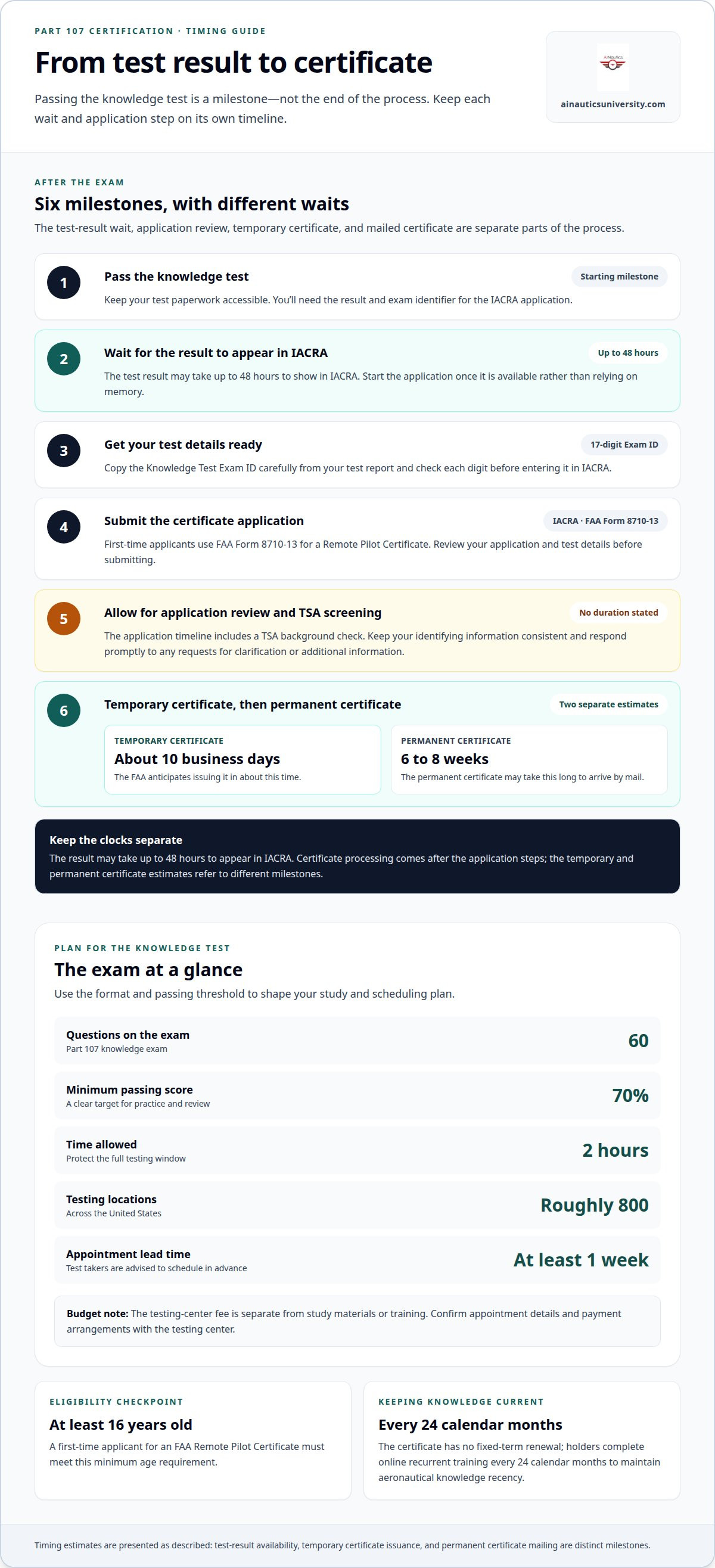
Passing the test is a major milestone, but it isn’t the final step. If you’re wondering how long it takes to get Part 107 certified, your test result may take up to 48 hours to appear in IACRA, and the FAA anticipates issuing a temporary certificate in about 10 business days. A permanent certificate may take 6 to 8 weeks to arrive by mail.
That wait can feel uncertain when you’re ready to put your new knowledge to work. This guide walks you through the process, from preparing for the knowledge test to submitting your application and receiving your certificate. You’ll learn what happens after you pass, which details you’ll need for IACRA, and how the temporary and permanent certificates fit into the timeline. With each step clearly laid out, you can plan your next move and make steady progress toward flying under Part 107.
Key Takeaways
- Plan for separate steps after the knowledge test: recording your result in IACRA, completing the application, and waiting for certificate processing.
- Keep your Knowledge Test Exam ID ready so you can enter your test result in IACRA.
- Know the test format and passing score before exam day to prepare with a clear study target.
- Build a study plan around the topics you need to master, then use practice and review to identify gaps before testing.
- Choose a learning approach that fits your schedule, whether you’re studying independently or preparing to teach UAS concepts.
Application timing after passing the test
- Allow the test result to reach IACRA. After you take the knowledge test, the result may take up to 48 hours to appear in IACRA. Use that time to keep your test paperwork accessible and note your Knowledge Test Exam ID. Start the application once the result is available, rather than entering details from memory. This separates test-result processing from the application review that follows.
- Get your test identifier ready. IACRA requires a 17-digit Knowledge Test Exam ID when you enter the exam result. Copy it carefully from your test report, then compare each digit before submitting. A transposed number can prevent the result from matching your application. Keep the report available as you complete the online steps, so you can refer to the same source if a field needs correction.
- Submit the certificate application in IACRA. First-time applicants use FAA Form 8710-13 for a Remote Pilot Certificate. Complete the requested information accurately and review the test details before sending the application. Treat submission as a separate milestone from passing the exam: a passing result supports the application, but it does not itself issue a certificate. Save your application details so you can follow its progress.
- Account for TSA background screening. The application timeline includes a TSA background check, so passing the knowledge test is not the final administrative step. Keep your identifying information consistent across your application and related records. Respond promptly to any requests for clarification or additional information. Include this screening stage in your overall plan, separate from the time it takes for a test result to appear.
- Watch for application progress and certificate issuance. After submission, monitor the application process and keep the contact information you provided accessible. The FAA anticipates that a temporary Remote Pilot Certificate can be issued in about 10 business days. That estimate concerns the temporary certificate, not the permanent card arriving by mail. Build the distinction into your schedule if you have a work or education plan tied to certification.
- Plan for the permanent certificate separately. The FAA may take 6 to 8 weeks to issue the permanent Remote Pilot Certificate by mail. This mailing period follows a different path from the test-result wait and temporary-certificate timing. For example, passing on a Monday does not mean the permanent card will arrive within the next few days. Track each milestone separately: test result, IACRA application, temporary certificate, and mailed certificate.
Knowledge test format, passing score, and duration
- Choose a testing location and reserve a time. The FAA Aeronautical Knowledge Test is offered at roughly 800 testing facilities across the United States. Find a location that fits your travel and scheduling needs, then reserve an appointment. Test takers are advised to schedule at least a week in advance. Use that lead time to organize study sessions and avoid making your exam date depend on a last-minute opening.
- Plan for the testing-center fee. Treat this as an exam expense, separate from any study materials or training you choose. Confirm appointment details and payment arrangements with the testing center when scheduling. Having the fee and logistics in order helps you focus on preparing for the exam.
- Prepare for the exam’s question count and passing threshold. The Part 107 knowledge exam contains 60 questions, and the minimum passing score is 70%. Use both figures to guide your preparation. Your goal is not simply to finish the material, but to demonstrate broad enough knowledge to meet the required score. Review areas where practice questions expose gaps, then revisit those concepts before test day.
- Protect the full testing window. Test takers have two hours to complete the FAA Aeronautical Knowledge Test. Schedule your appointment at a time when you can arrive prepared and devote the entire allotted period to the exam. For example, avoid placing another commitment immediately after the appointment. A full two-hour window gives you time to work through all 60 questions without treating the clock as an afterthought.
- Build a focused exam-day plan. Before your scheduled test, review the 70% passing threshold, the 60-question format, and your two-hour time limit. Divide preparation into manageable sessions, and use each session to strengthen a specific knowledge area. If a practice question reveals uncertainty, pause to understand the underlying concept rather than memorizing an answer alone. Arrive with your appointment details ready, and follow the testing center’s instructions.
Steps to obtain a Part 107 Remote Pilot Certificate
A Remote Pilot Certificate has no fixed-term renewal; holders must complete online recurrent training every 24 calendar months to maintain aeronautical knowledge recency, according to the Federal Aviation Administration.
If you already hold a pilot certificate issued under 14 CFR part 61 and completed a flight review within the previous 24 months, you can use that pathway. Your route skips the first-time knowledge-test requirement, so plan around eligibility and application processing instead.
- Confirm your eligibility first. A first-time applicant for an FAA Remote Pilot Certificate must be at least 16 years old, according to the Federal Aviation Administration. Check this before building a test and application schedule. If you’re helping a student plan ahead, make age eligibility the first checkpoint, then map the remaining certification tasks around it.
- Identify the correct certification pathway. Decide whether you’re applying as a first-time remote pilot or using an existing pilot certificate issued under 14 CFR part 61. The Part 61 route requires a flight review completed within the previous 24 months. Gather the relevant records early so you can determine which route matches your qualifications.
- Complete the requirements for your route. First-time applicants need to pass the FAA Aeronautical Knowledge Test. Applicants using the Part 61 pathway must meet its certificate and flight-review conditions. Use your route choice to organize the work ahead, rather than preparing for steps that don’t apply to your situation.
- Prepare accurate application information. Review the details you plan to submit and make sure they match your official records. Set aside time to read each prompt and correct errors before completing the application. Accurate information helps keep your application aligned with your eligibility route and supporting qualifications.
- Complete the FAA application process. Follow the FAA’s instructions for your selected pathway and finish each required application task. Keep a record of your submission and monitor its status. Treat application completion as its own milestone, separate from satisfying the knowledge-test or Part 61 eligibility requirements.
- Plan for ongoing knowledge recency. After certification, add online recurrent training to your planning calendar. Completing it every 24 calendar months supports aeronautical knowledge recency, according to the Federal Aviation Administration. Set a reminder well before your next training deadline, so this continuing responsibility stays visible alongside your UAS work.
- Connect certification to your intended operations. In the United States, commercial drone operations under Part 107 require an FAA Remote Pilot Certificate. Before planning a project, identify whether it falls under Part 107 and make sure your certification pathway aligns with that goal. This helps connect the credential to the work you’re preparing to do.
Study time and course completion estimate
- Set your estimate from your starting point. Your Part 107 study time depends on your familiarity with aviation concepts, your available study periods, and the topics that need review. Start by listing what you already understand and what feels new. For example, a learner with aviation experience may need less review of basic flight concepts than someone encountering them for the first time.
- Break the course into clear learning tasks. Divide your study plan into lessons, notes, and practice questions rather than treating the Part 107 material as one large assignment. Record each task in a calendar or checklist. This makes course completion easier to track and shows where you are spending time. If one lesson takes longer, adjust the remaining tasks instead of abandoning the plan.
- Use practice questions to find knowledge gaps. After studying a topic, answer related questions without looking at your notes. Mark missed or uncertain answers, then revisit the lesson covering that concept. If a question reveals confusion about a term, for example, add it to your review list and explain it in your own words.
- Build review into your study routine. Revisit earlier notes as you move through the Part 107 course. A short review helps you connect new information with concepts you have already studied. Keep a running list of difficult points, and update it when your understanding improves. This approach makes your preparation responsive to progress, rather than tied only to lessons completed.
- Estimate completion from your actual pace. Track how many course tasks you finish during each study session, then use that pace to plan the remaining work. Don’t rely on a course-duration estimate that doesn’t reflect your schedule or starting knowledge. If a busy week interrupts your routine, adjust your calendar and pick up with the next unfinished task.
- Set a readiness checkpoint before scheduling. Use a practice session to see whether you can explain key concepts and answer questions consistently. If you repeatedly miss questions on the same topic, revisit that lesson before booking the FAA knowledge test. If you understand the material more consistently, move on to final review and appointment planning.
- Keep course completion separate from certificate processing. Completing a study course prepares you for the knowledge test, but it doesn’t finish the later application steps. Track course progress, test preparation, exam scheduling, and the certificate application as separate milestones. This helps you estimate the learning phase without confusing it with the full certification timeline.
How long does it take to receive Part 107 test results?
- Keep your test paperwork together. After the exam, store the report with your certification records. Keeping documents in one place makes it easier to refer to the result during the next administrative step.
- Review the result before moving forward. Read the information carefully and make sure you understand the outcome shown. Refer to the report, rather than relying on memory, when deciding what to do next.
- Use the result to choose your next task. A passing result lets you proceed with the certificate application. If you need more preparation, use the topics that challenged you to guide your next study session.
- Keep application records consistent. When you continue the FAA process, use accurate information from your official documents. Set aside the test report while completing the relevant steps, then retain it with your application records.
- Track each milestone separately. Record your exam date, when you reviewed the result, and when you completed your next application task. This personal timeline helps you see your progress without confusing the test outcome with certificate issuance.
- Plan your next move around your goal. If certification supports a work or education plan, decide what you can prepare while the result is processing. For example, organize project requirements or coordinate your learning schedule, then return to the FAA process when the result is available.
Separate the test-result timeline from later operating requirements. As of April 6th, 2021, already-certified drone pilots no longer had to take an in-person recurrent exam at a PSI test center.
After certification, Part 107 operators must report an accident to the FAA if an operation results in property damage over $500.
AINautics University: Part 107 Training
AINautics University’s Part 107 Training helps learners prepare for the knowledge test and build a practical foundation in drone operations. Choose Self-Paced Certification if you want to work through your preparation independently. Educators can explore the Train-the-Teacher Program to support bringing UAS learning into their curriculum, while the VR Trailer Mobile Lab offers an immersive educational setting.
Choose learning options that fit your needs, whether you want structured preparation, a flexible study approach, or resources for teaching future drone professionals. Your next step depends on your role: prepare for your own exam, develop classroom instruction, or explore hands-on learning for students.
Contact AINautics University to explore the Part 107 learning option that fits your goals.
Turn Your Certification Goal Into a Flight Plan
Knowing how long it takes to get Part 107 certified helps you set expectations, but your next move is to turn preparation into a purposeful learning plan. Think beyond the exam: the knowledge you build can support future work, classroom projects, and new opportunities in the UAS field. Choose a study rhythm you can maintain, identify the concepts that need more attention, and keep your application steps organized as you progress.
If you’re an educator, consider how drone knowledge can connect with lessons and student career exploration. If you’re preparing for your own certificate, focus on building knowledge you can apply beyond test day. A clear learning path gives each step purpose and helps you move toward your goals with confidence.
Contact AINautics University to explore a learning path that supports your next step. Your progress starts with one focused action, and you’re ready to take it.
Frequently Asked Questions
How long does it take to become a certified drone pilot?
There isn’t one timeline for every applicant. If you’re estimating how long it takes to get Part 107 certified, separate your personal study pace from testing and application milestones. A practical approach is to note when each stage begins and finishes, then use your actual progress to plan the next one. This gives you a more useful estimate than counting only from the day you start studying.
How long will this course take me to complete?
Course completion depends on the learning format and the time you can dedicate to lessons. For a self-paced course, schedule study periods that fit your routine and track completed lessons. If a topic needs more review, adjust your plan rather than rushing ahead. This gives you a personal estimate based on your progress, not a timeline that may not match your learning needs.
Who is eligible to take the FAA written aeronautical knowledge drone test?
A first-time applicant for an FAA Remote Pilot Certificate must be at least 16 years old, according to the Federal Aviation Administration. Before making a study plan, decide whether you’re applying as a first-time applicant or through the Part 61 pathway. That distinction affects which qualification route you prepare for. If you’re supporting a student, make eligibility the first planning checkpoint.
How long does it take to study for the FAA Part 107 knowledge test?
Study time varies with your background, learning pace, and the subjects that need extra attention. To estimate your preparation time, review the material, note unfamiliar topics, and plan follow-up study around those gaps. Reassess your understanding with practice questions. If the same concepts remain difficult, adjust your schedule before booking the exam rather than treating completed lessons alone as proof of readiness.
How long is the FAA Part 107 test, and how many questions does it have?
The FAA Aeronautical Knowledge Test has 60 questions and allows two hours for completion. Use a practice session to rehearse your approach: read each question fully, move on if you’re stuck, and return to challenging items with time remaining. The minimum passing score is 70%. Reviewing your answer choices before submitting can help catch misread wording or accidental selections.
How soon can I schedule a Part 107 test at an FAA-approved testing center?
Test takers are advised to schedule at least a week in advance. Appointment availability depends on the facility and the date you choose, so plan your exam date around your preparation rather than assuming a preferred time will be open. The test is offered at roughly 800 testing facilities across the United States. Choose a location you can reach reliably and keep its appointment details handy.
How long does FAA approval take after applying for a Part 107 remote pilot certificate?
Allow for separate processing stages: the FAA anticipates a temporary certificate in about 10 business days, while a permanent certificate may take 6 to 8 weeks by mail. These estimates describe different milestones, not one combined approval date. If you’re planning work or a school project, distinguish the temporary certificate stage from delivery of the permanent document when organizing your timeline.
What steps are required to get an FAA Part 107 certificate?
Choose the pathway that fits your qualifications, complete its requirements, and submit the certificate application. First-time applicants take the knowledge-test route; eligible pilot-certificate holders may use the Part 61 pathway. Before applying, organize the records relevant to your route and review your details for accuracy. After certification, plan for online recurrent training every 24 calendar months to maintain aeronautical knowledge recency.

Article by
AINautics University Team
The team behind AINautics University, dedicated to drone education and FAA Part 107 certification prep, VR flight simulation, and STEM training programs for students and educators.


