
An LLC won’t clear you to fly commercially; FAA Part 107 does. The legal requirements for starting a drone business include the right pilot certification and compliance with flight rules, while choosing a business structure is a separate decision.
It’s easy to focus on the paperwork and overlook the rules that apply every time you fly. According to the Federal Aviation Administration, drone pilots must stay below 400 feet while flying in the United States, and some locations require airspace authorization before takeoff.
This guide explains how Part 107 certification, airspace restrictions, aircraft registration, and business-entity choices fit together. You’ll also learn which costs can shape your startup budget, so you can plan your next steps with a clearer view of both business formation and flight readiness.
Key Takeaways
- Separate flight compliance from business formation: creating an LLC doesn’t replace the pilot qualifications required for commercial drone work.
- Plan each flight around altitude limits, airspace restrictions, and any authorization needed for the location.
- Organize aircraft registration records and applicable waivers so the remote pilot can carry the required documents during operations.
- Compare business-entity options with your state’s filing process and the structure that fits how you plan to operate.
- Use focused Part 107 preparation to build the knowledge you need before taking on commercial drone work.
What Is Part 107 Certification - and Why Does It Matter?
Part 107 is the Federal Aviation Administration’s framework for many small drone flights in the United States. The Federal Aviation Administration requires a valid Part 107 certification for anyone flying a drone for business, including occasional freelance work. This is one of the legal requirements for starting a drone business, and forming an LLC doesn’t replace the pilot qualification. Commercial photography, mapping, and inspection work all require attention to the rules governing each flight.
The knowledge test is the exam applicants pass to demonstrate their understanding of Part 107 rules. It contains 60 questions and is taken at an FAA-approved testing center. Before scheduling, study airspace, weather, operating limits, and emergency procedures. These subjects connect directly to decisions such as whether a job site allows a safe flight.
A remote pilot certificate is the FAA credential needed to act as pilot in command for a Part 107 operation. According to the Federal Aviation Administration, a Part 107 remote pilot certificate and/or rating is required to act as remote pilot in command of a UAS operated under Part 107. Part 107 remote pilots must complete recurrent training every 24 months to continue flying commercially, according to the Federal Aviation Administration. Track the training deadline and keep certificate details accessible.
Client requirements are separate from FAA certification, but they can affect whether you’re hired. A real estate agency, insurer, or construction firm may ask for proof of certification before assigning a project. Understanding the legal requirements for starting a drone business also means clarifying responsibilities in the contract. Specify who plans the flight, secures site access, and delivers the agreed images or inspection data.
Flying commercially without valid Part 107 certification can lead to civil penalties of up to $32,666 per violation. Treat certification as a prerequisite, not paperwork to complete after accepting a job. If a client requests a flight before you hold the required credential, don’t act as remote pilot in command. Ensure the person assigned to that role holds the required certificate or rating.
Privacy, trespassing, and data-protection rules may vary by state and locality, separate from FAA flight rules. Get permission before accessing private property, and plan image or data collection to avoid unnecessarily capturing private spaces or personal information.
Use a practical readiness sequence before accepting commercial work: earn the required certificate, maintain recurrent training, and match each assignment to your qualifications. Ask clients early for the job location, intended deliverables, and site-access arrangements. This information helps you plan the flight and clarify responsibilities before work begins. Keep certification records organized with project documents so you can respond efficiently when a client asks for proof.
Airspace restrictions and flight altitude limits
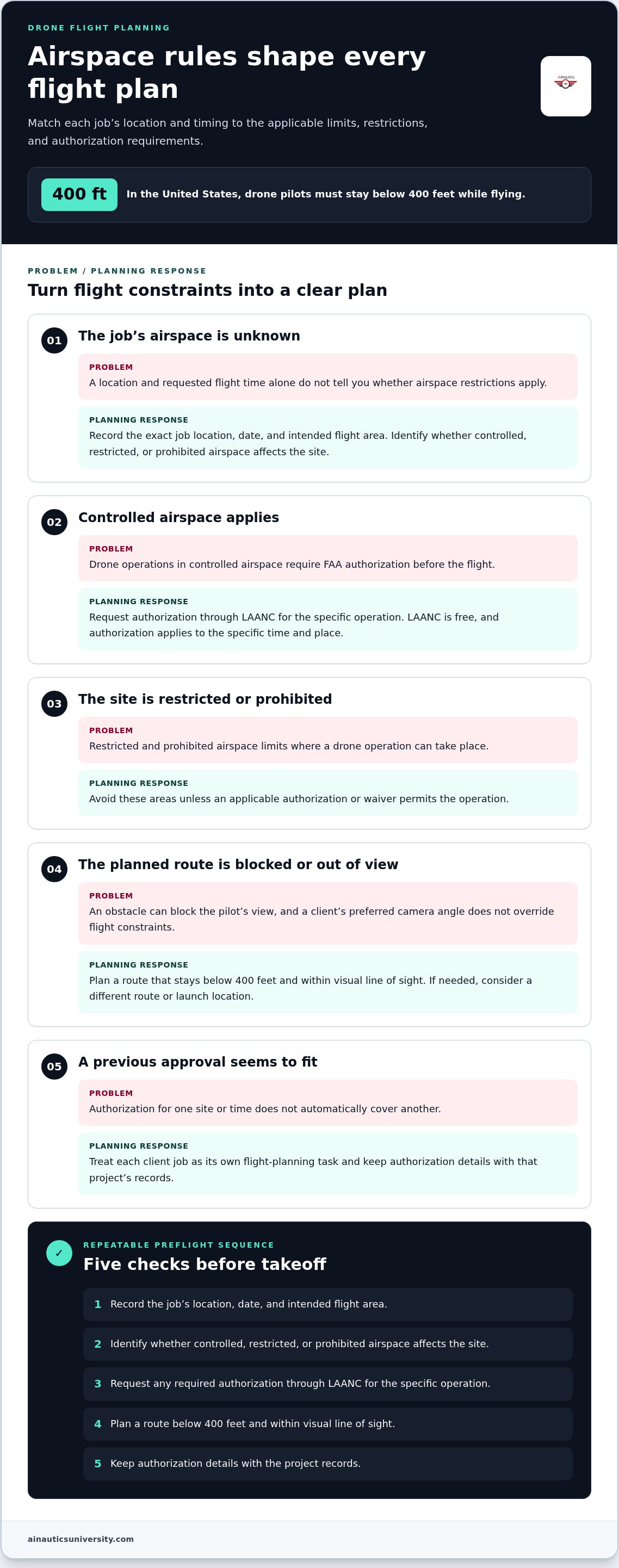
Airspace is the portion of the sky where specific flight rules apply. In the United States, drone pilots must stay below 400 feet while flying, according to the Federal Aviation Administration. That altitude limit is only one part of flight planning. A legal route also depends on the airspace above the launch site, nearby restrictions, and whether the planned operation needs authorization.
Controlled airspace is airspace where drone operations require FAA authorization. LAANC is a system operators can use to request that authorization. Before accepting a job, identify its exact location and planned flight time, then determine whether controlled airspace applies. If it does, request authorization before operating. Approval for one site or time does not automatically cover another.
LAANC authorization is free and applies to the specific time and place of an operation. Treat each job as its own flight-planning task. A property near an airport, for example, may require authorization even when a project farther away does not. Build the authorization step into your schedule rather than assuming the client’s requested date and location are ready for takeoff.
Restricted and prohibited airspace are areas drone pilots must avoid unless an applicable authorization or waiver permits the operation. Pilots must also keep their aircraft within visual line of sight. These rules affect how a project can be completed: a building inspection may need a different route or launch location if an obstacle blocks the pilot’s view. Do not let a client’s preferred camera angle override flight constraints.
Use a repeatable preflight process to connect the work order with the planned flight:
- Record the job’s location, date, and intended flight area.
- Identify whether controlled, restricted, or prohibited airspace affects the site.
- Request required authorization through LAANC for the specific operation.
- Plan a route that stays below 400 feet and within visual line of sight.
- Keep the authorization details with the project records.
These steps help turn airspace compliance into a practical part of every client engagement. A simulator can also help learners rehearse flight-planning decisions before applying them to real operations. Use a drone simulator to support practice as you build your understanding of operational scenarios.
Do I need an LLC for a drone business?
An LLC is a business structure, not a flight credential. The FAA’s Part 107 operating requirements focus on the remote pilot, aircraft, and flight, so forming an LLC is a separate business decision. Before choosing a structure, identify where you’ll operate and what state and local business registration rules apply. Those requirements can depend on the business location and activity.
Aircraft registration is the FAA process for identifying a drone used in an operation. In the United States, recreational flyers must register drones weighing more than 0.55 pounds and less than 55 pounds. Commercial operators must register all drones weighing less than 55 pounds, according to the Federal Aviation Administration. Drones weighing more than 55 pounds follow a separate registration process.
For a non-recreational drone operation, a business or organization must create a Part 107 account on FAA DroneZone. The account stakeholder doesn’t need a remote pilot certificate. That distinction lets an organization manage the account while a properly certificated remote pilot conducts the flight. Keep the account information aligned with who owns or operates the aircraft and who is responsible for the mission.
Registration records and applicable waivers are operating documents the remote pilot should carry for a Part 107 flight. A U.S. certificated remote pilot operating on behalf of a Part 107 account must carry the drone’s registration and any applicable authorizations or waivers. For example, if a flight relies on a waiver, keep that document available with the aircraft’s registration. Organize these records before launch, not after reaching the site.
Remote ID is an identification requirement that applies to commercial drone operators in the United States. Commercial operators must comply with Remote ID requirements for U.S. drones. Include Remote ID compliance in your aircraft setup process, alongside registration and account records. Creating an LLC, opening a DroneZone account, or registering an aircraft does not complete every separate operating requirement.
Use this sequence to prepare your business records:
- Choose a business structure and complete applicable state or local registration steps.
- Create the Part 107 account for the business or organization on FAA DroneZone.
- Register each aircraft required for the planned non-recreational operation.
- Keep registration and applicable authorizations or waivers available to the remote pilot.
- Address Remote ID requirements for commercial operations.
In short, an LLC and FAA flight compliance serve different purposes. Establish the business structure that fits your plans, then manage each aircraft and flight under the applicable FAA requirements.
Part 107 requirements for non-recreational drone operations
Part 107 and subsequent rulemakings established the framework for commercial drone operations in the United States, according to the U.S. Government Publishing Office. Photography, surveying, delivery, and other specialized services must follow the rules relevant to each planned operation.
Part 107 Operating Requirements
Part 107 operating requirements are FAA rules for non-recreational drone flights. Operators need to match each job’s flight plan to applicable requirements, including visual line of sight and any needed authorization. For night flights, drones must have anti-collision lighting visible for three miles, according to the Federal Aviation Administration. Operations over people may involve specific rules or waivers, so account for the planned flight conditions before accepting the work.
A remote pilot certificate is the required credential for the person acting as remote pilot in command. A business license or LLC doesn’t replace that certificate. For a photography assignment, for example, the operator must plan the flight under Part 107 even when the drone is small. Specialized work may change the operational details, but it doesn’t remove the need to assess the flight against FAA requirements.
Commercial Drone Registration
Commercial drone registration is the FAA process for identifying aircraft used for non-recreational operations. In the United States, operators flying for commercial or other non-recreational purposes must register all drones weighing less than 55 pounds, according to the Federal Aviation Administration. Part 107 drone registration costs $5 per aircraft and must be renewed every three years, according to the Federal Aviation Administration.
Register aircraft used in the business and keep each registration record accessible to the remote pilot. Track renewal timing alongside aircraft maintenance records, especially if the business operates multiple drones. Before assigning an aircraft to a job, confirm that its registration information matches the aircraft being flown. This simple recordkeeping step helps prevent paperwork mismatches during commercial operations.
Insurance and Operational Records
Insurance documentation shows a client that a drone business carries liability coverage. A certificate of insurance can be prepared for sharing when a client requests proof. Commercial building clients commonly request coverage between $1 million and $5 million.
Operational records document how a flight was planned and maintained. Part 107 doesn’t require one specific flight-log format, but retain flight logs, maintenance records, airspace authorizations, and pre-job site surveys. Use a consistent record system for each project. For example, connect a job’s site survey and authorization with its flight log, so the records remain easy to locate.
Permits and Waivers
A waiver is FAA permission for a specific operation that would otherwise fall outside a Part 107 operating rule. A permit is an approval that may apply to a location or activity. Depending on the location and service, a drone operation may need an airspace authorization or waiver. Identify the flight activity and site first, then determine which approvals apply before scheduling the job.
Keep each applicable authorization or waiver with the operation’s records. A delivery route, survey site, or night shoot may involve different conditions, so don’t assume one approval covers every project. The remote pilot operating under a Part 107 account must carry applicable authorizations or waivers. Record the approved scope and plan the flight accordingly, rather than treating a permit as blanket approval for future work.
Business entity formation costs
Business entity formation costs are the filing expenses for legally creating a business structure. That range covers formation costs, not every expense involved in launching a drone operation. Compare filing requirements in the state where you plan to establish the business.
The state filing fee is the main variable behind the formation range. The business structure you choose and the state’s process determine what paperwork to submit and which fees apply. An LLC is one option, but it is not a federal requirement for operating a drone. Keep the business-structure decision separate from FAA requirements for the remote pilot and aircraft.
Before filing, outline how the business will operate. A solo remote pilot working directly with clients may need a different setup from partners sharing equipment, expenses, and project responsibilities. Consider who will own the drone, sign client agreements, manage invoices, and maintain business records. These practical details help you compare structures without confusing entity formation with flight compliance.
Use a simple planning sequence to organize startup costs:
- Choose the state where the business will be established, then review its entity filing process.
- Compare LLC and similar entity structures against ownership, management, and recordkeeping plans.
- Keep entity paperwork separate from aircraft registration, pilot credentials, and flight authorizations.
- Build a broader budget for equipment, insurance, software, and services needed for planned work.
A broader budget matters because entity formation is only one part of launching a drone business. A photography operator may plan for different equipment than a mapping business. In either case, connect each planned expense to a business need, such as the drone, data processing, client deliverables, or operational records. If you plan to promote your services online, reviewing AI social media content tool pricing can also help you budget for marketing software to reach local clients. Do not treat a filing fee as the full launch budget.
Plan for administrative work after formation, too. Keep business records organized, separate business and personal transactions, and track state filing obligations. The exact tasks depend on the business structure and state. A clear record system can make it easier to manage client payments, equipment purchases, and project expenses as the business grows.
Once your structure and budget are mapped out, strengthen the flight knowledge behind your services. Explore Part 107 training for commercial drone work as you prepare to build a compliant operation.
AINautics University: Part 107 Training
AINautics University offers Part 107 Training to help learners prepare for commercial drone operations. Turn to structured study when you’re building the knowledge needed for the FAA exam, or choose Self-Paced Certification to learn on your own schedule. Educators can use the Train-the-Teacher Program to develop classroom instruction around drone and UAS topics, while the VR Trailer Mobile Lab supports hands-on learning experiences.
Training can connect exam preparation with operational decisions, from understanding airspace to planning compliant flights. Choose a learning format that fits your goals, whether you’re preparing to operate commercially or bringing UAS education into a school setting.
Visit ainauticsuniversity.com to explore learning options or contact AINautics University.
Build Your Drone Business With Confidence
Treat the legal requirements for starting a drone business as the foundation for the work you want to build. Turn regulatory knowledge into consistent professional habits: plan carefully, clarify responsibilities, and make sound decisions before each project begins. That discipline helps you build trust with clients while developing a business that can grow with your skills.
Your direction may be independent commercial work, a specialized UAS career, or bringing drone education into a school. Set a practical goal, identify the knowledge you need to reach it, and keep learning as your work evolves. Strong preparation supports sound judgment in the field and helps you approach new opportunities with purpose.
AINautics University offers learning pathways for aspiring drone professionals and educators. Explore AINautics University’s programs to find a useful next step for your goals. Keep building your expertise, and move forward with confidence.
Frequently Asked Questions
How do I obtain an FAA Part 107 remote pilot certificate, and what does it cost?
Pass the FAA knowledge test at an FAA-approved testing center to pursue a remote pilot certificate. Prepare by studying airspace, weather, operating rules, and safe flight planning. AINautics University offers Part 107 Training for learners preparing for commercial drone work. After certification, keep track of recurrent training so your knowledge stays current for continued operations.
Does a drone business need FAA aircraft registration, Remote ID, or airspace authorization?
Yes. Commercial operators must address aircraft registration and Remote ID, while airspace authorization depends on the planned location. Before accepting a job near controlled airspace, for example, identify the site and operating time, then request authorization through LAANC if required. Keep records tied to the aircraft and flight. A business account and an aircraft registration are distinct records, so organize both for the people managing operations.
What licenses, permits, and business registrations are required to start a drone company?
Requirements depend on the business activity and where it operates. A drone-cleaning business may also need state or local contractor licensing, depending on jurisdiction and contract value. Before launching, identify the business structure, state registration steps, and any activity-specific permits. Some cities require a right-of-way or sidewalk-use permit for sidewalk staging.
What insurance is required or recommended for a commercial drone business, and how much does it cost?
Drone liability insurance is commonly requested for commercial work, though the research facts don’t establish it as a universal FAA requirement. Optional hull insurance protects the aircraft itself and costs 6-10% per year of the insured equipment value. A construction client may request liability coverage between $1 million and $5 million.
How can a drone business get waivers for night flights, operations over people, or beyond visual line of sight?
Start by defining the exact operation and the rule relief it needs. A waiver applies to a specific operating constraint, not every future flight. Identify the location, aircraft, people involved, flight conditions, and safety procedures before preparing a request. Controlled-airspace authorization is separate and may be requested through LAANC. For night operations, plan for anti-collision lighting visible for three miles, as required by the FAA.
What state and local drone laws or permits should a drone business check before operating?
Review rules related to the service, property, and places where you stage equipment. For exterior drone cleaning, contractor licensing can depend on jurisdiction and contract value. Some cities require a sidewalk or right-of-way permit when equipment occupies public space and may restrict detergent-laden wash water from entering storm drains. For photography or inspection, plan property access and data collection carefully to address trespass and privacy concerns.
What are the penalties and liability risks for violating commercial drone regulations?
Flying commercially without valid Part 107 certification can result in civil penalties of up to $32,666 per violation. Beyond regulatory penalties, an unsafe flight can create property damage, injury, or a dispute over client deliverables. Reduce operational risk by documenting preflight checks, maintenance, site surveys, and authorizations. Keep insurance documentation ready to share when a client requests it, and define flight responsibilities clearly in project agreements.
What privacy, trespassing, and data-protection laws apply to commercial drone operations?
Privacy, trespassing, and data-protection requirements may vary by state and locality. Get permission before accessing private property, and avoid unnecessary capture of private spaces or personal information.

Article by
AINautics University Team
The team behind AINautics University, dedicated to drone education and FAA Part 107 certification prep, VR flight simulation, and STEM training programs for students and educators.


