
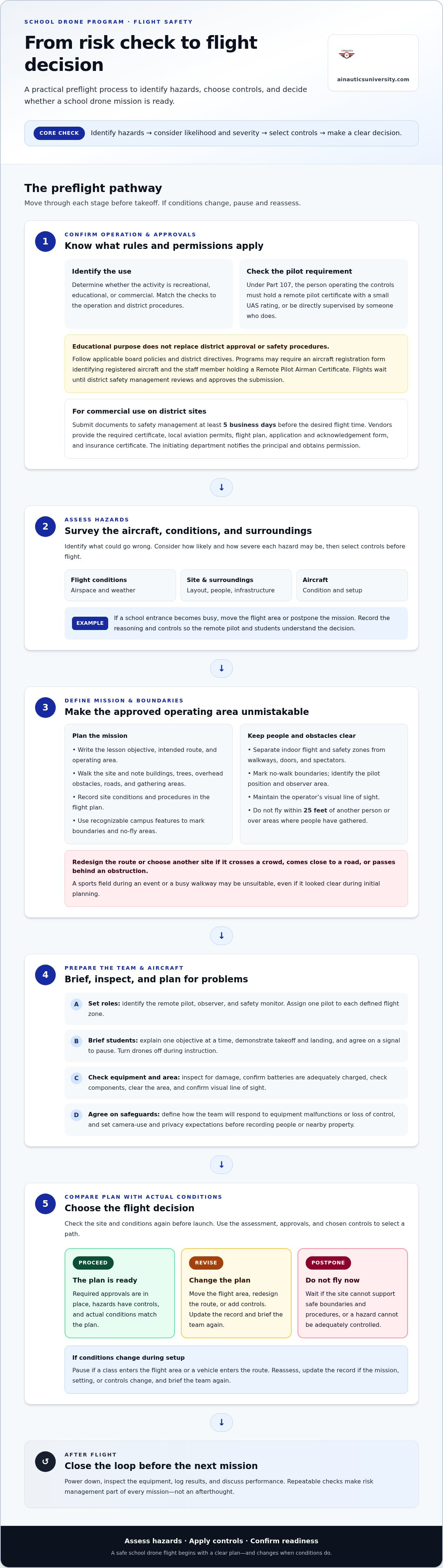
Managing risk in a school drone program starts with a preflight risk assessment: identify hazards, consider how likely and severe they are, and choose controls before flying. Assess the airspace, weather, site layout, nearby people and infrastructure, drone condition, and emergency response. Approval requirements also depend on district procedures and the type of operation.
A drone lesson can be engaging and practical, but safe operations involve more than checking the aircraft. Students and educators need clear boundaries, privacy expectations, and a shared plan for equipment malfunctions or loss of control.
This guide explains how to assess hazards, review compliance, define mission areas, prepare for emergencies, protect privacy, and build safety training into each flight. Use the process to decide whether a mission is ready, needs more controls, or should be postponed.
Key Takeaways
- Assess hazards before each mission, then decide whether to add controls, revise the plan, or postpone the flight.
- Match compliance checks to the operation and school district, and confirm the required approvals before takeoff.
- Set clear flight boundaries and define how the team will respond to equipment problems or loss of control.
- Establish camera-use and privacy expectations before recording, including rules for capturing people and nearby property.
- Build safe habits through structured instruction, practice, and clear roles so students know how to operate responsibly.
Pre-flight decision and compliance checks
A recreational flight is not automatically approved on school property. District procedures still apply. A risk assessment identifies hazards, considers their likelihood and severity, and selects controls before flight. A practical framework for managing risk in a school drone program turns that assessment into a clear decision: proceed, revise, or postpone.
-
Assess Flight Risks Before Launch
Start by reviewing airspace, weather, the site layout, nearby people and infrastructure, and the drone’s condition and setup. Identify what could go wrong, consider its likelihood and severity, and choose controls. For example, if a school entrance becomes busy, move the flight area or postpone the mission. Record the reasoning and controls so the remote pilot and students understand the decision.
-
Check Flight Rules and Requirements
Identify whether the activity is recreational, educational, or commercial, then apply the requirements relevant to that use. Under Part 107, the person operating the controls must hold a remote pilot certificate with a small UAS rating or be directly supervised by someone who does. Educational purpose alone doesn’t replace district approval or safety procedures.
According to district standards, drone use on school sites must comply with applicable board policies and safety regulations. Staff and students seeking educational use are directed to review established administrative guidelines and district directives. Programs often require a drone registration form identifying registered aircraft and the staff member holding a Remote Pilot Airman Certificate. Flights cannot proceed until district safety management reviews and approves the submission.
For commercial use on district sites, submit documents to safety management at least five business days before the desired flight time. Vendors must provide the required certificate, local aviation permits, flight plan, application and acknowledgement form, and insurance certificate. The initiating department must notify the principal and obtain permission.
-
Set Safety Zones and Flight Instructions
Before an indoor lesson, define flight and safety zones. Keep the aircraft’s operating area separate from walkways, doors, and spectators, and mark no-walk boundaries. Designate a pilot position and observer area. Explain one objective at a time, demonstrate takeoff and landing, and tell students what signal to use to pause. Turn drones off during instruction so learners can focus on the briefing.
-
Complete Pre- and Post-Flight Checks
Use a checklist before each lesson. Have students inspect the aircraft for damage, confirm the batteries are adequately charged, and check that components work properly. Make sure the area is clear and the operator can maintain visual line of sight. After the flight, power down, inspect the equipment, log results, and discuss performance. These repeatable steps make managing risk in a school drone program part of every mission, not an afterthought.
Defining missions and operating environments
Drones near people, buildings, roads, or airports can collide with obstacles, fall onto people or property, or capture images without consent. Define the mission and its boundaries before choosing a launch site or flight path.
-
Define the Mission and Flight Setting
Write down the lesson objective, the aircraft’s intended route, and its operating area. A campus mapping exercise, for example, needs a different flight path from a short indoor hovering lesson. Define where the drone may travel, where it must not go, and who is responsible for each part of the activity.
Walk the site before flight. Note buildings, trees, overhead obstacles, roads, gathering areas, and changes in foot traffic. Choose an operating area that keeps the flight away from people and sensitive locations. A sports field during an event or a busy walkway may be unsuitable, even if it appears clear during initial planning.
Record the mission purpose, site conditions, and procedures in the flight plan. Identify the remote pilot, observer, and safety monitor. Assign one pilot to each defined flight zone so students know who controls the aircraft. Keep the mission within the team’s training and certification level instead of adding unfamiliar tasks during a live flight.
For outdoor activities, mark no-fly zones and restricted areas on a site map. Define boundaries using recognizable campus features, such as a building edge or field line, and explain the route in plain language. Review the map with students before flight so they can identify the approved area.
-
Identify Nearby Flight Risks
Inspect the planned route for people, buildings, roads, and nearby infrastructure. A drone near a road could distract drivers or leave little room to respond if it veers off course. Buildings and trees can block the pilot’s view, while people below may be injured if an aircraft falls. Avoid flying over areas where people have gathered.
Keep the aircraft within the operator’s line of sight, and maintain the stated separation from people. School drone operators should not fly within 25 feet of another person. Plan flights conservatively and check applicable airspace and operating conditions before launch. These limits belong in the mission plan, not just in a verbal reminder.
Check whether the proposed route passes near an airport or crosses areas used by school traffic. If it requires flying over a crowd, close to a road, or behind an obstruction, redesign it. Set an alternate location or cancel the activity if the site cannot support the defined boundaries and procedures.
Before launch, compare actual conditions with the written plan. If a class moves into the flight area or a vehicle enters the route, pause and reassess. Update the record when the mission, setting, or controls change, then brief the team again before flight resumes.
Emergency and lost-link planning
Before each school flight, agree on who will act, how students should pause, and where people should move. Drones can fall and injure people or damage property, so prepare for equipment malfunctions and loss of control.
-
Plan for Emergencies
Write an emergency response plan for the specific flight area. Identify who will direct the response, who will manage the drone, and what signal will stop student activity. Tell the class where to move and how to keep the flight area clear if the aircraft behaves unexpectedly.
Cover likely situations, including a malfunction, loss of control, or a drone falling. For each, define who calls the pause, who guides students away, and who checks the aircraft’s location. If someone is injured or property is damaged, follow the school’s established emergency and reporting procedures. Keep the plan accessible to the supervising educator and flight team.
Before takeoff, review the response aloud with the pilot, observer, and safety monitor. Use one clear signal, such as a spoken “pause,” and make sure students understand it. Tell them to stop moving toward the aircraft and follow the educator’s directions. Do not let a student retrieve a drone while the pilot is managing an unstable flight.
Set a decision point for ending the activity. If the aircraft creates an immediate hazard, the remote pilot should prioritize people and follow the preapproved response. Resume only after the educator reassesses the area, equipment, and team readiness.
-
Prepare for Lost-Link Events
Agree on a lost-link response before flight, and make sure everyone understands their role. A lost-link event is an interruption in communication between the pilot and the aircraft. The response should account for the flight area, nearby people, and the aircraft’s operating instructions.
Have the remote pilot review the aircraft’s instructions and establish a response suited to the planned mission. Do not assume every drone behaves the same way when its connection is interrupted. Brief the observer and safety monitor on what to watch for, how to alert the pilot, and how to keep students outside the flight area.
During flight, the observer should report a lost connection clearly and promptly. The pilot should stop student activity and follow the response agreed on before takeoff. Keep the aircraft in sight when possible, and prevent bystanders from entering its path. If the drone lands or comes down, secure the area before anyone approaches.
Practice the sequence without an active flight. Ask students to respond to a simulated lost-link call by pausing, stepping back, and listening for directions. A short rehearsal helps the team follow procedures instead of crowding the pilot with questions during an actual event.
Privacy and neighboring property considerations
Decide what the camera may capture before a school drone takes flight. Clear camera rules help students respect people, school boundaries, and neighboring property.
-
Consider Privacy During Drone Flights
Set camera rules before powering on the drone. School policy should prohibit recording or photographing people without their consent. Explain the rule to students, educators, and observers, including during indoor activities when a camera may be operating. A drone can capture images improperly, so supervise camera use deliberately instead of making assumptions about what the aircraft sees.
Identify the purpose of each recording before flight. If the lesson is about hovering, for example, students may not need to record classmates or nearby rooms. Keep the camera directed at the learning task, and pause or disable it if people unexpectedly enter the frame. Assign someone to remind the group about the camera protocol.
Define how images will be handled after landing. Decide who may access them, how they support the lesson, and when they should be removed under school procedures. Limit access to the educational purpose. If a student asks to record someone, the educator should pause the activity and apply the school’s consent rules before camera use resumes.
Brief students on a simple response: stop recording if someone appears without consent, then tell the educator. This gives the remote pilot a clear action and prevents uncertain camera use from continuing during flight.
-
Account for Neighboring Property
Map the school boundary and nearby private property before choosing a route. Identify homes, windows, yards, and other places where a camera could intrude. A flight path over a school field may still capture a neighbor’s property, so consider the camera’s view as well as the drone’s position.
Choose a route that avoids pointing the camera toward neighboring spaces. For example, shift an observation path inward from the campus edge or face the camera toward school grounds rather than nearby homes. Mark the boundary clearly on the mission plan and explain it to the pilot and observer before takeoff.
Establish written procedures for privacy concerns. Specify who receives a concern, who can pause the flight, and how the school records its response. If an activity is designed to collect images, define their purpose, access, and handling before flight. Align these decisions with school policy and the expectations communicated to affected families or neighbors.
Reassess if the drone moves beyond the planned area or captures an unintended view. Pause recording, bring the aircraft back within the approved school area, and notify the supervising educator. Keep the flight record focused on the mission and any privacy action taken, not unnecessary personal details.
Training as part of drone safety
Make training part of mission preparation, not a separate lesson. Before operating a drone, students need to understand safe handling, their roles, and how to respond.
-
Train Staff and Supervise Students
Prepare educators to teach safe procedures and supervise students. Before students operate a drone, explain each safety rule, why it matters, and the consequences of unsafe behavior. Model proper handling, then check that students can repeat the instructions and demonstrate the expected actions.
Start beginners with basic controls, hovering, safe takeoff and landing, and simple objectives. Add advanced challenges only after students can perform foundational tasks carefully. A drone simulator can help students become familiar with controls before they operate an aircraft.
Assign roles clearly during group work. One student can pilot while others serve as visual observer, safety monitor, data recorder, or flight planner. Rotate roles across lessons so students build different skills, but keep control responsibilities clear. Under Part 107, the person operating the controls must hold a remote pilot certificate with a small UAS rating or be directly supervised by someone who does.
-
Prepare for Emergency Response
Teach the emergency sequence before students fly. Practice the pause signal, where students should move, and who gives instructions if a drone malfunctions or control is lost. Rehearse a verbal scenario, then review everyone’s response before starting a live flight.
Choose school aircraft for the activity and setting. Microdrones or drones under 2 kg are among the types students should inspect before takeoff. There is no single cost for a school setup; costs depend on the aircraft selected, the lesson’s needs, and the equipment required for safe practice.
Insurance also matters. Drones are generally not covered under standard insurance. For commercial drone vendors working on Wake County Public School System sites, the required insurance certificate names the Wake County Board of Education as additionally insured for general liability and aviation coverage. Schools should distinguish this vendor requirement from coverage for student activities.
After practice sessions, review whether students followed instructions and whether the response procedures worked as intended. Test drone technology and safety protocols regularly, and update instruction when equipment or procedures change. Educators strengthening classroom readiness can build staff and student drone flight skills through structured training.
AINautics University: Part 107 Training
AINautics University offers Part 107 Training for educators and learners preparing for FAA remote pilot certification. Use structured instruction to strengthen understanding of the rules and responsibilities relevant to school drone operations. Educators developing classroom programs can also explore the Train-the-Teacher Program, while Self-Paced Certification supports learners who prefer independent study. The VR Trailer Mobile Lab offers another educational option for bringing UAS learning into school settings.
Consider training when staff need to build their knowledge, students are exploring drone careers, or a school wants a stronger foundation for safe instruction. Training can support informed decisions, but every mission still needs its own risk assessment, approval process, and safety procedures.
Contact AINautics University to discuss the educational pathway that fits your school or learning goals.
Build a Safety Culture That Grows With Your Program
A school drone program can teach more than flight skills. It can help students practice sound judgment, clear communication, and responsibility around emerging technology. Reinforcing this sense of personal accountability parallels broader youth guidance efforts, where educators frequently turn to youth mentors like Jeff Yalden to help teens navigate decision-making and emotional maturity. Make each mission an opportunity to strengthen those habits, then carry the lessons into the next activity. Over time, managing risk in a school drone program becomes part of how students plan, collaborate, and make decisions, not just a preflight task.
Educators can shape that culture by connecting classroom learning with practical UAS knowledge. AINautics University supports this path with education for learners and teachers. Choose a next step that fits your school’s goals and helps your team build confidence through informed preparation.
Contact AINautics University to discuss drone safety and explore an educational path for your program. Give students room to learn, prepare, and grow into responsible participants in the future of aviation.
Frequently Asked Questions
What Is A Drone Risk Assessment And Why Is It Required?
A drone risk assessment identifies hazards, considers their likelihood and severity, and selects controls before flight. It helps the school decide whether to proceed as planned or make changes. For example, if weather shifts or a group enters the planned area, record the new condition, reassess its effect, and adjust or pause the mission. Keep the reasoning with the flight record so the team can learn from its decisions.
What FAA rules apply to school drone programs in the United States?
For operations under Part 107, the person operating the controls must hold a remote pilot certificate with a small UAS rating or be directly supervised by someone who does. The applicable requirements depend on how the school uses the drone. Before each activity, identify its purpose, operator, and operating area, then review the rules that apply to that operation alongside district procedures. Educational use does not remove the need for a deliberate compliance review.
Does a school drone program need FAA registration, a Remote ID, or a Part 107 pilot?
Check registration, Remote ID applicability, and pilot qualifications as separate items for each aircraft and mission. District procedures may add their own registration steps. For example, Wake County Public School System requires educational drone-use submissions identifying registered drones and the staff member holding a Remote Pilot Airman Certificate. For Part 107 operations, the control operator must hold the appropriate remote pilot certificate or be directly supervised by someone who does.
What safety policies and preflight checklists should a school drone program use?
Use a written policy that assigns approval, supervision, and flight-area responsibilities, then pair it with a checklist students can follow. Include aircraft condition, battery charge, functioning components, weather, the flight area, and the team’s emergency response. Record checklist issues, such as a damaged component or unclear boundary, and review them before the next lesson. This turns recurring problems into specific improvements to instruction or procedures.
How should schools protect student privacy when drones record video or images?
Set a clear purpose for recording and limit camera use to that purpose. Tell students that people must not be photographed or recorded without consent, and assign an educator to oversee camera decisions. For example, if a lesson needs footage of a landing, frame the launch area rather than classmates or nearby rooms. Before sharing or retaining images, follow school procedures and limit access to people who need them for the stated educational purpose.
What state and local drone laws or school district policies apply to school drone programs?
Applicable requirements can include district policies, local site rules, and state or federal requirements. Review the school’s procedures before planning a flight, because approval steps may differ for educational use and commercial work. Wake County Public School System directs educational users to Board Policy 4344/5035/6422 and R&P Policy 4334/5035/6422. Its commercial-use process also requires Risk Management approval before flights proceed, so plan submissions around the district’s review process.

Article by
AINautics University Team
The team behind AINautics University, dedicated to drone education and FAA Part 107 certification prep, VR flight simulation, and STEM training programs for students and educators.


