
Effective school drone safety protocols start with a written emergency plan, a site assessment, and clear rules for students and staff. In the United States, the FAA’s Part 107 requirements apply to drone operations, including pilot certification and aircraft registration. If a flight becomes unsafe or the drone behaves unexpectedly, the operator should land it.
Planning ahead matters: classroom activities and field flights can introduce hazards, privacy concerns, and uncertainty about what to do when something goes wrong. A practical safety process gives everyone clear roles before the drone takes off.
Learn how to prepare emergency responses, review insurance, identify and reduce hazards, protect privacy, and manage indoor and outdoor flight risks. The sections ahead turn these priorities into practical steps educators can use to build a safer, more confident drone program.
Key Takeaways
- Write emergency procedures for equipment malfunctions and loss of control, and make sure everyone knows when to land.
- Before a field flight, review whether the school’s insurance applies to the planned operation and understand relevant limits and exclusions.
- Assess the site for obstacles, people, weather, and restricted areas, then reduce hazards before takeoff.
- Set clear rules for recording and photography so students and staff understand privacy expectations.
- Use defined classroom flight zones, clear roles, and a risk assessment to keep indoor and outdoor activities organized.
1. Emergency response planning
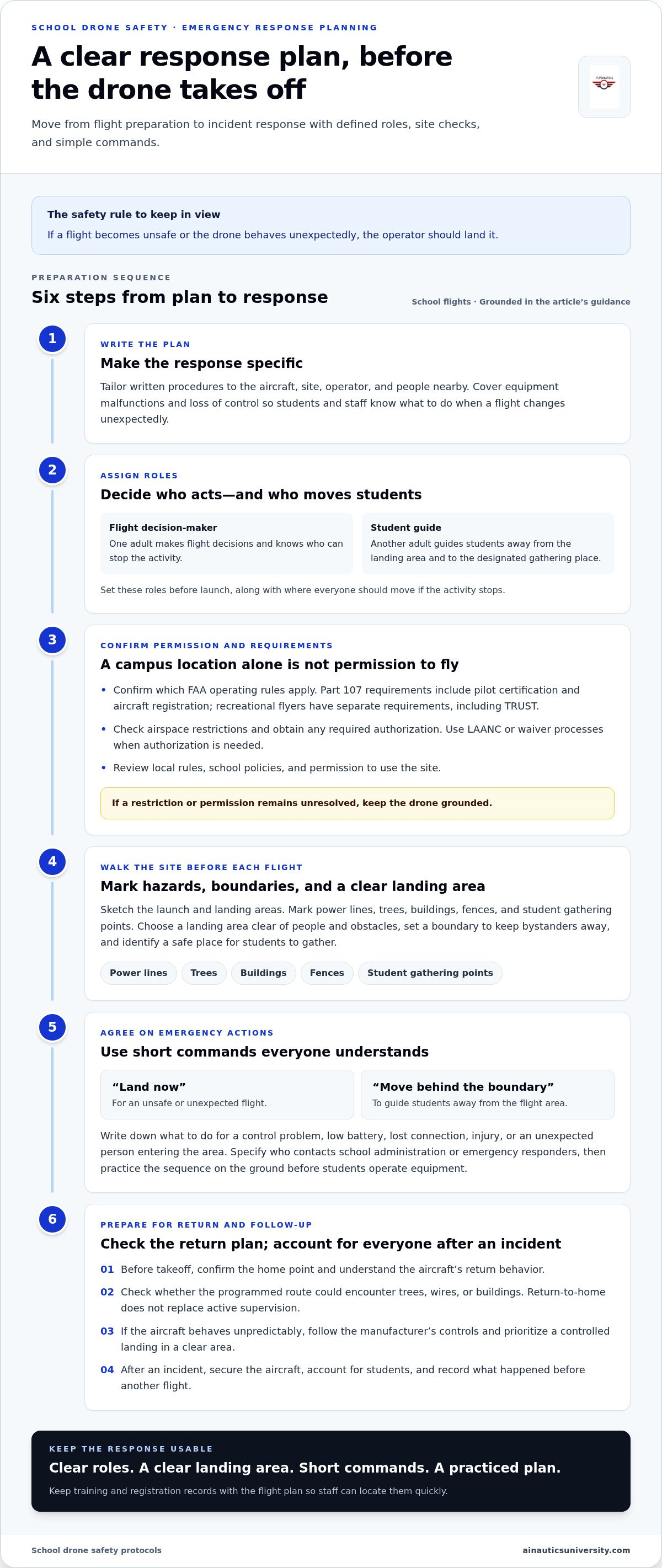
A written emergency plan gives students and staff clear actions when a flight changes unexpectedly. Make school drone safety protocols specific to the aircraft, site, operator, and people nearby. Assign one adult to make flight decisions and another to guide students away from the landing area. Before launch, identify who can stop the activity and where everyone should move.
According to the Federal Aviation Administration, Part 107 requirements apply to U.S. drone operations, including pilot certification and aircraft registration. Confirm which operating rules apply before planning a school flight. A recreational flight has separate requirements: the Federal Aviation Administration requires recreational drone flyers to complete TRUST. Keep training and registration records with the flight plan so staff can locate them quickly.
Where can schools legally fly drones on or near campus? Fly only where the airspace allows the operation, any required authorization is in place, and the school has permission to use the site. Check airspace restrictions and use LAANC or waiver processes when authorization is needed. A campus location alone does not make a flight permissible.
Do state or local laws add drone restrictions for schools? They can. Local laws and ordinances may affect flights over private property, so review the rules that apply to the campus and planned route. Consider school policies and property access, not just airspace. If any restriction or permission remains unresolved, keep the drone grounded.
Walk the launch and landing areas before each flight. Mark power lines, trees, buildings, fences, and student gathering points on a simple site sketch. Choose a landing area clear of people and obstacles. Set a boundary to keep bystanders away, and identify a safe place for students to gather if the flight stops.
Write down what to do if there is a control problem, low battery, lost connection, injury, or unexpected person entering the area. Use short commands, such as “land now” and “move behind the boundary.” Specify who contacts school administration or emergency responders. Practice the sequence on the ground before students operate equipment.
Prepare the return-to-home procedure before takeoff. Confirm the home point, understand the aircraft’s return behavior, and check whether its programmed route could encounter trees, wires, or buildings. Return-to-home does not replace active supervision. If the aircraft behaves unpredictably, follow the manufacturer’s controls and prioritize a controlled landing in a clear area. After an incident, secure the aircraft, account for students, and record what happened before another flight.
2. Insurance verification before field flight operations
Before a school drone leaves campus, review the insurance documents for the planned flight. Ask the school’s risk manager or insurer to identify the applicable policy and explain its limits, exclusions, and reporting process. Match the policy details to the operation: school-owned or borrowed aircraft, staff or student pilots, location, and whether the flight supports instruction or another purpose. Record who reviewed the documents and when.
What FAA rules apply to school drone flights in the United States? The Federal Aviation Administration’s Part 107 requirements apply to U.S. drone operations, including pilot certification and aircraft registration. Confirm which operating category fits the planned activity before scheduling a field flight.
Use a written insurance review rather than relying on a verbal assumption. Check whether the policy addresses bodily injury and property damage, and whether its exclusions affect student participation, off-campus locations, or the planned operation. Keep relevant policy records with the school’s flight plan. If coverage terms change, update the flight file before the next operation.
Include weather in the go-or-no-go review. Avoid flights in adverse conditions, including high winds or reduced visibility. If the forecast changes before launch, pause and reassess. Reschedule if the crew cannot maintain safe control and observation.
What preflight checklist should schools use for drones? Use a checklist covering the aircraft, batteries, controls, weather, site, crew roles, flight plan, and insurance review. Have the pilot complete it before each flight, then record any issue and its resolution.
- Inspect the aircraft, propellers, battery, and controller for damage or faults.
- Review current weather, visibility, site boundaries, and nearby activity.
- Confirm the pilot’s qualifications and assign crew communication roles.
- Match the flight plan to the reviewed insurance documents.
Agree on concise crew calls before takeoff. The pilot should announce launch, changes in the flight, and landing. An observer can report people entering the area or changes in visibility. Set a clear stop command, and ensure every crew member knows who can call it.
After landing, inspect the aircraft for damage, secure the battery, and note any malfunction. Log the date, site, pilot, purpose, weather observations, checklist completion, and unusual events. A consistent record helps the school spot recurring issues and support insurance reporting if an incident occurs. Staff can also rehearse checklist steps using a drone simulator before field operations.
3. Hazard identification and risk mitigation
Map the flight area before students arrive. Mark launch and landing points, school boundaries, pedestrian routes, and restricted areas. Define outdoor no-fly zones around places where students gather or move between classes. Keep the planned route clear of sensitive infrastructure, including power stations, water treatment facilities, correctional facilities, heavily traveled roadways, and government facilities.
Review the site from the drone’s planned operating height, not just from the ground. Identify nearby obstacles and choose a route that stays below surrounding obstacles when possible. The school drone safety checklist recommends a maximum altitude of 400 feet and a distance of at least 25 feet from individuals and property not owned by the school. Treat these as planning limits, then create wider buffers wherever the site allows.
Weather can quickly change the risk picture. Check aviation weather resources, such as METAR reports, before the flight. Compare current conditions with the aircraft’s operating guidance and the school’s limits. If wind or reduced visibility makes control or observation difficult, delay the activity. Record the weather review with the flight plan so the crew can explain its go-or-no-go decision.
Inspect each aircraft before takeoff, including school drones under 2 kg. Look for visible damage, check battery charge, and confirm that all components work. A cracked propeller, loose part, or unreliable control can turn a clear site into an unsafe operation. Remove a drone from the activity if an inspection reveals a problem.
- Walk the planned route and note people, obstacles, and sensitive sites.
- Set boundaries that separate students and bystanders from the flight area.
- Check weather information and reassess conditions before launch.
- Inspect the aircraft, battery, controls, and other components.
- Confirm airspace requirements and obtain any required authorization before flight.
Plan for pedestrian movement, not just the scheduled flight path. A class change, sports practice, or delivery can bring people into the operating area. Assign a safety spotter if the pilot cannot monitor both the drone and nearby activity. Agree on a stop command before launch, and land if the area becomes unsafe.
Make the site review a repeatable process. Record hazards, selected controls, and any remaining risks for each location. Update the plan when the launch point, route, weather, or school program changes. These steps help educators apply regulations consistently without assuming one campus plan fits every flight.
Educators should define outdoor no-fly zones and restricted areas, taking account of the school community and rules about flying drones overhead. Assess pedestrian traffic and whether safety spotters are needed before a commercial drone operation.
4. Privacy and recording consent
Set camera rules before students begin flying. A drone camera can capture classmates, staff, visitors, or neighboring property. Explain when recording is allowed, who may operate the camera, and how footage will be used. Include the rules in the lesson briefing, before recording starts. For example, a mapping exercise may need images of the field, but not identifiable faces.
Tell everyone when cameras are operating indoors. Explain the activity, the purpose of recording, and who can view the footage. Give participants a clear way to raise concerns before filming begins. If a student objects to appearing in footage, adjust the camera angle or assign a task outside the recording area. These steps make expectations clear and keep the learning activity focused.
Use permission as a practical safeguard. Don’t photograph or record people in places where they expect privacy without their permission. Avoid pointing cameras into changing areas, restrooms, or private offices. Before flying near neighboring property, plan the route to avoid capturing windows or private activities. If the camera can’t avoid those areas, change the route or keep recording off.
- Brief the class before activating any camera.
- Identify the operator and explain the recording purpose.
- Keep the camera directed toward the approved subject.
- Stop recording if someone enters a private or restricted area.
- Limit access to footage to people involved in the lesson.
Plan how footage will be handled before the first flight. Decide where files will be stored, who can review them, and when the class will delete them. Use school-approved storage rather than personal accounts or public sharing tools. Label files by lesson or project, not by sensitive personal details. If a clip captures an unintended conversation or person, exclude it from class use.
Indoor flying requires extra care because cameras may capture people at close range. Mark the flight zone and camera-facing area, then brief students on where to stand. Ask the pilot to aim the camera only at the lesson target, such as a marked course or model structure. An observer can monitor the camera view and call for a pause if it captures unrelated activity.
For a successful aviation lesson, make privacy part of the preflight conversation. Teachers should model the same rules they expect students to follow. Review the recording plan after each activity, especially if the next lesson uses a new location or camera purpose. Clear expectations help students learn responsible image-making alongside flight skills.
5. Risk assessment and classroom management
Start each lesson with a written risk assessment. Identify hazards related to the aircraft, room, students, and activity. For example, a moving drone near desks creates different risks from a stationary demonstration. Record who may be affected and which control will reduce each risk. Reassess if the lesson, room layout, or flight plan changes.
Use a simple rating method to prioritize hazards. Rate each hazard’s likelihood on a 1-5 scale, then rate its potential consequences on a 1-5 scale. Multiply the likelihood rating by the severity rating to calculate operational risk. A loose object near a flight zone might be unlikely to cause harm, but a crowded room can raise the possible consequences. Address the highest risks first.
Assign a trained adult to supervise every student flight. The adult sets the rules, controls access to the flight area, and stops the activity if students or classroom traffic enter the zone. Give each student a defined role, such as pilot, observer, or recorder. Rotate roles only after the aircraft has landed and the teacher has given instructions.
Separate indoor flight zones from safety zones. Mark the flight area with visible floor boundaries, and keep observers outside it. Move desks, bags, and loose materials away from the drone’s path. Plan a safe landing point clear of doors and student movement. Before takeoff, explain how students should respond if the drone moves outside the planned zone.
Consider airspace and the remote operating environment before choosing an activity. A classroom exercise should stay within the pilot’s ability to maintain visual contact and control. Use an observer if the pilot needs help watching the drone or monitoring nearby people. Agree on clear calls, including a stop command, before the flight begins.
How should schools manage student supervision and drone use? Set adult oversight, student roles, boundaries, and stop conditions before each activity. Keep the aircraft grounded while students enter or leave the flight area, and resume only after the supervisor confirms the room is ready.
After each lesson, record hazards, controls used, and any unexpected event. Compare the planned risk with what actually occurred, then adjust the next session’s layout or assignments. For educators building practical control skills before classroom flights, practice drone operation in a simulator.
Define indoor safety zones and flight zones before an activity, and make each boundary clear to everyone using the confined space. Keep the areas distinct in the plan so everyone understands the intended flight path and the areas outside it. If the layout cannot preserve clear boundaries, choose an activity that does not require flight in that space.
The school drone safety checklist recommends using an observer to help maintain visual contact when needed. Decide in advance when the pilot needs this support, and ensure the observer can focus on the aircraft and alert the operator if visual contact becomes difficult. The checklist also recommends confirming that the operating environment is safe and the operator is competent and proficient in drone operation. Check both conditions before authorizing flight. If either is not met, keep the drone grounded and revise the activity.
AINautics University: Part 107 Training
AINautics University helps educators and learners build the knowledge needed for responsible drone programs. Its Part 107 Training and Self-Paced Certification support those preparing for FAA certification, while the Train-the-Teacher Program helps educators bring UAS learning into the classroom. The VR Trailer Mobile Lab offers another way to introduce students to drone education.
Use these learning options when your school is developing a program, preparing instructors, or helping students pursue aviation skills. Training can complement written safety procedures by helping participants understand the responsibilities behind each flight and classroom role.
To explore AINautics University’s educational offerings, visit ainauticsuniversity.com.
Build a Stronger Foundation for Future Flights
A school drone program can grow beyond a single activity when safety is part of how students learn and work together. Give learners meaningful roles, encourage careful decision-making, and make responsible operation a standard they carry into future projects. Strong school drone safety protocols can make each flight an opportunity to develop sound judgment alongside technical skills.
Educators can keep building that foundation as their program evolves. AINautics University’s Part 107 Training, Train-the-Teacher Program, and VR Trailer Mobile Lab support different steps in drone education, from instructor development to student learning. Explore the options that fit your next step, or contact AINautics University to learn more. Your next classroom flight can begin with a clearer plan and a stronger learning experience.
Frequently Asked Questions
What drone safety policies should schools include?
Schools should define who approves flights, who can operate aircraft, and how lessons are authorized. Include expectations for student conduct, equipment access, training records, and incident reporting. Clarify who maintains policy documents and how staff learn about updates. For example, a substitute teacher should be able to find the current rules and know whom to consult before a scheduled drone activity.
What training or certification do school drone operators need?
For operations under FAA Part 107, the person acting as remote pilot needs the applicable certification. Students may learn flight skills, but the school should clearly identify the responsible pilot for each activity. Classroom preparation can include airspace concepts, operating decisions, and practice with flight scenarios. AINautics University’s Part 107 Training and Self-Paced Certification are educational options for learners preparing for certification.
What are the safety risks of school drone use and how can they be reduced?
Student excitement can create operational risks, especially if several learners crowd the controls or reach toward an aircraft. Designate one person as the active pilot, keep other students outside the control area, and pause the exercise if instructions aren’t followed. Give a verbal briefing before each activity, then review whether students followed their roles before allowing another flight.
What privacy rules apply when schools use drones to record students?
Make recording decisions part of lesson design. Decide whether identifiable images are necessary, who will see the finished work, and whether a non-recorded alternative is available. Before sharing a class project beyond its intended audience, review the footage for student identities and incidental captures. Apply the school’s existing student-record and media practices to drone footage, just as you would to other classroom recordings.
What insurance and liability coverage do schools need for drone programs?
There isn’t one insurance setup that fits every school program. Distinguish liability protection for claims involving injury or property damage from protection for damage to the drone itself; a policy may treat these differently. Ask the district’s insurance representative how each applies to the planned activity. The school’s aircraft ownership, operator, location, and educational use can affect the review.
What emergency procedures should schools follow after a drone crash or malfunction?
After immediate safety needs are addressed, preserve a clear incident record. Note the time, location, aircraft involved, flight purpose, control actions, and sequence of events. Keep relevant flight logs and collect accounts from people who witnessed what happened. Notify the school administrator through the established reporting channel, and keep the aircraft out of use until the school completes its review.

Article by
AINautics University Team
The team behind AINautics University, dedicated to drone education and FAA Part 107 certification prep, VR flight simulation, and STEM training programs for students and educators.


