
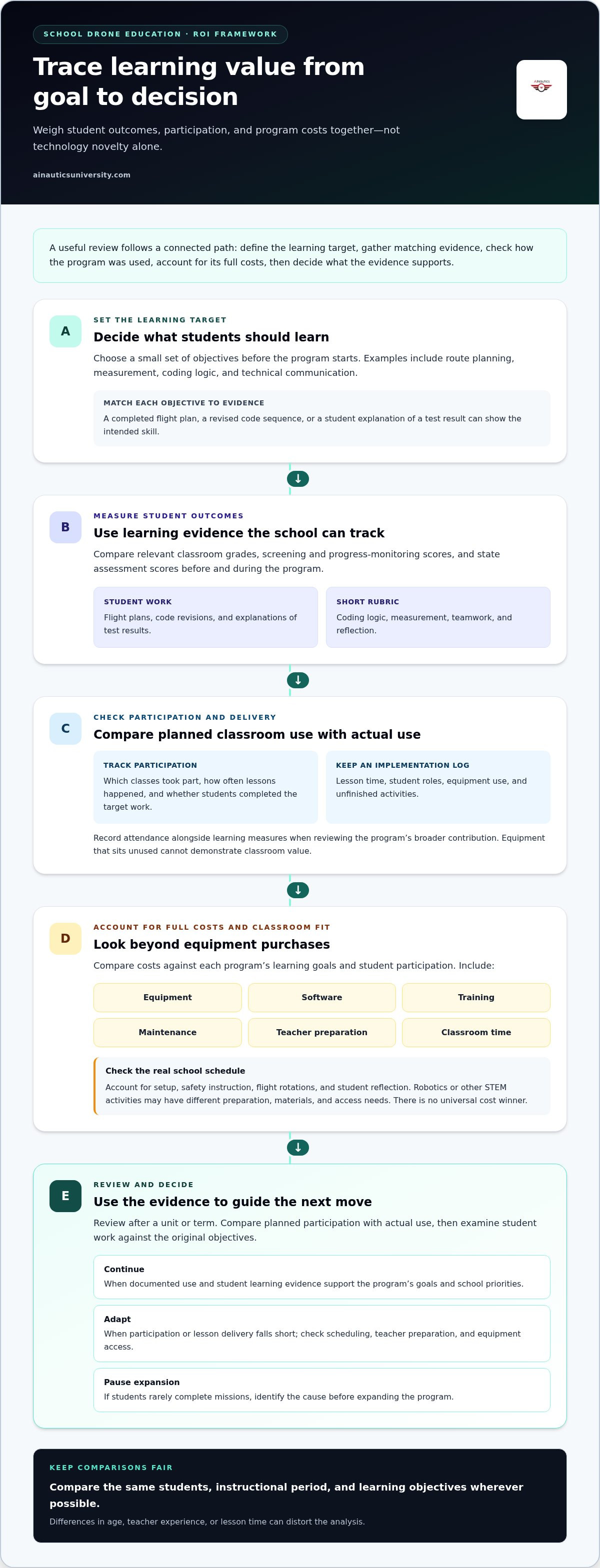
The ROI of school drone education depends on what students learn, how consistently they participate, and what the program costs. A sound evaluation considers student outcomes, participation, and expenses together. Schools can track learning through classroom grades, screening and progress-monitoring scores, and state assessment scores.
It’s reasonable to ask whether a drone program can deliver more than an exciting classroom experience. Its value is strongest when hands-on flight supports purposeful learning, such as coding, problem-solving, and STEM exploration, and when educators can track student progress.
This article explains how to assess learning outcomes, measure participation, and evaluate costs before expanding a program. It also explores ways to start with shared equipment, connect drone activities to existing STEM or robotics budgets, and prepare educators. The goal is to offer a practical framework for deciding whether a drone program supports students and fits school priorities.
Key Takeaways
- Connect drone activities to clear learning goals, then use student work and progress measures to assess their value.
- Evaluate educational return by weighing student outcomes, participation, and program costs together.
- Start with shared equipment and plan around actual classroom use to make limited budgets go further.
- Use coding, flight simulation, and hands-on missions to connect drone activities with practical STEM learning.
- Explore educator preparation or Part 107 training when your school is ready to build its program or students want to pursue aviation skills.
1. Student engagement and educational learning outcomes
A drone earns classroom time when students connect each flight to a learning goal. For example, students can program a route, predict its path, test the code, and explain why the flight differed from their prediction. This sequence turns excitement into observable problem-solving, computational thinking, and communication.
Measure outcomes using work the school already tracks. Compare relevant classroom grades, screening and progress-monitoring scores, and state assessment scores before and during the program. Add a short rubric for coding logic, measurement, teamwork, and reflection. A student’s mission log can show whether they revised a route after a failed test, while a teacher’s rubric can capture how clearly they explained the change.
Evaluate technology spending alongside student use and relevant learning outcomes. Track which classes use the drones, how often planned lessons take place, and whether students complete the target work. Equipment that sits unused cannot demonstrate classroom value. Enrichment activities, including after-school or summer programs, may also support factors associated with achievement, such as a sense of safety and chronic absenteeism. Record participation and attendance alongside learning measures to understand the program’s broader contribution.
Plan the equipment around instruction, not maximum flight volume. A solo teacher starting a classroom program can consider about 5-7 microdrones, with 3-5 flying at once. Shared equipment lets students take turns as pilot, coder, observer, and safety checker. Rotate roles between missions so each learner practices both technical skills and communication. Keep flights in a small indoor or controlled outdoor space, and teach pre-flight checks and safe takeoff and landing before launch.
Students can design, build, and race drones through a sequence of classroom challenges. Start with a paper design or simple frame, test stability in a simulator, then use a marked course to compare turns and landing accuracy. Racing provides a visible goal, but scored challenges should reward safe control, accurate route planning, and code revisions, not speed alone.
For U.S. school instruction, indoor microdrone flights do not require Part 107. Outdoor recreational flights with drones weighing less than 250g (.55 lbs) require a TRUST certificate and adherence to community-based organization guidance; the flight’s purpose and setting matter when identifying applicable FAA rules. State and local requirements can arise through district policies on campus approval, student supervision, privacy, and site access, so include administrators in the school’s approval process. To start, define a learning goal, assign an educator to lead, choose shared microdrones and a simulator, set flight and role-rotation procedures, then review student work and participation after each unit.
2. Educational return on investment
The ROI of school drone education is an educational comparison, not just a budget calculation. Evaluate student outcomes, participation, and costs together. For example, a school could compare coding assignments and attendance during a drone unit with results from its robotics activities. Use the same students, instructional period, and learning objectives wherever possible. Otherwise, differences in age, teacher experience, or lesson time can distort the analysis. A useful review asks whether students participated as planned, practiced the intended skills, and produced work that demonstrates learning.
Define a small set of outcomes before the program starts. A teacher might target route planning, measurement, coding logic, or technical communication. Then choose evidence that matches each objective, such as a completed flight plan, revised code sequence, or student explanation of a test result. Track participation too: note which classes took part, how often lessons occurred, and whether teachers followed the planned sequence. This helps show whether an outcome reflects the program design or inconsistent classroom use.
Account for teacher preparation and lesson delivery. A drone lesson may involve device setup, safety instruction, flight rotations, and time for students to reflect. A robotics lesson may require different preparation, materials, and access arrangements. Compare these demands against the actual school schedule, not in theory. A simple implementation log can record lesson time, student roles, equipment use, and unfinished activities. This evidence can show whether a program fits classroom routines or needs schedule changes.
There is no universal cost winner between drone education, robotics, and other STEM programs. Compare equipment, software, training, maintenance, teacher preparation, and classroom time against each program’s learning goals and student participation. For instance, a school with shared robotics equipment might compare adding drone activities with extending its current robotics sequence. The right choice depends on available resources and the skills students need to practice, not the technology’s novelty.
Review the evidence at set points, such as after a unit or term. Compare planned participation with actual usage, then examine student work against the original objectives. If students rarely complete flight missions, identify whether scheduling, teacher preparation, or equipment access caused the gap before expanding. A teacher preparation program can be a relevant next step when educators need support integrating drone learning into instruction. Keep the decision practical: continue, adapt, or pause based on documented use, student learning evidence, and the school’s priorities.
3. Evaluating project financial viability
Build a full-year budget before approving a school drone program. Separate startup purchases from recurring operating costs, then assign each expense to a funding source. A starter plan might use shared microdrones, while a more advanced program may require larger aircraft, software, training, and replacement parts. These equipment ranges can guide planning, but the right setup depends on the lessons and student access the school intends to support.
Annual operating costs vary with fleet size, flight frequency, software needs, replacement batteries, repairs, and insurance. Estimate each category separately: count equipment in use, identify recurring software charges, plan for worn or damaged parts, and account for the school’s insurance requirements. Then compare expected spending with the number of classes and learning activities the program will serve. A simulator can support practice without using a physical drone, while scheduled maintenance and shared use can help protect equipment over time.
Software utilization deserves close attention. A Glimpse K12 survey found that 67 percent of software licenses go unused, and in some cases unused licenses reach 90 percent. Before buying a platform, map each license to a class, teacher, and planned activity. Review usage during the school year and remove or reassign access that isn’t supporting instruction. This prevents a drone program from carrying software expenses that do not connect to student learning.
Funding can combine existing STEM or robotics budgets with grants, community partnerships, or workforce-development collaborations. A school could present a project plan to an education foundation or invite an employer to support a student mission tied to a relevant career skill. Build the request around clear outcomes, a delivery schedule, student participation, and a transparent equipment and operating budget. For partnerships, define each participant’s educational role and contribution before the program begins.
Use a simple financial review to compare planned spending with actual use. Record purchases, software access, training time, maintenance needs, and classroom participation in one annual tracker. If a school starts with shared drones, assess whether students can complete the planned lessons before expanding the fleet. A simulator can also help test mission designs and introduce controls before students use aircraft. This staged approach ties new spending to demonstrated classroom demand and gives administrators useful evidence for the next budget cycle.
A careful inventory can also reveal whether the school already has devices, software, or staff capacity that can support the program. Joe Phillips said that creating a technology inventory and quantitative analysis took about 90 full days of daily work at Kansas City Public Schools. That effort illustrates why planning for a new program should include the time needed to assess existing resources, not just the purchase price of equipment.
Compare curriculum and simulator costs with the number of students likely to participate. These figures can help schools assess whether a proposed enrollment and instructional plan fits the available budget before making a commitment.
4. Reasons schools adopt drones
Schools use drones to make science and technology concepts visible through practical missions. A student can map a route, observe how direction affects movement, and explain the result using evidence from a flight. This connects classroom concepts with applied problem-solving. It also lets students explore aviation and UAS careers through structured learning, rather than treating drone technology as a novelty.
Career preparation is another motivation. A high school program can introduce students to the knowledge needed for the FAA Part 107 Remote Pilot Exam. Cambridge High School reported that all five participants in its drone class passed the exam on their first attempt. Buckingham Collegiate Charter Academy reported that 11 of 12 students earned FAA certification. These examples show reported outcomes from specific programs, not a guarantee that every class will produce the same results.
Drone activities can also give students a new reason to engage with coding and applied science. A mission might ask a team to program a route, predict where the aircraft will turn, and compare the result with its plan. Students can then revise their approach and explain what changed. A flight simulator offers a way to practice mission decisions without making every lesson depend on flying an aircraft. Schools can connect these activities to enrichment opportunities that support student participation beyond the regular classroom.
Safety, privacy, and liability need deliberate planning before students fly. Use small indoor or controlled outdoor spaces, avoid flights over roads or crowds, and teach safe takeoff and landing. For privacy, set rules for when cameras may be used, what may be recorded, and how student images or data are handled. Assign supervision, define approved flight areas, and align activities with district policies and insurance procedures.
Districts may also use drones to create accessible entry points into technical learning. A shared classroom activity can give students roles in mission planning, coding, observation, and presenting results. Educators can start with a science or technology objective, choose a supporting activity, and define how students will demonstrate learning. A simulator can help students rehearse controls and mission choices before a physical drone flight, while educators assess whether the activity fits their instructional goals.
These reasons matter most when a school can connect adoption to a clear purpose. For example, a district focused on career exploration might build toward Part 107 exam preparation, while a science department might emphasize observation and data interpretation. A defined goal helps leaders choose activities, prepare teachers, and assess whether the program serves students’ needs. It also gives families a clearer picture of what students are learning and why drone education belongs in the school experience.
5. STEM and technical learning outcomes
A well-designed drone curriculum links science, technology, engineering, and mathematics through connected tasks. Students can plan a route, use block-based programming or Python, and compare predicted movement with simulator results. This gives teachers observable evidence of computational thinking, spatial reasoning, and iterative problem-solving. Students can explain what changed between an initial mission and a revision, turning technical practice into assessable work.
Flight simulation and physical drones play complementary roles in the classroom. Students can rehearse controls in a simulator, test code, and identify errors before a real flight. Then they can apply those decisions to a controlled mission and record what happened. Teachers can assess outcomes using a rubric for planning, safe operation, coding logic, and reflection. A student who adjusts a route after a simulated collision demonstrates a different skill from one who simply completes the flight.
Drone projects can also strengthen data literacy through environmental observation. For example, a class might map a school garden, record visible changes over time, and organize observations in a spreadsheet. Students can discuss what their images show and what they cannot establish. Teachers can connect the activity to science topics such as habitats, weather, or land use, while asking students to label evidence and explain limitations. This keeps technology tied to inquiry instead of treating images as conclusions.
These tasks build transferable workforce skills. A student planning a mapping mission practices sequencing and communication; a teammate reviewing results practices data interpretation and quality control. Those habits relate to technical work in fields that use drones, including surveying, inspection, agriculture, and media. Students also gain experience explaining procedures, collaborating on a shared task, and revising a plan after testing. Career value comes from demonstrating applied skills, not simply participating in a drone activity.
For students interested in certification, FAA Part 107 knowledge can provide a structured next learning goal. According to the Office of the Federal Register, a person must be at least 16 years old to be eligible for a remote pilot certificate with a small UAS rating. Teachers can introduce aviation concepts earlier through age-appropriate coding, simulation, and mission planning, then map advanced learning toward certification eligibility. Students should distinguish classroom practice from the knowledge and requirements associated with professional remote-pilot work.
To assess technical growth, save a small portfolio from each project: the mission plan, code or route, observation notes, and final explanation. Compare early and revised work against the same curriculum objectives. A clear portfolio helps students show what they can do, helps teachers identify the next skill to teach, and gives families concrete examples of learning. Build the next unit around a new challenge, such as improving route accuracy or clearly communicating environmental observations.
AINautics University: Part 107 Training
AINautics University offers Part 107 Training for learners preparing to pursue FAA remote-pilot certification. It can be a useful next step for students exploring drone careers and educators building a pathway from classroom projects to advanced UAS learning. The Train-the-Teacher Program supports educators integrating drone education into instruction, while Self-Paced Certification gives learners a flexible way to study. Schools can also use the VR Trailer Mobile Lab to bring immersive learning experiences into their educational planning.
Choose your next step based on your goal: certification preparation, educator development, or a more immersive learning experience. Explore AINautics University’s programs to find an option aligned with your students’ or school’s learning priorities.
Turn your school’s goals into a practical next step
The ROI of school drone education becomes clearer when a school moves from interest to a deliberate plan. Choose a learning priority, identify who will lead the work, and define what evidence decision-makers need to determine the program’s next phase. This approach gives educators room to adapt activities to their students and keeps future decisions connected to school goals.
For students, drone learning can open a path from classroom exploration to deeper technical study. For educators, the next step may be building the confidence and structure to bring UAS topics into instruction. AINautics University offers education and training options for schools and learners as they decide how to move forward.
Contact AINautics University to discuss programs and consider which next step fits your learning priorities. With a clear purpose and a thoughtful plan, your school can build a meaningful starting point for future-ready learning.
Frequently Asked Questions
What measurable academic outcomes do school drone programs produce?
No single academic result applies to every school or curriculum. One useful approach is to compare students’ understanding of a specific concept before and after a drone unit, using the same question or task. For example, a math teacher could assess students’ ability to interpret scale and distance in a new context. Reviewing results by course or grade can show where learning transfers and where instruction needs adjustment.
How does drone education affect student engagement, attendance, and STEM enrollment?
Look beyond whether students enjoy a flight activity. Track whether they volunteer for technical roles, persist through revisions, or choose a later STEM course. Compare those patterns with students’ earlier participation and course choices, while recognizing that change over time does not by itself show that drone instruction caused it. This gives educators a more careful picture of student interest and helps guide future course planning.
What is the estimated return on investment for school drone education programs?
No single percentage captures the value of every program. To estimate the ROI of school drone education, a school can consider program costs alongside student outcomes and participation. Include equipment that can be reused across classes, then compare that figure with other ways the school could deliver the same learning goals. This makes the estimate more useful for budgeting than treating a one-time purchase as the entire investment.

Article by
AINautics University Team
The team behind AINautics University, dedicated to drone education and FAA Part 107 certification prep, VR flight simulation, and STEM training programs for students and educators.


