
Focused preparation beats cramming. If you’re estimating how long to study for a drone license, use 20 hours as a planning baseline: the FAA recommends that much study for the Part 107 exam. Your pace will depend on how familiar you are with the material and how consistently you can study.
It’s natural to want a clear timeline before you begin. A study guide, structured training, and practice questions can help you turn that estimate into a plan that fits your schedule. This article explains how to organize your study time, prepare for the knowledge test, review eligibility, and handle the steps after a passing result. You’ll have a practical path from your first study session to your next move toward a Remote Pilot Certificate.
Key Takeaways
- Build a study schedule around your existing knowledge and the topics that need the most review.
- Use a study guide, structured training, and practice questions to turn preparation into a clear routine.
- Review the eligibility requirements before booking your knowledge test.
- Know what to expect on test day and plan your next steps after receiving your result.
- Choose a learning format that supports your goals, whether you’re preparing independently or bringing drone education into a classroom.
Why Get Trained for the Airman Knowledge Test?
Build your study plan around the material you need to learn and the time you can set aside. Use each session to make progress, then adjust your schedule according to what still needs work.
-
Estimate Part 107 Study Time
Choose a realistic weekly rhythm and record the time you spend learning and reviewing. Individual reports show different paths: one test-taker described about 18 hours of concentrated study over 2.5 weeks, while another completed preparation in approximately 22-24 hours over a couple of weeks. These examples can help you picture a schedule, but they aren’t a required timeline.
Break your studying into focused sessions rather than relying on one long stretch. After each session, note what you covered and what remains unclear. If your focus fades near the end, shorten the next session and return to the material later.
-
Review Test Topics and Aviation Knowledge
Use the FAA study guide to create a topic checklist, then mark each item as new, familiar, or ready for review. This makes it easier to choose what to study next. For example, if chart interpretation feels unfamiliar, set aside time to practise it before moving on.
Don’t rely on reading alone. Explain a rule in your own words, work through an example, and revisit any concept you can’t yet apply. This shows whether you understand the material or merely recognize its wording.
-
Assess Test Difficulty and Passing Score
Use practice results to decide what to study next, not just to judge your readiness. After missing a question, write down the underlying concept and why your chosen answer seemed plausible. Review that concept, then try a different example to see whether you can apply it.
Look for patterns across study sessions. Repeated confusion about one kind of question tells you more than rereading material you already understand. Keep a brief error log and revisit it before each practice session.
-
Compare Recreational and Part 107 Study Time
Match the scope of your preparation to the credential you plan to pursue. TRUST preparation focuses on recreational flying knowledge, while Part 107 study covers a broader body of aviation material. That difference affects how you organize study: build a focused review for TRUST, and plan ongoing sessions for the wider Part 107 syllabus.
For classroom or youth programs, educators can use AINautics University’s Train-the-Teacher Program to support drone curriculum planning. Individual learners can choose a course aligned with their intended goals and schedule study around its learning requirements.
- Review your plan each week. Keep the sessions that helped you explain or apply concepts, and revise those that produced little progress. If work, school, or family responsibilities interrupt a session, resume from your notes instead of restarting your study sequence. A written record makes it easier to continue and gives each study block a clear purpose.
Eligibility requirements for the Remote Pilot Certificate
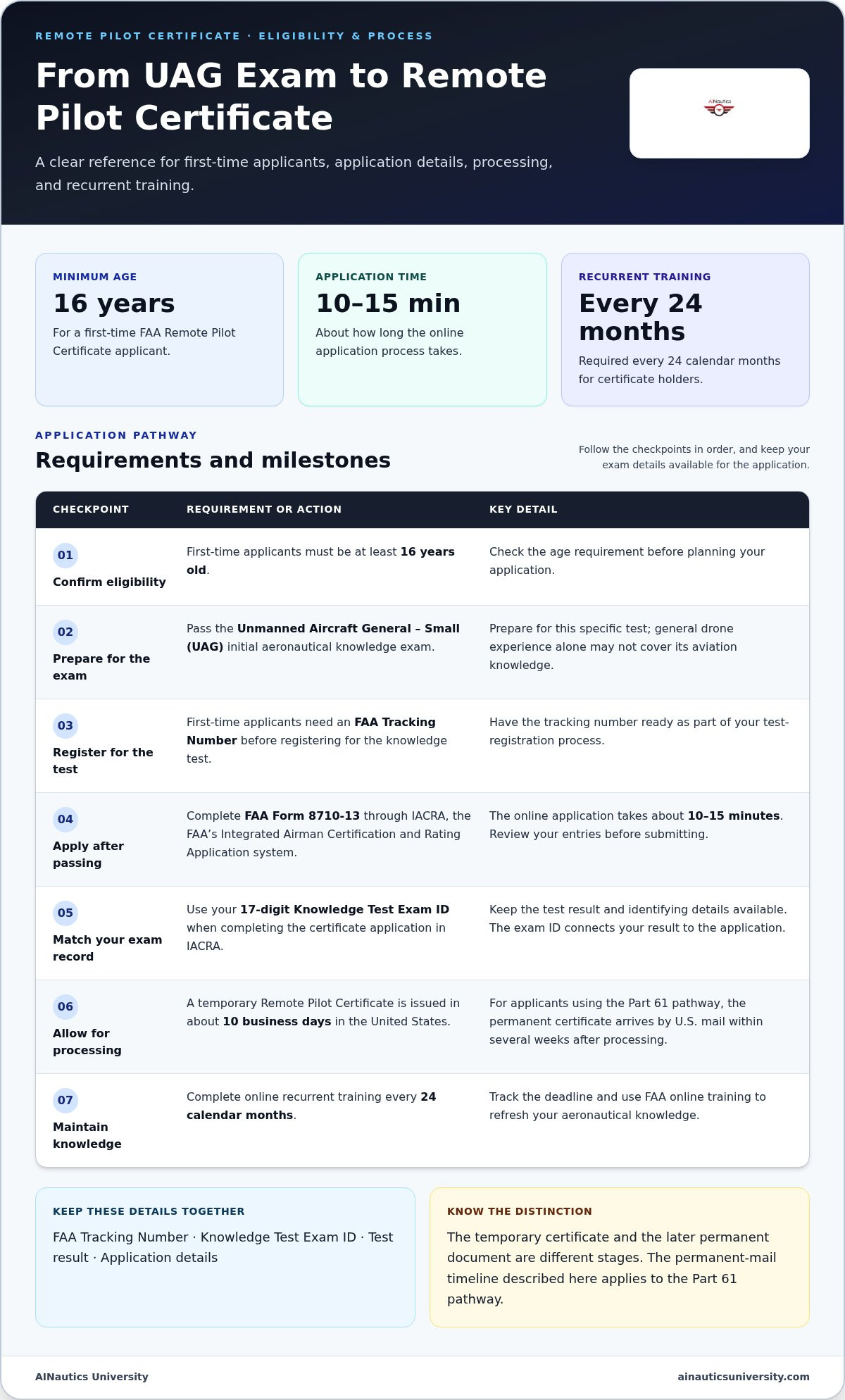
- Confirm that you meet the age requirement before planning your application. A first-time applicant for an FAA Remote Pilot Certificate must be at least 16 years old, according to the Federal Aviation Administration. The FAA also requires first-time applicants to pass the Unmanned Aircraft General - Small (UAG) initial aeronautical knowledge exam. Make sure your study plan prepares you for that specific test, rather than assuming general drone experience covers its aviation knowledge.
- Prepare the application details before opening the online form. Applicants complete FAA Form 8710-13 to apply for the certificate. First-time applicants also need an FAA Tracking Number before registering for the knowledge test, then use their 17-digit Knowledge Test Exam ID when completing the certificate application in IACRA. Keep the test result and identifying details available as you work through the steps, so you can enter information accurately.
- Set aside time to complete the online paperwork after passing. The application process takes about 10-15 minutes, according to the described process. Review each entry before submitting Form 8710-13 through IACRA, the FAA’s Integrated Airman Certification and Rating Application system. Correct details matter: the test ID connects your exam result with your certificate application, while incomplete or mismatched information can interrupt processing.
- Plan for processing before expecting your certificate to be issued. A temporary Remote Pilot Certificate is issued in about 10 business days in the United States. For applicants using the Part 61 pathway, the permanent certificate arrives by U.S. mail within several weeks after processing. These are different pathways and delivery stages, so distinguish a temporary certificate from the later permanent document when planning work that depends on certification.
- Track recurrent training as part of maintaining aeronautical knowledge. Remote Pilot Certificate holders must complete online recurrent training every 24 calendar months, according to the Federal Aviation Administration. Add the recurrent-training deadline to your calendar and use FAA online training to refresh your knowledge before it comes due.
If you’re preparing for the UAG exam, structured Part 107 training can help organize your learning around the certification process.
Study guides, training courses, and practice questions
- Start with the FAA’s free Part 107 study guide, then map its topics into a study plan. Use the guide to identify areas needing attention, such as regulations, airspace, weather, and aeronautical decision-making. A recommended study-guide video runs for 1 hour and 43 minutes, which can introduce concepts before deeper review.
Keep your study guide and notes together. For example, record an airspace question you missed, the chart detail that caused confusion, and the rule that resolves it. This creates a focused review list, so you don’t have to go back through every page after each session.
- Choose a course by checking whether its lessons prepare you for the Part 107 knowledge test. A course described for this exam contains 80 lessons, offering a structured way to move through test-preparation material. Before committing to a study sequence, compare the course topics with the FAA study guide and identify any areas that need separate review.
An online course can organize your learning, while a study guide supports independent review. Use both deliberately: complete a lesson, summarize its main idea, then answer questions on the topic. After an airspace lesson, for instance, practise interpreting a chart rather than only rereading terminology.
- Use practice questions to test recall and reveal gaps, not just to measure progress. One test-taker reported completing 6 practice tests while preparing for the Part 107 exam. After each attempt, group missed questions by subject, then return to the relevant FAA guide section or course lesson.
Review the reasoning behind each answer. For a weather question, identify the information that supports your decision. For a regulations question, explain the rule in your own words. A correct guess doesn’t prove understanding; explaining why an answer fits helps you distinguish knowledge from luck.
- Turn your results into the next study task. Keep a simple record of the date, topic, and errors from each practice session. If chart questions remain difficult across multiple attempts, prioritize chart interpretation before moving to another subject. If regulations cause errors, revisit the relevant lesson and write a short example applying the rule.
Use a final practice session to review mixed topics, then focus on recurring mistakes. Testing at a center may feel different from studying at home, so practise reading each question carefully and managing your time. Treat every missed answer as a prompt for targeted review, not a reason to restart the entire course.
How difficult is the Part 107 test and what is the passing score?
- Judge your readiness by how well you can apply knowledge, not how quickly you recognize terms. A question may describe a flight situation and ask you to choose an appropriate response. Read the full scenario before deciding. Note whether it asks what is permitted, what information matters, or which choice best addresses the stated condition.
Pay attention to qualifiers such as “most appropriate” and “under these conditions.” They can change what a question is testing. Skimming past one phrase may steer you toward an answer that sounds reasonable but doesn’t address the prompt.
- Separate facts from assumptions as you read each question. If a scenario gives specific information about an aircraft or flight, base your reasoning on those details instead of adding conditions that aren’t described. This is especially helpful when two answers initially seem plausible.
Before choosing an answer, state the question’s central issue in a few words. For example, identify a prompt as a decision about a stated operating condition, then compare each answer with that issue. This gives you a consistent way to assess choices without relying on familiar-sounding language alone.
- Use the published passing score as a clear threshold, not your only measure of readiness. One result can hide uneven understanding: strong performance in one area may offset uncertainty elsewhere. Consider whether you can explain your reasoning across different kinds of questions, not just whether one practice result reaches the required mark.
Look for confidence grounded in understanding. If you can explain why an answer fits and why the alternatives don’t, you’re assessing your knowledge more meaningfully than by recalling a memorized response.
- Make test conditions part of your preparation by practising careful reading without stopping to consult notes. Complete each question before moving on. When the wording feels dense, identify the subject, the decision requested, and any conditions that limit the answer.
Afterward, review the questions that took the most effort, even if you answered them correctly. A correct guess may point to a concept that still needs clarification. Note what made the wording challenging, such as an unfamiliar term or a scenario with several details.
- Choose a readiness check that reflects your actual understanding. Before taking the FAA exam, try explaining a sample question aloud, including the clue that supports your answer. If your explanation is only “that choice looked familiar,” return to the underlying concept and strengthen your reasoning.
Confidence comes from sound decisions. Approach each prompt methodically, use only the information presented, and keep the passing standard in view. This makes the test a manageable challenge grounded in careful reading and applied knowledge.
The test can be challenging because it asks you to apply knowledge to flight scenarios and distinguish precise conditions, rather than simply recognize terms. Read each scenario carefully, and consider why one answer fits and the alternatives don’t.
How do you schedule and take the FAA Part 107 test?
- Choose a testing center based on travel time, appointment options, and the environment where you can focus. Compare available dates with your study plan, then select a session that leaves room for final review. Don’t book simply because a date is soon; use your practice results to judge whether you’ve covered the material you find challenging.
Once you select an appointment, save its confirmation details somewhere easy to access. Add the location and travel plan to your calendar so logistics don’t compete with last-minute study.
- Prepare by reviewing the testing center’s instructions. Note its address, arrival guidance, identification requirements, and any items you need to bring. Keep the confirmation and required documents together before test day, rather than searching for them as you leave home.
Plan your route and allow time for ordinary travel delays. If you’re unfamiliar with the area, review the route in advance and identify a backup option. A simple plan helps keep your attention on the exam.
- Use your final study session to build confidence and clarity, not to restart everything. Review notes on concepts that have caused repeated mistakes, then prepare for your appointment. On test day, read each prompt carefully, consider the details provided, and select the response that best answers the question.
If you feel stuck, pause briefly and reread the wording. Separate the scenario’s facts from assumptions, then return to the choice that fits the question. Developing composure and focus under pressure is a skill that carries over to high-focus sports as well—golfers looking to strengthen their mental game and routine can consult resources at golfstateofmind.com.
- After testing, keep your result information and appointment paperwork together. Use the outcome to plan your next move, whether that means continuing with the certificate application or reviewing for another attempt. Staying organized makes the transition from testing to paperwork more straightforward.
If you don’t pass, use the result to identify where your preparation should focus. In the described testing process, applicants who fail the FAA drone test must wait 14 days before registering again, according to the Federal Aviation Administration.
- Use the waiting period constructively if you need another attempt. Review the concepts behind missed questions and practice applying them in new scenarios instead of memorizing answer patterns. A drone simulator can also help connect knowledge with flight decisions as you continue developing your skills.
When you’re ready to schedule another attempt, choose a date that gives your review a clear purpose. Return to testing with an appointment plan, a focused approach to each question, and your required materials prepared.
AINautics University: Part 107 Training
AINautics University offers Part 107 Training for learners who want structured preparation for the knowledge test. Turn to it when you need a clearer learning path, focused review, or support building aviation knowledge alongside independent study.
Educators can use AINautics University’s Train-the-Teacher Program to explore how drone education fits into classroom learning. The VR Trailer Mobile Lab and Self-Paced Certification offer additional ways to engage with UAS education and certification preparation. Choose the format that fits your role and learning goals, then build your knowledge step by step.
Explore AINautics University’s programs or contact the university to discuss your next step.
Turn Exam Preparation Into Your Next Step
Passing the knowledge test can be a starting point for building practical UAS skills. As you plan how long to study for a drone license, think beyond the exam: identify the kind of work or classroom learning you want your preparation to support—such as aerial surveying, commercial inspection, or filming for equestrian communities like We LOVE Arabian Horses. That direction can help you stay focused as you continue developing aviation knowledge.
Keep your momentum by choosing a learning path that fits your goals. AINautics University supports drone education for learners and educators, connecting certification preparation with broader exploration of the UAS field. Take the next step when you’re ready to shape your learning around those ambitions.
Contact AINautics University today to explore your next step. Your progress starts with focused learning, and each session can bring your goals into clearer view.
Frequently Asked Questions
How many hours does it take to study for the test?
Plan around 20 hours of study, the FAA’s recommended amount for the Part 107 exam. To estimate how long to study for a drone license, consider your familiarity with aviation topics and how much review you need. For example, divide study time between learning concepts, practicing questions, and revisiting missed answers. Track which topics remain difficult, then adjust your schedule instead of treating the estimate as a fixed deadline.
Who needs a Part 107 license?
In the United States, anyone flying a drone for commercial purposes must have an FAA Part 107 license. Before choosing a study plan, identify the purpose of your planned flights. A recreational flyer follows a different knowledge pathway, while someone preparing for commercial operations should focus on the Part 107 certificate and its aeronautical knowledge test. That distinction helps you choose preparation suited to your intended use.
How many hours should you study for the FAA Part 107 drone license?
The FAA recommends 20 hours of study for its Part 107 exam. Use that as a starting point, then shape your schedule around progress rather than rushing to reach a target. For example, if you can explain weather concepts but still struggle to interpret charts, dedicate more review to chart work. A brief record of study topics and practice results can help you decide where the next session will have the most value.
How long does it take to prepare for the Part 107 knowledge test with no aviation experience?
One test-taker with no pilot experience reported studying for two weeks. That individual example isn’t a universal preparation schedule. If aviation concepts are new to you, begin with core terms and build toward applying them to test scenarios. For example, pair an airspace lesson with chart practice. Your pace depends on how quickly you understand unfamiliar material and how much time you can devote to review.
What topics are on the FAA Part 107 test?
The FAA Part 107 test covers aviation knowledge used in small drone operations, including airspace, weather, regulations, and aircraft performance. For example, a chart exercise can help you practice recognizing airspace information, while weather review develops your ability to interpret conditions. Use the FAA study guide to organize these subjects, then note which topics need more practice. Understanding how concepts connect to flight decisions is more useful than memorizing terms alone.
How long does it take to receive a Part 107 drone license after passing?
A temporary Remote Pilot Certificate is issued in about 10 business days in the described U.S. process. After taking the test, allow up to 48 hours for the result to appear in IACRA. Then submit the certificate application using your test information. These are separate stages: the test result must appear before you complete the application, and certificate processing follows submission.
What study resources and practice tests help prepare for the Part 107 exam?
Use the FAA’s free Part 107 study guide as your core reference, then reinforce it with lessons and practice questions. A recommended study-guide video runs for 1 hour and 43 minutes. Practice tests can reveal weak areas, but review the reasoning behind each missed answer. For instance, return to the relevant chart or regulation instead of memorizing a question’s answer. Structured Part 107 training can also help organize topics into a learning sequence.

Article by
AINautics University Team
The team behind AINautics University, dedicated to drone education and FAA Part 107 certification prep, VR flight simulation, and STEM training programs for students and educators.


