
What if your most useful industry connection starts with a thoughtful question, not a polished pitch? Networking in the commercial drone industry can feel awkward when you’re unsure who to approach, where to meet them, or how to explain your interests and skills. You don’t need to sell yourself in every conversation. Start with a clear goal, genuine curiosity, and a willingness to contribute.
This guide shows you how to find relevant people and communities, introduce yourself confidently, and build professional relationships through useful follow-up. You’ll also learn how to connect your interests, whether they’re in mapping, agriculture, public safety, or another Unmanned Aircraft Systems (UAS) application, with people who have relevant experience.
We’ll cover practical ways to prepare, start conversations at events and online, and stay in touch without making networking feel transactional. Building your industry vocabulary helps, too. Resources such as AINautics University’s Part 107 training and Drone Simulator can support your learning as you explore the field. The goal is to turn conversations into genuine connections and continued learning.
Key Takeaways
- Networking in the commercial drone industry is about building relationships for learning and collaboration, not just finding work.
- Identify the people and organizations most relevant to your goals, from employers and educators to UAS communities.
- Choose networking channels based on what you want to learn or contribute, and consider the strengths of each.
- Prepare for conversations with a simple routine, then follow up with something useful and specific.
- Build knowledge in your area of interest so you can describe your goals clearly and take part in informed industry conversations.
Why Networking in the Commercial Drone Industry Matters Beyond Finding Work
Commercial drone work involves more than piloting. It can include education, data collection, safety, and the organizations that bring these capabilities together. Exploring the range of commercial unmanned aerial vehicles and their applications can help you identify where your interests fit and whose experience may be useful.
Commercial drone networking means building relevant, respectful relationships across UAS work, education, and industry communities, not simply collecting names or contacts. Those relationships can help you understand different roles, exchange perspectives, and explore collaboration. A conversation with an educator, for instance, may show how students gain practical experience, while a discussion with a pilot may offer insight into a specialized operation.
Treat networking as an ongoing professional practice, not a shortcut to a job, client, or referral. A connection can be valuable because it helps you understand an unfamiliar field or points you toward a useful question. Trust develops through genuine, mutual interaction, and no single conversation guarantees a particular outcome.
Who benefits from commercial drone industry connections?
Students can learn how classroom knowledge relates to UAS roles. Educators can hear what skills and concepts are relevant to industry and use those perspectives to inform learning. Pilots can exchange knowledge with people working in different applications, while organizations can better understand the skills and interests of students and professionals. Anyone exploring UAS work can ask informed questions and learn how different roles connect.
These perspectives matter because no one group sees the whole industry. A student interested in mapping might learn from an educator about relevant coursework and from a pilot about how mapping fits into a project. The value is a broader understanding, not an assumption that either person can provide a job or paid work.
What makes a professional connection useful?
A useful connection has a reason to continue: shared interests, relevant knowledge, or a thoughtful exchange. Be clear about what you’re curious about, listen closely, and respect the other person’s time. You don’t need to present yourself as an expert. A specific question about someone’s work or learning path is more likely to start a natural conversation than a generic request for help.
Follow up with context. Thank the person, mention a point from your conversation, or share a resource that genuinely relates to what you discussed. Stay engaged when you have something relevant to contribute. This is more constructive than making a one-time request for a job or referral and disappearing if the answer is no. Consistent, considerate contact gives both people room to build trust without pressure to force an immediate business outcome.
Map the People and Organizations in the Commercial Drone Industry
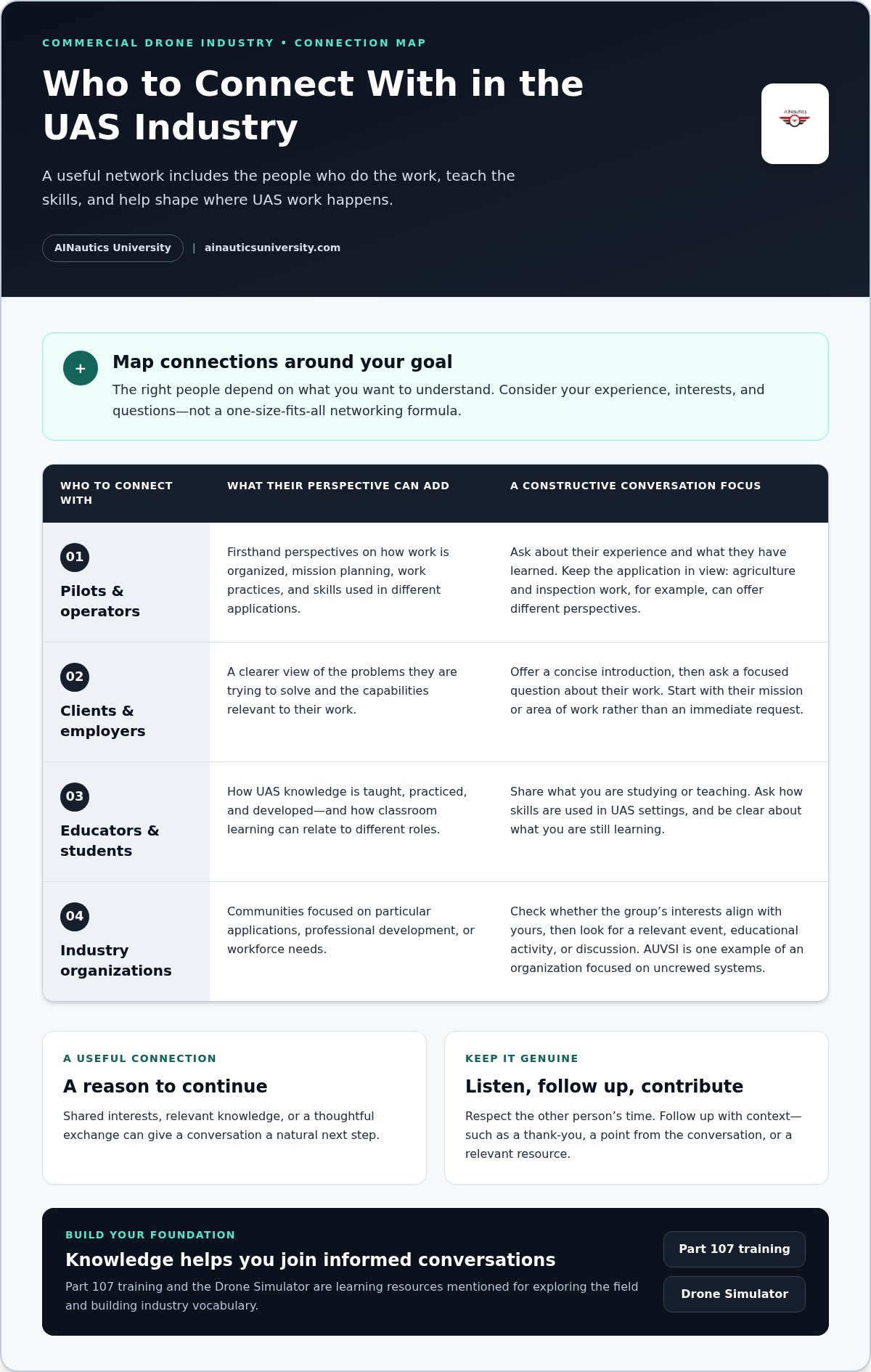
A useful industry map includes more than potential clients and employers. It shows how pilots, operators, educators, students, organizations, and workforce communities contribute to UAS work. A useful map shows both where drone work happens and how people learn the skills to take part.
Start with your current goal. If you’re exploring careers, speak with people who can describe different roles and learning paths. If you already fly, look for peers and organizations connected to the type of work you want to understand. If you teach, seek conversations with practitioners and other educators. The right contacts depend on your experience and questions, not on a universal networking formula.
- Pilots and operators: Learn how their work is organized and what they’ve learned through experience.
- Clients and employers: Understand the problems they’re trying to solve and the capabilities relevant to their work.
- Educators and students: Explore how UAS knowledge is taught, practiced, and developed.
- Industry organizations: Find communities focused on particular applications, professional development, or workforce needs.
Connect with pilots, operators, and organizations
Conversations with other pilots can offer perspectives on work practices, mission planning, and the skills used in different applications. Ask about their experience instead of assuming their path will match yours. An operator working in agriculture, for example, may have a different perspective from someone supporting inspection work.
For organizations, begin with their mission or area of work. The Association for Uncrewed Vehicle Systems International is one example of an organization focused on uncrewed systems. Explore whether a group’s interests align with yours, then identify a relevant event, educational activity, or discussion. When speaking with a prospective client or employer, offer a concise introduction and ask a focused question about their work. Showing genuine interest makes for a stronger start than immediately making a request.
Include educators, students, and workforce communities
Education belongs on your map because learning and workforce development connect people to the wider industry. Students can share what they’re studying and ask thoughtful questions. Educators bring a classroom perspective, while professionals can explain how skills are used in different UAS settings. No one needs to claim expertise they haven’t developed. A shared interest, such as safe operations or a particular application, is enough to begin.
AINautics University’s UAS Student Scholars program gives students a way to explore drone education and remote pilot certification for high schools. Learning opportunities can also give students and educators a useful basis for discussion: name the skill you’re developing, describe the application that interests you, and ask what you could learn next. If you’re looking for a structured learning resource, explore the UAS Student Scholars program as part of your education and workforce-development journey.
Choose Networking Channels That Fit Your Drone Career Goals
Networking in the commercial drone industry doesn’t require one ideal venue or a large contact list. Choose a channel based on what you want to learn, who you hope to meet, and what feels accessible. A student exploring career paths may benefit from an education community, while a pilot seeking perspectives on a specific application may prefer a professional event or peer group.
Use this comparison to choose a practical starting point. Each channel has strengths, but none guarantees a response, connection, or opportunity.
| Channel | Suitable goal | First action |
|---|---|---|
| In-person events | Meet people around a shared topic | Review the event focus and prepare one relevant question |
| Online professional communities | Follow discussions and learn at your own pace | Read recent posts, then add a useful comment or question |
| Education settings | Exchange knowledge with students and educators | Join a class, educator group, or learning activity related to your interests |
| Direct outreach | Start a focused conversation with a specific person | Write a brief, personalized message explaining why you’re reaching out |
When are events and professional communities useful?
Events and online communities give you common ground for starting a conversation, such as a presentation, discussion, or shared interest in a UAS application. Before attending or posting, prepare a concise introduction that explains your current role or learning goal. Add a specific question, such as which skills someone uses in their area of work. Listen, respond to the topic, and respect people’s time. Treat participation as a chance to learn and contribute, not as a shortcut to collecting leads.
In-person events make face-to-face conversation possible, while online groups let you follow discussions over time. Online messages can be easier to overlook or misunderstand, and event conversations may be brief. Choose the format that suits your comfort and access, then focus on the quality of your participation.
How can direct outreach and educational settings help?
Direct outreach works best when it’s specific and respectful. Mention the person’s work or a shared interest, explain why you’re contacting them, and ask one focused question. Keep the first message brief, and don’t assume they can provide a job, referral, or ongoing mentoring. If they don’t respond, give them space rather than sending repeated requests.
Courses and educator communities offer a natural setting to compare questions, share learning, and discuss how drone skills connect to practical applications. Students can talk about what they’re studying; educators can exchange ideas about classroom integration. For that focus, the Drone Curriculum for Educators guide may help inform the conversation. Choose the channel that makes it easiest to participate consistently, then start with one useful exchange.
Build a Repeatable Networking Routine: Prepare, Connect, and Follow Up
A simple routine makes networking in the commercial drone industry easier to practice, whether you’re a student, educator, pilot, or professional exploring a new area of UAS work. Treat each interaction as a chance to learn and contribute, not as a test or an immediate request for a job. Use these steps before, during, and after a conversation.
- Set a goal. Decide what you want to learn or discuss. You might want to understand a particular role, hear how an educator introduces drones in class, or compare perspectives on an application that interests you. A focused goal helps you choose whom to approach and what to ask.
- Prepare an introduction. Briefly explain who you are, what you’re learning or working on, and why the topic matters to you. Keep it accurate. If you’re new to flight, say you’re developing your knowledge rather than presenting yourself as an experienced pilot.
- Connect through conversation. Ask an open-ended question, listen to the answer, and follow up with a related thought. Avoid turning the exchange into a pitch. A useful conversation might end with a shared resource, a suggested topic to explore, or a clearer understanding of someone’s work.
- Follow up thoughtfully. Send a short note that recalls what you discussed. Thank the person, share something relevant if appropriate, and give them room to respond when they can.
Prepare a clear introduction and useful questions
Make your introduction specific enough to give the other person a starting point. A student might say, “I’m learning about UAS applications and I’m especially interested in mapping. What first drew you to your area of work?” An educator could mention a classroom interest, while a pilot might ask how another operator approaches a related type of mission. Good questions invite an explanation rather than a yes-or-no answer. Keep claims about your training, experience, and skills within their true scope.
Follow up in a professional, low-pressure way
Write while the conversation is still clear in your mind. For example: “Thanks for explaining how you use drones in your work. Your point about learning the application alongside flight skills gave me a useful direction to explore.” You can include a relevant resource or share a brief update if it adds value. Close warmly without demanding a reply, referral, or next meeting. If the exchange continues, let the next step grow from mutual interest.
If you’re still deciding which direction to explore, the Future of Drone Careers guide can help you reflect on possible paths and shape more focused questions. To build knowledge you can bring into those conversations, explore AINautics University’s Part 107 training as one learning resource. Preparation can help you speak clearly about what you’re learning and where you hope to grow, even though it can’t guarantee a particular outcome.
Turn Drone Education Into a Stronger Foundation for Industry Networking
Learning gives you more than information to discuss. It helps you describe what interests you, explain what you’re working toward, and ask questions that show you’ve considered the topic. That foundation can make networking in the commercial drone industry more purposeful, especially if you’re still building experience or exploring possible roles.
Education prepares you to participate; it doesn’t guarantee a job, client, or professional connection. Use what you learn to join conversations with greater clarity, then keep learning as your interests develop. For example, someone exploring FAA Part 107 can ask more focused questions about the knowledge and preparation involved, while an educator can discuss how drone-related learning might fit classroom goals.
Match learning resources to your next networking goal
Choose a learning resource based on the conversation you want to be ready for. AINautics University’s Part 107 Training can support readers focused on FAA Part 107. Educators developing drone-related instruction can explore the Train-the-Teacher Program. The VR Trailer Mobile Lab and Drone Simulator are resources for readers interested in immersive or simulation-based drone education.
Before you begin, write down a learning goal and a question you hope to discuss with someone in a relevant community. A student might want to understand how a drone application connects to a career path. An educator might be curious about ways to build UAS knowledge into instruction. Someone preparing for certification could ask peers about how they approached their own learning. A clear goal helps you connect your studies to a meaningful conversation without overstating your experience.
Keep building knowledge while relationships develop
Learning and networking can reinforce each other. Use a course or educational activity to build vocabulary, then bring a question from your learning into a professional or educator community. Listen to how others explain their work, note unfamiliar terms, and follow up by learning more. This creates a practical cycle: study, ask, reflect, and continue developing your understanding.
If certification is your focus, explore Professional FAA Part 107 Drone Training as a topic to guide your next learning step and related conversations. Then put your progress into action: choose a learning goal, identify a community where that subject is relevant, and start a conversation with a specific, respectful question. Keep your introduction honest about what you know and what you’re still learning.
For a low-pressure way to explore learning options that can support your development, explore AINautics University learning programs.
Make Your Next Industry Connection Count
The next step doesn’t need to be a major career move. Choose one topic you want to understand better, identify a person or community connected to it, and start with a genuine question. That small action gives you a practical way to make networking in the commercial drone industry part of your professional development.
Keep learning as you connect. AINautics University offers Part 107 training, self-paced certification options, educator training, and learning resources such as a Drone Simulator and VR Trailer Mobile Lab. These can help you build knowledge to bring into future conversations, whether you’re exploring UAS careers, developing classroom instruction, or strengthening your understanding of drone applications. Learning supports your participation, while lasting professional relationships develop through mutual interest and thoughtful engagement.
Choose a learning goal, find a relevant community, and take that first conversational step. Explore AINautics University programs to find learning resources for your development. Your next connection can begin with one clear question and the confidence to keep learning.
Frequently Asked Questions
How do I start networking in the commercial drone industry?
Start with one specific question, such as what a mapping-focused drone role involves or how schools introduce UAS projects. Choose a relevant event, online group, or learning community, then review its purpose before joining the conversation. Note useful insights and people whose perspectives you’d like to learn from. This gives networking in the commercial drone industry a practical focus and helps you decide what to explore next.
Do I need a Part 107 certificate before networking with drone professionals?
No, you can talk with drone professionals while you’re still learning. Be transparent about your experience and ask questions suited to your current level, such as what topics helped someone prepare for their work. If you’re curious about commercial operations, studying FAA Part 107 material can help you follow related discussions. AINautics University’s Part 107 training is one learning resource; don’t describe yourself as certified unless you’ve earned the certificate.
What should I say when introducing myself to a drone industry professional?
Give a brief, honest introduction that helps the person understand your perspective. For example: “I’m a high school educator exploring how UAS can support classroom learning. What kinds of drone projects have you seen students engage with?” A pilot might instead mention the application they’re learning about. Keep the focus on your real interests, not inflated credentials. One relevant question makes it easier for the other person to respond with a useful example or perspective.
Where can students meet people in the commercial drone industry?
Students can begin with people and groups connected to their learning, such as instructors, school programs, UAS-focused events, or online professional communities. Ask a teacher or program leader about discussions or activities related to your interests. You can also contact a professional with a brief, specific question about their work. Identify yourself as a student, and use each conversation to learn more about the field before deciding what to pursue.
How do I follow up after meeting a drone industry contact?
Follow up with a short message that gives the person enough context to remember you. Mention where you spoke or the subject you discussed, then thank them for one useful detail. For example, you might say their explanation clarified a term you’d been studying. If you share an article or resource, explain why it connects to the discussion. Keep the note courteous and easy to answer, and don’t treat silence as an obligation to keep asking.
Can networking help me find a job in the commercial drone industry?
Networking can help you understand roles and develop professional awareness, but it can’t promise employment. Use conversations to learn what skills different kinds of work involve, then compare those insights with your experience and learning goals. If a discussion points to a knowledge area you haven’t studied, make it a development goal. Build your qualifications deliberately and keep your introduction accurate. Connections can inform your career decisions without guaranteeing a job offer.

Article by
AINautics University Team
The team behind AINautics University, dedicated to drone education and FAA Part 107 certification prep, VR flight simulation, and STEM training programs for students and educators.


