
A drone proposal is stronger when it reads like a learning plan, not a shopping list. Getting school administration buy-in for drones means showing how a program can support student learning and workforce development, while making its goals, staffing, safety planning, and resource needs clear. School leaders need to understand what students will learn, who will guide them, and what decisions the school is being asked to make.
This guide offers a practical way to build that case. You’ll learn how to connect hands-on UAS learning to classroom goals, compare program models, and prepare for an administrator meeting. A focused proposal helps decision-makers assess the program’s educational value and what planning it requires.
It also helps to show how teacher preparation and student learning fit together. AINautics University offers a Train-the-Teacher Program, a Drone Simulator, a VR Trailer Mobile Lab, and student learning and certification programs. These are options to consider as you shape an instructional pathway, alongside your school’s curriculum and implementation planning.
Key Takeaways
- Make getting school administration buy-in for drones easier by presenting a focused educational purpose before discussing equipment.
- Organize your proposal around student outcomes, curriculum alignment, educator preparation, resources, and a clear review process.
- Compare program models to identify an approach that fits your school’s learning goals and capacity.
- Use your administrator meeting to address concerns and request a practical next step, such as permission to plan or review an instructional approach.
- Consider how teacher development, student learning, simulation, and mobile-lab options could support a connected drone learning pathway.
Getting school administration buy-in for drones starts with the learning goal
An outcomes-led school drone program is a planned learning experience with defined student goals, prepared educators, appropriate resources, and responsible operating procedures. That’s the core case for getting school administration buy-in for drones: the request is to support an educational program, not simply to acquire equipment.
Start with what students should learn, then explain how a drone-related activity could support that learning. Drones serve many purposes, as a general overview of drones illustrates, so narrow your proposal to the goals that matter at your school. A demonstration may spark interest, but administrators also need to know how the subject fits instruction, who will lead it, and what planning is involved.
Identify the people who shape the decision. Depending on the school, they may include a principal, curriculum or career and technical education (CTE) leader, teachers, facilities staff, and district administrators responsible for safety, technology, or risk review. Map the approval path before making your request. A teacher may explain the instructional plan, while operating procedures or resource decisions may call for district-level input.
Connect the drone program to student outcomes
Name the intended learning outcomes before proposing activities or tools. For example, students might explain basic flight concepts, document observations, or present findings from a class investigation. Make each outcome observable by identifying the work, explanation, or demonstration that would show learning. Connect these goals to an existing STEM, CTE, or career-learning priority so administrators can see how UAS education supports instruction the school already values.
Keep claims measured. A program can introduce students to concepts relevant to UAS careers, but a proposal should not promise credentials, jobs, or particular results. The drone curriculum for educators guide can help frame classroom integration around learning objectives rather than equipment alone.
Understand what administrators need to evaluate
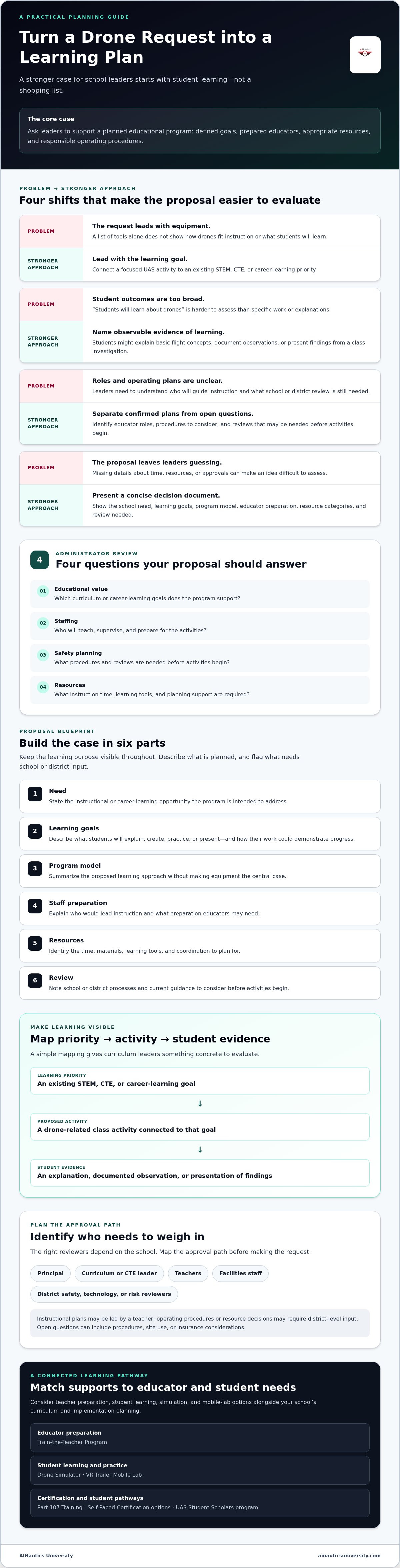
Organize the discussion around four questions: What educational value will students gain? Who will prepare and lead instruction? How will the school plan for responsible operations? What resources, time, and approvals will implementation require? Be clear about what your proposal already answers, such as learning goals and educator roles, and what needs school or district review, such as applicable procedures, site use, or insurance considerations.
- Educational value: Which curriculum or career-learning goals does the program support?
- Staffing: Who will teach, supervise, and prepare for the activities?
- Safety planning: What procedures and reviews are needed before activities begin?
- Resources: What instruction time, learning tools, and planning support are required?
Bring clear answers where you have them, and list open questions for follow-up. This shows administrators that you understand the difference between a strong learning goal and a complete implementation plan. It also gives the school a practical basis for deciding what to review next.
Build a school drone proposal around evidence, curriculum fit, and responsible planning
A concise proposal helps administrators assess an idea without having to guess how it would work. Organize it as a decision document: identify the school need, define learning goals, describe a program model, explain educator preparation, list resource categories, and outline the review needed before implementation. Make each part specific enough to discuss, and distinguish established plans from questions that need school or district input.
Curriculum, trained educators, and implementation planning belong together. Learning goals become actionable when staff and school processes can support them.
- Need: State the instructional or career-learning opportunity the program is intended to address.
- Learning goals: Describe what students will explain, create, practice, or present. Identify how their work could demonstrate progress.
- Program model: Summarize the proposed learning approach without making equipment the central case.
- Staff preparation: Explain who would lead instruction and what preparation educators may need.
- Resources: Identify the time, materials, learning tools, and coordination to plan for.
- Review: Note the school or district processes and current guidance to consider before activities begin.
Show how the idea fits school priorities
Connect the proposed experience to priorities the school already recognizes, such as STEM learning, CTE, or a district pathway. A class might study flight concepts, use observation data in a lesson, or present a project connected to a career theme. Describe the planned student work rather than promising an unmeasured result. For related context on student pathways, the UAS scholarship and high-school pathway guide can help frame how learning connects with future exploration.
Make the alignment visible in a simple mapping: name the learning priority, the proposed activity, and the evidence students would produce. This gives curriculum leaders something concrete to evaluate and helps teachers see where the program could complement existing instruction.
Make resource and funding conversations transparent
Present needs by category instead of bundling them into one estimate. Separate curriculum, educator preparation, learning tools, and program coordination. AINautics University’s Train-the-Teacher Program and Drone Simulator are options to consider when planning educator development and student learning activities.
- Instruction: Curriculum materials and time for lesson planning.
- People: Educator preparation and coordination responsibilities.
- Learning tools: Resources selected to support the intended student experience.
- Funding: School or district budgets, grants, and workforce partnerships to investigate.
Treat funding as a research task, not an assumed solution. Before including a funding source in the proposal, review its eligibility requirements and the relevant district policy. Similarly, describe safety and regulatory review as planned responsibilities, and consult current FAA guidance before citing specific requirements.
As you refine the proposal, AINautics University’s educator training and student learning resources can help you consider how preparation and instruction may fit into the plan.
Compare drone program models to address cost, capacity, and safety concerns
There isn’t one right way to build a school drone program. A curriculum-led approach, educator training, simulation, and a mobile lab serve different needs. Comparing them makes getting school administration buy-in for drones a practical discussion about learning, staff capacity, delivery, and planning, rather than a request to purchase equipment without a clear instructional role.
Use this comparison to identify a starting point, not to declare a universal winner. A school may combine approaches over time. Each option still needs clear learning goals and review of the school’s operating procedures.
| Model | Learning purpose | Educator preparation | Delivery considerations | Decision questions |
|---|---|---|---|---|
| Curriculum-led | Connect UAS topics to planned classroom learning and student work. | Educators need to understand the lesson goals and how to guide activities. | Consider how lessons fit the timetable, curriculum, and available learning resources. | Which subjects or pathway does it support, and what will students produce? |
| Educator training | Build teacher readiness to introduce drone-related learning. | Preparation is the central focus. AINautics University’s Train-the-Teacher Program is one option. | Plan for educator participation and how learning will connect to instruction. | Who will lead the program, and what preparation do they need? |
| Simulation-supported | Include simulation as part of a structured learning experience. | Teachers should understand how simulation supports the lesson, rather than treating it as the entire program. | Consider how the tool fits the learning setting and the school’s instructional plan. Explore the immersive drone training technology guide when weighing simulation or VR. | What concept or skill will simulation help students explore? |
| Mobile-lab approach | Consider a mobile learning environment as part of program delivery. | Identify the educators involved and how they’ll connect the experience to learning goals. | Plan for scheduling, coordination, and how the lab-based experience fits school activities. | Does this approach fit the school’s instructional needs and capacity? |
Choose a model that fits educator capacity
Start with the people who will deliver instruction. If teacher preparation is the main constraint, explore educator training before adding other program components. AINautics University offers self-paced certification options, and its Drone Simulator and VR Trailer Mobile Lab are distinct learning resources to consider alongside educator preparation and curriculum. Choose tools based on the lesson goals and the school’s capacity to use them, not simply because they are available.
Address safety and FAA questions without overclaiming
Separate classroom discussion, simulation activities, and aircraft operations in the planning conversation. Each raises different implementation questions. For any planned flight activity, use current FAA educational-user resources and verify the requirements that apply to the school’s circumstances. A training course, certification, or learning tool alone doesn’t resolve every operational or district review question.
As you compare options, AINautics University’s drone education resources can help you consider educator preparation, simulation, and mobile-lab approaches alongside the instructional model.
Prepare a clear administrator meeting and a practical approval request
A productive meeting ends with a decision administrators can understand and act on. Before you meet, prepare a one-page summary that states the instructional need, the proposed student experience, and the specific approval you’re seeking. Separate confirmed plans from open questions so school leaders can see what’s ready for consideration and what still needs review.
Use this sequence to guide the conversation: establish the need, show the learning fit, compare program models, address risks and review needs, then request a defined next step.
- Establish the need. Briefly explain the learning opportunity the proposed program is designed to support.
- Show the learning fit. Connect the planned student experience to curriculum or career-learning priorities, and describe what students would do or produce.
- Compare models. Present the approaches you’ve considered and why one may fit the school’s goals and capacity.
- Address risks. Identify planning, oversight, and district review questions that need attention before implementation.
- Request a next step. Ask for a specific decision, such as permission to develop a plan, begin a review, or explore a limited instructional pilot.
Prepare for administrator questions
Expect questions about learning value, educator readiness, resources, oversight, and how the school will assess the experience. Answer with details from your proposal, such as planned student work, staff roles, and resource categories. If a question requires district-level review, say so and identify the next step instead of guessing. Avoid promising funding, compliance outcomes, student certifications, or career placements.
Keep the meeting focused on the decision at hand. Permission to plan an instructional approach doesn’t require administrators to approve every future activity or resource immediately. It authorizes a manageable next step to clarify scope, responsibilities, and outstanding questions.
Make the next decision easy to understand
State the request in one sentence: “I’m asking for permission to develop a school drone learning plan for review, including curriculum goals, educator preparation, resource needs, and the operational questions that require district input.” Adjust it to match your school’s process. If certification planning is relevant to the intended pathway, AINautics University’s Part 107 drone training guide can provide context for that discussion.
Use the one-page summary to label three categories clearly: confirmed facts, open questions, and decisions requested. A confirmed curriculum connection belongs in the first category; a pending district review belongs in the second; and the approval request belongs in the third. This format helps leaders distinguish the educational case from items that still need investigation.
As you prepare the next planning step, explore school drone education resources that can inform educator preparation and student learning.
Turn school approval into a supported drone learning pathway with AINautics University
Approval is a starting point. Building a learning pathway takes coordination between educator preparation, student instruction, and the school’s implementation plan. Keep those elements connected: define what students will learn, prepare the educators who will guide them, and identify the planning steps needed to deliver a program that fits school priorities.
AINautics University offers school-focused resources to help inform those decisions. Use them as options within your planning process, alongside school and district review. The school’s goals, intended learners, and educator capacity can guide which resources belong in the pathway.
Match AINautics University resources to the school’s goals
Begin with the school’s primary need. If educator readiness is central, consider the Train-the-Teacher Program. If student learning and remote pilot certification are priorities, the Drone/UAS Student Scholars Remote Pilot Certification For High Schools has 16 modules, with pricing available upon request.
For higher education, the Universities & Technical Colleges program has 20 modules. Schools can request a demo, and pricing is available upon request. These options have different audiences and structures, so use the school’s goals and intended learners to guide the discussion rather than assuming one is right for every institution.
For individual learners, AINautics University’s SELF-PACED Remote Pilot Certification is $49.00 and has 16 modules. The AG Remote Pilot Certification is $149 and has 20 modules. These are distinct courses, so match the course details to the learner and the school’s purpose when discussing certification preparation.
Move from initial interest to an informed next step
Before exploring a program option, summarize the school’s instructional goals, educator capacity, resource questions, and approvals still under review. This short brief helps keep the conversation focused. It also separates the learning model under consideration from decisions the school has not made, such as the scope of activities or implementation details.
Consider how individual resources could support the plan. AINautics University’s Drone Simulator and VR Trailer Mobile Lab are learning-resource options to consider alongside educator development and student instruction. Their place in the pathway depends on the school’s goals and its approach to delivering instruction.
Use the approval process to build a sequence, not just authorize a purchase: clarify goals, prepare educators, select learning resources, and plan implementation. This keeps student learning at the center while giving school leaders a practical way to evaluate the program’s fit. For teams focused on getting school administration buy-in for drones, the next useful move is to compare school priorities with the available education options.
Explore school drone education with AINautics University and consider which resources align with your school’s goals.
Keep the learning pathway moving forward
Approval is not the finish line. It creates room to learn what works for your school, listen to educators and students, and make thoughtful adjustments as the program develops. If planning moves ahead, set a time to review the experience with school leaders. Consider what students engaged with, what educators need next, and which questions remain before expanding or changing the approach.
This reflection keeps the program connected to its original purpose as circumstances shift. It also gives administrators a clear basis for future decisions, grounded in the school’s experience rather than assumptions. That’s how getting school administration buy-in for drones can lead to a stronger, more responsive learning pathway over time.
AINautics University’s school-focused education resources can help you consider options for educator development and student learning as you plan what comes next. Explore school drone education with AINautics University and take the next step that fits your school’s goals. Start by outlining the learning outcomes, educator needs, and program model you want to discuss.
Frequently Asked Questions
How can I explain the educational value of a drone program to school administrators?
Make the value visible through a sample student task and a simple way to review it. For instance, students could keep a project log that records decisions, questions, and what they learned from a classroom activity. Administrators can then see how the learning process might be assessed, not just demonstrated. This gives getting school administration buy-in for drones a concrete point of discussion without claiming results the school hasn’t measured.
What should a school drone program proposal include?
Along with the core proposal, include a brief implementation calendar and a responsibility chart. The calendar can show when planning, educator preparation, and review would happen, while the chart identifies who owns each task. Add a clear boundary for what the current request does and doesn’t authorize. These details help administrators understand how the work could be coordinated and prevent an early planning decision from being mistaken for approval of every future activity.
How much does it cost to get a drone program approved at a school?
There’s no single cost for every school, and permission to plan may involve different expenses from a fully developed program. Build a budget worksheet with separate scenarios, such as a limited initial scope and a broader future option. For each, record assumptions and note which items are essential versus optional. This lets decision-makers discuss priorities before settling on a model, without presenting an unverified estimate or treating possible grants as guaranteed funding.
Can a school begin drone education without starting with outdoor flights?
Yes. Students can explore UAS concepts through activities that don’t involve operating an aircraft, such as analyzing prepared aerial images, comparing possible uses for collected information, or planning a hypothetical mission on paper. These exercises can help a teacher assess how the subject fits a lesson before considering flight activities. AINautics University also offers a Drone Simulator and VR Trailer Mobile Lab as learning resources for schools to consider.
What happens if school administration is concerned about safety?
Turn the concern into specific planning questions. For a proposed activity, document who supervises, how participants receive instructions, what conditions would lead the school to pause, and who reviews the plan before it proceeds. Keep those notes with the program materials so administrators can see how responsibilities are handled. Consult current FAA educational-user resources and district processes for applicable requirements, and avoid describing any activity as risk-free.
Is a drone program a good fit for a school with limited teacher capacity?
It can be worth assessing, but the initial scope should reflect the time educators can set aside. Review the school calendar, identify a teacher who can coordinate the first learning activity, and decide what can reasonably be deferred. AINautics University’s Train-the-Teacher Program is an educator-focused resource to consider. Starting with a clearly bounded instructional plan can help the school assess capacity before committing to a wider program.

Article by
AINautics University Team
The team behind AINautics University, dedicated to drone education and FAA Part 107 certification prep, VR flight simulation, and STEM training programs for students and educators.


