
With the FAA projecting over 500,000 certified remote pilots by 2026, the sky is no longer just a vast open space; it's a highly regulated professional workplace. You've likely realized that mastering the best Part 107 test prep tips is the mandatory entry point for a lucrative career in surveying, defense, or public safety. However, staring at complex sectional charts and deciphering cryptic METAR weather codes often feels like learning a foreign language. It's frustrating when generic study guides leave you drowning in information overload rather than focusing on the high-value concepts that actually appear on the $175 exam.
You can overcome these challenges and launch your career with confidence. This guide delivers the exact study strategies and expert insights required to pass your FAA Remote Pilot exam on the first attempt. We'll explore the most heavily weighted exam topics and provide actionable study shortcuts designed for modern learners. From utilizing the AINautics Drone Simulator to understanding Remote ID enforcement, you'll gain a clear path from certification to professional mastery. We'll also highlight how our Part 107 Training and UAS Student Scholars programs transform technical knowledge into workforce readiness, ensuring you're prepared for the $57,000 to $95,000 salary range typical of today's commercial pilots.
Key Takeaways
- Identify the updated 2026 FAA exam standards to prioritize the five core knowledge areas that carry the most weight on your test.
- Simplify the complexity of sectional charts and aviation weather by translating technical codes into actionable flight safety decisions.
- Implement the most effective Part 107 test prep tips by using the AINautics Drone Simulator to visualize airspace boundaries instead of relying on rote memorization.
- Master test-day performance by familiarizing yourself with the Airman Knowledge Testing Supplement and applying logical elimination strategies to multiple-choice questions.
- Bridge the gap between passing the exam and launching a career by exploring specialized pathways like the AINautics UAS Student Scholars program.
Navigating the 2026 FAA Part 107 Exam Standards
Mastering the FAA Remote Pilot exam requires more than a passing grade; it demands a professional mindset. As autonomous systems become the norm, the FAA has shifted toward workforce readiness and safety. We recommend a 90-day study timeline to achieve total mastery. This structured approach allows you to implement effective Part 107 test prep tips without the stress of cramming. For educators, this timeline is especially powerful when integrated into a semester-long curriculum through our Train-the-Teacher Program.
The 2026 landscape focuses heavily on how pilots interact with complex, automated environments. The FAA expects you to understand not just the how of flight, but the why behind safety protocols. This transition means your preparation must move beyond simple flashcards. You need to visualize how a drone operates within the National Airspace System. Our Part 107 Training is designed to bridge this gap, moving students from basic awareness to industry-ready expertise.
Eligibility and Registration Requirements
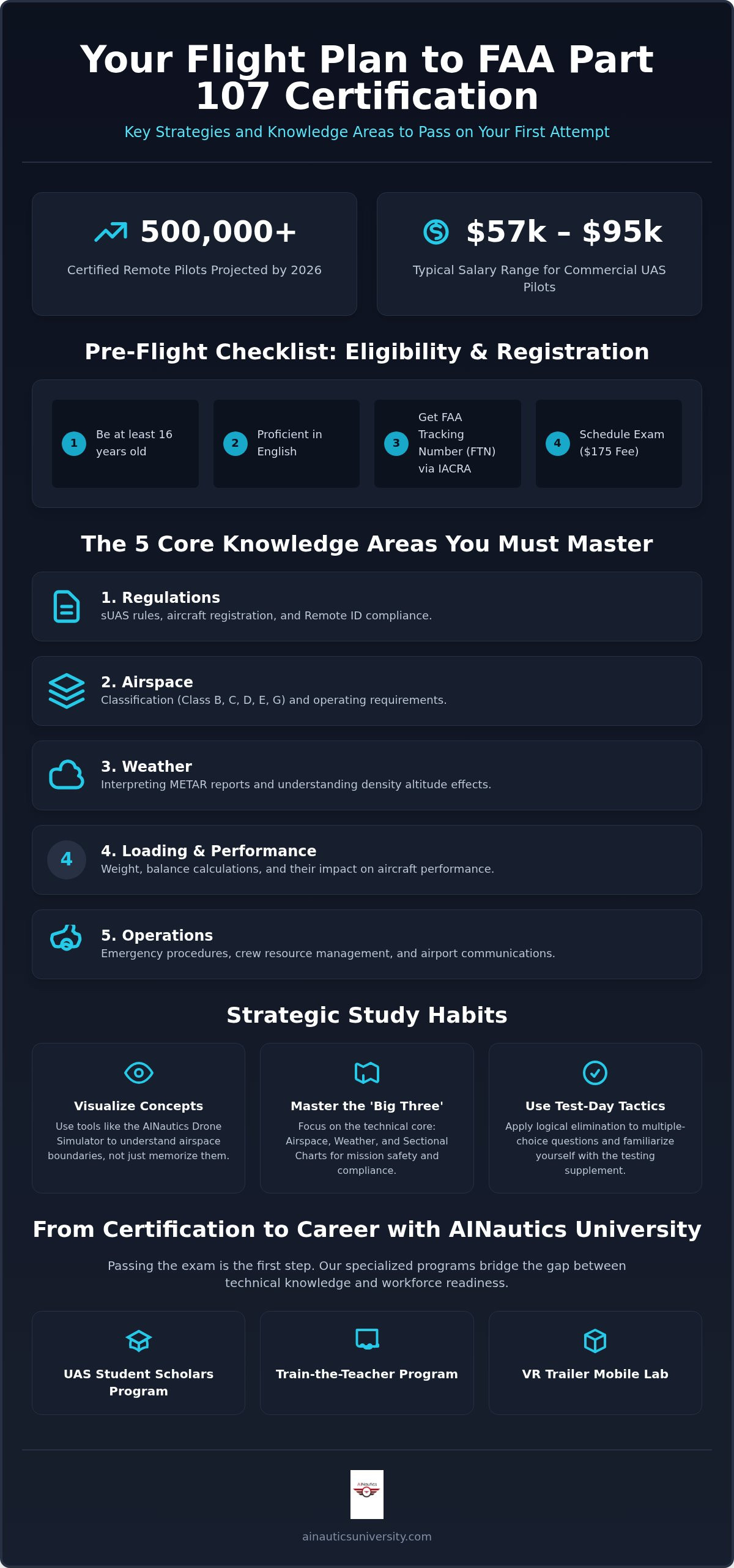
Before diving into Part 107 test prep tips, confirm you meet basic eligibility. Applicants must be at least 16 years old and demonstrate English proficiency. Your first step is creating a profile in the Integrated Airman Certification and Rating Application (IACRA) system to secure your FAA Tracking Number (FTN). This permanent ID is required for all FAA certifications. Once secured, schedule your exam at an authorized Knowledge Testing Center. The mandatory 2026 testing fee is $175 per attempt.
The Five Knowledge Areas You Must Master
The exam is a weighted assessment of five critical domains. You must demonstrate proficiency in:
- Regulations: sUAS rules, registration, and Remote ID compliance.
- Airspace: Classification and operating requirements.
- Weather: Interpreting METARs and density altitude effects.
- Loading: Weight, balance, and aircraft performance.
- Operations: Emergency procedures and airport communication.
Our Self-Paced Certification options help you master these topics. Schools can also use the VR Trailer Mobile Lab to provide students with hands-on context. This is a core component of the UAS Student Scholars program.
Success on the exam is the first milestone in the Learn, Train, Certify, Fly, Work pipeline. By setting a clear 90-day goal, you create the momentum needed to transition from a student to a professional. Whether you're a high schooler in the UAS Student Scholars program or an educator using our VR Trailer Mobile Lab, these standards are your roadmap. Mastering them ensures you're ready for high-demand sectors like surveying and defense, where specialized knowledge is the primary differentiator.
Mastering the 'Big Three': Airspace, Weather, and Charts
Airspace, weather, and charts represent the technical core of the FAA exam. Mastery of these pillars is what separates a hobbyist from a professional UAS pilot. While many students find these topics intimidating, they are the most critical for ensuring mission safety and regulatory compliance. One of the most effective Part 107 test prep tips is to move beyond memorization and understand the logic of the National Airspace System. For example, you must differentiate between Class B, C, D, and E controlled airspace and Class G uncontrolled airspace. Knowing that Class G is the only airspace where you can typically fly without prior authorization is fundamental to your daily operations.
Professional readiness also involves understanding environmental regulations. Pilots conducting inspections on cell towers or bridges must remain aware of the Migratory Bird Treaty Act. This law protects nearly all native bird species; disturbing a nest during a drone flight can lead to significant legal penalties. Integrating this level of awareness into your study routine prepares you for the high-stakes environments found in the UAS Student Scholars program.
Decoding Sectional Charts Like a Pro
Sectional charts are the primary maps used by pilots to identify hazards and airspace boundaries. You must be able to identify airport symbols and runway lighting configurations at a glance. A circle with small ticks indicates that lighting is available, which is vital for planning night operations. Additionally, you must calculate Maximum Elevation Figures (MEF). These numbers represent the highest point in a specific quadrangle, including both terrain and man-made obstructions. Recognizing Special Use Airspace (SUA), such as Prohibited or Restricted areas, is non-negotiable. Flying into these zones without permission can result in the immediate suspension of your certificate.
Understanding Aviation Weather and Performance
Weather affects drone performance more than most beginners realize. You must analyze the impact of density altitude on your aircraft. High density altitude means thinner air, which reduces lift and forces your motors to work harder, significantly shortening battery life. Understanding fog formation is equally important. Radiation fog often forms on clear, calm nights as the ground cools, while advection fog occurs when warm, moist air moves over a cold surface. Interpreting METAR and TAF reports is a required skill for the exam. You should be able to translate abbreviations like "BR" for mist or "OVC" for overcast sky cover into actionable flight decisions.
To truly grasp these complex concepts, we recommend hands-on practice. You can leverage the AINautics Drone Simulator to visualize airspace boundaries and practice maneuvers in varying weather conditions before you ever step into a testing center. This immersive approach ensures that when you see a METAR code or a sectional symbol on the exam, you aren't just guessing; you're applying professional knowledge.
Strategic Study Habits: Moving Beyond Rote Memorization
Passive learning is the primary reason many candidates struggle with the technical depth of the FAA exam. Watching endless video lectures often creates a false sense of security without building the critical thinking skills required for complex flight scenarios. To truly excel, you must transition from memorization to application. Implementing active Part 107 test prep tips, such as scenario-based training, allows you to visualize how regulations and weather patterns interact during a real-world mission. This approach ensures you don't just recognize a correct answer; you understand the aeronautical logic behind it.
Active recall is another essential habit for high-weight regulatory topics. Instead of re-reading your notes, quiz yourself on specific rules like Remote ID compliance or night flight requirements. This retrieval practice strengthens neural pathways and ensures that technical data remains accessible under the pressure of the testing center. By engaging with the material through self-testing, you move closer to the professional mastery expected in the commercial UAS industry.
The Power of Simulation-Based Prep
The AINautics Drone Simulator serves as a bridge between theoretical knowledge and practical flight. It allows you to practice navigating virtual Class D airspace boundaries, transforming flat sectional chart symbols into immersive 3D environments. This builds the spatial awareness necessary to identify obstructions and maintain safe distances from manned aircraft. You can also simulate emergency procedures, such as lost-link scenarios or battery failures, in a risk-free setting. Linking your simulator performance to specific knowledge areas helps you identify whether you truly understand aircraft loading and performance or if you need to revisit those modules in your training.
Building a Self-Paced Study Routine
Consistency is more effective than intensity when preparing for a professional certificate. Structure your study week using modular learning blocks that focus on one core domain at a time. Our Self-Paced Certification options provide the flexibility to align your training with your personal schedule, whether you're a student in the UAS Student Scholars program or an educator balancing a full classroom. Use practice exams strategically to identify knowledge gaps. If you consistently miss questions regarding aviation weather, dedicate your next three learning blocks specifically to METAR interpretation and density altitude calculations. This targeted approach prevents information overload and keeps your momentum steady throughout your 90-day preparation timeline.
Test Day Logistics and Mental Performance Tips
Success at the Knowledge Testing Center is the result of professional preparation meeting a calm, focused performance. You've spent weeks mastering technical data through our Part 107 Training. Now, you must execute. Arriving at the center with a complete testing kit is your first priority. You'll need a valid government-issued photo ID and a basic, non-programmable calculator. The center provides the Airman Knowledge Testing Supplement, but you should be intimately familiar with its layout before you sit down. Integrating these Part 107 test prep tips into your final review ensures you're ready for the $175 investment in your career.
Time management is a critical component of your strategy. You have 120 minutes to answer 60 multiple-choice questions. This allows for approximately two minutes per question, which is more than enough time if you don't get stuck. One of the most vital Part 107 test prep tips is to manage your mental energy. If a question about density altitude or complex airspace seems overwhelming, don't let it derail your momentum. Use the "flag for review" feature and move on. You'll often find that later questions provide context that helps you solve the ones you skipped.
Navigating the Testing Supplement
The Airman Knowledge Testing Supplement is not just a collection of charts; it's your primary resource during the exam. Spend the first few minutes of your session familiarizing yourself with the legends and figures. These pages contain the keys to decoding every symbol on the sectional charts. When a question provides specific coordinates, cross-reference them carefully with the correct figure page. Precision is mandatory here. If you're unsure of a technical term, check the supplement's glossary. It's an open-book resource for definitions that can save you from second-guessing your knowledge of emergency procedures or loading limits.
Advanced Test-Taking Strategies
The FAA often uses "distractor" answers that look correct at first glance but contain subtle errors. Always read every answer choice before making your selection. Apply the process of elimination to narrow your options. Even if you're uncertain, you can often remove one choice that is clearly incorrect, increasing your odds of success. Stay calm when encountering questions regarding newer regulations like Remote ID or night operations. These are designed to test your mastery of current standards, not to trick you. If you've followed a structured study routine, you have the specialized knowledge to identify the most correct option.
Ready to prove your expertise and join the growing workforce of certified pilots? Enroll in our Part 107 Training today to gain the confidence and technical skills needed to ace your exam on the first try.
Accelerating Your UAS Career with AINautics University
Passing the FAA exam is a significant milestone, but it's only the first step in your professional journey. In 2026, the drone industry demands more than just a certificate; it requires specialized technical mastery. While Part 107 test prep tips help you clear the regulatory hurdle, AINautics University focuses on what comes next. We bridge the gap between theoretical knowledge and the high-demand skills needed for aerospace, defense, and surveying. Our mission is to transform students into workforce-ready professionals who understand data capture, analysis, and operational safety. This approach ensures you're prepared for a career where full-time salaries typically range from $57,000 to $95,000.
We provide a clear "Learn, Train, Certify, Fly, Work" pipeline that aligns your certification with STEM-focused career pathways. It's not just about operating a remote controller. It's about executing complex missions for enterprise roles in construction or public safety. By joining our community, you aren't just another pilot; you're a specialist committed to the highest standards of safety. We offer Self-Paced Certification options for those who need flexibility while pursuing their professional goals. This ensures that every student, regardless of their starting point, has a direct path to the 2026 autonomous systems workforce.
Solutions for Schools and Educators
Educators are the backbone of the future UAS workforce. Our Train-the-Teacher Program empowers instructors to deliver professional-grade UAS education without a steep learning curve. We help schools implement a comprehensive drone curriculum in just 90 days. This rapid launch ensures that classroom learning aligns perfectly with state and district standards. Institutional learning reaches new heights with our VR Trailer Mobile Lab. This mobile facility brings cutting-edge simulation and hands-on technology directly to the students, making high-level training accessible to every school district.
The UAS Student Scholars Program
High school students seeking excellence can join the UAS Student Scholars program. This initiative positions young pilots at the forefront of the industry before they even graduate. By combining Part 107 test prep tips with advanced simulation and real-world context, we ensure our graduates are ready for the technical demands of modern employers. We believe in the empowerment of the individual through specialized knowledge. Whether you're an individual pilot or an educational leader, AINautics University provides the tools to navigate the complexities of the UAS industry with confidence and expertise. Your professional future starts here.
Launch Your UAS Career with Professional Mastery
Passing the FAA Remote Pilot exam is the defining moment that transforms an enthusiast into a certified professional. By applying these Part 107 test prep tips, you've moved beyond simple memorization to master the technical logic of airspace, weather, and regulations. You now understand that success in the 2026 drone industry requires more than just a passing grade; it demands a commitment to operational excellence. This foundational knowledge is your gateway to a specialized career in surveying, defense, or public safety.
As a Service-Disabled Veteran-Owned Small Business, AINautics University provides a STEM-aligned, mission-driven curriculum designed for your success. We don't just help you pass a test; we prepare you for the workforce. Whether you're an educator seeking a comprehensive 90-day program launch for your school or a student ready to specialize, our training provides the tools you need. Take the next step in your professional journey and join a community of industry leaders. Enroll in AINautics University Part 107 Training and start your career today. The sky is open for those prepared to lead, and we're ready to help you take that first professional flight.
Frequently Asked Questions
What is the passing score for the FAA Part 107 exam in 2026?
The passing score for the FAA Part 107 exam in 2026 remains 70%. This means you must correctly answer at least 42 out of the 60 multiple-choice questions. While the score requirement hasn't changed, the complexity of the material has increased. Utilizing professional Part 107 test prep tips ensures you're prepared for the nuances of modern regulations. Our Self-Paced Certification modules are designed to help you exceed this baseline and achieve true technical mastery.
How much does it cost to take the Part 107 drone test?
The mandatory fee to take the initial aeronautical knowledge test is $175 per attempt. This fee is paid directly to the FAA's authorized testing contractor, PSI, and is the same across all national testing centers. It's important to budget for this cost as part of your career launch. Because every retake requires an additional fee, using the AINautics Drone Simulator to gain confidence before your appointment is a smart financial and professional decision.
Can I take the Part 107 exam online from home?
You can't take the initial Part 107 exam online from home in 2026. All first-time applicants must schedule their test at an authorized Knowledge Testing Center and complete it in a proctored environment. However, once you're certified, the recurrent training required every 24 months is available for free through the FAA's online portal. For schools, our VR Trailer Mobile Lab brings an immersive testing-prep environment directly to your campus to simulate these high-stakes conditions.
How long is the FAA Remote Pilot Certificate valid?
Your FAA Remote Pilot Certificate doesn't technically expire, but your authority to exercise its privileges is valid for 24 calendar months. To stay current, you must complete a free online recurrent training course before that two-year window closes. This ensures all pilots remain updated on evolving rules like Remote ID enforcement. Our UAS Student Scholars program emphasizes this pipeline to help you maintain your professional standing and workforce readiness throughout your career.
Do I need to own a drone before taking the Part 107 test?
You don't need to own a drone before taking the Part 107 test. The exam focuses on aeronautical knowledge, regulations, and safety procedures rather than hands-on flight skills. In fact, many students use our Drone Simulator to practice flight maneuvers virtually while they study for the written exam. This allows you to gain valuable experience and understand airspace boundaries without the upfront cost of hardware, making the path to certification more accessible for everyone.
What happens if I fail the Part 107 exam?
If you fail the Part 107 exam, you must wait 14 calendar days before you're eligible to retake it. You'll also need to pay the $175 testing fee again for each attempt. To avoid this delay and extra cost, we recommend following structured Part 107 test prep tips and utilizing our Part 107 Training. Our curriculum identifies your specific knowledge gaps, allowing you to focus your study efforts on the areas that need the most improvement.
How does the AINautics Drone Simulator help with test prep?
The AINautics Drone Simulator helps with test prep by transforming abstract concepts into immersive experiences. Instead of just reading about Class D airspace or weather effects, you can virtually fly in those environments to build spatial awareness. This scenario-based training is far more effective than rote memorization. It allows students to practice emergency procedures and lost-link scenarios in a risk-free setting, ensuring they're ready for both the exam and real-world commercial operations.
Is the Part 107 test harder in 2026 than in previous years?
The Part 107 test in 2026 is more comprehensive because it incorporates modern standards like Remote ID and night operations. While the core aviation principles remain the same, the FAA now expects pilots to understand autonomous systems and operations over people. This shift makes professional training essential. Our Train-the-Teacher Program and UAS Student Scholars curriculum are constantly updated to reflect these 2026 standards, ensuring our community stays at the forefront of the industry.

Article by
AINautics University Team
The team behind AINautics University, dedicated to drone education and FAA Part 107 certification prep, VR flight simulation, and STEM training programs for students and educators.


