
With the global drone market projected to reach $100.74 billion in 2026, the demand for skilled pilots has never been higher. Many aspiring flyers feel stalled by the perceived complexity of the FAA's legal framework. Understanding the Part 107 certification requirements is the first essential step for any student or educator looking to join this high growth workforce. It is natural to feel some anxiety about the technical terminology or the difficulty of the official knowledge test.
We agree that the regulatory landscape should empower you, not overwhelm you. This guide provides a definitive roadmap to mastering the 2026 standards so you can earn your license with confidence. You will discover exactly who is eligible, how to prepare for the exam, and the most efficient ways to use resources like our Drone Simulator and Self-Paced Certification options. Whether you are a high schooler in the UAS Student Scholars program or a teacher using our Train-the-Teacher curriculum, this breakdown ensures you are ready for the flight line. Let's turn that confusion into a professional career path.
Key Takeaways
- Identify the fundamental Part 107 certification requirements, such as the minimum age of 16 and the necessary language proficiency for all commercial applicants.
- Gain a competitive edge by mastering the core competencies of the FAA Aeronautical Knowledge Test, covering everything from airspace classifications to emergency procedures.
- Navigate the bureaucratic process with ease by following a structured checklist for obtaining your FAA Tracking Number and scheduling your exam.
- Discover the modern path to maintaining your certificate through free online recurrent training, ensuring it's easy to keep your skills current every two years.
- Learn how to leverage specialized resources like the Drone Simulator and Self-Paced Certification to bridge the gap between learning and a professional career.
Who Can Become a Remote Pilot? Eligibility and Prerequisite Standards
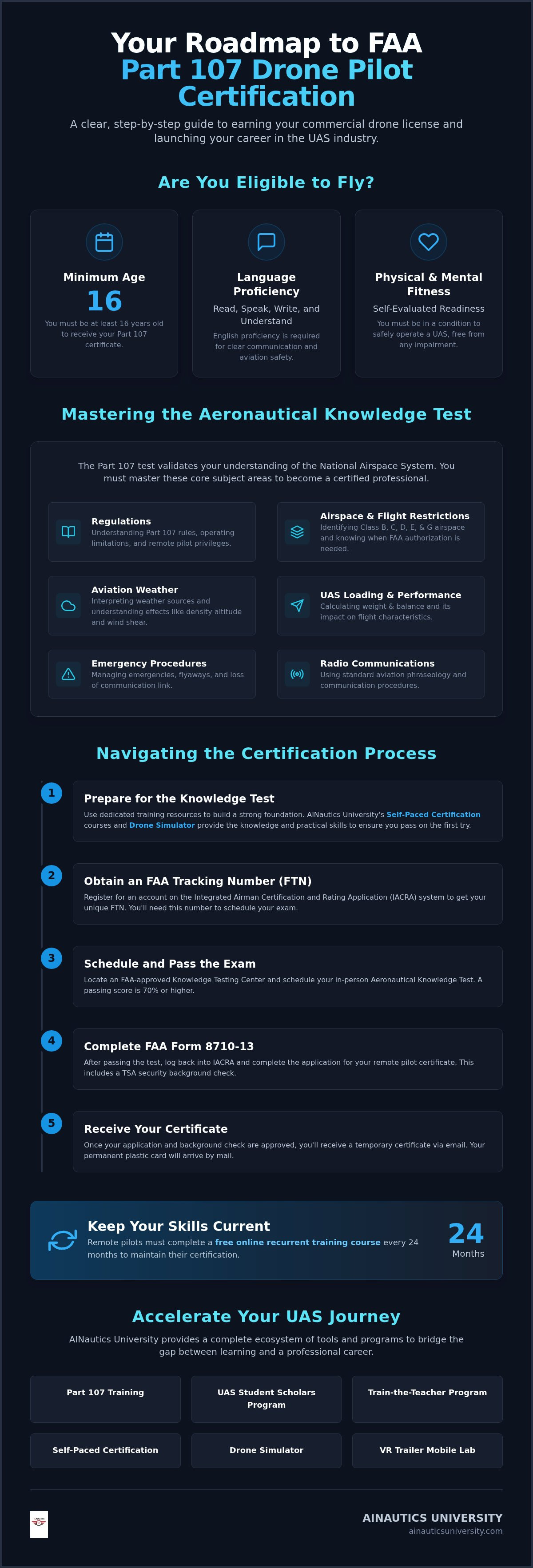
The FAA defines a remote pilot as any individual operating an Unmanned Aircraft System (UAS) for commercial purposes under Part 107 rules. To transition from a hobbyist to a professional, you must meet specific Part 107 certification requirements designed to ensure the safety of the National Airspace System. These prerequisites act as a baseline for responsibility. They ensure every pilot possesses the maturity and capability to manage complex flight environments. The barrier to entry is intentionally accessible, but the standards remain high to maintain the integrity of the skies.
The 16-Year-Old Threshold for Students
Setting 16 as the minimum age ensures pilots have the cognitive maturity to handle emergency procedures and regulatory compliance. While you can't hold the official certificate until your 16th birthday, your career preparation doesn't have to wait. Many motivated students begin their journey years earlier. Through the UAS Student Scholars program, high schoolers build a strong foundation in aeronautical knowledge long before they are legally eligible to test. You can complete your training through Self-Paced Certification options and be ready to schedule your exam the day you turn 16. This head start is a significant advantage for those looking to enter the workforce immediately after graduation.
English Language and Safety Readiness
Standardized communication is a non-negotiable pillar of aviation safety. All applicants must demonstrate the ability to read, speak, write, and understand the English language. This rule ensures that every pilot can interpret weather briefings, understand airspace charts, and communicate effectively with other stakeholders in the industry. It's about clarity and precision during flight operations. Beyond language, you must maintain physical and mental readiness. The FAA does not require a formal medical certificate for remote pilots. Instead, it places the responsibility on you to self-evaluate. You must be in a physical and mental condition that allows for the safe operation of a small UAS. This means being free from fatigue, certain medications, or any impairment that could compromise safety. If you're new to the industry, exploring drone training for beginners provides an excellent baseline for these safety expectations. Meeting these Part 107 certification requirements proves you're ready for the professional responsibilities of a certified pilot.
Mastering the FAA Knowledge Test: Core Subject Areas and Competencies
The Aeronautical Knowledge Test is the primary hurdle for all Part 107 applicants. It transforms a casual flyer into a certified professional by validating your understanding of the National Airspace System. Successfully navigating the Part 107 certification requirements means mastering several technical domains. The exam evaluates your grasp of applicable regulations, rating privileges, and the specific limitations of small UAS operations. It also dives deep into aviation weather sources and how various atmospheric conditions, like density altitude or wind shear, impact your aircraft's performance.
As you prepare, consult the official FAA Part 107 Certification standards to ensure your study materials are current. This test isn't just about memorization. It's about demonstrating that you can operate safely alongside manned aircraft. You'll need to interpret complex charts and make real-time decisions based on regulatory data.
Airspace and Flight Operations
Understanding the different layers of the sky is critical for mission success. You must be able to distinguish between Class B, C, D, E, and G airspace on a sectional chart without getting lost in the technical jargon. Class B airspace surrounds the busiest airports, while Class G is generally uncontrolled. Operational requirements dictate that you maintain a visual line of sight at all times and adhere to specific altitude limits, typically 400 feet above ground level. Controlled airspace represents specific atmospheric zones where air traffic control service is provided to ensure the safe separation of all aircraft. Knowing when you need prior authorization to fly in these areas is a core competency for any professional pilot.
Emergency Procedures and Decision Making
Safety in the field relies on Aeronautical Decision Making (ADM). This involves a systematic approach to the mental processes used by pilots to consistently determine the best course of action in response to a given set of circumstances. You must also understand how loading and performance affect your flight. Adding heavy sensors or cameras changes the weight and balance of your drone, which can lead to unpredictable handling or battery drain. Mastery of radio communication procedures and airport operations ensures you can coexist with other flyers. Honing these skills on a Drone Simulator provides a safe environment to apply theoretical knowledge before your official test day. This practical preparation builds the confidence needed to manage real-world emergencies and complex missions effectively.
Step-by-Step: Navigating the Certification Process in 2026
Moving from a student to a professional pilot requires a clear understanding of the administrative path. While the Part 107 certification requirements focus on knowledge, the actual process happens through specific digital portals and physical testing centers. Following these steps in order prevents delays and ensures your application moves smoothly through the FAA system.
- Step 1: Create a profile in the Integrated Airman Certification and Rating Application (IACRA) to obtain your FAA Tracking Number (FTN).
- Step 2: Use your FTN to schedule an appointment at an FAA-approved Knowledge Testing Center.
- Step 3: Pass the initial aeronautical knowledge test, which consists of 60 multiple-choice questions.
- Step 4: Return to IACRA to complete FAA Form 8710-13 for your remote pilot certificate.
- Step 5: Download your temporary certificate once the TSA security vetting is complete, then wait for your permanent hard card in the mail.
The Role of the FTN and IACRA
The IACRA portal is your primary interface with the FAA throughout your aviation career. Your FTN is a unique, permanent identifier that stays with you forever. When you first register, ensure your name matches your government-issued identification exactly. Even a small discrepancy can cause administrative friction during the testing phase. Managing these digital credentials carefully allows you to update your address, renew your recency of knowledge, and track your certifications as you advance in the UAS industry. To officially Become a Drone Pilot, you must master this portal before you ever touch a controller.
What to Expect on Test Day
Arriving at the testing center prepared reduces anxiety and improves performance. You must bring a valid photo ID that includes your signature and current physical address. The testing center provides all necessary supplemental materials, such as the Airman Knowledge Testing Supplement with its various charts and diagrams. You have two hours to complete the 60 questions. A passing score is 70 percent, which means you need at least 42 correct answers. Many students find that structured Part 107 drone training simplifies these steps by offering practice exams that mirror the actual testing environment. This preparation ensures you aren't just meeting the Part 107 certification requirements, but exceeding them with a deep understanding of safe flight operations.
Beyond the License: Recurrency and Professional Standards
Earning your certificate is a major milestone, but it's not a "one and done" achievement. While the physical card doesn't expire, your legal authority to fly depends on maintaining your recency of knowledge. This is a critical part of the Part 107 certification requirements that ensures every pilot stays current with evolving safety standards. In the fast-moving UAS sector, resting on your initial training is a risk to your career and public safety. True mastery requires a commitment to lifelong learning and operational excellence.
Maintaining Compliance in a Changing Industry
The FAA has streamlined the 24-month rule by shifting to a free online recurrent training module. This replaces the old requirement of returning to a testing center and paying a fee every two years. Today, you simply complete the training on the FAA Safety website to keep your privileges active. Beyond the basics, you must stay informed on operational updates like Remote ID and the expanding Beyond Visual Line of Sight (BVLOS) regulations. Professional pilots also understand their environmental responsibilities, such as adhering to the Migratory Bird Treaty Act. This involves implementing wildlife-aware procedures to avoid disturbing protected species during flight. Take a look at the future of drone careers to see how these advanced competencies open doors in environmental and industrial sectors.
Professionalism and Risk Management
Transitioning from a licensed pilot to a workforce-ready professional requires a commitment to documentation and risk management. Tier 1 pilots don't just fly; they manage missions. This includes maintaining detailed mission logs and conducting documented wildlife assessments before take-off. These habits protect you legally and prove your value to high-level clients. Once you've established these professional standards, you can leverage your credentials in the iFlyDrone marketplace. This platform connects certified pilots with nationwide opportunities, helping you turn your specialized knowledge into a sustainable career. To start building these high-level habits today, explore our professional development programs. Continuous learning is the true hallmark of an industry leader who understands that Part 107 certification requirements are simply the baseline for professional entry.
Accelerating Your UAS Journey with AINautics University
AINautics University bridges the gap between basic legal compliance and professional mastery. While many programs focus solely on helping you pass the test, our mission-driven instruction prepares you for the complexities of the modern workforce. We understand that meeting the Part 107 certification requirements is only the start of your journey. Our ecosystem is designed to support students, educators, and professionals through every phase of the "Learn, Train, Certify, Fly, Work" pipeline. We don't just provide information; we build careers.
For those balancing school or a full-time job, we offer Self-Paced Certification options. These modules provide the flexibility to study the technicalities of airspace and weather on your own schedule without sacrificing depth. If you are an educator looking to bring these opportunities to your campus, our Train-the-Teacher Program provides the tools and credentials needed to lead a successful UAS program. This ensures that the next generation of pilots receives high-quality, standardized instruction from day one.
STEM-Aligned Learning for Schools
We specialize in helping schools navigate the technical and regulatory hurdles of aviation education. Our "Launch a Drone Program in 90 Days" model is a proven framework that transforms traditional classrooms into cutting-edge CTE pathways. We customize our curriculum to align with state and district standards, ensuring that students earn valuable credits while they prepare for their license. The VR Trailer Mobile Lab takes this engagement further. It brings a high-tech, immersive environment directly to your school, allowing students to experience flight dynamics and safety protocols in a controlled, virtual setting. This hands-on approach builds the confidence required to meet Part 107 certification requirements and excel in real-world applications.
Immersive Technology and Scenario-Based Training
Mastering flight requires more than just reading a manual. Our drone simulator allows you to log flight hours and refine your skills before you ever touch a real controller. This technology is essential for scenario-based training, where you can practice high-stakes missions like vertical structure and cell tower inspections. These simulations prepare you for the precision required in industrial environments. By combining theoretical knowledge with immersive practice, AINautics University ensures you are not just a certified pilot, but a workforce-ready professional. We provide the bridge between passing a test and launching a sustainable career in the rapidly growing UAS industry.
Take Command of Your Future in UAS
Navigating the Part 107 certification requirements is more than a regulatory hurdle; it's your entry point into a multi-billion dollar industry. You now have a clear roadmap, from meeting the basic age and language standards to mastering complex airspace and weather data. Remember that your journey doesn't end with a passing test score. Maintaining your recency of knowledge through free online training ensures you remain a safe and compliant professional as the industry evolves.
At AINautics University, we're committed to your long-term success. As a Service-Disabled Veteran-Owned Small Business, we provide mission-driven STEM curriculum designed for real-world impact. Whether you're a student seeking a career head start or an educator utilizing our 90-day school program rollout guarantee, we have the tools to help you soar. Don't let technical complexity hold you back from a high-growth career path.
Start your professional drone career with AINautics University today and join a community of innovators shaping the future of flight. The sky is no longer the limit; it's your workplace.
Frequently Asked Questions
What are the basic eligibility requirements for a Part 107 license?
To meet the basic Part 107 certification requirements, you must be at least 16 years old. Applicants need to read, write, speak, and understand English. You also have to pass a TSA security background check. Beyond these legal hurdles, you must be in a physical and mental condition that allows for safe flight. Our UAS Student Scholars program helps younger learners prepare for these standards before they reach the legal age to test.
How much does the FAA knowledge test cost in 2026?
The initial FAA knowledge test fee is $175 per attempt in 2026. This payment is made directly to the PSI testing center when you schedule your exam. It's important to remember that this fee is non-refundable, so thorough preparation is key. Many students use our Self-Paced Certification modules to ensure they're ready to pass on their first try, avoiding the cost and frustration of a retake.
Can I take the Part 107 exam online from home?
You cannot take the initial Part 107 knowledge test online from home. The FAA requires all first-time applicants to visit an authorized PSI Knowledge Testing Center to ensure a secure and proctored environment. However, once you've earned your certificate, the required recurrent training every 24 months is available for free online through the FAA Safety website. We recommend using a Drone Simulator during your study process to gain hands-on experience before your in-person appointment.
How long is the Part 107 remote pilot certificate valid?
Your Remote Pilot Certificate doesn't have an expiration date. However, to keep your flight privileges active, you must maintain your recency of knowledge every 24 months. This is done by completing a free online recurrent training course provided by the FAA. If you let this window lapse, you aren't legally allowed to fly commercially until the training is finished. Professional standards require staying current with all evolving Part 107 certification requirements.
What happens if I fail the FAA drone knowledge test?
If you don't pass the exam on your first attempt, you must wait 14 calendar days before you can retake it. You'll also need to pay the $175 testing fee again for the new appointment. To avoid this delay, we encourage students to engage with our immersive learning tools like the VR Trailer Mobile Lab. Thorough preparation through structured Part 107 Training significantly increases your chances of passing with a high score the first time.
Do I need a Part 107 license to fly a drone for school projects?
Yes, you generally need a Part 107 license if the drone flight is part of a formal curriculum or for-profit school activity. While purely recreational flying falls under different rules, any flight that supports a commercial or educational program usually requires a certified pilot. Our UAS Student Scholars program is designed specifically to help high schoolers earn this credential, allowing them to legally conduct advanced missions for school projects and future career opportunities.
How do teachers get certified to teach drone programs in high school?
Educators can become certified through our specialized Train-the-Teacher Program. This curriculum focuses on both earning the FAA Remote Pilot Certificate and mastering the pedagogy of autonomous systems. We provide a 90-Day Drone Program Launch for schools that includes teacher training, curriculum alignment, and ongoing instructor support. This ensures teachers have the confidence and legal authority to lead students through the complexities of modern UAS operations and workforce readiness.
What is the difference between a recreational flyer and a Part 107 pilot?
The primary difference is the intent of the flight. A recreational flyer operates strictly for personal enjoyment and must follow the Exception for Limited Recreational Operations. A Part 107 pilot is a professional authorized to fly for commercial, educational, or governmental purposes. Earning a license means you've mastered the Part 107 certification requirements, allowing you to fly missions for compensation, perform inspections, or enter the iFlyDrone workforce marketplace for professional opportunities.

Article by
AINautics University Team
The team behind AINautics University, dedicated to drone education and FAA Part 107 certification prep, VR flight simulation, and STEM training programs for students and educators.


