
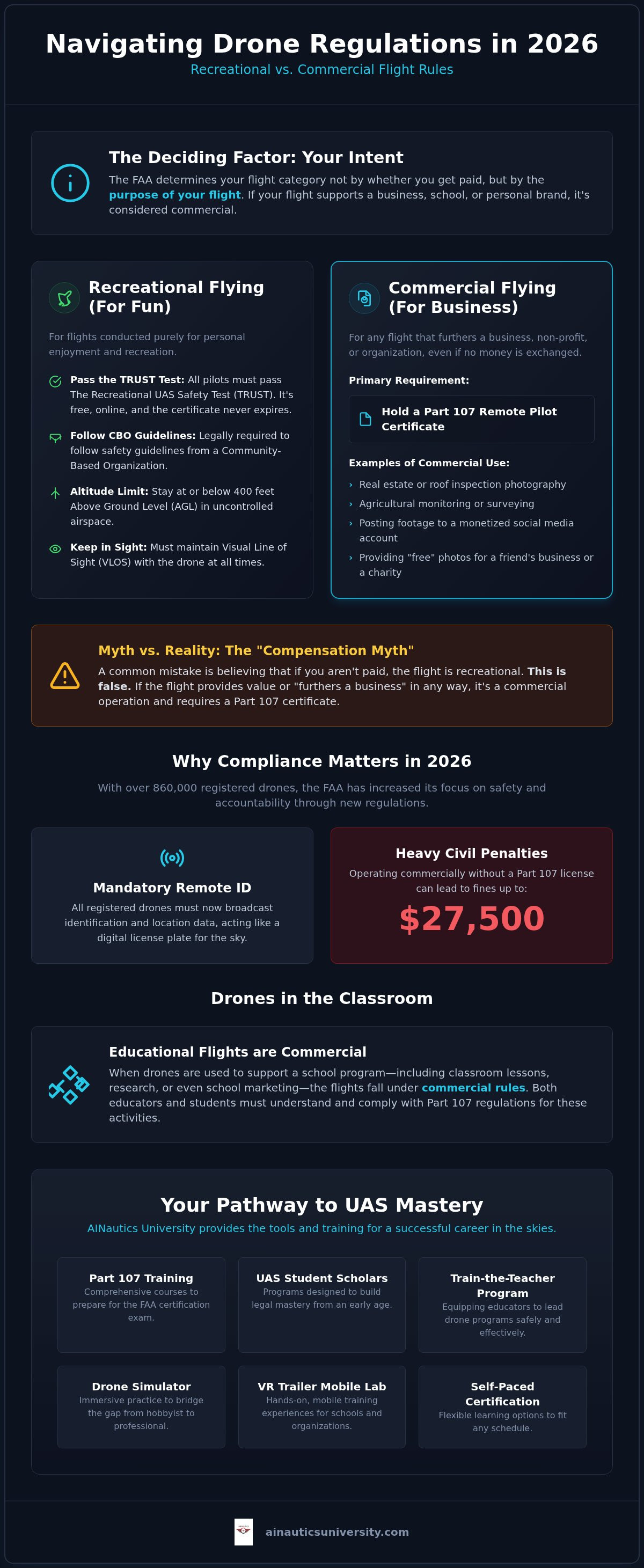
Did you know that posting your drone footage to a monetized social media account could result in an FAA fine of up to $27,500? In 2026, the distinction in recreational vs commercial drone laws isn't just about cash in hand; it's about your intent the moment those propellers spin up. If your flight supports a business, a school program, or even a personal brand, you're likely operating under commercial rules.
It's natural to feel confused by the complexities of Remote ID and registration fees. You want to enjoy the flight or build a career without the constant fear of legal oversight. We promise to demystify these boundaries so you can fly with confidence and ensure your school or business stays fully compliant.
This guide breaks down the essential 2026 FAA requirements, from the free TRUST certificate to professional Part 107 certification. We'll also highlight how AINautics University supports your journey through specialized Part 107 Training and the UAS Student Scholars program. Prepare to master the legal landscape and turn your passion into a future-ready profession.
Key Takeaways
- Understand how the FAA defines flight categories based on your "intent" rather than whether or not you receive payment for your work.
- Master the essential differences in recreational vs commercial drone laws to ensure compliance with 2026 Remote ID standards and avoid civil penalties.
- Identify the specific eligibility requirements for the Part 107 Remote Pilot Certificate, the industry-recognized credential for professional UAS careers.
- Learn how students and educators can navigate federal law within the classroom, including the latest rules for grading and research flights.
- Discover how immersive tools like the Drone Simulator and VR Trailer Mobile Lab bridge the gap between hobbyist flight and professional mastery.
Defining the Line: Recreational vs. Commercial UAS Operations
The legal boundary between a hobbyist and a professional pilot rests entirely on one factor: your intent when you power up your drone. Under recreational vs commercial drone laws, the FAA doesn't just look at whether money changed hands. They look at the purpose of the flight. If you fly purely for personal enjoyment, you operate under the Exception for Limited Recreational Operations. However, if your flight supports a business, a nonprofit, or even a school's marketing department, you've crossed into commercial territory.
The "Business Furtherance" Test
Commercial flight includes any operation that furthers a business or organization. This covers obvious tasks like real estate photography, roof inspections, or agriculture monitoring. It also includes less obvious scenarios. If you're a content creator with a monetized social media channel, your drone footage is considered a commercial asset. The FAA views this as a business operation because the content generates revenue or promotes a brand.
Commercial UAS Operation: Any drone flight conducted for business purposes, in furtherance of an organization, or for compensation or hire.
Many pilots fall into the "compensation myth" trap. They believe that as long as they aren't paid, the flight remains recreational. This is a dangerous misconception. Taking "free" photos for a friend's landscaping company or a local charity is a commercial act. Because the flight provides value to a business entity, you must hold a Part 107 Remote Pilot Certificate. Our Part 107 Training ensures you understand these nuances before you ever take off to do a professional favor.
Why 2026 Compliance Matters
In 2026, the FAA has increased its focus on Remote ID compliance and registration accuracy. With over 860,000 registered drones in the United States as of 2025, the sky is increasingly crowded. Misclassifying your flight isn't just a paperwork error; it's a legal liability. Operating a commercial flight under recreational rules can lead to civil penalties reaching $27,500.
- Remote ID: All registered drones must now transmit identification and location data.
- Intent: You must determine your flight category before takeoff to ensure you're following the correct safety protocols.
- Liability: Professional certification protects you and your organization from the fallout of unauthorized operations.
Programs like UAS Student Scholars help younger pilots navigate these risks early. We focus on building a foundation of legal mastery that lasts a lifetime. Understanding the distinction in recreational vs commercial drone laws is the first step toward a safe and profitable career in the skies.
Flying for Fun: Limited Recreational Operations
Operating a drone for personal enjoyment is a rewarding way to explore the skies, but it still requires a clear understanding of federal safety standards. While the barrier to entry is lower than professional flight, the FAA expects hobbyists to follow a specific set of rules known as the Exception for Limited Recreational Operations. Mastering the nuances of recreational vs commercial drone laws ensures you can fly without the risk of heavy fines or equipment seizure.
The core requirement for any recreational flight is that it must be purely for fun. If you're practicing maneuvers to improve your skills for a future job or filming a community event for a nonprofit, you've likely left the recreational category. Hobbyist flight is about the joy of the experience, not the utility of the data captured.
Mandatory TRUST Testing
Every recreational pilot, regardless of age, must pass The Recreational UAS Safety Test (TRUST) before their first flight. This test is free, available online, and focuses on basic safety and airspace knowledge. Once you pass, your completion certificate never expires. At AINautics, we encourage all students to treat TRUST as their first step toward a safety-first mindset. It builds the foundational awareness needed to interact safely with manned aircraft and other pilots in the national airspace.
Safety Guidelines and Community Standards
Hobbyist pilots don't just fly by their own rules. The FAA requires you to follow the safety guidelines of a Community-Based Organization (CBO). These guidelines provide a structured framework for safe flight, covering everything from pre-flight checks to emergency procedures. Staying within these standards is a legal requirement for maintaining your recreational status.
- Altitude Limits: You must stay at or below 400 feet Above Ground Level (AGL) in uncontrolled airspace.
- Line of Sight: You must keep your drone within your visual line of sight at all times without the aid of binoculars or telescopes.
- Manned Aircraft: You must always give way to manned aircraft and never interfere with their flight paths.
- Registration: If your drone weighs 250 grams (0.55 lbs) or more, you must register it with the FAA. This costs $5 and covers all your recreational drones for three years.
Registration is a simple but critical step for accountability. In 2026, Remote ID compliance is also mandatory for all registered drones. This technology allows the FAA and law enforcement to identify the drone's location and the pilot's control station in real-time. If you're a student looking to move beyond the basics, programs like our UAS Student Scholars provide the perfect bridge from hobbyist fun to professional mastery.
Flying for Business: FAA Part 107 Requirements
Hobbyist flight offers freedom, but the FAA Part 107 Remote Pilot Certificate is the industry's gold standard for anyone seeking a career in UAS. Understanding the shift in recreational vs commercial drone laws is critical when you transition from flying for fun to flying for profit. To hold this certificate, you must be at least 16 years old, demonstrate English proficiency, and pass a TSA security vetting process. These standards ensure that every professional pilot operates with a high level of accountability and safety.
The benefits of certification go far beyond a paycheck. Part 107 pilots can fly at night and operate over people with category-compliant drones, privileges not typically granted to recreational flyers. These expanded rights allow for complex operations in urban environments and around-the-clock infrastructure monitoring. If you're ready to dive into the technical specifics of the exam, our Professional FAA Part 107 Drone Training Guide provides a deep dive into the 2026 certification requirements.
The Path to Certification
Earning your license follows a structured five-step process. First, you must study the complex regulations, weather patterns, and loading charts required for safe flight. Second, you'll schedule and pass the Unmanned Aircraft General knowledge test at an FAA-approved testing center. Third, you complete FAA Form 8710-13 via the IACRA system to apply for your license. Fourth, you receive your permanent certificate once the TSA vetting is complete. Finally, you must maintain your knowledge through recurrent training every 24 months. AINautics University offers Self-Paced Certification options to fit this rigorous path into your existing schedule.
Commercial Rights and Responsibilities
Holding a commercial license brings increased responsibility. You're required to perform a thorough pre-flight inspection before every takeoff to ensure the aircraft is safe for operation. This includes checking battery health, propeller integrity, and signal strength. Additionally, you must report any accident resulting in serious injury or property damage over $500 to the FAA within 10 days. These rules maintain the safety of the national airspace while allowing you to build a specialized UAS career. Mastering recreational vs commercial drone laws means accepting that professional flight requires a higher standard of discipline and documentation.
Drones in Education: Where Schools Fit Into Federal Law
Legislative changes in 2018 and 2021 fundamentally altered how educational institutions interpret recreational vs commercial drone laws. These updates provide a clear path for students to operate drones as part of their formal coursework without needing immediate professional certification. Under these rules, a student's flight is considered recreational if it's performed for a grade or to fulfill a class requirement. This shift allows schools to integrate UAS technology into STEM programs with fewer legal hurdles for the learners themselves.
The distinction becomes sharper when looking at the purpose of the flight beyond the student's grade. If a teacher operates a drone to record a football game for the school's social media or conducts data collection for a university research project, the FAA classifies this as commercial work. Because the flight furthers the goals of the organization, it falls under Part 107 regulations. Schools must distinguish between these two scenarios to maintain federal compliance and protect their liability.
Building a successful program requires a structured approach to both flight and law. Our Drone Curriculum for Educators provides a roadmap for districts to manage these complexities. To ensure schools are ready for the 2026 school year, we utilize a 90-Day Program Launch methodology. This process moves a school from interest to operational readiness quickly, ensuring all hardware, software, and legal protocols are in place before the first propeller spins.
When Educators Need Part 107
Teachers often act as the Remote Pilot in Command (PIC) for classroom activities. Even if students are the ones on the controls, the teacher remains responsible for the safety and legality of the operation. This professional responsibility makes the flight commercial in nature. Our Train-the-Teacher program, known as UAS Teacher Scholars, empowers educators to earn their Part 107 certification and lead with confidence. This training ensures that instructors aren't just hobbyists; they're specialized mentors who understand the full scope of recreational vs commercial drone laws.
The UAS Student Scholars Program
Students who excel in the classroom often look for ways to turn their skills into a career. The UAS Student Scholars program provides a bridge for these high-achievers to move from recreational use to professional mastery. By earning a workforce-ready credential while still in school, students position themselves at the forefront of the industry. This preparation is vital for those exploring the Future of Drone Careers, where specialized knowledge is the primary currency of success.
Educators ready to launch a compliant and career-focused UAS program can explore our Train-the-Teacher Program to get started today.
Preparing for the Future of UAS Mastery
Understanding the distinction between recreational vs commercial drone laws is your legal baseline. It's the foundation of every safe flight. Yet, true industry mastery requires more than just memorizing statutes. It demands the ability to apply those laws in high-stakes, real-world environments. You must bridge the gap between theoretical knowledge and practical execution to truly excel in the UAS industry.
Immersive drone training technology plays a central role in this evolution. Traditional study methods often leave pilots feeling unprepared for the split-second decisions required in the field. By using advanced tools, you can experience complex flight scenarios before ever leaving the ground. This approach builds the muscle memory and situational awareness necessary for a successful career.
Scenario-Based Learning for Part 107
The AINautics Drone Simulator provides a risk-free digital environment where you can test your limits. You can practice identifying controlled airspace boundaries or navigating around obstacles without the financial risk of a hardware crash. This tool is especially valuable for those transitioning from drone training for beginners to expert-level operations. It allows you to fail, learn, and iterate until your compliance becomes second nature.
Our VR Trailer Mobile Lab takes this experience a step further. It brings hands-on workforce training directly to your location, offering a portable classroom equipped with the latest immersive drone training technology. This lab ensures that students and educators get the tactile experience they need to master professional flight standards in a controlled, expert-led setting.
Joining the iFlyDrone Marketplace
Earning your Part 107 certification isn't the end of your journey; it's the beginning of your professional life. AINautics University connects certified pilots to the iFlyDrone Marketplace, a nationwide platform for UAS work opportunities. This marketplace bridges the gap between learning a skill and finding a job. It allows you to put your specialized knowledge to work in industries like agriculture, public safety, and infrastructure inspection.
By focusing on both recreational vs commercial drone laws and advanced flight skills, you position yourself as a high-value asset in the workforce. Whether you're a student building a portfolio or an educator launching a new program, the path to success is clear. Master the rules, sharpen your skills through simulation, and step into the future of flight with confidence.
Master the Skies with Professional Certification
The evolution of UAS technology has created a landscape where the distinction between recreational vs commercial drone laws is the foundation of every safe and legal flight. Whether you're a student exploring a new hobby or an educator launching a district-wide initiative, knowing your intent before takeoff is non-negotiable. You've learned that hobbyist flight is purely for enjoyment, while professional operations require the discipline and authority of a Part 107 certificate.
AINautics University is here to help you bridge the gap between curiosity and career readiness. As a Service-Disabled Veteran-Owned Small Business (SDVOSB) and AUVSI member, we provide the expertise needed to navigate these regulations through our 90-Day Drone Program Launch and the iFlyDrone workforce marketplace. From self-paced certification to hands-on learning in our VR Trailer Mobile Lab, we provide the tools for your success.
Start Your Journey to Professional UAS Certification with AINautics University and take your place in the future of aviation. The horizon is wide open, and your path to mastery begins today.
Frequently Asked Questions
Do I need a Part 107 license if I am a student flying for a school project?
Students don't need a Part 107 license for schoolwork because of updated legislative rules. A student's flight is considered recreational if it's strictly for a grade or class requirement. However, the school must ensure the program is compliant. Our UAS Student Scholars program helps students understand these boundaries while preparing them for professional certification once they're ready to enter the drone workforce.
Can I fly my drone for a non-profit organization under recreational rules?
You cannot fly for a non-profit under recreational rules. The FAA defines commercial flight as any operation that furthers an organization, regardless of whether you're paid. Because the flight provides value to the non-profit, it falls under Part 107 requirements. Understanding the nuances of recreational vs commercial drone laws is vital for volunteers to avoid legal risks while supporting their community missions.
What happens if I fly commercially without a Part 107 certificate in 2026?
Flying commercially without a certificate in 2026 carries significant risks, including civil penalties of up to $27,500. The FAA has increased enforcement, especially regarding Remote ID compliance and unauthorized business flights. Beyond fines, you face potential criminal penalties for reckless operation. Utilizing tools like our Drone Simulator allows you to practice safely while you complete your official Part 107 Training and earn your credentials.
Does the FAA distinguish between "hobbyist" and "recreational" pilots?
The FAA uses the terms "hobbyist" and "recreational" interchangeably to describe pilots who fly purely for personal enjoyment. There's no legal distinction between the two. Both must pass the TRUST test and follow community-based safety guidelines. If your flight has any purpose beyond personal fun, such as career development or business support, you must transition to professional standards and obtain a license.
Do teachers need a Part 107 license to demonstrate drone flight in the classroom?
Teachers often need a Part 107 license if they act as the Remote Pilot in Command (PIC) for a school program. While students can fly recreationally for a grade, the instructor overseeing the flight is performing a professional duty for the school district. Our Train-the-Teacher Program, known as UAS Teacher Scholars, provides educators with the specialized knowledge and certification needed to lead classroom flight operations legally.
Can I use recreational flight rules for a YouTube channel that is not yet monetized?
You generally cannot use recreational rules for a YouTube channel if your intent is brand growth or future monetization. The FAA looks at the intent of the flight at the time of takeoff. If you're building a content library for a business venture, it's considered commercial. Most creators find that getting a license is the safest path to ensure their channel's long-term compliance and professional viability.
What are the Remote ID requirements for recreational vs. commercial drones?
Remote ID requirements apply to all registered drones, but the registration rules differ. All commercial drones must be registered and equipped with Remote ID regardless of weight. Recreational drones only require registration and Remote ID if they weigh 250 grams or more. Our VR Trailer Mobile Lab offers hands-on experience with these technologies, ensuring students and professionals understand how to maintain compliance in the 2026 regulatory environment.
How much does it cost to get an FAA Part 107 license?
The FAA Part 107 knowledge test fee is $175, which is paid to an approved testing center. This doesn't include the cost of study materials or preparation courses. To ensure success on the first attempt, many pilots invest in our Self-Paced Certification options. These programs provide structured, expert-led training that covers everything from airspace to complex regulations, helping you enter the workforce with confidence.

Article by
AINautics University Team
The team behind AINautics University, dedicated to drone education and FAA Part 107 certification prep, VR flight simulation, and STEM training programs for students and educators.


