
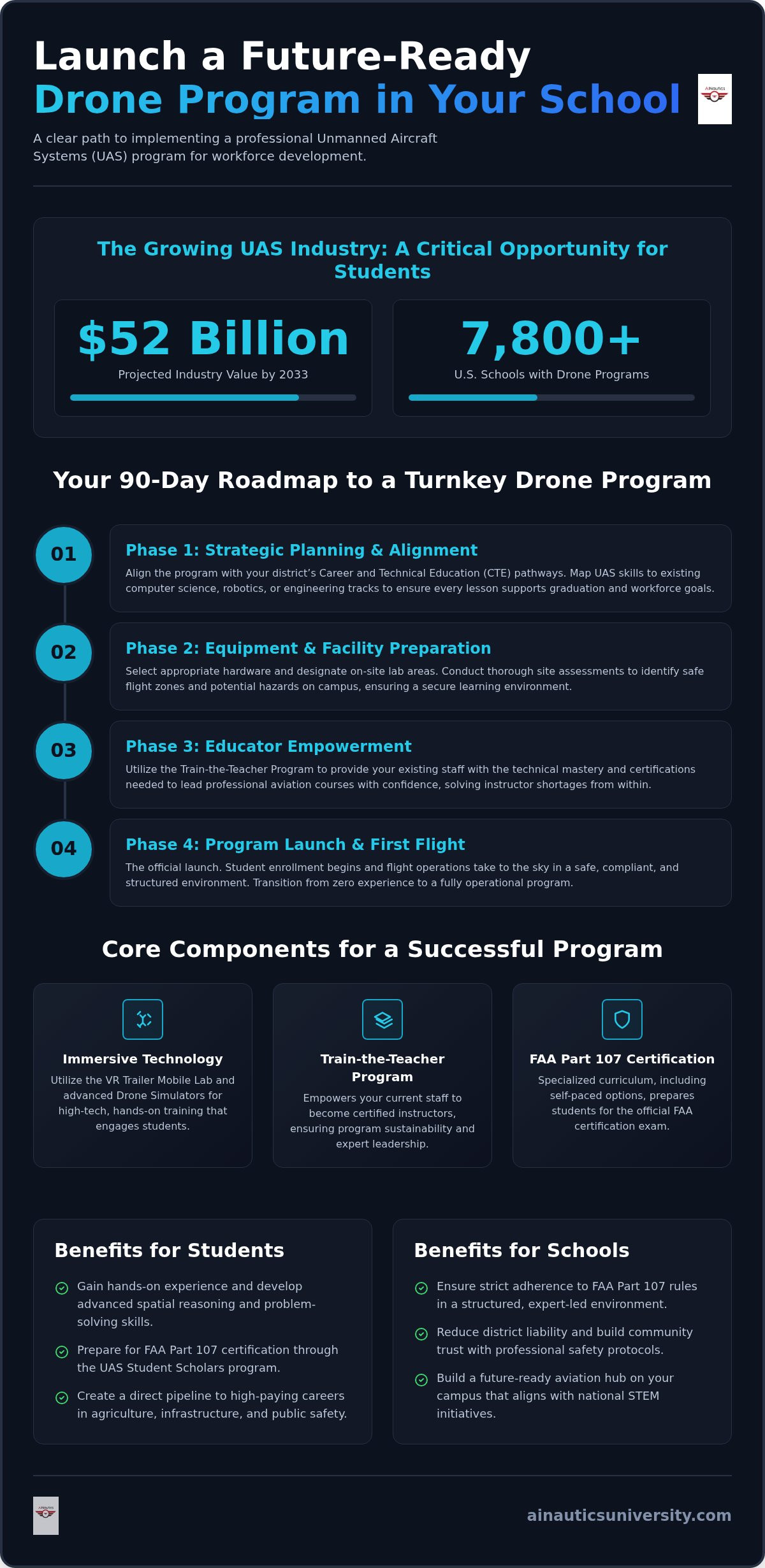
Over 7,800 schools across the United States have already integrated Unmanned Aircraft Systems into their science and engineering curricula, making on-site drone training for schools a critical priority for 2026. You likely recognize the massive potential for your students in an industry projected to reach $52 billion by 2033, but the path to implementation often feels blocked by regulatory red tape and a lack of specialized staff. It's common to feel overwhelmed by FAA compliance or the challenge of selecting the right equipment for a high school environment.
This guide provides a clear solution to those hurdles. We'll show you how to launch a workforce-aligned UAS program in just 90 days using immersive tools like our VR Trailer Mobile Lab and Drone Simulator. You'll learn how the Train-the-Teacher Program empowers your existing staff to lead with confidence, ensuring students gain the skills needed for Part 107 certification. From the UAS Student Scholars program to our self-paced certification tracks, we'll preview the roadmap to building a future-ready aviation hub right on your campus.
Key Takeaways
- Learn the proven 90-day framework for launching a turnkey UAS program that aligns with district CTE pathways and professional standards.
- Understand how the Train-the-Teacher Program solves instructor shortages by empowering your current staff to lead professional aviation courses.
- Explore how to deliver high-tech on-site drone training for schools using mobile solutions like the VR Trailer Mobile Lab and advanced simulators.
- Discover the specialized pipeline that prepares students for FAA Part 107 certification and high-paying careers through the UAS Student Scholars program.
On-Site Drone Training: A Catalyst for STEM Success
On-site drone training for schools is a comprehensive, campus-based immersion into the world of autonomous systems. It represents a decisive shift from recreational flying toward professional workforce development. Today, students aren't just learning to pilot unmanned aerial vehicles (UAVs); they're mastering the data collection and analysis skills required in high-demand industries. Sectors like infrastructure, agriculture, and public safety now depend on skilled UAS operators to perform critical tasks. AINautics University supports this transition through a mission-driven instruction model that focuses on mastery and future-readiness.
The Educational Value of Hands-On UAS Instruction
Moving beyond the textbook is essential for student success in technical fields. Physical flight experience is critical for engagement, as it allows students to see the immediate results of their work. During drone operations, students develop advanced spatial reasoning and technical problem-solving skills that are difficult to replicate in a traditional classroom setting. They must manage real-world variables like wind speed, GPS signals, and equipment health. This practical application aligns perfectly with national STEM and STEAM initiatives. Our UAS Student Scholars program ensures that students aren't just flying; they're learning the science behind the flight.
Navigating FAA Compliance and Safety Standards
Safety and legality are the cornerstones of any professional aviation program. Every school flight operation must strictly adhere to FAA Part 107 rules and regulations. Implementing on-site drone training for schools provides a structured environment where safety protocols are taught and enforced. This professional approach reduces district liability and builds community trust by showing that the program is managed with expert oversight. By using our Part 107 Training and the Train-the-Teacher Program, districts can certify their own staff to lead these programs. This ensures that the school maintains a safe, compliant, and highly effective learning environment for all participants.
The 90-Day Roadmap: Implementing a Turnkey Drone Program
Launching a professional aviation program shouldn't take years of trial and error. AINautics University utilizes a structured 90-day framework designed to move school districts from initial concept to active flight operations with efficiency. This timeline ensures that every critical component, from regulatory safety to student enrollment, happens in a logical and compliant sequence. By following a proven roadmap, administrators can avoid common pitfalls and focus on delivering high-quality on-site drone training for schools.
Phase 1 begins with strategic planning. We align the program with your district’s Career and Technical Education (CTE) pathways to ensure that every lesson contributes to graduation requirements and workforce goals. Phase 2 shifts the focus to equipment selection and facility preparation. We help you designate specific areas for on-site labs, ensuring your hardware choices support the learning objectives without unnecessary waste. In Phase 3, we prioritize educator empowerment through the Train-the-Teacher Program, which provides staff with the technical mastery they need. Finally, Phase 4 marks the official launch, where student enrollment begins and flight operations take to the sky.
Planning and Standards Alignment
Success starts with choosing the right drone curriculum for educators that matches both state and national standards. It is vital to map UAS skills directly to existing computer science, robotics, or engineering tracks. This integration helps students see the connection between theory and career application. Throughout this process, your district must strictly follow the FAA rules for educational drone use to maintain legal standing and safety. Setting clear, measurable goals for student certification ensures the program remains focused on professional readiness rather than just recreational play.
From Planning to First Flight
Safety is the primary concern for any campus-based aviation activity. You'll need to establish a clean paper trail for regulatory compliance, including maintenance logs and flight records. This phase involves conducting thorough site assessments to identify safe flight zones and potential hazards on your campus. Our comprehensive framework provides a seamless 90-day transition that takes your district from zero experience to a fully operational, flight-ready program. If you're ready to begin this transformation, you can explore our program launch services to see how we support your district's specific needs.
By the end of the 90-day cycle, your school won't just have drones; it'll have a sustainable ecosystem for on-site drone training for schools. This rapid rollout allows you to capture student interest while the technology is at its peak, providing immediate value to your community. Every step is designed to build a foundation of safety, mastery, and professional excellence.
Empowering Educators: The Train-the-Teacher Model
The primary obstacle to starting a successful aviation program isn't the technology; it's the instructor shortage. Many districts find it difficult to hire external commercial pilots who also possess the pedagogical skills required for a classroom. To solve this, schools must empower their existing staff to become certified experts. Our Train-the-Teacher Program provides a sustainable solution by turning science, technology, and CTE educators into confident UAS leads. This approach ensures that on-site drone training for schools remains a permanent fixture of the curriculum rather than a temporary elective.
We don't just provide a manual and walk away. AINautics University offers ongoing support and regular curriculum updates to keep your staff current with evolving FAA regulations. By building a community of UAS Teacher Scholars, we facilitate knowledge sharing across districts. This network allows educators to swap best practices and troubleshooting tips, creating a resilient educational ecosystem. When teachers feel supported, their students thrive, and the program's value to the community grows every year.
Professional Development for Modern Classrooms
Teachers in our program focus on mastering the material required for the Professional FAA Part 107 Drone Training exam. We move beyond simple test preparation to cover effective pedagogical strategies for teaching autonomous systems to high schoolers. This training allows schools to revolutionize STEM education by keeping expertise in-house. Relying on internal staff for instruction is significantly more cost-efficient than hiring outside contractors. It also ensures that the program aligns with the school’s specific culture and academic standards.
Advanced Workforce Readiness Skills
Modern drone operations require more than just stick-and-rudder skills. We train educators to teach mission planning and execution support, which are critical for commercial success. Classrooms transform into labs where students tackle real-world scenarios, such as infrastructure inspection or precision agriculture. We also incorporate essential wildlife-aware procedures into the curriculum. Teachers learn to guide students through Migratory Bird Treaty Act compliance and other environmental safety standards. This level of detail prepares students for the complexities of the professional world, ensuring they graduate with a sophisticated understanding of the industry's legal and ethical responsibilities.
By investing in your staff, you're building a foundation for long-term success. Certified teachers provide the continuity needed to scale the program as interest grows. With on-site drone training for schools led by qualified internal staff, your district becomes a leader in career-ready aviation education.
Harnessing Immersive Technology: VR Trailers and Drone Simulators
Aviation education reaches its peak when students can experience the thrill of flight without the immediate risk of equipment damage. High-tech tools are no longer optional additions; they're the foundation of a modern program. Our VR Trailer Mobile Lab acts as a central hub for on-site drone training for schools, providing a professional environment that mirrors commercial flight decks. This immersive setup allows students to tackle scenario-based training that mimics the complex challenges found in infrastructure inspection or search and rescue missions. By using these tools, your district can provide a level of training that was once reserved for high-end flight schools.
Why has immersive drone training technology become the gold standard in 2026? It’s because these systems provide a vital bridge between classroom theory and the high-stakes reality of the field. Students don’t just watch videos; they engage with the technology in a way that builds deep, lasting expertise and professional confidence.
The Mobile Lab Advantage
Many school districts lack the budget or space to build a permanent, high-end aviation facility. The VR Trailer Mobile Lab solves this by bringing a state-of-the-art UAS lab directly to your school parking lot. This mobile solution eliminates the need for expensive internal renovations or permanent facility modifications. It also ensures equitable access across the entire district. One trailer can rotate between multiple campuses, ensuring every student has the chance to work with the same advanced tools regardless of their home school’s infrastructure. It’s an efficient way to scale a program without a massive capital investment.
Simulation-Based Mastery
Before a student ever touches a live aircraft, they must build the necessary muscle memory. The AINautics Drone Simulator provides a crash-free environment where learners can practice complex maneuvers repeatedly. This simulation-based approach allows students to master precision flight and emergency procedures without the fear of costly accidents. Once they achieve proficiency in the virtual world, they graduate to live UAS Student Scholar missions. Teachers can easily track student progress through our Self-Paced Certification modules, ensuring every learner meets the required benchmarks before moving to actual flight operations. If you're ready to bring this technology to your campus, book a demo of our VR Trailer Mobile Lab today.
Launching Your School’s Drone Program with AINautics University
Partnering with AINautics University means aligning your district with a Service-Disabled Veteran-Owned Small Business (SDVOSB) that understands the value of precision and mission success. We aren't just a training provider; we're a comprehensive partner in your workforce development strategy. Our "Learn → Train → Certify → Fly → Work" pipeline is a proven framework designed to guide students from their very first flight to their first professional paycheck. This system connects your school directly to national resources and the iFlyDrone pilot marketplace. This connection ensures that the technical skills mastered through on-site drone training for schools lead to real-world employment opportunities for your graduates.
A Comprehensive Ecosystem for UAS Excellence
We provide a balanced ecosystem that combines our flexible Self-Paced Certification options with intensive, hands-on on-site training sessions. This hybrid model offers the flexibility students need while maintaining the high standards required for professional mastery. We're dedicated to preparing students for high-growth future drone careers in sectors like precision agriculture, emergency response, and infrastructure management. By leveraging our AUVSI membership and deep industry credibility, we ensure your students graduate with more than just a certificate. They leave with a professional reputation and a clear path forward in the aviation industry.
Getting Started: Your First 90 Days
The journey toward a professional drone program begins with a simple consultation to define your specific goals. Your first 90 days will involve a detailed site assessment and a comprehensive curriculum review. This phase allows us to identify the safest flight zones on your campus and ensure our training materials align perfectly with your state’s CTE standards. We customize the UAS Student Scholars program to match your school’s unique demographic and academic focus. Whether your priority is engineering, data science, or public safety, we tailor the experience to maximize student engagement and success.
District leadership must act now to embrace these autonomous systems. The technology is already here, and the workforce demand is growing every day. By choosing a professional partner, you ensure your program is safe, compliant, and results-oriented from day one. Request a program consultation with AINautics University today to see how we can build a future-ready aviation hub at your school.
Leading the Future of Aviation Education
Building a professional UAS program is no longer a distant goal for forward-thinking districts. By utilizing a proven 90-day implementation roadmap, your school can transition from initial planning to active flight operations with confidence. Immersive tools like the VR Trailer Mobile Lab and Drone Simulator create a safe, high-tech environment for mastery. The Train-the-Teacher model also ensures your program is led by qualified internal staff, fostering long-term sustainability and cost-efficiency.
Implementing on-site drone training for schools equips students with the specialized knowledge required for FAA Part 107 certification and high-growth careers. As an SDVOSB and proud member of AUVSI, AINautics University is committed to being your partner in technological advancement and workforce readiness. We provide the tools and expertise needed to bridge the gap between current curriculum standards and the demands of the modern aviation industry.
Take the first step toward empowering your students and staff today. Launch your school’s drone program in 90 days with AINautics University and prepare your community for the opportunities of tomorrow. The sky is just the beginning for your student scholars.
Frequently Asked Questions
How long does it take to start a drone program at my school?
It takes exactly 90 days to move from the initial planning phase to live flight operations using our structured rollout framework. This timeline includes strategic alignment with district goals, equipment selection, and specialized teacher training. By following this step-by-step roadmap, schools can avoid common delays and establish a compliant program quickly. This efficiency allows students to begin their journey toward professional certification within a single academic semester.
Do students need a license to fly drones on school property?
Students don't necessarily need a license for recreational or purely educational flights under specific FAA rules, but a Part 107 certificate is required for any professional-level work. Our program focuses on preparing students for this official FAA certification to ensure they are workforce-ready. Obtaining a license ensures they can legally participate in commercial data collection and advanced missions. It also provides the foundation for higher-level safety and operational compliance.
What is a VR Trailer Mobile Lab and how does it help students?
The VR Trailer Mobile Lab is a portable, state-of-the-art classroom that brings immersive technology directly to your campus parking lot. It features virtual reality stations and advanced flight simulators that allow students to practice complex maneuvers in a risk-free environment. This mobile setup provides equitable access to professional tools across an entire district without requiring permanent building modifications. It’s a key component of effective on-site drone training for schools in 2026.
Can our existing teachers lead the drone program?
Yes, your current staff can lead the program through our specialized Train-the-Teacher model. We provide educators with the technical mastery and pedagogical strategies needed to teach autonomous systems effectively. This approach solves the instructor shortage and ensures program sustainability by keeping expertise within the district. Teachers become certified UAS Teacher Scholars, capable of guiding students through both theoretical classroom lessons and hands-on flight labs using our proven curriculum.
Is on-site drone training safe for high school students?
Safety is our top priority and is maintained through a documented "clean paper trail" of procedures and simulation-based learning. Students build essential skills on the AINautics Drone Simulator before ever touching a live aircraft. This practice ensures they understand emergency protocols and mission planning. Professional on-site drone training for schools also includes compliance with wildlife-aware procedures and the Migratory Bird Treaty Act to ensure responsible environmental stewardship during every flight mission.
What career paths are available for students with a Part 107 certification?
Students can explore high-demand careers in infrastructure inspection, precision agriculture, public safety, and aerial cinematography. The Part 107 certification is the primary credential needed to work as a professional UAS operator. Our "Learn → Train → Certify → Fly → Work" pipeline connects graduates to the iFlyDrone marketplace, where they can find workforce opportunities. Salaries for skilled pilots with specialized expertise in areas like thermal imaging or mapping continue to grow significantly each year.
How does AINautics University align with CTE and STEM standards?
Our curriculum is specifically designed to align with state and district standards for Career and Technical Education (CTE) and STEM initiatives. We map UAS skills to existing computer science and engineering tracks to ensure every lesson supports graduation requirements. As an AUVSI member and SDVOSB, we provide industry-recognized credentials that carry weight with employers. This alignment ensures that students are learning workforce-ready skills that translate directly into professional success after they graduate.
Does the school need to purchase its own fleet of drones?
While having a fleet can be beneficial, it's not a requirement for starting your program with us. AINautics University focuses on providing the training, curriculum, and immersive tools like the VR Trailer Mobile Lab to get your program off the ground. We don't sell hardware, but we guide you through the equipment selection process to ensure you choose the right tools for your labs. This approach allows schools to focus their budget on high-quality instruction.

Article by
AINautics University Team
The team behind AINautics University, dedicated to drone education and FAA Part 107 certification prep, VR flight simulation, and STEM training programs for students and educators.


