
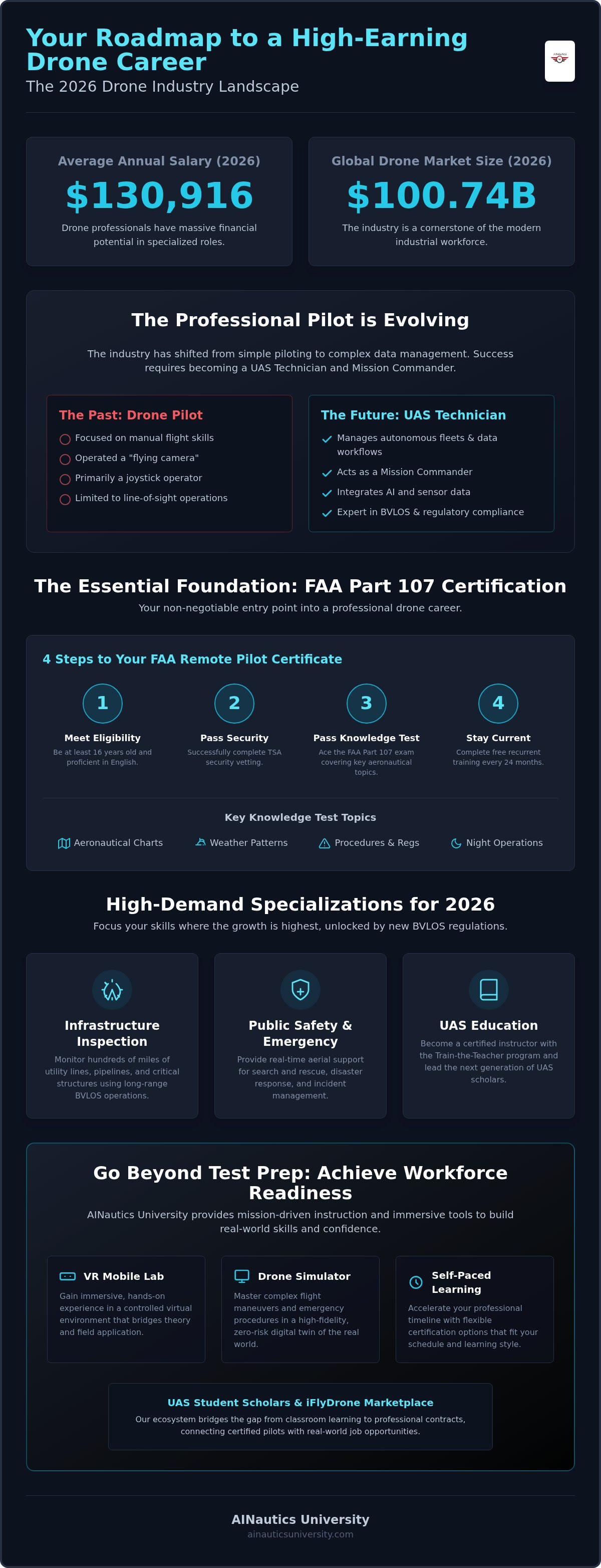
The average annual salary for a drone pilot in the United States has reached approximately $130,916 in 2026. While the financial potential is massive, the drone pilot career path often feels obscured by shifting FAA regulations and technical complexity. You're likely looking for a way to cut through the confusion and find a stable, high-paying role in this $100 billion industry. It's common to feel stuck between wanting to fly and not knowing which specialized skills the market actually demands.
We've designed this roadmap to take you from a curious beginner to a certified professional with confidence. You'll discover how to navigate FAA Part 107 Training and use advanced tools like the AINautics VR Trailer Mobile Lab to gain immersive experience. We'll explore how Self-Paced Certification and high-fidelity Drone Simulators prepare you for the real-world challenges of the 2026 landscape. This guide previews the exact steps needed to join the UAS Student Scholars program and secure your place in a future-ready workforce.
Key Takeaways
- Learn why the 2026 industry is shifting from basic flight to advanced UAS Technicians who specialize in AI and autonomous systems.
- Master the requirements for your FAA Remote Pilot Certificate and find out how Self-Paced Certification can accelerate your professional timeline.
- Identify high-demand specializations that align with your skills to create a high-earning drone pilot career path in specialized commercial sectors.
- Discover how immersive tools like the Drone Simulator and VR Trailer Mobile Lab provide safe, hands-on mastery before you ever step onto a real-world site.
- Find out how the UAS Student Scholars program and the iFlyDrone marketplace bridge the gap between classroom learning and professional contracts.
The 2026 Drone Industry: Why Now is the Time for a UAS Career
The global drone market has reached a staggering $100.74 billion in 2026. This massive valuation has fundamentally transformed the drone pilot career path from a niche hobby into a cornerstone of the modern industrial workforce. We've moved past the era where simply "flying" was enough to secure a professional contract. Today, the industry demands Unmanned Aircraft Systems (UAS) Technicians who can manage complex data workflows and oversee autonomous fleets. An Unmanned Aerial Vehicle (UAV) is no longer just a flying camera; it's a sophisticated node in a digital network that powers logistics and precision agriculture.
Success in this evolving environment requires a significant shift in mindset. Artificial Intelligence integration means that automation now handles the bulk of flight stability and obstacle avoidance. This doesn't make the human element obsolete. Instead, it elevates the pilot's role to that of a mission commander. Because the technical stakes are higher, starting with foundational drone training for beginners is vital to ensure you understand the software-driven nature of modern flight. AINautics University supports this transition through immersive tools like our VR Trailer Mobile Lab and high-fidelity Drone Simulator, which bridge the gap between theory and field application.
Defining the Professional UAS Pilot in 2026
Recreational flyers enjoy the view, but commercial Remote Pilots manage the data. In 2026, the distinction is clear: professionals focus on mission planning and post-flight analysis to solve specific business problems. You aren't just operating a joystick; you're managing a suite of sensors that capture critical infrastructure data. The 2026 UAS professional is a data-driven systems manager who integrates autonomous technology with regulatory compliance to deliver actionable industrial insights.
Projected Growth Sectors for New Pilots
The finalization of FAA Part 108 rules in 2026 has officially unlocked widespread Beyond Visual Line of Sight (BVLOS) operations. This regulatory shift has supercharged the infrastructure inspection sector, allowing pilots to monitor hundreds of miles of utility lines or pipelines from a single location. Public safety agencies have also expanded their UAS divisions, using drones for real-time emergency management and search and rescue operations. For those with an interest in education, our Train-the-Teacher Program prepares educators to lead new programs through the UAS Student Scholars initiative. Whether you choose Self-Paced Certification or structured Part 107 Training, the demand for specialized expertise across these sectors is at an all-time high.
The Essential Foundation: FAA Part 107 and Beyond
The FAA requires every commercial operator to Become a Certificated Remote Pilot before accepting a single paid mission. It's the law. In 2026, this certification isn't just a hurdle; it's a badge of professional legitimacy. While the industry has matured, the Remote Pilot Certificate remains the non-negotiable entry point for any drone pilot career path. This foundation ensures every pilot understands the complex rules governing our shared airspace.
Step-by-Step to Your FAA License
The path to certification is clear but rigorous. You must be at least 16 years old, demonstrate English proficiency, and pass a TSA security vetting process. The centerpiece of this journey is the FAA Part 107 Knowledge Test. This exam covers critical topics like aeronautical chart reading, weather patterns, and emergency procedures. In 2026, pilots must also demonstrate mastery of Remote ID requirements and night operation protocols, which are now standard. Once you earn your license, you must stay current. The FAA provides free online recurrent training every 24 months to keep your skills sharp and your legal status active.
Workforce-Ready Training vs. Simple Test Prep
Passing the test is only the beginning. Many providers focus solely on "teaching to the test," but Part 107 drone training should provide much more than rote memorization. Rote memorization might help you pass a multiple-choice test. It won't help you when a sensor fails at 400 feet. AINautics University prioritizes mission-driven instruction. This approach integrates operational safety and real-world compliance into your daily flight routine. We prepare you for the current landscape and the imminent arrival of Part 108 standards for autonomous flight.
For professionals in career transition, flexibility is vital. Our Self-Paced Certification options allow you to build expertise without pausing your current income. You can supplement your learning with our Drone Simulator to build muscle memory in a risk-free environment. This combination of theory and immersive practice ensures you're ready for the workforce the moment your certificate arrives. If you are ready to start your journey, you can explore our certification programs to find the right fit for your goals and schedule. Building a sustainable drone pilot career path starts with choosing training that values mastery over shortcuts.
Choosing Your Specialization: 2026 Career Pathways
By 2026, the global drone market has surpassed $100 billion. A generic license is no longer the finish line for a successful drone pilot career path. To truly excel, you must align your interests with a specific technical niche. Whether you are a student exploring a UAS scholarship for high school students or a professional pivoting careers, specialization is your greatest asset. While the first step is to Become a Certificated Remote Pilot, your long-term success depends on mastering industry-specific sensors and software.
Federal compliance in 2026 now emphasizes "Wildlife-Aware" inspections. This specialized approach ensures that industrial work doesn't disrupt local ecosystems, which is a key requirement for securing government and municipal contracts. Pilots who understand these environmental nuances alongside technical flight skills are seeing the highest demand in the workforce.
High-Growth Commercial Sectors
The commercial landscape has moved far beyond simple photography. Precision Agriculture has become a dominant sector, where pilots use multispectral sensors to analyze crop health and optimize yields. This role requires a deep understanding of data processing and agricultural software. Infrastructure and Utilities also offer stable career options. Pilots in this field conduct cell tower and vertical structure inspections, significantly reducing the risks associated with manual climbing. Public Safety remains a critical growth area. Agencies now rely on certified pilots for search and rescue missions and live-event situational awareness, making it a rewarding drone pilot career path for those with a background in emergency services.
The UAS Educator Pathway
As the industry grows, the need for qualified instructors has skyrocketed. Many professionals are choosing the UAS Educator Pathway to train the next generation of pilots. Our Train-the-Teacher Program provides the pedagogical tools and technical mastery needed to lead classrooms effectively. Educators are now developing comprehensive drone curriculum for educators that integrates with existing STEM programs at both K-12 and collegiate levels. Programs like the UAS Student Scholars initiative offer a structured environment where mentors can guide students from their first flight to professional certification. This pathway allows you to leverage your flight experience to build a sustainable career in academia while shaping the future of the Unmanned Aircraft Systems industry.
Mastering Flight: Simulators and Immersive Technology
A common misconception in the UAS community is that practical skill only comes from flying physical aircraft in an open field. While field time is valuable, the modern drone pilot career path has shifted toward software-driven flight. In 2026, the complexity of autonomous systems means you're often managing an interface rather than just pushing sticks. Professional mastery now requires a deep understanding of how these digital systems interact with the physical world. This is why high-fidelity simulation has become the industry standard for elite training.
Relying on "cheap practice drones" in your backyard is no longer a viable strategy for commercial readiness. Professional hardware is expensive and carries significant operational risk. By utilizing immersive drone training technology, you can bridge the gap between theory and the field without the fear of a costly crash. This approach allows you to focus on mission objectives and data quality rather than just basic stabilization.
Why Simulation is Non-Negotiable
Simulation provides a zero-risk environment to practice emergency procedures that are too dangerous to attempt in real life. Whether it's a sudden motor failure or a lost-link scenario, you can repeat these events until your response is automatic. This builds the muscle memory necessary for complex maneuvers in high-stakes industrial environments. Our scenario-based training replicates actual work sites, such as active construction zones or utility corridors. This ensures your first real-world mission feels like your hundredth.
Immersive Learning Tools
The AINautics Drone Simulator offers a 360-degree situational awareness experience that standard screen-based systems can't match. We take this further with our VR Trailer Mobile Lab. This mobile facility brings high-tech UAS education directly to schools and districts, fostering collective learning through shared immersive experiences. For those who need flexibility, our self-paced modules allow you to master advanced flight software on your own schedule. These tools ensure you aren't just a pilot, but a highly skilled technician ready for the demands of the 2026 workforce. If you're ready to build your skills in a professional environment, sign up for our immersive training programs today.
From Training to Workforce: The AINautics Ecosystem
Securing a license is a major milestone, but it doesn't automatically guarantee a steady stream of high-paying contracts. In 2026, the most successful professionals understand that a drone pilot career path requires a support system that extends beyond the classroom. While generic job boards often leave new pilots competing on price alone, a mentor-driven approach focuses on value and specialized expertise. We've built an ecosystem that doesn't just teach you how to fly; it positions you to work in the future of drone careers by connecting you with real-world opportunities.
Our commitment to professional excellence is backed by our status as a Service-Disabled Veteran-Owned Small Business (SDVOSB). This designation brings a level of mission-critical discipline and credibility that is highly valued by federal and state agencies. When you train within this ecosystem, you're leveraging a brand that understands the rigors of government and municipal contracting. For organizations looking to build their own internal UAS departments, our '90-Day Program Launch' methodology provides a proven framework to move from initial concept to an operational flight team with speed and precision.
The Learn-Train-Certify-Fly-Work Pipeline
Generic training often leaves a gap between certification and employment. AINautics University closes this gap by integrating directly with the iFlyDrone marketplace. This nationwide platform connects our certified pilots with lucrative municipal and commercial contracts, ensuring your skills meet immediate market needs. During your training, you'll build a professional portfolio by completing mission-driven projects that mirror actual industrial tasks. The AINautics ecosystem streamlines career entry by providing a direct bridge from immersive technical certification to a curated commercial marketplace.
Next Steps for Aspiring Pilots
Your journey begins with a clear assessment of your current goals. Evaluate your existing technical background and identify the training gaps that stand between you and your desired specialization. Whether you're a professional seeking Self-Paced Certification or a student ready to join the UAS Student Scholars program, the right path is available. We encourage you to engage with our leadership team, including Chief Pilot Taz Little, to gain insights into the current demands of the 2026 workforce. Enrolling in our comprehensive Part 107 Training is the first step toward a future where your skills are in high demand across the global UAS industry. Take the lead in your professional development and join a community dedicated to your long-term success.
Charting Your Course in the Modern UAS Industry
The transition from simple flight to sophisticated systems management is complete. In 2026, success belongs to those who choose a specialized path and master the data-driven tools of the trade. You've seen that a drone pilot career path is built on a foundation of FAA certification, but it's sustained through immersive simulation and mission-driven expertise. By leveraging tools like the Drone Simulator and VR Trailer Mobile Lab, you gain the confidence to handle real-world industrial challenges before your first day on the job.
AINautics University provides the comprehensive infrastructure you need to excel. As a Service-Disabled Veteran-Owned Small Business (SDVOSB), we deliver mission-driven instruction from industry experts who understand exactly what the modern workforce requires. Our ecosystem doesn't stop at the classroom; we provide direct access to the nationwide iFlyDrone pilot marketplace to help you secure professional contracts. Start your professional journey with AINautics University's Part 107 Training today.
The sky is no longer a limit; it's your new office. We're ready to help you lead the next generation of aviation with the skills and confidence to succeed.
Frequently Asked Questions
What is the average salary for a drone pilot in 2026?
The average annual salary for a drone pilot in the United States has reached approximately $130,916 in 2026. Most professionals earn between $100,000 and $155,000 depending on their specialization and experience level. Entry-level roles typically start around $39,075, while senior-level pilots with five to eight years of experience can earn over $71,862. Freelance pilots often charge hourly rates between $80 and $250 for specialized commercial missions.
Do I need a college degree to start a drone pilot career path?
You don't need a four-year college degree to start a successful drone pilot career path. The primary legal requirement is the FAA Part 107 Remote Pilot Certificate, which focuses on operational safety and airspace regulations. However, many high-growth sectors prioritize candidates with specialized certifications. Programs like our UAS Student Scholars provide students with the technical foundation and industry-recognized credentials necessary to enter the workforce directly after high school.
How long does it take to become a professional drone pilot?
Obtaining your FAA Remote Pilot Certificate can take as little as a few weeks of dedicated study. However, reaching professional mastery typically requires several months of hands-on experience. Our Self-Paced Certification allows you to learn at your own speed, while our Drone Simulator helps you build muscle memory quickly. For organizations, our 90-Day Program Launch methodology provides a structured timeline to move from initial planning to full flight operations.
Can I start a drone business with just a Part 107 license?
A Part 107 license is the legal foundation for any commercial drone business, but it's only the first step. To operate professionally, you'll also need commercial liability insurance and a robust understanding of mission planning. Success in 2026 requires more than just flying; you must deliver high-quality data. Integrating with platforms like the iFlyDrone marketplace can help new business owners find municipal contracts without the overhead of a massive marketing budget.
What are the most in-demand drone skills in 2026?
In 2026, the most in-demand skills include Beyond Visual Line of Sight (BVLOS) operations and AI-driven data analysis. Industry leaders look for pilots who can manage autonomous fleets and interpret complex sensor data from multispectral or LiDAR cameras. Specializations in precision agriculture and infrastructure inspection are particularly lucrative. Mastering these tools through our VR Trailer Mobile Lab ensures you can meet the technical demands of high-paying federal and state contracts.
Is the drone pilot career path suitable for career changers?
The drone pilot career path is an excellent choice for career changers looking to enter a high-growth technology sector. Many professionals transition from fields like construction, public safety, or education by leveraging their existing industry knowledge. Our Self-Paced Certification options make it possible to train while maintaining your current job. By adding UAS expertise to your resume, you become a highly valuable asset in any industry adopting autonomous systems and aerial data collection.
How does the iFlyDrone marketplace help new pilots find work?
The iFlyDrone marketplace serves as a direct bridge between your training and professional workforce placement. It connects FAA Part 107-certified pilots with municipalities and organizations that need aerial data but don't want to manage an internal flight department. This platform eliminates the need for you to spend months searching traditional job boards. Instead, you can access a curated stream of contract opportunities that value your mission-driven instruction and specialized technical skills.
What hardware should I buy to start my professional training?
We recommend starting your training with a high-fidelity Drone Simulator rather than purchasing expensive hardware immediately. Simulation allows you to master complex maneuvers and emergency procedures in a zero-risk environment. Once you've built the necessary muscle memory, you can evaluate which professional-grade aircraft best suits your chosen specialization. AINautics University focuses exclusively on training and educational resources to ensure you have the skills to operate any professional UAS platform safely.

Article by
AINautics University Team
The team behind AINautics University, dedicated to drone education and FAA Part 107 certification prep, VR flight simulation, and STEM training programs for students and educators.


