
What if your Remote Pilot Certificate isn't just a license, but a ticking clock that could ground your career before you even realize it? It's easy to lose track of the 24-month window while you're busy managing flight logs and 2026 Remote ID requirements. Many pilots feel a sense of dread when they realize their authority to fly commercially might have lapsed without a single warning from the FAA. You aren't alone in feeling that the transition from initial testing to ongoing Part 107 recurrent training feels like a moving target.
This guide will show you exactly how to maintain your certificate and bridge the gap between simple regulatory compliance and true professional flight mastery. We'll break down the free FAA online training requirements, the latest 2026 airspace shifts, and how specialized tools like the AINautics Drone Simulator can sharpen your skills beyond the exam. You'll gain the clarity needed to navigate the 2026 UAS landscape while ensuring your career remains on an upward trajectory. Whether you are an educator in our Train-the-Teacher program or a professional pilot, staying current is your most important mission.
Key Takeaways
- Understand the critical 24-calendar-month window to ensure your commercial flight authority never lapses.
- Master the step-by-step process for completing your Part 107 recurrent training through the FAA’s free online portal.
- Discover how to bridge the gap between regulatory compliance and professional mastery using tools like the AINautics Drone Simulator.
- Learn how school administrators can leverage the Train-the-Teacher Program to maintain legal compliance for campus drone initiatives.
- Unlock the "Learn -> Train -> Certify -> Fly" pipeline to turn your active certification into a competitive advantage in the 2026 workforce.
The 24-Month Rule: Why Part 107 Recurrent Training Matters
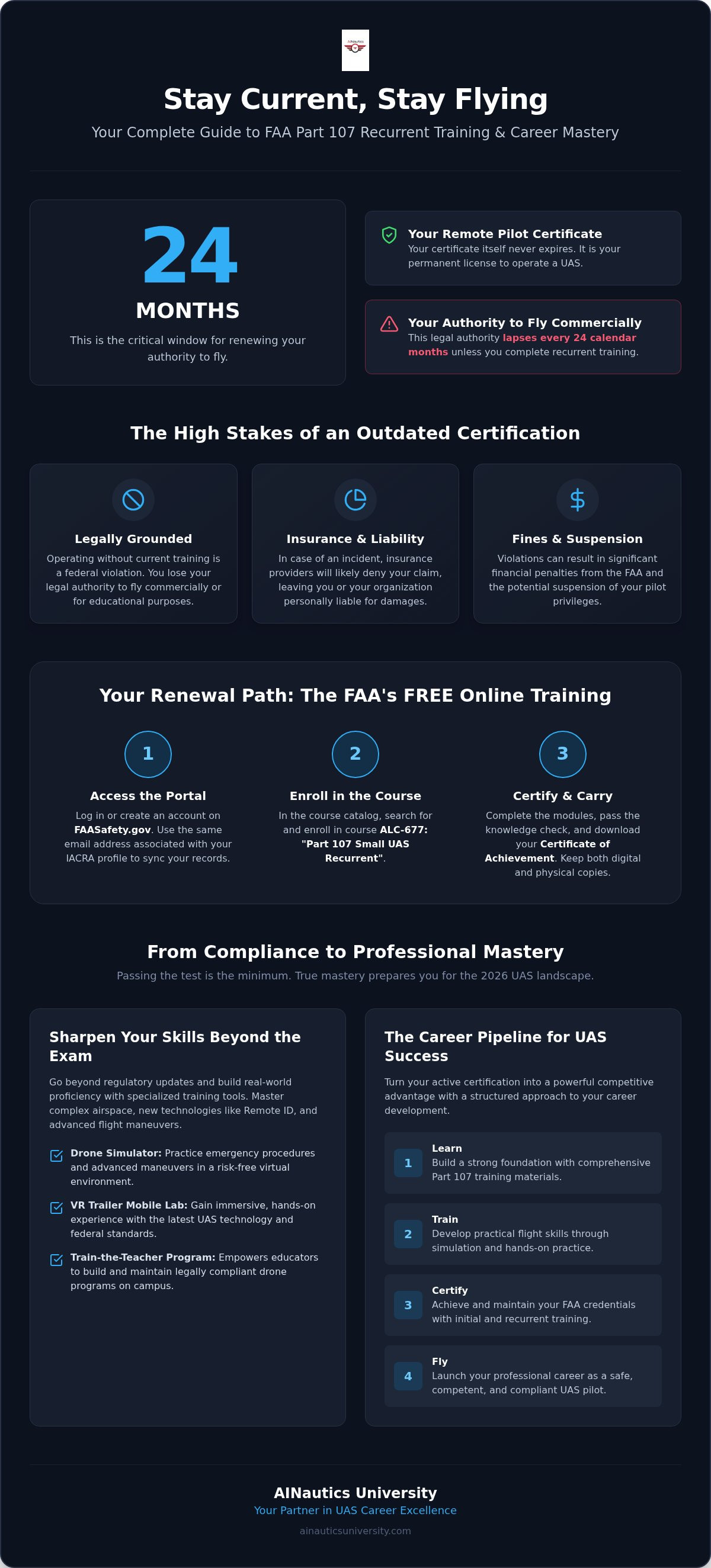
The FAA Remote Pilot Certificate is unique because it never technically expires. However, your legal authority to fly a drone for work or school depends entirely on your currency. Under the current FAA regulations for commercial drone operators, you must complete Part 107 recurrent training every 24 calendar months. If you miss this window, your certificate remains in your pocket, but your ability to operate in the national airspace is legally grounded. It's a common trap for busy pilots who assume their physical card is all they need.
The FAA shifted from paid, in-person testing to free online recurrent training to ensure pilots stay updated without financial friction. This move reflects the rapid pace of the industry. In 2026, a pilot who hasn't reviewed the latest rules is a liability. Operating without valid documentation isn't just a paperwork error; it's a federal violation that can lead to heavy fines and the suspension of your pilot privileges. You must treat this requirement as a professional milestone rather than a bureaucratic hurdle.
Legal Implications for Commercial Operations
Staying current is a prerequisite for professional liability insurance. If an incident occurs and your Part 107 recurrent training is out of date, your insurance provider will likely deny the claim. This leaves you or your employer personally liable for damages. For enterprise fleets and school programs, maintaining a strict compliance log is essential for safety and legal protection. Certification is your permanent license, while currency is the legal status that allows you to exercise the privileges of that license every 24 months.
The Evolution of UAS Rules in 2026
The drone industry moves fast. Since your initial exam, the FAA has integrated complex standards for Remote ID and night operations. Your recurrent training acts as a vital bridge to these new requirements. At AINautics University, we help pilots move beyond the basic test. Our Train-the-Teacher Program and VR Trailer Mobile Lab provide the immersive environment needed to master these shifting federal standards. We don't just want you to pass a quiz; we want you to be a leader in the 2026 UAS workforce. Staying ahead of these changes ensures you remain a valuable asset to any organization or educational institution. Mastery is a continuous journey, not a one-time event.
Step-by-Step Guide to Completing FAA Recurrent Training
Completing your Part 107 recurrent training is a streamlined, digital process designed to keep your knowledge sharp without the need for an in-person testing center. The FAA transitioned to this model to ensure every pilot has access to the most current safety information at no cost. You'll start by visiting the FAA Safety Team (FAASTeam) website, which serves as the central hub for your ongoing education and certification tracking. It's a professional responsibility that keeps you compliant and ready for the field.
Navigating the FAASafety.gov Portal
Your first step is to log in or create an account on FAASafety.gov. If you already have a certificate, use the same email address linked to your IACRA profile to keep your records synchronized. Once logged in, search the course catalog for "Part 107 Small UAS Recurrent," specifically course ALC-677. This is the official FAA's online recurrent training designed for existing remote pilots. After you complete the modules, you must download and print your Certificate of Achievement. Keep a digital copy on your phone and a physical copy in your flight kit. FAA inspectors or employers may ask to see this documentation alongside your original Remote Pilot Certificate to verify your currency.
Preparing for the Recurrent Knowledge Check
The training modules cover critical updates, but the final knowledge check requires a solid grasp of foundational aviation concepts. You'll face questions on airspace classifications, weather patterns, and emergency procedures. If it's been nearly two years since your last deep dive into the regulations, use our comprehensive Part 107 drone training resources to refresh your memory on sectional charts and METAR reports. Don't overlook the importance of reviewing the latest Aeronautical Chart updates, as airspace boundaries often shift between renewal cycles.
Success on the recurrent check is about more than just a passing score; it's about maintaining a professional standard of safety. If you find yourself struggling with specific maneuvers or airspace transitions, our Drone Simulator offers a risk-free environment to practice complex scenarios before your next mission. Once you finish the online modules, take a moment to verify that your FAA Safety Team profile reflects your new currency date. This lifelong tracking system ensures you're always ready for the next 24-month cycle without the fear of flying on an expired status.
Beyond the Certificate: Maintaining Flight Proficiency
Legal currency isn't the same as operational mastery. The online exam ensures you know the rules, but it doesn't move the sticks for you. Pilots who only engage with regulations every two years often suffer from "skill fade." This is the gradual loss of precision and decision-making speed that occurs when you don't fly regularly or challenge your limits. If you only focus on the minimum requirements, you're leaving your professional reputation to chance.
While the Part 107 recurrent training process is a convenient way to stay legal, it shouldn't be your only touchpoint with aviation safety. True proficiency requires a monthly routine that integrates both theory and practice. High-performing pilots treat their 24-month window as a deadline for mastery, not just a box to check on a website. You need to actively bridge the gap between knowing the law and executing a flawless mission.
The Role of the AINautics Drone Simulator
Muscle memory is a perishable skill that requires constant reinforcement. Our Drone Simulator allows you to build complex mission profiles in a risk-free virtual environment. You can practice emergency maneuvers, such as motor failures or sudden loss of GPS, without risking expensive equipment. Simulators bridge the gap between reading about a procedure and executing it perfectly under pressure. This consistent practice ensures that when you face a real-world challenge, your response is instinctive and accurate. It's the most efficient way to maintain your edge between Part 107 recurrent training cycles.
Immersive Learning with the VR Trailer Mobile Lab
Advanced UAS education is evolving toward immersive, hands-on experiences. The VR Trailer Mobile Lab provides the depth of training needed to prepare for high-stakes commercial inspections and public safety missions. VR technology places you in the center of the action. It allows you to navigate tight spaces or inspect critical infrastructure before you ever arrive on-site. This workforce-ready training separates a basic certificate holder from a professional flight specialist. By accessing these mobile lab resources, you ensure that your skills remain as current as your paperwork. Mastery is about being ready for the mission, not just the test.
Recurrent Training Strategies for Educators and Schools
Managing a school-wide drone program involves more than just keeping batteries charged. It requires a meticulous approach to regulatory compliance. If a lead instructor fails to complete their Part 107 recurrent training, the entire student flight program can face immediate legal and insurance risks. Schools must treat instructor currency as a non-negotiable safety standard to protect both the institution and the students. This alignment ensures that your Career and Technical Education (CTE) programs meet state and district standards for workforce readiness.
AINautics University supports K-12 districts by providing ongoing curriculum updates that reflect the 2026 regulatory environment. We understand that teachers are often balancing multiple subjects. Our goal is to streamline the compliance burden so you can focus on instruction. By integrating regulatory updates directly into the classroom environment, we help educators maintain a high standard of excellence without the stress of independent research.
The Train-the-Teacher Program Advantage
Maintaining a staff of certified pilots is easier when you have a structured support system. Our Train-the-Teacher Program simplifies the recurrent training process for educators. It provides a clear roadmap for staying current while offering professional development credits that count toward district requirements. By building a sustainable UAS Teacher Scholar network, districts can ensure that knowledge isn't siloed with just one individual. This creates a resilient program that can grow and adapt as technology shifts.
UAS Student Scholars and Compliance
We believe that professional habits start in the classroom. Teaching students about regulatory currency is a vital part of their career path. When students see their instructors prioritizing Part 107 recurrent training, they learn that compliance is a hallmark of a professional pilot. We incorporate these recurrent concepts directly into our high school drone curricula. This preparation ensures the next generation enters the workforce with a mindset focused on safety and legal standards. Students who understand the "why" behind the rules become the most reliable pilots in the industry.
If you're ready to launch or scale a compliant UAS program at your school, explore our 90-Day Drone Program Launch for schools. We provide the tools and expertise to keep your instructors current and your students flying safely.
Maximizing Your UAS Career with AINautics University
Your Remote Pilot Certificate is more than a legal permit; it's a professional asset that signals your commitment to excellence. In a competitive market, maintaining your Part 107 recurrent training is the baseline. We help you turn that baseline into a career-defining advantage. Our "Learn -> Train -> Certify -> Fly" pipeline isn't just a slogan. It's a methodical approach to career growth that ensures you're always prepared for the next technological shift. By staying current, you position yourself as a reliable expert who understands the weight of federal compliance.
Credibility matters when you're applying for high-stakes roles in infrastructure or public safety. AINautics University is a Service-Disabled Veteran-Owned Small Business (SDVOSB) and a member of AUVSI. We bring military-grade precision to UAS education. When you train with us, you're joining a lifelong ecosystem dedicated to autonomous systems mastery. We don't just help you pass a test; we help you build a resume that stands out to enterprise leaders who value safety and standards above all else.
Mission-Driven Instruction for Real-World Success
Moving from a recreational mindset to a mission-ready professional requires specialized knowledge. While the FAA provides the basic rules, our advanced certifications give you the skills to execute complex operations. For busy professionals, our self-paced drone certification options allow you to balance your career with your education. Chief Pilot Taz Little often reminds our students that relevance in this industry is a moving target. You can't afford to be stagnant. Our mission-driven instruction focuses on the practical application of UAS technology, ensuring you're ready for the field the moment you finish your training.
Your Next Steps in the UAS Industry
Don't wait for your 24-month window to close before thinking about your next move. Use this time to plan your training calendar and explore specialized pathways. Whether you're interested in precision agriculture or high-resolution thermal inspections, the opportunities in 2026 are vast. Once you've secured your currency, consider joining our UAS Student Scholars program to deepen your expertise. This is the perfect time to leverage your active status and seek out new challenges. Get started with AINautics University today and take the next step in your professional journey. The future of flight is waiting, and we're here to help you lead it.
Take Command of Your Professional Flight Path
Maintaining your status in the national airspace is more than a legal requirement; it's a commitment to the highest standards of aviation safety. You've learned that currency is the bridge between your certificate and your right to fly. Completing your Part 107 recurrent training is your biennial opportunity to reset and sharpen your skills. True mastery goes beyond the online exam. It requires the immersive, hands-on experience found in our VR Trailer Mobile Lab and the precision of our Drone Simulator.
As a Service-Disabled Veteran-Owned Small Business, AINautics University provides the mission-driven instruction you need to stay relevant. Our STEM-aligned curriculum ensures that educators and students alike are prepared for the technological demands of 2026. Whether you're managing a school-wide fleet or building a solo career, we provide the lifelong ecosystem necessary for success. Don't let your authority lapse or your skills fade.
Elevate your UAS career with AINautics University training and join a community of pilots who lead with expertise. The skies are evolving, and you have the tools to stay ahead of the curve. Your next mission starts with the right preparation.
Frequently Asked Questions
How often do I need to complete Part 107 recurrent training?
You must complete your Part 107 recurrent training every 24 calendar months to maintain your aeronautical knowledge currency. While your Remote Pilot Certificate itself doesn't expire, your legal authority to fly commercially lapses if you miss this window. We recommend setting a calendar reminder for 22 months after your last completion date. This proactive approach ensures you have ample time to review the latest UAS technology shifts without risking an accidental grounded status.
Is the FAA recurrent training course free to take?
Yes, the official FAA recurrent training course is completely free for all certified remote pilots. You can access it through the FAA Safety Team (FAASTeam) website at any time. This digital shift removed the previous requirement for paid, in-person testing at specialized centers. By offering this resource at no cost, the FAA ensures that every pilot can stay updated on critical safety regulations and 2026 airspace rules without facing unnecessary financial barriers.
What happens if my Part 107 currency expires?
If your currency expires, you lose the legal privilege to operate a drone under Part 107 rules immediately. You cannot fly for commercial, educational, or governmental purposes until you successfully complete the recurrent training. Your physical certificate remains valid, but it's essentially parked until you refresh your knowledge. Flying with an expired currency is a federal violation. It can lead to significant fines and negatively impact your professional standing or insurance coverage.
Do I need to take a proctored exam at a testing center for renewal?
No, you don't need to visit a proctored testing center for your renewal. The current process is entirely web-based and can be finished from your home or office. This is a major change from the initial certification exam, which still requires an in-person, proctored test at an FAA-approved site. The online format focuses on updated safety protocols and new regulations. It makes it easier for busy professionals and educators to maintain their legal flight status.
How do I prove to an inspector that I have completed my recurrent training?
You prove your currency by presenting your FAA Certificate of Achievement alongside your Remote Pilot Certificate. After finishing the online course, you'll receive a downloadable certificate that includes your name and the completion date. It's best practice to keep a digital copy on your smartphone and a physical printout in your flight kit. Inspectors or law enforcement officers will look for this documentation to verify you've met the 24-month Part 107 recurrent training requirement.
Can I fly at night after completing the 2026 recurrent training?
Yes, completing the current recurrent training course grants you the authority to fly at night without a specific waiver. The training modules now include dedicated sections on night physiology and required aircraft lighting. You must ensure your drone is equipped with anti-collision lights visible for at least three statute miles. They must also flash at a rate sufficient to avoid a collision. This integration simplifies operations for missions involving infrastructure inspection or public safety.
Does AINautics University offer support for Part 107 renewal?
AINautics University provides extensive support to help you move beyond the basic FAA requirements. As an SDVOSB focused on workforce development, we use our AINautics Drone Simulator and VR Trailer Mobile Lab to offer immersive environments that refresh your flight proficiency. We also support educators through our Train-the-Teacher Program, ensuring school programs remain compliant. Our goal is to bridge the gap between test-taking and true professional mastery during your Part 107 recurrent training cycle.
Is there a specific course number for the Part 107 recurrent training in 2026?
The primary course number for the Part 107 recurrent training is ALC-677, titled Part 107 Small UAS Recurrent. You can find this specific module by searching the course catalog on the FAASafety.gov portal. It's designed specifically for pilots who already hold a Part 107 certificate. Completing this exact course ensures your records are correctly updated in the FAA system. This allows you to continue your commercial operations and educational missions with total confidence.

Article by
AINautics University Team
The team behind AINautics University, dedicated to drone education and FAA Part 107 certification prep, VR flight simulation, and STEM training programs for students and educators.


