
By 2035, the global drone market is projected to reach a staggering $209.91 billion, making a self-paced drone certification a vital asset for any modern professional. You're likely balancing a demanding schedule while trying to decode dense FAA manuals, all while worrying about the $175 fee for an exam you can't afford to fail. It's a common frustration to feel that your professional goals are stuck behind a wall of information overload and rigid classroom hours.
This guide provides a definitive 2026 roadmap to obtaining your professional license, ensuring you master Part 107 regulations without sacrificing your current commitments. We understand that specialized knowledge should be accessible and empowering. By focusing on a flexible curriculum, you can build the confidence needed to pass your exam on the first attempt and secure a credential that industry leaders respect.
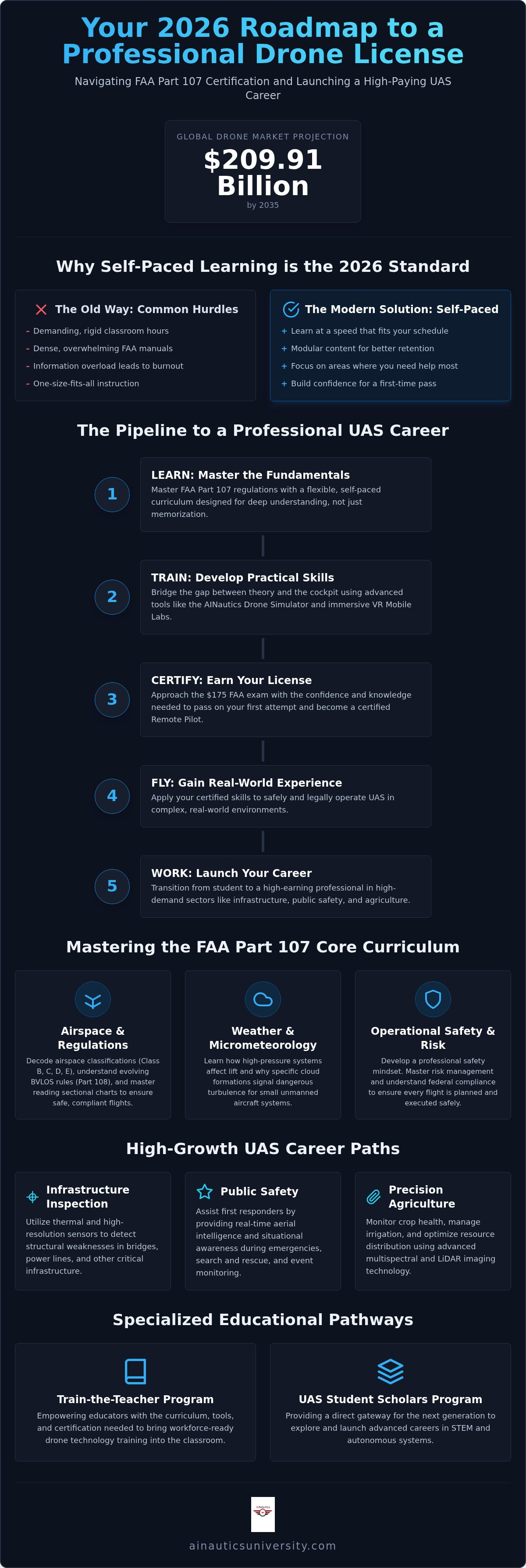
We'll explore the "Learn, Train, Certify, Fly, Work" pipeline, highlighting how resources like the AINautics Drone Simulator and UAS Student Scholars program bridge the gap between theory and the cockpit. From immersive VR Trailer Mobile Labs to specialized Train-the-Teacher programs, you'll discover exactly how to navigate the evolving UAS industry and launch a high-paying career on your own terms.
Key Takeaways
- Understand why the flexible model of a self-paced drone certification has become the 2026 industry standard for creating workforce-ready pilots.
- Master the complexities of the FAA Part 107 framework, including airspace and weather, using a curriculum tailored for independent study.
- Learn how to bridge the gap between theory and flight using the AINautics Drone Simulator and immersive VR technology.
- Identify specialized career pathways such as the UAS Student Scholars program for youth or the Train-the-Teacher Program for educators.
- Discover how the "Learn, Train, Certify, Fly, Work" pipeline streamlines your transition from a student to a high-earning UAS professional.
Why Self-Paced Drone Certification is the Professional Standard in 2026
A self-paced drone certification is more than just a digital textbook. It's a flexible learning model that empowers students to master complex UAS regulations at a speed that fits their unique cognitive load and schedule. In 2026, the industry has shifted away from simple test memorization toward workforce-ready training. Employers no longer just want to know if you can pass a test; they want to know if you can safely operate an Unmanned aerial vehicle (UAV) in complex environments.
This year marks a pivotal moment for the autonomous systems industry. With the global market projected to reach over $209 billion by 2035, the demand for specialized knowledge is at an all-time high. AINautics University meets this demand through its Self-Paced Certification options, ensuring that learners don't just memorize facts but actually internalize the safety protocols required for professional flight.
Breaking Down the UAS Professional Landscape
The professional landscape for drone pilots has expanded far beyond basic photography. In 2026, we see a massive surge in demand across several critical sectors:
- Infrastructure Inspection: Using thermal sensors to detect structural weaknesses in bridges and power lines.
- Public Safety: Assisting first responders with real-time situational awareness during emergencies.
- Precision Agriculture: Monitoring crop health and optimizing resource distribution through multispectral imaging.
Obtaining a Remote Pilot Certificate is the essential foundation for these high-paying paths. Programs like the UAS Student Scholars initiative demonstrate how this certification serves as a gateway to advanced STEM careers for the next generation. The economic impact is clear. As autonomous systems become integrated into every level of the workforce, those with specialized training will lead the market.
The Flexibility Advantage for Modern Learners
Most career changers and educators can't afford to step away from their primary responsibilities for weeks of fixed-time classes. Choosing a self-paced drone certification solves this by offering modular content. Breaking down dense topics like micro-meteorology or Class B airspace into manageable segments significantly improves long-term retention. Whether you're a teacher looking into the Train-the-Teacher Program or a professional balancing a full-time job, you can customize your pace. You can spend more time on sectional charts if aviation is new to you, or move quickly through technical specs if you already have a background in robotics. This tailored approach ensures you're prepared for the FAA Part 107 exam without the burnout associated with traditional classroom settings.
The Core Curriculum: Mastering FAA Part 107 at Your Own Speed
Mastering the FAA Part 107 certification requirements requires a deep dive into three critical pillars: airspace, weather, and operations. While many students feel intimidated by the volume of information, a self-paced drone certification allows you to absorb these concepts through structured, modular learning. You aren't just memorizing definitions. You are learning to interpret the environment around your aircraft. This involves understanding how high-pressure systems affect lift and why specific cloud formations signal dangerous turbulence for small drones.
Navigating Airspace and Regulations
Airspace classification is the language of the sky. You must decode the boundaries of Class B, C, D, and E airspace to ensure you don't interfere with manned aircraft. In 2026, staying current also means understanding the finalization of Part 108 rules, which govern Beyond Visual Line of Sight (BVLOS) operations. The Remote Pilot Certificate serves as the legal foundation for federal compliance and professional accountability in commercial drone flight. Learning to read sectional charts without an instructor requires high-quality visual aids and interactive tools. These resources help you identify restricted areas, military operations areas, and temporary flight restrictions that can change in an instant.
Operational Safety and Risk Management
Safety isn't a checkbox; it's a mindset. A professional curriculum emphasizes scenario-based modules that force you to make "go/no-go" decisions based on real-world variables like wind shear or battery degradation. You must maintain a documented paper trail for every mission to ensure compliance and mitigate liability. This level of preparation transitions you from a hobbyist to a professional who can handle emergency procedures with composure. Our self-paced drone certification prepares you for real-world mission planning by teaching you to evaluate risks before the drone ever leaves the ground. Effective mission planning starts with a solid theoretical foundation, which is exactly what our Part 107 Training provides to help you move from the screen to the sky.
Overcoming the Hands-On Hurdle: Simulators and Virtual Reality
A common concern for many entering the industry is whether a self-paced drone certification can provide the hands-on experience needed for professional flight. Many assume they need an instructor physically present to correct every stick movement. While the Recreational UAS Safety Test (TRUST) is sufficient for hobbyists, the professional Part 107 landscape demands much more. We address this hurdle using the AINautics Drone Simulator. This tool serves as the vital bridge between theoretical knowledge and operational mastery. It allows you to build muscle memory and refine your control inputs through repetitive, risk-free simulation. You aren't just reading about flying; you're practicing it in a high-fidelity digital environment.
The Power of Simulation-Based Training
Simulation-based training is a game changer for modern UAS education. It allows you to practice in diverse weather conditions and complex environments that would be impossible to replicate safely in person. You can test your response to sudden wind shear or a mid-flight sensor failure without risking thousands of dollars in hardware. This eliminates the "fear of crashing" that often slows down progress for new pilots. By removing the financial risk of hardware damage during the learning phase, we make professional training more accessible. Your performance data from the simulator integrates directly into your certification progress, giving you objective feedback on your readiness for live flight.
VR and Mobile Labs: The Future of Remote Learning
Virtual reality is revolutionizing the way we approach remote learning. Our VR Trailer Mobile Lab provides an immersive experience that mimics real-world scenarios, from industrial inspections to high-stakes search and rescue missions. This immersive drone training technology creates a sense of presence that standard video lectures cannot match. It forces you to maintain situational awareness and make split-second decisions as if you were truly in the cockpit. For schools and organizations, this mobile lab setup offers a scalable way to deliver high-level training to a large group of students simultaneously. By the time you reach the field, you've already conquered the most difficult maneuvers virtually, ensuring your first real takeoff is a confident one.
Choosing Your Path: From Student Scholars to Teacher Certifications
Generic drone courses often fail because they ignore the regulatory and pedagogical nuances of the classroom. A one-size-fits-all drone course doesn't work for schools or busy professionals because their goals are fundamentally different. A professional needs efficiency and career-specific skills, while an educator needs to align with state standards and district requirements. A self-paced drone certification provides the flexibility required to meet these specific needs without disrupting the school day or a professional work schedule. It allows for a customized experience that respects the learner's time and prior knowledge.
Workforce readiness is the ultimate goal of specialized education. By aligning a self-paced drone certification with state and district standards for Career and Technical Education (CTE) pathways, schools can ensure their students are ready for high-paying roles. This alignment is crucial for securing funding and accreditation. It allows institutions to offer high-quality, specialized knowledge that counts toward graduation and professional credentials. We provide the structure to make this transition seamless for both the student and the institution.
UAS Teacher Scholars: Leading the Classroom
Professional development for teachers accelerates classroom integration. You can't just hand a teacher a drone and expect a successful program to emerge. The Train-the-Teacher Program empowers educators to lead their own drone programs with confidence and authority. We offer a 90-day program launch for schools, providing a step-by-step rollout for school districts. This methodical approach ensures that the curriculum is sustainable and meets all FAA regulatory requirements. Teachers are the bridge between technology and the future workforce. For a deeper look at this process, see our drone curriculum for educators guide.
Student Pathways to Workforce Readiness
Preparing the next generation for high-tech careers in autonomous systems is a core mission of our university. The UAS Student Scholars program provides a pathway for high schoolers to enter the workforce with a competitive edge. These students aren't just learning to fly; they're learning data science, engineering, and safety management. Earning a credential early gives students a head start for UAS scholarship for high school students opportunities. High school students who earn their Part 107 certificate early are positioned for immediate entry into an industry where specialists can command impressive salaries right out of school. This early specialization is a powerful differentiator for college applications and job interviews alike.
If you're ready to bring this technology into your district or start your own journey, explore our Train-the-Teacher Program today.
Launch Your UAS Career: The AINautics University Advantage
Earning your license is the starting line, not the finish. While many providers focus solely on the exam, AINautics University builds a bridge to the workforce through our "Learn, Train, Certify, Fly, Work" pipeline. This integrated ecosystem ensures you don't just hold a piece of paper; you possess the operational competence required by top-tier employers. A self-paced drone certification through our platform provides the theoretical foundation, but our commitment to your career extends far beyond the classroom. We transform learners into specialists who understand the high-stakes environment of commercial autonomous systems.
Our membership in AUVSI and our status as a Service-Disabled Veteran-Owned Small Business (SDVOSB) add layers of credibility to your credentials. These affiliations signal to the industry that your training meets rigorous standards of excellence and federal compliance. Transitioning from a certified pilot to a workforce-ready professional requires a clear roadmap, and our 90-day launch program for individuals and institutions provides exactly that. You can move from enrollment to operational readiness with the confidence of a pilot trained by industry leaders.
Workforce Development and Career Support
Success in the UAS industry depends on your ability to translate technical knowledge into actionable data for clients. We support professionals in transition by offering career-focused guidance that goes beyond basic flight skills. Whether you're moving from a traditional trade or starting fresh, we connect you to the broader industry marketplace. This includes understanding how to position your skills in sectors like surveying, thermal inspection, and public safety. For a deeper analysis of where the industry is headed, explore our future of drone careers outlook. We help you identify high-growth niches where your certification will deliver the highest return on investment.
The SDVOSB Difference in Drone Education
Veteran-led instruction brings a unique level of discipline and mission-driven focus to drone education. Our SDVOSB status reflects a commitment to operational excellence and federal contracting standards that few other institutions can match. We don't just teach you how to fly; we teach you how to execute missions with precision and accountability. This specialized approach is why school districts and corporate partners trust us to launch their programs. By choosing our self-paced drone certification, you're aligning yourself with a mentor-driven organization invested in your long-term success. Your journey toward mastery starts with a single decision to prioritize quality and professional standards. Explore our Self-Paced Certification options today and take the first step toward your new career.
Secure Your Future in the Autonomous Skies
The transition from a curious observer to a certified professional has never been more accessible. By choosing a self-paced drone certification, you've prioritized both flexibility and mastery. You now understand how to navigate complex FAA Part 107 regulations and bridge the gap between theory and flight using advanced simulators. Whether you're an educator launching a district program or a student entering a STEM career, you have a clear roadmap for success in the expanding UAS market.
AINautics University stands ready to support your journey as a mission-driven, Service-Disabled Veteran-Owned Small Business. As an AUVSI member, we provide the specialized knowledge and industry credibility you need to stand out. Our STEM-focused curriculum is designed to move you quickly through the "Learn, Train, Certify, Fly, Work" pipeline. Don't let rigid schedules hold back your professional growth. Start Your Self-Paced Drone Certification at AINautics University today. The future of flight is waiting for you, and your first mission starts now.
Frequently Asked Questions
Is a self-paced drone certification as valid as an in-person one?
Yes, a self-paced drone certification carries the exact same legal weight as an in-person course. The FAA focuses on your ability to pass the aeronautical knowledge test, not your method of study. Professional organizations and employers value the Remote Pilot Certificate regardless of whether you studied in a classroom or via a flexible, modular curriculum. AINautics University ensures our digital courses meet the same rigorous standards as our immersive labs.
How long does it typically take to complete a self-paced Part 107 course?
Most students complete their certification prep within two to four weeks. However, the primary benefit of this format is the ability to move at your own speed. If you have prior aviation knowledge, you might finish in a few days. If you're balancing a full-time job or teaching schedule, you can spread the modules over several months. Our curriculum is designed for maximum retention without a fixed timeline.
Do I need to own a drone before starting my certification training?
No, you don't need to purchase hardware before beginning your training. In fact, we recommend starting with the AINautics Drone Simulator to build muscle memory before investing in an aircraft. This approach allows you to practice maneuvers and emergency procedures in a risk-free environment. Since we don't sell hardware, our focus remains entirely on your educational development and operational safety rather than pushing specific drone models.
What happens if I fail the FAA Part 107 exam after taking a self-paced course?
If you fail the exam, you must wait 14 days before you can retake it. You'll also need to pay the $175 testing fee again to the FAA-approved testing center. To avoid this, our self-paced drone certification training includes comprehensive practice exams that mirror the actual test environment. We focus on scenario-based learning to ensure you're fully prepared for the complexities of the official assessment on your first attempt.
Can high school students enroll in self-paced drone certification programs?
Yes, high school students are encouraged to enroll through our UAS Student Scholars program. While you must be at least 16 years old to take the official FAA Part 107 exam, you can begin the curriculum and simulation training much earlier. This early start provides a significant advantage for those pursuing STEM careers or UAS scholarships. It allows students to enter the workforce with a professional credential already in hand.
What are the hardware requirements for using a drone simulator at home?
The AINautics Drone Simulator is designed to run on most modern Windows-based PCs or laptops. You'll need a standard computer with a dedicated graphics card for the best experience. We also recommend using a compatible USB controller to mimic the feel of actual flight sticks. This setup allows you to bridge the gap between theory and flight from your own home, ensuring you're ready for real-world missions.
How often do I need to renew my FAA drone certification?
Your Remote Pilot Certificate never technically expires, but you must maintain your currency every 24 months. To do this, you complete a free online recurrent training course provided by the FAA. This ensures you stay updated on the latest regulations, such as the upcoming Part 108 rules for Beyond Visual Line of Sight (BVLOS) operations. Staying current is essential for maintaining federal compliance and continuing professional commercial operations.
Are there specific self-paced paths for teachers wanting to start a school program?
Yes, our Train-the-Teacher Program is specifically designed for educators who want to implement a drone program within their district. This path aligns with state and district standards for CTE pathways, allowing teachers to master the material while learning how to instruct others. We offer a 90-day program launch that guides you from the initial planning stages to live flight operations, ensuring your school's program is sustainable and compliant.

Article by
AINautics University Team
The team behind AINautics University, dedicated to drone education and FAA Part 107 certification prep, VR flight simulation, and STEM training programs for students and educators.


