
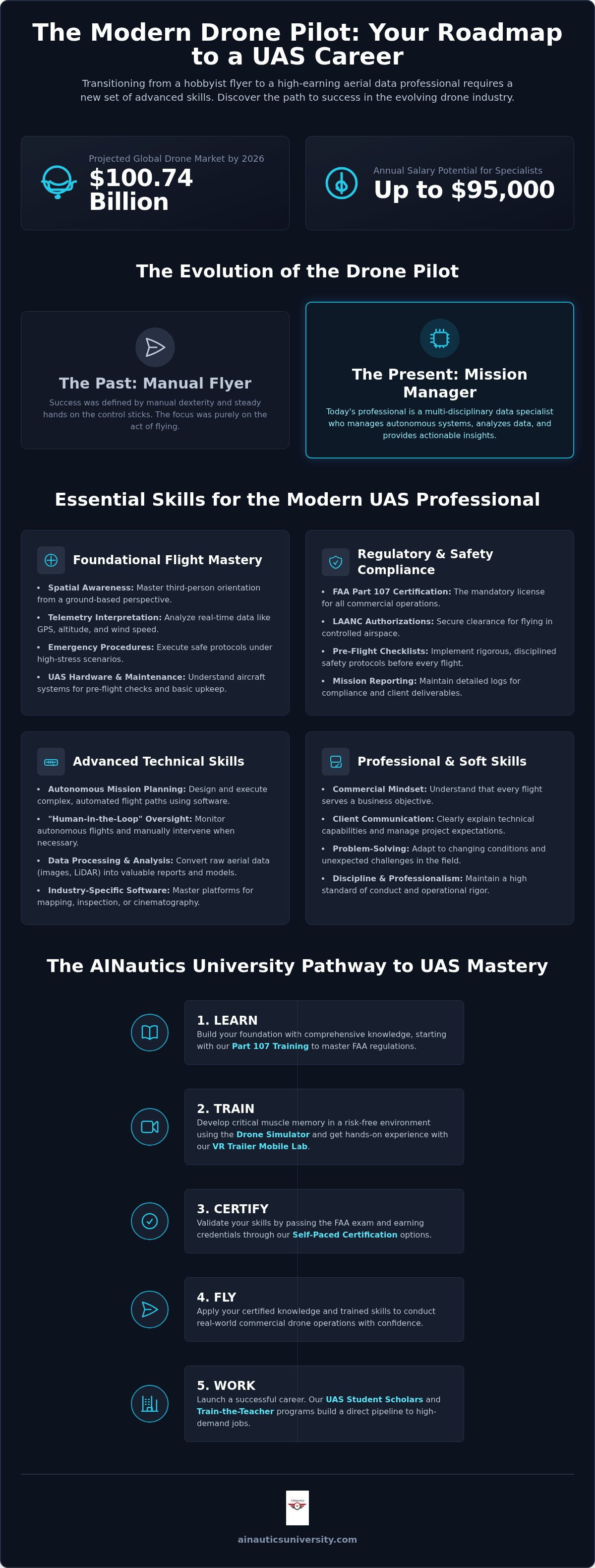
By the end of 2026, the global drone market is projected to reach a staggering $100.74 billion. Yet, many aspiring flyers discover that an FAA Part 107 license is just the baseline, not the finish line, for a high-paying career. If you've felt overwhelmed by technical jargon or wondered if your hobbyist experience is enough to land a commercial role, you aren't alone. Understanding the specific skills needed for drone pilot roles is the first step toward a career that can pay up to $95,000 annually.
The industry has shifted. Today's most successful operators aren't just "flyers"; they're aerial data experts who provide actionable insights for sectors like infrastructure and public safety. We promise to help you identify the precise blend of technical, regulatory, and industry-specific skills required to launch a successful UAS career in this evolving market. You'll learn how to move beyond basic joystick movements to master the data processing and mission management skills that employers demand.
This guide provides a clear checklist of marketable skills and demystifies the path to professional mastery. Whether you're exploring AINautics University's Self-Paced Certification or practicing complex maneuvers on a Drone Simulator, you'll gain the confidence to start your professional journey. From foundational Part 107 Training to specialized industry applications, here's your roadmap to becoming a future-ready pilot.
Key Takeaways
- Learn how the modern UAS professional has transitioned from a manual flyer to a multi-disciplinary data specialist managing autonomous systems.
- Gain a clear understanding of the essential regulatory requirements, including FAA Part 107 rules and LAANC airspace authorizations.
- Identify the technical skills needed for drone pilot roles in specialized industries like infrastructure inspection and high-end aerial media capture.
- Explore the AINautics University pipeline that guides students through the "Learn → Train → Certify → Fly → Work" process for long-term career success.
- Discover how immersive tools like the Drone Simulator and VR Trailer Mobile Lab prepare learners for real-world operational challenges in a safe environment.
The Evolution of the Drone Pilot: Skills Beyond the Joysticks
The role of a drone pilot has undergone a radical transformation. In the early days of the industry, being a "good pilot" simply meant having steady hands on the sticks. Today, the skills needed for drone pilot success involve a sophisticated mix of technical mastery and data analysis. If you examine the history of unmanned aerial vehicles, you'll see how these machines evolved from simple remote-controlled aircraft into highly autonomous commercial assets that require more than just basic flight knowledge.
By 2026, the industry has moved firmly into "mission-driven" piloting. While recreational flying focuses on the experience of flight, commercial operations focus on the value of the information gathered. A modern professional is a multi-disciplinary specialist. They understand how sensors, software, and flight paths converge to solve complex problems in construction, agriculture, and public safety. They don't just fly; they manage complex aerial data-collection systems.
The Shift Toward Autonomous Systems Mastery
Automation does not replace the pilot; it redefines their responsibilities. Modern pilots must master AI-driven flight paths and mission-planning software. You are no longer just an operator; you are a mission manager. This role requires "human-in-the-loop" oversight. You must possess the intuition to monitor automated missions and the skill to execute a manual override if conditions change. Using tools like the AINautics Drone Simulator allows students to practice these critical transitions. This builds the muscle memory needed for real-world operations before they ever step into the VR Trailer Mobile Lab for immersive, hands-on training.
Professionalism and the Commercial Mindset
A professional mindset is what separates a hobbyist from a career pilot. In a commercial setting, every flight is a data-collection exercise. This demands extreme discipline, including the rigorous use of pre-flight checklists and detailed post-mission reporting. It also involves effective client communication. You must manage expectations and explain technical limitations clearly to stakeholders who may not understand the technology. AINautics University integrates these soft skills into the UAS Student Scholars program to ensure students are workforce-ready. For educators, the Train-the-Teacher Program provides the framework to bring these high-level industry standards into the classroom, preparing students for the realities of the 2026 job market.
Core Technical Skills and Flight Mastery
Remote piloting requires a unique form of spatial awareness that differs significantly from traditional aviation. Since you aren't sitting in a cockpit, you must learn to orient the aircraft from a ground-based perspective, often referred to as "third-person" flight. This requires constant interpretation of telemetry data, such as GPS strength, altitude, and wind speed, alongside real-time sensor feedback. Managing power systems and executing emergency procedures are also vital skills needed for drone pilot success in a commercial environment. Flight mastery is the ability to maintain situational awareness under high-stress scenarios.
Building Muscle Memory with Immersive Technology
Simulation is no longer an optional luxury; it's a professional standard for safety and proficiency. Practicing high-risk maneuvers with physical hardware is costly and creates unnecessary risk for new pilots. The AINautics Drone Simulator provides a controlled environment where students can test their limits and learn from mistakes without financial consequences. This immersive drone training technology creates a realistic cognitive load that traditional textbook study cannot match. VR-based training prepares you for the specific FAA remote pilot requirements by simulating complex environments like active construction sites or dense urban areas. For schools, integrating the VR Trailer Mobile Lab offers an even deeper level of engagement, allowing students to experience these scenarios in a collaborative, mobile setting.
Understanding UAS Hardware and Maintenance
Technical proficiency extends far beyond the control sticks to the hardware itself. You don't need to be an aerospace engineer, but you must be a competent technician capable of basic troubleshooting. This includes inspecting gimbal systems for smooth operation and checking propulsion units for signs of wear or mid-air failure risks. Managing firmware updates is critical for safety and ensures compliance with modern standards like Remote ID. Every commercial pilot is responsible for ensuring their equipment is "airworthy" before every takeoff. To build these essential skills needed for drone pilot careers, many students start with Self-Paced Certification options that cover these technical foundations in depth. Understanding your aircraft's health ensures that you can focus on the mission rather than worrying about mechanical failure.
Regulatory Compliance and Operational Safety
Compliance is the bedrock of a professional UAS career. While many beginners assume that a basic understanding of flight is enough, the actual skills needed for drone pilot roles involve deep mastery of federal regulations and safety protocols. This goes beyond rote memorization. You must be able to apply FAA Part 107 rules to real-world scenarios, such as determining if a specific urban environment requires a waiver or a simple LAANC (Low Altitude Authorization and Notification Capability) request. Airspace classifications are not just lines on a chart; they're the boundaries of your professional playground.
Operational safety also demands a high level of administrative discipline. Maintaining accurate flight logs and maintenance records is a legal necessity for commercial operators. These documents provide a "clean paper trail" that proves your commitment to safety and equipment airworthiness. Effective risk assessment and mitigation strategies are essential when flying in complex environments. You must identify potential hazards, such as power lines or non-participating people, and have a clear plan to avoid them before the propellers start spinning. This proactive approach is what distinguishes a professional from a hobbyist.
Navigating the FAA Part 107 Certification
Earning your remote pilot certificate is the first major milestone in the "Learn → Train → Certify → Fly → Work" pipeline. The exam focuses heavily on critical areas like aviation weather, aircraft loading, and airspace classifications. Attempting to study these technical subjects alone can be overwhelming. A structured Part 107 drone training program provides the clarity needed to pass the test and understand the underlying logic of the rules. As the industry looks toward 2026, staying updated on evolving Beyond Visual Line of Sight (BVLOS) regulations under the proposed Part 108 framework is vital for those seeking long-term career growth. Self-Paced Certification options allow you to build this foundation on your own schedule without sacrificing depth.
Ethical and Environmental Compliance
Professionalism extends to how you interact with the environment and the community. You must implement wildlife-aware procedures, specifically complying with the Migratory Bird Treaty Act to avoid disturbing protected species during inspections. Privacy considerations are equally important. Successful pilots build community trust by being transparent about their operations and respecting local privacy expectations. Developing these skills needed for drone pilot success ensures that your work is both legal and ethically sound. Programs like the UAS Student Scholars program emphasize these ethical standards, preparing the next generation of pilots to lead with integrity. Documenting environmental assessments as part of your mission planning protects both the pilot and the brand they represent.
Specialized Industry Application Skills
To move from a junior operator to a high-earning professional, you must develop industry-specific expertise. These specialized skills needed for drone pilot roles focus on how you handle the data once the aircraft is in the air. It isn't enough to just fly; you must understand the "why" behind every mission. This involves designing flight paths that maximize data efficiency, ensuring every battery cycle provides the highest possible value to the client. Modern pilots are expected to be data-literate, which means having a basic understanding of photogrammetry. This is the process of taking multiple overlapping photos to create accurate 2D maps, known as orthomosaics, or complex 3D models.
When you understand how Geographic Information Systems (GIS) use this data, you become a bridge between the aerial environment and the client's decision-making process. This level of specialization is what allows pilots to secure roles in high-stakes industries like construction management and environmental science. By focusing on the end product, you elevate your value from a simple operator to a critical project stakeholder. Building these skills needed for drone pilot success starts with a commitment to continuous learning beyond the initial certification.
Aerial Media and Storytelling
In the creative and marketing sectors, the demand for Tier 1 capture is growing. This involves much more than just hitting a record button. You must master lighting, composition, and visual storytelling to deliver finished media products that drive economic development. High-end skills like capturing 360° panoramas and documenting construction progress require precise flight control and an eye for detail. Students in the UAS Student Scholars program often begin their journey here, learning how to translate a client's vision into a technical flight plan that yields professional results.
Public Safety and Inspection Protocols
Industrial applications require a different level of technical precision. Vertical structure inspections for telecommunications and utilities require the ability to identify defects while maintaining a safe distance from energized equipment. In public safety, Search and Rescue (SAR) missions rely on a pilot's ability to interpret thermal imaging data in real-time to locate missing persons. Integrating this UAS data into municipal asset management systems is a highly marketable skill in 2026. Educators using the Train-the-Teacher Program can help students prepare for these high-stakes roles by introducing them to mission profiles that go beyond simple photography. Ready to specialize? Start your journey with professional Part 107 Training today.
The Roadmap to UAS Mastery with AINautics University
AINautics University provides a comprehensive roadmap through its "Learn → Train → Certify → Fly → Work" pipeline. This structured approach ensures that every learner acquires the precise skills needed for drone pilot success in a competitive market. For high school students, the UAS Student Scholars program offers a direct career pathway, integrating technical flight training with academic credit. It isn't just about flying; it's about building a professional foundation that lasts. By following this pipeline, students transition from curious beginners to certified professionals with a clear understanding of the industry's demands.
Scaling this education requires a collaborative effort with schools and districts. The Train-the-Teacher program empowers educators to lead their own UAS classrooms, providing them with the curriculum and tools to succeed. This allows institutions to implement high-quality training without needing to hire outside specialists. Schools can choose between Self-Paced Certification for student flexibility or immersive, instructor-led models. This versatility ensures that every student, regardless of their starting point, has access to industry-standard training that meets them where they are.
Workforce Development and Career Readiness
Transitioning from a student to a professional requires more than a certificate. It requires exposure to real-world commercial scenarios. AINautics utilizes scenario-based training to prepare pilots for the complexities of the job site, from managing hardware failures to navigating complex airspace. Once certified, pilots can connect to the iFlyDrone workforce marketplace, which serves as a bridge to active employment opportunities. Staying informed about the future of drone careers allows you to align your training with the fastest-growing sectors in the industry. This proactive planning ensures that your skill set remains relevant as technology evolves.
Immersive Learning with the VR Trailer Mobile Lab
The VR Trailer Mobile Lab is a game-changer for accessibility in UAS education. This high-tech mobile lab brings hands-on autonomous systems training directly to students, regardless of their geographic location. It serves as a powerful catalyst for STEM and CTE pathways, providing immersive experiences that traditional classrooms can't replicate. By engaging with these advanced tools, students develop the technical skills needed for drone pilot roles in 2026 and beyond. It turns abstract concepts into tangible experiences. If you're ready to take the first step, exploring drone training for beginners is the best way to start your journey toward UAS mastery today.
Chart Your Flight Path to Professional Success
The drone industry is no longer waiting for the future; it's already here. Mastering the skills needed for drone pilot success in 2026 requires a commitment to being more than just an operator. You must become a data specialist who understands the intersection of technology, regulation, and industry-specific needs. By moving through a structured pipeline of learning and certification, you ensure that you aren't just licensed, but truly workforce-ready. High-paying roles in infrastructure, public safety, and media are waiting for those who can turn aerial data into actionable insights.
As a Service-Disabled Veteran-Owned Small Business, AINautics University provides a mission-driven, STEM-aligned curriculum designed for real-world impact. Whether you're a student in the UAS Student Scholars program or an educator scaling impact through the Train-the-Teacher Program, the tools for mastery are within reach. From the Drone Simulator to the VR Trailer Mobile Lab, immersive education bridges the gap between theory and the high-stakes reality of commercial flight. The sky isn't the limit; it's your new office. Take the first step toward a career that transforms how the world works.
Ready to lead the next generation of aviation? Start Your Journey to UAS Mastery with AINautics University and secure your place in the evolving global market.
Frequently Asked Questions
What is the most important skill for a drone pilot to have?
Situational awareness is the most critical skill for any pilot. This involves the ability to process telemetry data, environmental conditions, and airspace requirements simultaneously. In 2026, data literacy is equally vital. You must understand how to capture high-quality information that meets client needs. AINautics University emphasizes this through mission-driven training, ensuring you don't just fly but deliver value as a data-acquisition specialist who can solve real-world problems.
Do I need a college degree to be a professional drone pilot?
You don't need a four-year college degree to build a successful career in the UAS industry. Employers prioritize FAA Part 107 certification and proven technical proficiency over traditional academic credentials. Programs like the UAS Student Scholars provide high schoolers with a head start on these career pathways. Specialized training in fields like thermography or mapping often carries more weight than a general degree when applying for high-paying commercial roles in utility or construction sectors.
How long does it take to master drone flight skills?
Mastery is an ongoing process, but you can achieve commercial proficiency in about 90 days with a structured program. While basic flight controls can be learned in a few hours, the skills needed for drone pilot success in complex environments take longer to develop. AINautics University's 90-Day Program Launch helps institutions roll out comprehensive curricula that guide students from initial interest to workforce readiness through consistent, scenario-based practice.
Is the FAA Part 107 license enough to get a job in 2026?
The FAA Part 107 license is the legal requirement for commercial flight, but it is rarely enough to secure a top-tier job on its own. It proves you know the rules of the sky, but it doesn't prove you can perform complex inspections or create detailed 3D models. To be competitive, you should pair your license with specialized training, such as the AINautics Self-Paced Certification or hands-on experience in the VR Trailer Mobile Lab.
What technical software skills should a drone pilot learn?
Modern pilots must be proficient in data-processing software like Pix4D or DroneDeploy for photogrammetry and orthomosaic mapping. Understanding how to integrate aerial data into Geographic Information Systems (GIS) or municipal asset-management platforms is a high-demand skill. You should also master mission-planning apps that automate flight paths for maximum efficiency. These technical skills needed for drone pilot careers ensure you can deliver the finished media products and analytical reports that clients expect.
Can I learn drone piloting skills through a simulator?
Simulators are one of the most effective ways to build muscle memory and practice high-risk maneuvers without endangering physical hardware. The AINautics Drone Simulator allows you to experience realistic weather conditions and equipment failures in a safe environment. This immersive technology bridges the gap between theory and flight. It's a standard part of professional training that builds the confidence required for complex commercial missions and emergency procedure execution before moving to live flight.
Are there specific skills needed for drone inspections vs. photography?
Drone inspections require specialized knowledge of vertical structure analysis and defect identification, often using thermal imaging sensors. Photography and cinematography focus more on composition, lighting, and storytelling. While both paths require flight mastery, an inspector must understand federal compliance with rules like the Migratory Bird Treaty Act during cell-tower checks. AINautics University's curriculum covers these distinct mission profiles to help you choose a specialized career path that fits your professional goals.
What are the soft skills required for a drone pilot career?
Professional pilots need strong communication skills to manage client expectations and coordinate with ground crews. Discipline is essential for following pre-flight checklists and maintaining accurate maintenance logs. You also need sound ethical judgment regarding privacy and community relations. These human element skills are integrated into the Train-the-Teacher Program, ensuring that instructors can model the professionalism required in the workforce. Success depends as much on your reliability as it does on your flight precision.

Article by
AINautics University Team
The team behind AINautics University, dedicated to drone education and FAA Part 107 certification prep, VR flight simulation, and STEM training programs for students and educators.


