
What if the biggest barrier to launching a world-class aviation program wasn't your budget or your building's square footage, but simply how fast you could park a mobile drone training lab? Many educators and organization leaders feel the pressure of keeping up with 2026 FAA regulations while facing the high costs of permanent equipment. It's a common struggle to find specialized instructors who can bridge the gap between classroom theory and flight ready skills. You want to provide your students with a clear path to high growth careers, but the technical hurdles often feel insurmountable.
We understand that building a future ready workforce requires more than just textbooks. This guide explores how a portable, immersive solution provides a turnkey way to launch FAA compliant UAS programs. We'll detail how AINautics University utilizes the VR Trailer Mobile Lab and our Drone Simulator to drive student engagement. You'll see how our Train-the-Teacher Program and UAS Student Scholars framework move your organization toward FAA Part 107 certification readiness using a proven 90 day launch model. We are moving toward a future where specialized UAS education is accessible, portable, and professional.
Key Takeaways
- Learn how a mobile drone training lab provides a cost-effective, self-contained learning environment that eliminates the need for expensive permanent facilities.
- Explore how the VR Trailer Mobile Lab and advanced Drone Simulators create high-fidelity, risk-free training scenarios for students.
- Discover the 90-day program launch framework that combines mission-driven instruction with the Train-the-Teacher Program for rapid deployment.
- Understand the "Learn to Work" pipeline that prepares participants for FAA Part 107 certification and high-growth UAS career paths.
- Evaluate the flexibility of mobile units in reaching multiple departments or schools with a single, turnkey educational ecosystem.
What is a Mobile Drone Training Lab?
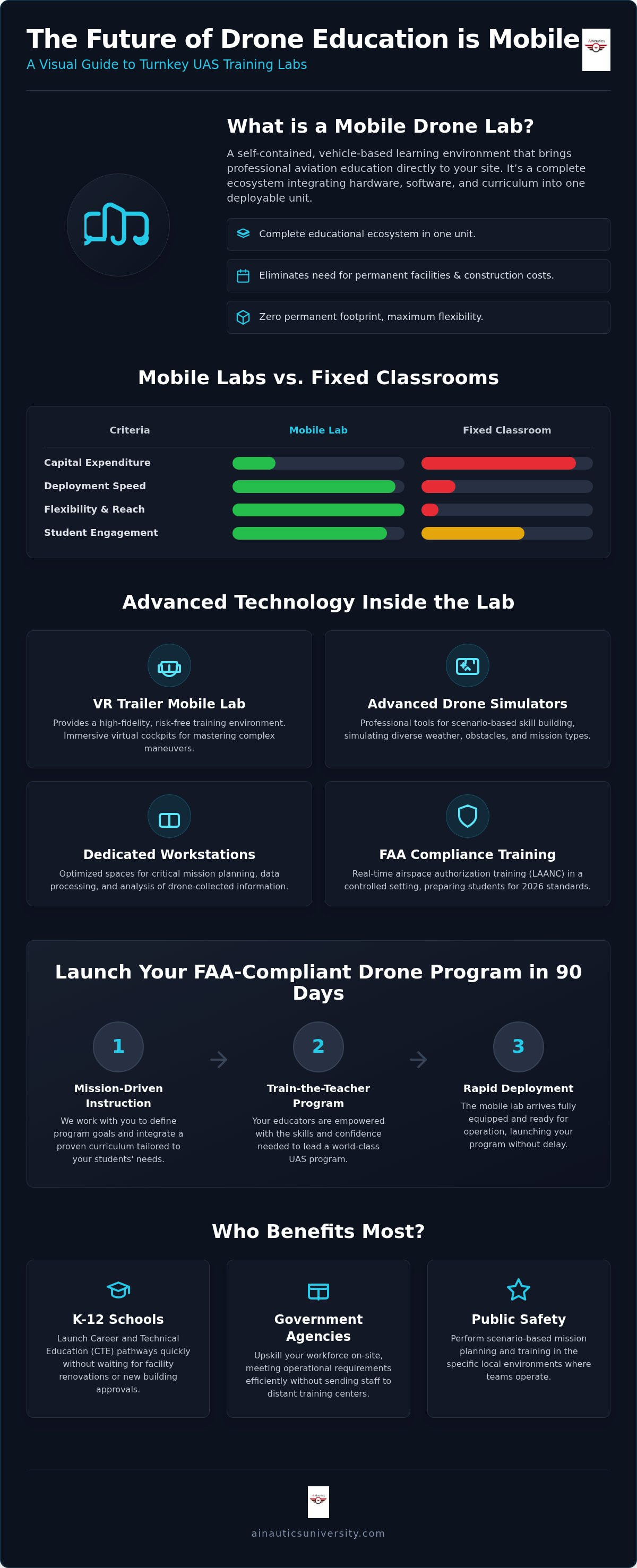
A mobile drone training lab is a self-contained, vehicle-based learning environment designed to bring professional aviation education directly to your site. It isn't just a trailer with some gear inside. It's a sophisticated ecosystem equipped with the latest Unmanned Aircraft Systems (UAS) technology. These labs function as mobile hubs that provide everything a student needs, from technical workstations to safe flight zones, without requiring a single square foot of permanent building space.
The industry has moved away from simple hardware-only kits that often gather dust in storage closets. Today, the focus is on immersive, mobile educational ecosystems. A mobile drone training lab integrates hardware, software, and curriculum into one deployable unit. This approach significantly reduces capital expenditure by eliminating construction costs. It also drives high-impact engagement by creating a specialized environment that feels like a professional workplace rather than a standard classroom.
As we approach 2026, educational standards are prioritizing flexible, mission-driven solutions. Organizations need the ability to adapt to changing FAA regulations without being tied to a fixed physical location. A mobile lab offers a zero permanent footprint, allowing schools and agencies to launch high-quality programs exactly where they are needed most.
The Evolution of UAS Education Technology
UAS education has evolved from teaching basic quadcopter flight to training students on advanced autonomous systems. This shift is vital for bridging the STEM gap, particularly for underfunded or rural districts that can't afford to build a permanent laboratory. By utilizing immersive drone training technology, AINautics University provides a high-fidelity experience that mirrors the real-world aviation industry. These mobile units allow multiple schools to share a single, state-of-the-art resource, ensuring that every student has access to the tools required for future mastery.
Who Benefits Most from a Mobile Drone Lab?
Different organizations use mobile labs to solve unique logistical challenges. The versatility of these units makes them ideal for several key sectors:
- K-12 Schools: Districts can launch Career and Technical Education (CTE) pathways quickly. They don't have to wait for facility renovations or new building approvals.
- Government Agencies: These organizations can upskill their workforce on-site. It's an efficient way to meet operational requirements without sending staff to distant training centers.
- Public Safety: Police and fire departments can perform scenario-based mission planning in the specific environments where they work.
A mobile drone training lab serves as a bridge between current skill sets and the technological demands of the future. It provides a practical, results-oriented path for anyone looking to enter the UAS industry.
Advanced Technology Inside a Modern Mobile UAS Lab
A modern mobile drone training lab is far more than a storage unit for aircraft. It functions as a high-tech command center designed to mirror the operational reality of the commercial UAS industry. The centerpiece of this setup is often the VR Trailer Mobile Lab, which provides a high-fidelity environment for risk-free flight training. Students step into a virtual cockpit where they can master complex maneuvers without the fear of damaging expensive hardware.
Inside the lab, advanced AINautics Drone Simulators allow for scenario-based skill building. These aren't generic games; they are professional tools that simulate diverse weather conditions, obstacle courses, and mission types. Complementing the simulators are dedicated workstation configurations. These spaces are optimized for mission planning and data analysis, teaching students how to process the information their drones collect. To ensure compliance with 2026 standards, these labs include robust connectivity for real-time FAA airspace authorization training. This allows learners to practice using LAANC (Low Altitude Authorization and Notification Capability) in a controlled, educational setting.
The Role of VR in Drone Education
Virtual reality trailers provide a superior experience compared to traditional screen-based flight. By immersing the student in a digital environment, we remove the distractions of the physical classroom. This leads to faster skill acquisition and higher confidence during the transition to live flight. VR-integrated mobile labs increase student retention by providing 360-degree situational awareness in complex flight scenarios. This immersive approach significantly reduces equipment damage because students have already logged dozens of "perfect" flights in the simulator before they ever pick up a physical controller.
Curriculum and Software Integration
Technology only works when it's paired with a structured learning path. AINautics University integrates self-paced certification modules into the lab environment, allowing students to progress at their own speed. This individualized learning is supported by scenario-based training that focuses on real-world commercial applications like infrastructure inspection and public safety.
It's essential to align these mobile lab activities with a comprehensive drone curriculum for educators. This ensures that every hour spent in the lab contributes directly to Part 107 certification readiness and career mastery. If you're ready to see how these tools can transform your program, explore our VR Trailer Mobile Lab options today.
Mobile Labs vs. Fixed Classrooms: Evaluating Your Investment
Deciding between a permanent facility and a mobile drone training lab often comes down to long-term sustainability. Fixed classrooms demand a permanent footprint, which is a luxury many crowded schools simply don't have. A mobile unit bypasses the "no available classroom" problem entirely. It allows organizations to launch a program without waiting for architectural approvals or construction crews. You can park the lab, plug it in, and start training immediately.
When analyzing the Total Cost of Ownership (TCO), mobile labs often emerge as the more efficient choice. Permanent labs require specialized electrical work, upgraded HVAC systems to handle server heat, and high-level security to protect hardware. A mobile lab is a self-contained ecosystem. It arrives ready to work, eliminating the need for expensive facility retrofitting. This flexibility allows a single unit to reach multiple schools or departments, spreading the investment across a larger student population.
Infrastructure and Maintenance Comparisons
Maintenance for a fixed lab is a constant drain on resources. Technology in the UAS sector evolves rapidly. Updating twenty fixed workstations every few years is a massive undertaking for any IT department. In contrast, a mobile lab ensures students always use current-year technology. It's easier to upgrade a single mobile unit than to overhaul multiple static classrooms across a district. This model ensures consistent program quality, regardless of which campus the lab is visiting. It provides a reliable standard of excellence that fixed labs struggle to maintain over time.
Impact on Student Outcomes
Engagement metrics show that the "novelty factor" of a mobile lab acts as a powerful motivator. Students don't just walk into another room; they enter a professional, high-tech environment. This immersion builds a direct bridge to future drone careers. They aren't just learning theory; they are gaining exposure to professional-grade enterprise equipment.
Programs like the UAS Student Scholars thrive in this environment because it feels like a real-world job site. Career readiness isn't just about the certificate. It's about the confidence gained from using professional tools in a focused setting. By choosing a mobile drone training lab, you provide students with a clear path toward mastery and professional success in the evolving aviation industry.
Implementing a Mobile Drone Program in 90 Days
Launching a professional UAS initiative doesn't have to be a multi-year project. Our 90-day program launch framework provides a structured path from initial assessment to active flight operations. This methodical approach ensures that your organization meets all regulatory requirements while building a sustainable educational ecosystem. We focus on results-oriented milestones that move your program from vision to reality with efficiency.
Phase 1 begins with a thorough needs assessment. We align the program with your specific state or district standards to ensure long-term viability. Phase 2 focuses on teacher professional development through the UAS Teacher Scholars program. This step is critical because it prepares your staff to lead the initiative. In Phase 3, we handle the logistics of scheduling the mobile drone training lab visit and managing student scholar registration. Finally, Phase 4 marks the launch of flight operations where students engage in mission-driven instruction. By following this timeline, schools can transition from interest to active certification training within a single semester.
The Train-the-Teacher Model
Sustaining a high-tech program requires local expertise. The AINautics University model focuses on empowering educators so they can continue the momentum after the mobile drone training lab moves to its next location. In 2026, professional development for teachers goes far beyond basic flight skills. It involves mastering data analysis, mission planning, and regulatory oversight. Integrating our Train-the-Teacher program into your district-wide PD days ensures that your staff stays at the cutting edge of the industry. This creates a legacy of knowledge that benefits students for years to come.
FAA Compliance and Safety Standards
Safety is the cornerstone of any aviation program. We ensure that every school initiative meets current FAA Part 107 requirements through rigorous oversight. Educational UAS programs must balance FAA Part 107 certification with mission-specific safety protocols to ensure workforce readiness. AINautics University provides operational safety and compliance services that take the guesswork out of regulatory adherence. This allows your instructors to focus on teaching while we manage the complexities of airspace authorizations and safety audits. We handle the technical details so you can focus on student success.
Ready to start your journey? Learn more about our 90-Day Program Launch framework today.
AINautics University: Empowering Schools Through Mobile Innovation
AINautics University isn't just a training provider. We're a bridge between classroom education and the high-demand careers of the future. Our mission is built on a clear, actionable pipeline: Learn, Train, Certify, Fly, and Work. This comprehensive approach ensures that every participant isn't just learning a hobby but is preparing for a professional life in the UAS industry. As a Service-Disabled Veteran-Owned Small Business (SDVOSB), we bring a mission-driven focus to every partnership. This status is particularly valuable for federal and state educational contracting, providing administrators with a reliable, veteran-led partner for workforce development.
Our support extends from the initial mission planning stages to long-term UAS program sustainment. We understand that a mobile drone training lab is a significant investment in your community's future. That's why we stay involved, providing the resources and expertise needed to keep your program running at peak performance. Central to this excellence is our UAS Student Scholars program. This initiative recognizes students who demonstrate exceptional skill in both flight and technology, positioning them as leaders among their peers and preparing them for the workforce of 2026.
A Turnkey Solution for Modern Districts
Starting a drone program often feels overwhelming due to regulatory hurdles and equipment costs. AINautics University removes this friction by offering a fully integrated solution. We provide national scalability, bringing elite drone training to any location regardless of existing infrastructure. Whether you're in a rural district or a major urban center, the mobile drone training lab delivers the same high-standard experience. To help your students reach their certification goals, we recommend exploring our professional FAA Part 107 drone training guide. This resource serves as a roadmap for the mastery required in the modern aviation landscape.
Join the Next Generation of UAS Leaders
The impact of mission-driven instruction goes beyond the classroom. It directly affects career placement and long-term professional success. We've seen incredible success stories from our UAS Student Scholars program, where graduates have moved directly into roles in infrastructure, public safety, and environmental monitoring. These students aren't just flying drones; they're solving real-world problems with advanced technology. They represent the specialized knowledge and future-readiness that industries are searching for.
If you're ready to empower your students and launch a world-class program, the next steps are simple. You can request a mobile lab visit for your organization to see the technology in action. We're here to guide you through every stage of the journey, ensuring your organization becomes a leader in the UAS industry.
Take Flight with Mobile UAS Innovation
The transition to a mobile drone training lab represents more than just a logistical shift; it's a commitment to providing students with the most advanced tools available. By prioritizing flexibility and immersive technology, your organization can bypass the high costs of permanent infrastructure while maintaining strict FAA compliance. We've seen how integrating a VR Trailer Mobile Lab and professional Drone Simulators creates a risk-free environment where mastery becomes achievable for every learner. These tools ensure your students aren't just reading about aviation but are experiencing it firsthand.
As a Service-Disabled Veteran-Owned Small Business and proud member of AUVSI, AINautics University is dedicated to your success. Our 90-Day Program Launch Framework ensures you don't have to navigate the complexities of UAS education alone. Whether you're focused on Part 107 certification or building a long-term CTE pathway, the tools for excellence are within reach. It's time to empower your students with the specialized knowledge they need for the high-growth careers of tomorrow.
Launch your school's drone program in 90 days with AINautics University. Your journey toward aviation leadership starts here.
Frequently Asked Questions
What is included in a mobile drone training lab?
A mobile drone training lab includes a comprehensive suite of professional aviation tools. It features the VR Trailer Mobile Lab for immersive flight, advanced AINautics Drone Simulators, and specialized workstations for data analysis. The lab also provides all necessary mission planning software and a structured curriculum. This turnkey environment ensures that students have access to the same technology used by enterprise UAS pilots, facilitating a seamless transition from the classroom to the field.
How much space does a VR trailer mobile lab require for setup?
The VR Trailer Mobile Lab requires a standard parking or staging area that can safely accommodate the vehicle and its deployment footprint. You should plan for a space similar to a large commercial trailer with room for students to enter and exit safely. It's best to choose a level surface with nearby access to power and internet connectivity to support the high-tech simulation equipment and real-time FAA airspace authorization tools.
Can a mobile lab help students prepare for the FAA Part 107 exam?
Yes, preparing students for the FAA Part 107 exam is a primary objective of the lab experience. The curriculum integrates Part 107 Training modules that cover essential topics like airspace regulations, weather patterns, and operational safety. By combining theoretical knowledge with hands-on practice in the mobile drone training lab, students build the confidence and technical understanding needed to pass the certification exam and begin their professional UAS careers.
Is the mobile lab curriculum aligned with STEM and CTE standards?
Every mobile drone training lab program is specifically aligned with STEM and Career and Technical Education (CTE) standards. AINautics University works closely with administrators to ensure the curriculum meets state and district requirements for workforce development. This alignment helps schools secure funding and provides students with stackable credentials that are recognized by both higher education institutions and industry employers in the rapidly growing autonomous systems sector.
How many students can a mobile drone lab accommodate at once?
A single mobile drone training lab session typically accommodates a standard classroom cohort through a rotation-based learning model. While some students engage with the VR Trailer and simulators, others work on mission planning or data analysis at the internal workstations. This modular approach ensures that every student receives personalized, hands-on instruction. The goal is to maintain a high level of engagement and safety while maximizing the number of learners who benefit from each visit.
Does AINautics University provide the instructors for the mobile lab?
AINautics University provides expert guidance and mission-driven instruction during the initial rollout of the lab. Our focus is on a collaborative model where our specialists work alongside your staff to launch the program. Through the Train-the-Teacher Program, we empower your educators to lead the curriculum and manage flight operations. This approach ensures that your school builds internal expertise and can sustain the UAS program long after the mobile lab's scheduled visit.
What are the requirements for a school to host a mobile drone lab visit?
Hosting a mobile drone training lab visit requires a designated outdoor space for the trailer and access to standard utilities. Schools should provide a level parking area and a reliable power source to run the simulators and VR equipment. Additionally, administrators need to coordinate student registration for the UAS Student Scholars program and ensure that participating teachers have completed the necessary preliminary training. We provide a detailed checklist during the 90-day launch phase to simplify this process.
How does the Train-the-Teacher program work with the mobile lab?
The Train-the-Teacher Program works in tandem with the mobile drone training lab to create a sustainable learning model. Educators participate in professional development sessions that cover UAS operations, safety protocols, and curriculum integration. During the lab visit, these teachers observe and assist in live flight scenarios. This hands-on experience allows them to master the technology and instruction methods needed to continue the program independently, ensuring long-term success for the school's aviation initiative.

Article by
AINautics University Team
The team behind AINautics University, dedicated to drone education and FAA Part 107 certification prep, VR flight simulation, and STEM training programs for students and educators.


