
What if the most advanced flight laboratory in the country didn't require a single square foot of your school's permanent floor plan? You likely agree that finding dedicated classroom space for emerging technology is a persistent challenge. Between the high cost of permanent infrastructure and the speed of industry changes, many educators feel they're falling behind. A mobile drone training lab solves these challenges by delivering a complete, professional-grade environment directly to your organization. It's a vital tool for an industry projected to reach a $100 billion market size by the end of 2026.
You'll discover how these immersive hubs accelerate career readiness and simplify the path to FAA Part 107 certification. We'll look at how tools like the AINautics VR Trailer Mobile Lab and high-fidelity drone simulators create a clear pipeline from the classroom to the workforce. This article previews the future of UAS education. You'll see how to build a scalable program that keeps students engaged with the latest technology without the burden of a fixed facility.
Key Takeaways
- Traditional classrooms often lack the vertical space for drone flight, making mobile solutions a safer and more effective alternative for hands-on training.
- A mobile drone training lab delivers high-fidelity flight simulators and VR technology directly to your site to accelerate student engagement.
- These self-contained units provide a scalable way to share expensive resources across a district, ensuring equitable access for all students.
- You'll learn how to implement a professional UAS program in 90 days using a turnkey model that covers everything from planning to flight operations.
- Integrating immersive technology with programs like UAS Student Scholars prepares learners for the high-demand career paths of the 2026 drone industry.
The Evolution of UAS Education: Why Static Classrooms Aren't Enough
Traditional educational settings weren't designed with aviation in mind. Standard classrooms lack the vertical clearance and safety protocols required for safe flight operations. When you introduce prop-wash and signal interference into a crowded room, safety risks increase and student focus can waver. Static labs also face a technology trap. UAS hardware and software evolve faster than most school renovation cycles can handle. A mobile drone training lab solves this by offering a professional, "pop-up" environment that is purpose-built for high-tech learning. This model effectively bridges the gap between drone training for beginners and the rigorous demands of professional certification.
Breaking Down Barriers to STEM Adoption
Space constraints often kill STEM initiatives before they start. Urban schools lack square footage, while rural districts struggle with the logistics of centralized facilities. Mobile labs remove these barriers entirely. They eliminate the need for expensive permanent facility renovations, which can drain budgets for years. Instead, a mobile drone training lab serves as a shared resource that travels across multiple sites. This shared model ensures equitable access to technology for every Unmanned Aerial Vehicle (UAV) enthusiast. AINautics University leverages the VR Trailer Mobile Lab to give districts a turnkey solution that avoids the high costs of fixed infrastructure while maintaining professional standards.
The Demand for Field-Ready Workforce Skills
The drone industry in 2026 demands more than just a certificate. Employers look for pilots who have logged hours in realistic scenarios and understand complex operational workflows. While a Drone Simulator provides a safe entry point, students eventually need to experience the physical logistics of flight operations. Mobile labs facilitate this by providing a controlled, field-ready environment that mimics professional job sites. This practical approach is essential to meet future drone career demands across sectors like public safety, construction, and agriculture.
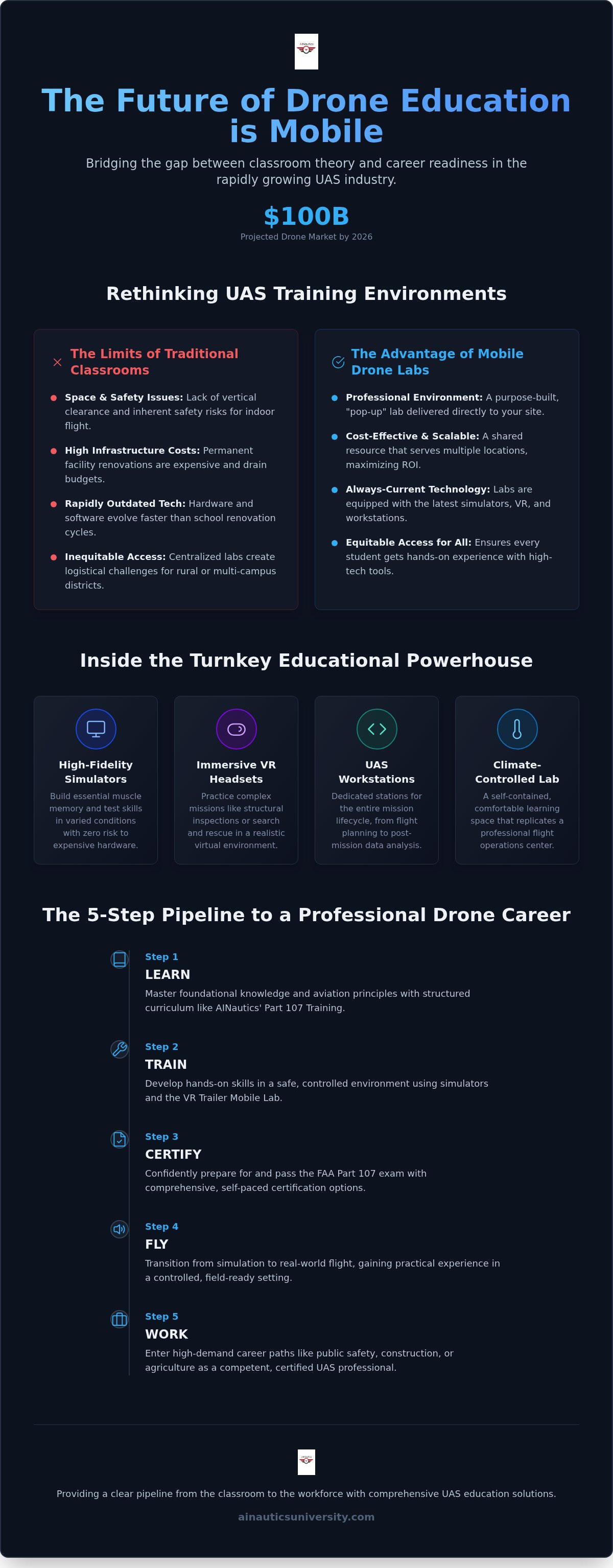
Mastery in the UAS field isn't achieved through reading alone. It requires a progression from simulation to physical flight under varied conditions. Mobile labs provide the infrastructure for this transition. They help students visualize complex concepts like airspace management and wildlife-aware inspection procedures in a real-world setting. By using a "Learn → Train → Certify → Fly → Work" pipeline, AINautics ensures that students don't just pass the Part 107 exam but emerge as competent operators. This results-oriented approach is what separates a hobbyist from a professional pilot who is ready to enter a high-growth workforce.
Inside the Mobile Drone Training Lab: Equipment and Technology
A mobile drone training lab is more than just a trailer with equipment. It's a self-contained, climate-controlled learning environment designed to replicate professional flight operation centers. Inside, you'll find high-fidelity drone simulators, VR headsets, and dedicated UAS workstations. This setup allows students to engage with immersive drone training technology in a zero-risk setting. By using scenario-based software, learners can practice complex tasks like structural inspections or search and rescue missions before they ever touch a physical controller in the field. This environment isn't just about flying; it's about the entire mission lifecycle, from planning to post-flight data analysis.
The Role of the Drone Simulator
Mastery begins with repetition. A professional Drone Simulator builds the essential muscle memory needed for precision flight. Students can test their skills in heavy winds, low visibility, or congested airspaces without the fear of damaging expensive hardware. This virtual phase significantly reduces repair costs and insurance liabilities for schools. It's a practical way to ensure every student is ready for the technical demands of the industry. These simulators use real-world physics to mimic how a craft responds to pilot input, making the transition to actual flight much smoother. For educators, this means more time spent on advanced techniques and less time on basic repairs.
Virtual Reality (VR) for Immersive Mission Planning
VR takes training beyond the screen. It allows students to step into a 3D environment to visualize flight paths and mission parameters. This immersive approach makes it easier to understand the complex rules set by FAA Unmanned Aircraft Systems. Instead of just reading about Part 107 regulations, students experience them spatially. They can walk through a virtual job site, identify hazards, and plan their approach in a 360-degree view. Multi-sensory learning significantly increases information retention, ensuring that safety protocols become second nature. This level of engagement is a core component of the UAS Student Scholars program, where students apply these virtual lessons to real-world challenges.
These technologies work together to create a seamless transition from student to professional pilot. By integrating these tools into a 90-day program launch, organizations can quickly establish a world-class training program. If you're ready to bring this level of tech to your campus, you can explore our VR Trailer Mobile Lab options today. This turnkey approach ensures that your students are not just passing tests but are truly ready for the workforce.
Benefits of Bringing the Lab to the Learner: Mobile vs. Fixed Facilities
Deciding between a permanent installation and a mobile unit often comes down to one factor: agility. While fixed labs provide a consistent location, they often become underutilized or technologically stagnant. A mobile drone training lab, however, thrives on movement and adaptation. It allows educational institutions to maximize their investment by rotating the facility across multiple campuses. This creates equitable access for students in diverse geographic areas without requiring every school to build its own specialized room. The arrival of a professional trailer on campus also creates a "special event" atmosphere. This psychological boost increases student motivation and signals that the training is tied to a real-world career path rather than just another elective.
Flexibility and Scalability
Mobile labs offer a level of versatility that static classrooms can't match. You can deploy these units for intensive summer programs, weekend community workshops, or traditional semester-long rotations. This scalability is vital for districts looking to implement a comprehensive drone curriculum for educators across a national or regional network. As UAS technology evolves, updating a single mobile hub is far more efficient than retrofitting dozens of fixed labs. The interior of the VR Trailer Mobile Lab is designed for modularity, allowing for quick hardware swaps and software updates to keep pace with the 2026 industry standards.
Professional Atmosphere and Career Readiness
Stepping into a mobile lab feels different than sitting at a school desk. The environment mimics a commercial flight operations center, which immediately establishes a professional tone. This setting is crucial for students undergoing Part 107 drone training. It encourages a "safety-first" culture that is difficult to replicate in a standard multipurpose room. By using professional-grade equipment like the Drone Simulator within this dedicated space, students begin to see themselves as pilots. This shift in identity is a hallmark of the UAS Student Scholars program, where learners are treated as emerging professionals. They don't just learn about drones; they experience the rigor and discipline required by the aviation industry.
The cost-benefit analysis favors mobile infrastructure for many reasons. Beyond the savings on construction and square footage, mobile units reduce the need for redundant equipment purchases. A single set of high-end VR headsets and workstations can serve hundreds of students across a district. This efficiency allows organizations to allocate more resources toward student certifications and advanced flight training. It's a pragmatic approach to workforce development that prioritizes high-impact learning over brick-and-mortar limitations.
Launching Your Program: From Planning to Mobile Flight Operations
Moving from a conceptual idea to an operational flight program requires a structured approach. AINautics University uses a 90-day program launch framework to guide organizations through this transition. This timeline ensures that your mobile drone training lab is fully integrated and ready for student use within a single semester. The process begins by identifying key stakeholders, including school administrators, CTE coordinators, and community industry partners. By bringing these groups together early, you ensure the program has the necessary support and funding to remain sustainable over the long term. This collaborative start sets the foundation for a professional aviation culture within your school or organization.
Phase 1: Planning and Standards Alignment
The first 30 days focus on defining clear learning objectives for your UAS Student Scholars. It's essential to align your mobile lab activities with both state and district education standards to ensure the curriculum provides academic credit. We work with you to customize the training to meet local workforce needs, whether those are in precision agriculture, infrastructure inspection, or public safety. During this phase, you'll also establish critical safety protocols and insurance requirements. Because mobile missions take place at various sites, having a standardized checklist for site assessment and risk mitigation is non-negotiable. This planning ensures that every flight is compliant with FAA regulations and school safety policies.
Phase 2: Instructor Preparation and Certification
Program sustainability depends on having qualified leaders on-site. The Train-the-Teacher Program is designed to equip your staff with the technical and pedagogical skills needed to manage a mobile drone training lab. Instructors must first master the material they will teach, which includes passing the FAA Part 107 remote pilot exam. We provide the resources for this certification through our professional training modules. Once certified, teachers undergo hands-on orientation with the VR systems and the Drone Simulator. This ensures they can troubleshoot equipment and guide students through complex virtual missions with confidence. Preparing your staff is the most important step in moving from a "cool piece of tech" to a high-impact educational program.
Operational safety is the bedrock of any aviation program. As you move toward your first flight, our team helps you finalize your operational manuals and maintenance logs. These documents are vital for maintaining FAA compliance and ensuring the longevity of your hardware. By the end of the 90-day window, your instructors will be certified, your standards will be aligned, and your students will be ready to begin their journey toward professional mastery. If you're ready to start this process, you can schedule your 90-day program launch with our expert team today. This structured path removes the guesswork and lets you focus on what matters most: empowering the next generation of UAS professionals.
The AINautics VR Trailer Mobile Lab: A Turnkey Educational Powerhouse
The AINautics VR Trailer Mobile Lab is the physical hub of a larger educational framework. It's not just a collection of tech; it's a complete ecosystem designed to move students through the "Learn, Train, Certify, Fly, Work" pipeline. As a Service-Disabled Veteran-Owned Small Business (SDVOSB), AINautics University brings the precision and discipline of professional aviation to every school district we serve. This specialized background ensures that our programs meet the highest commercial standards, giving students a competitive edge in the workforce. By integrating the trailer into your existing curriculum, you provide a professional grade environment that prepares learners for the high stakes of the 2026 UAS industry.
Integrated Learning Ecosystem
A mobile drone training lab serves as the bridge between theoretical knowledge and field mastery. Inside the trailer, students connect their work on the Drone Simulator to their Part 107 Training modules. This seamless integration allows them to apply regulatory concepts in a virtual flight environment immediately. This mission-driven approach is a core part of the UAS Student Scholars program. It transforms abstract rules into practical, scenario-based skills. For many students, this path begins with the UAS scholarship 2026 opportunities. These pathways provide the financial and educational support needed to move from a curious beginner to a certified remote pilot. The mobile lab ensures that these scholars have the best tools available to support their career goals.
Expert Support and Sustainment
We don't just deliver a trailer and leave. AINautics provides ongoing support to ensure your program remains at the cutting edge of technology. Our curriculum is updated continuously to reflect the latest FAA regulations and industry shifts expected in late 2026. This sustainment model includes professional development for UAS Teacher Scholars, ensuring they stay ahead of the technical curve. Graduates of the program also gain access to the AINautics workforce marketplace. This platform connects certified pilots with real world commercial opportunities, closing the loop between education and employment. This long term commitment to student and teacher success makes our mobile drone training lab a sustainable investment for any forward-looking organization.
Implementing this level of technology is straightforward with our 90-day program launch model. We handle the complexities of planning, standards alignment, and instructor preparation so you can focus on student outcomes. This turnkey approach removes the typical barriers to entry for advanced STEM programs. Your organization can go from initial planning to active flight operations in a single semester. If you are ready to empower your community with the future of UAS education, the next step is to begin the alignment process. This journey ensures your students aren't just watching the future of technology; they are leading it.
Leading the Future of Aviation Education
The drone industry in 2026 demands a workforce that is certified, competent, and field-ready. Adopting a mobile drone training lab allows you to deliver this high-level preparation directly to your students without the constraints of traditional facility planning. By combining the VR Trailer Mobile Lab with a proven 90-day launch model, you can establish a professional aviation culture that inspires confidence and excellence. You don't have to navigate the complexities of FAA compliance or curriculum development alone. AINautics University operates as a Service-Disabled Veteran-Owned Small Business, bringing commercial expertise and turnkey solutions to every partnership. Our FAA Part 107 certified instructors are ready to help you bridge the gap between STEM education and high-growth career paths. The opportunity to lead in UAS education is here. Launch your school's drone program in 90 days with AINautics University and empower your community to reach new heights. Your students are ready to fly; it's time to give them the wings.
Frequently Asked Questions
What is included in a mobile drone training lab?
A professional mobile drone training lab includes a climate-controlled learning environment equipped with high-fidelity drone simulators and virtual reality headsets. You'll also find dedicated UAS workstations and scenario-based software designed to mimic commercial missions. This setup provides a safe, immersive space where students build muscle memory and technical skills without the risk of hardware damage. It serves as a complete turnkey solution that brings professional aviation standards directly to your school's doorstep.
How much space is required to host a VR trailer mobile lab?
You only need a standard parking area or a flat, accessible surface to host the VR Trailer Mobile Lab. Because the unit is self-contained, it eliminates the requirement for permanent indoor renovations or high-ceiling flight areas. This mobility allows your organization to rotate the facility between different campuses or community centers. It's an ideal solution for urban or rural districts that lack the square footage for a fixed, dedicated aviation laboratory.
Can a mobile lab help students get their FAA Part 107 license?
Yes, the mobile lab is a vital resource for students pursuing their FAA Part 107 Remote Pilot Certificate. It bridges the gap between theoretical study and practical application by using the Drone Simulator to reinforce airspace regulations and safety protocols. Students can walk through virtual 3D environments to visualize Part 107 rules in action. This immersive experience significantly increases information retention, ensuring learners are fully prepared for the certification exam and future commercial careers.
Is the mobile drone lab suitable for K-12 students?
The mobile drone lab is specifically designed to support K-12 students, particularly those in middle and high school Career and Technical Education (CTE) programs. The curriculum aligns with state and district education standards to ensure students receive academic credit for their work. By using immersive technology, the lab keeps younger learners engaged with STEM concepts through hands-on mission planning. It provides a clear pathway for students to transition from high school into high-demand UAS careers.
How do teachers get trained to use the mobile drone lab technology?
Educators receive comprehensive preparation through the AINautics Train-the-Teacher program, also known as the UAS Teacher Scholars initiative. This program guides staff through the technical aspects of the mobile lab, including how to operate VR systems and flight simulators. Teachers also receive focused training to pass their own FAA Part 107 remote pilot exam. This model ensures the program remains sustainable by empowering local staff to lead flight operations and mentor their students with confidence.
What are the safety requirements for operating a mobile drone lab at a school?
Operating a mobile drone training lab at a school requires strict adherence to FAA regulations and standardized safety protocols. We help you establish site assessment checklists to identify local hazards and mitigate risks before any flight begins. The lab itself is a controlled environment that reduces physical danger through simulation-first training. Organizations must also maintain proper insurance coverage and documented maintenance logs. These procedures ensure a professional, safety-first culture that protects students, staff, and the community.
Can the mobile lab be used for adult workforce development programs?
The mobile lab is highly effective for adult workforce development and enterprise training programs. It provides a professional environment for municipal employees, public safety officers, and private-sector technicians to master autonomous systems. The lab’s modular interior can be adapted to focus on specific industry needs, such as vertical structure inspection or thermal mapping. This flexibility makes it a valuable asset for community colleges and government agencies looking to upskill their workforce for the 2026 drone economy.
How does the AINautics 90-day launch program work for new labs?
The 90-day launch program is a structured three-month rollout that moves your organization from initial planning to live flight operations. During the first phase, we align the curriculum with your district's educational standards and workforce goals. The second phase focuses on instructor preparation through our Train-the-Teacher modules and Part 107 certification. Finally, we assist with the technical setup and safety checklists for your first mobile mission. This turnkey framework removes the guesswork from starting a new UAS program.

Article by
AINautics University Team
The team behind AINautics University, dedicated to drone education and FAA Part 107 certification prep, VR flight simulation, and STEM training programs for students and educators.


