
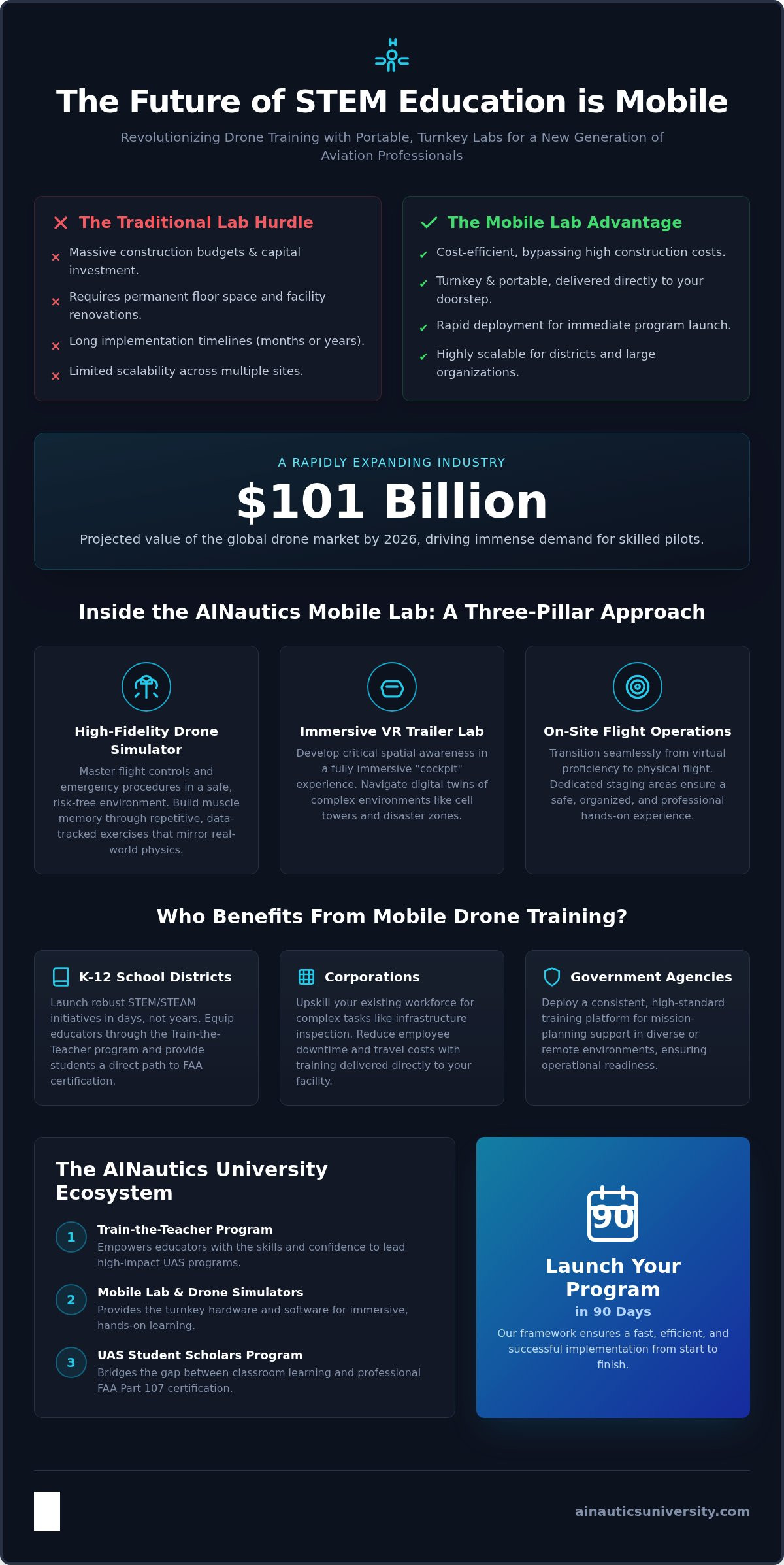
What if the most advanced STEM classroom in your district didn't require a single square foot of permanent floor space or a massive construction budget? As the global drone market is projected to reach nearly $101 billion in 2026, the traditional classroom is being replaced by the mobile drone training lab. This portable powerhouse brings industry-standard mastery directly to your doorstep, bypassing the high costs and space constraints of permanent lab installations.
You've likely seen the massive potential for your students in the Unmanned Aircraft Systems (UAS) sector, but you're also feeling the pressure of navigating complex FAA Part 107 regulations and finding qualified instructors. It's a common hurdle that keeps many schools from launching high-quality programs. We believe that every student deserves access to the future of aviation, regardless of their school's existing facilities.
This article explores how a mobile drone training lab can revolutionize your curriculum through immersive, portable technology. You'll discover how AINautics University provides a turnkey solution using our VR Trailer Mobile Lab and Drone Simulator. We'll also preview how our Train-the-Teacher Program and UAS Student Scholars initiative prepare both educators and students for real-world career success in a rapidly expanding industry.
Key Takeaways
- Discover how a mobile drone training lab delivers a turnkey, portable learning environment without requiring permanent facility renovations or high construction costs.
- Explore how the AINautics Drone Simulator and VR technology allow students to master complex flight skills in a safe, risk-free virtual setting.
- Learn why schools are choosing mobile solutions over static labs to achieve better scalability and cost-efficiency across multiple sites.
- See how the 90-day program launch framework and Train-the-Teacher initiative empower educators to lead sustainable, high-impact UAS programs.
- Understand how the UAS Student Scholars program bridges the gap between classroom learning and professional FAA Part 107 certification.
Defining the Mobile Drone Training Lab Experience
A mobile drone training lab is a self-contained, turnkey ecosystem designed to bring high-level technical instruction directly to the learner. Traditional industrial training centers often require permanent real estate, specialized HVAC modifications, and significant capital investment. In contrast, a mobile lab arrives on-site, fully equipped with the latest flight technology and industry-aligned curriculum. This mobile drone training lab model is essential as the Unmanned aerial vehicle industry moves toward sophisticated commercial applications like precision agriculture and infrastructure monitoring.
Organizations use the AINautics VR Trailer Mobile Lab to bypass the logistical hurdles of traditional construction while maintaining elite training standards. It creates an immersive, risk-free environment where students build mastery through repetition. This approach effectively bridges the gap between abstract classroom theory and the rigorous demands of the commercial UAS workforce. It's a practical solution for any institution that needs to scale its technical offerings without expanding its physical footprint.
The Core Components of a Portable UAS Lab
A professional-grade mobile drone training lab relies on three technical pillars to ensure student mastery. First, high-fidelity drone simulators allow for initial muscle memory development. Students practice takeoff, landing, and emergency procedures without the fear of hardware damage. Second, VR-enabled environments create scenario-based mission planning. Pilots-in-training navigate complex digital twins of vertical structures or disaster zones. Finally, the lab provides dedicated on-site flight pads. These staging areas ensure a safe, organized transition from virtual proficiency to physical flight operations.
Who Benefits Most from Mobile Training?
The demand for skilled pilots is growing across various sectors, and the mobile model serves each uniquely. K-12 school districts can launch robust STEM or STEAM initiatives in days rather than months. By integrating the Train-the-Teacher program, districts ensure their staff is prepared to lead these labs effectively. Corporations looking to upskill their existing workforce for vertical structure inspections also find value here. They can bring the training directly to their facility, which reduces employee downtime and travel costs. Government agencies require mission-planning support in diverse, sometimes remote, environments. A mobile lab provides a consistent, high-standard training platform that can be deployed wherever the mission dictates.
The technology inside a mobile drone training lab transcends simple hardware. It integrates sophisticated software and immersive hardware to create a professional training environment. While some providers focus on basic UAV assembly, AINautics prioritizes a simulator-to-VR pedagogical flow. This method ensures that students don't just learn to fly; they learn to execute complex commercial missions. Organizations like the Mobile STEM Bus have demonstrated how portable technology bridges the educational gap. Our labs take this concept further by specializing in industry-specific career readiness.
The Role of the AINautics Drone Simulator
Initial flight training shouldn't happen in the air. The AINautics Drone Simulator provides a safe, scenario-based environment where beginners can fail without consequence. Students build muscle memory through repetitive exercises that mimic real-world physics and weather conditions. Every flight session is tracked through integrated LMS data. This allows instructors to identify specific technical weaknesses before they become safety hazards. This data-driven approach ensures that every student meets the proficiency requirements of FAA Part 107 standards. It builds a foundation of safety and regulatory readiness from the very first session. You can explore these tools further through our UAS educational resources.
Immersive VR Trailer Mobile Lab Advantages
Virtual Reality is often viewed as a gimmick, but in our labs, it's a core training tool. The VR Trailer Mobile Lab creates a "cockpit" experience that fully immerses the student in the mission. They develop the spatial awareness required for complex maneuvers like navigating around cell towers or power lines. This immersive tech allows multiple students to observe a single mission on external screens. It turns a solo flight into a collaborative learning moment. By mastering these digital environments, students prepare for the future of drone careers. In 2026, the industry standard shifts toward remote operations and autonomous monitoring. These tools provide the specialized knowledge needed to lead in that space.
Why Schools and Enterprises Choose Mobile Labs Over Static Facilities
Choosing between a static facility and a mobile drone training lab often comes down to one factor: agility. While traditional universities invest millions in permanent structures, these facilities often struggle to keep pace with rapid hardware cycles. A mobile solution eliminates the need for expensive real estate investments or facility modifications. You don't need to rewire a building or install specialized HVAC systems to launch a professional program. Instead, you get a standardized environment that arrives ready for immediate use.
This approach ensures every student works with the same high-quality equipment and curriculum. Deployment happens in weeks, not the years typically required for capital construction projects. For school districts with multiple campuses, the lab serves as a rotating asset. This mobility ensures that specialized education isn't locked behind a single zip code. It's a scalable model that grows with your needs rather than becoming a fixed liability.
Solving the Space and Budget Dilemma
Static labs often become "sunk costs" when technology shifts. A mobile drone training lab avoids this trap by serving as a shared resource that can be updated centrally. It significantly lowers the barrier to entry for drone training for beginners. Instead of every school needing its own dedicated space, a single VR Trailer Mobile Lab can move between locations. This allows districts to maximize their budget while providing elite-level exposure to all students. It's a practical way to offer high-tech education without the high-tech price tag of new construction.
Ensuring Workforce Readiness
Static classrooms often lack the immersive environment required for true competency. Workforce development requires hands-on experience that mirrors the field. By aligning the curriculum with CTE (Career and Technical Education) pathways, we ensure students aren't just learning a hobby. They're preparing for a career. The mobile lab environment is specifically designed to get students ready for the professional FAA Part 107 certification. This focus on industry standards transforms the lab from a novelty into a critical workforce pipeline. Students gain the confidence to handle physical UAS operations because they've already mastered the virtual and scenario-based challenges provided on-site.
How to Implement a Mobile Drone Program in 90 Days
Launching a high-tech aviation program often feels like a multi-year project involving construction permits and massive capital requests. Our 90-day launch framework changes that timeline. It moves your institution from initial planning to live flight operations in a single semester. This efficiency is possible because the mobile drone training lab arrives as a fully integrated, turnkey solution. We handle the technical infrastructure so you can focus on student engagement and career outcomes.
The 90-Day Launch Framework
The process begins with a comprehensive needs assessment. We align the curriculum with your specific state or district standards to ensure every credit earned is meaningful. Once the foundation is set, we move into Phase 2: teacher training. Through the Train-the-Teacher program, also known as UAS Teacher Scholars, we empower your existing staff to lead the lab with confidence. They don't need to be prior pilots; our experts guide them through every regulatory and technical requirement.
In Phase 3, the VR Trailer Mobile Lab is delivered and staged on-site. This setup includes establishing flight pads and safety protocols that ensure FAA compliance from day one. Finally, Phase 4 focuses on student enrollment and the rollout of mission-driven curriculum. By integrating our Drone Simulator and Self-Paced Certification options, you provide a flexible learning environment that accommodates different student paces. You can begin this transformation today by exploring our program launch resources.
Sustaining Your UAS Program
A successful program requires more than just a strong start. It needs a path for long-term growth and career placement. We provide ongoing instructor support and regular curriculum updates to keep your program at the cutting edge of 2026 industry standards. Students who excel can leverage the iFlyDrone marketplace, a dedicated platform for connecting certified pilots with professional opportunities. This creates a direct pipeline from the classroom to the workforce.
For educators planning their long-term strategy, referencing a drone curriculum for educators guide is essential. It helps you map out multi-year pathways that lead to advanced specializations. By combining the physical assets of the mobile drone training lab with a robust digital curriculum, you create a sustainable ecosystem. This model ensures your program remains relevant as UAS technology continues to evolve into autonomous and beyond-visual-line-of-sight operations.
AINautics University stands apart from providers who simply sell hardware. We offer a comprehensive ecosystem that moves beyond the "hobbyist" mindset. Our mobile drone training lab is the physical foundation of a much larger mission: creating a sustainable workforce for the autonomous systems industry. As a Service-Disabled Veteran-Owned Small Business (SDVOSB), we bring a level of discipline and regulatory authority that is essential for government and federal contracting. This status provides our partners with a unique advantage when pursuing public sector initiatives. Our instructional model follows a clear "Learn, Train, Certify, and Work" pipeline. We don't just hand over equipment; we provide mission-driven instruction that prepares pilots for high-stakes commercial tasks. This includes precision data collection and vertical infrastructure analysis. Through the iFlyDrone ecosystem, we offer turnkey solutions for managing the data your fleet collects. This ensures your program produces results that are immediately useful in the professional market.Why AINautics University?
We position ourselves as more than a vendor; we're visionary mentors dedicated to your long-term success. Our UAS Student Scholars program recognizes and cultivates excellence in flight, providing high-achieving students with a platform to showcase their skills. We bridge the gap between classroom theory and professional pilot opportunities. This direct pipeline is what sets our curriculum apart. We focus on mastery and future-readiness, ensuring your students are prepared for the technological demands of 2026 and beyond.
Next Steps for Your Institution
Elevating your STEM or workforce training program starts with a clear assessment of your goals. Whether you're looking to upskill an existing team or launch a new CTE pathway, we're here to guide you. Consider these immediate actions:
- Evaluate your current facility constraints and budget requirements.
- Schedule a live demonstration of our VR Trailer Mobile Lab to see the technology in action.
- Enroll your staff in the Train-the-Teacher Program to build internal capacity.
- Begin your institutional journey toward FAA Part 107 mastery with our specialized Part 107 Training and Drone Simulator modules.
The future of UAS education is portable, immersive, and results-oriented. By partnering with AINautics University, you're not just buying a lab; you're investing in a proven framework for success. Let's build the next generation of aviation leaders together.
Leading the Next Generation of Aviation Excellence
The shift toward portable, high-tech education is no longer a future concept; it's the current standard for 2026. A mobile drone training lab provides the agility your institution needs to bypass construction delays and high facility costs while delivering elite instruction. By combining immersive VR technology with our 90-day program launch framework, you can move from initial planning to live flight operations in a single semester. This model ensures that every student gains the mastery required for professional FAA Part 107 certification.
As a Service-Disabled Veteran-Owned Small Business, AINautics University is committed to mission-driven instruction that leads to real careers. We provide more than just tools; we offer a direct pipeline to the workforce through our nationwide pilot marketplace. Whether you're an educator looking to upskill your staff or a student aiming for the top of the UAS industry, the path to specialization is ready for you. It's time to take the first step toward building a sustainable, future-ready aviation program. Launch your drone program in 90 days with AINautics University and empower your community to lead the autonomous revolution.
Frequently Asked Questions
What is included in a mobile drone training lab?
A professional mobile drone training lab includes a turnkey environment equipped with flight technology and a complete UAS curriculum. Specifically, we provide the VR Trailer Mobile Lab, high-fidelity simulators, and mission-planning workstations. It also features on-site flight pads and all necessary safety equipment. This comprehensive setup allows schools to bypass permanent construction costs while providing an immersive, industry-standard learning space that prepares students for the 2026 drone workforce.
How does the AINautics 90-day program launch work?
The AINautics 90-day launch is a structured, three-month rollout that moves an institution from planning to live flight operations. It begins with a needs assessment and alignment with district standards to ensure educational compliance. Next, we provide teacher training through our UAS Teacher Scholars program. Finally, we deliver the physical lab and help set up operational safety protocols. This framework ensures a rapid, compliant start for any STEM or workforce development initiative.
Is the VR drone simulator effective for FAA Part 107 prep?
The AINautics Drone Simulator is a critical tool for building the muscle memory and situational awareness required for certification. While the Part 107 exam focuses on knowledge, the simulator provides the practical context needed to understand airspace and emergency procedures. It creates a risk-free environment where students master complex maneuvers before transitioning to physical flight. This makes the certification process more intuitive and significantly improves safety standards for new pilots in the industry.
Can teachers without drone experience lead these programs?
Our Train-the-Teacher program, known as UAS Teacher Scholars, is specifically designed to empower educators regardless of their aviation background. We provide the technical knowledge, regulatory guidance, and curriculum support needed to lead a mobile drone training lab effectively. Our team of FAA-certified pilots mentors your staff through every step, ensuring they feel confident managing equipment and leading student missions. This model creates a sustainable internal program that doesn't rely on outside contractors.
What industries hire graduates of mobile drone labs?
Graduates are prepared for careers in telecommunications, precision agriculture, public safety, and infrastructure inspection. Many find opportunities in vertical structure analysis, such as cell tower or power line monitoring. The global drone market is projected to reach $100.74 billion by 2026, creating high demand for certified pilots in construction progress monitoring and emergency management. Our iFlyDrone marketplace also helps connect these skilled graduates with professional opportunities across the entire United States.
How do mobile labs handle FAA airspace authorizations?
We provide comprehensive advisory support for FAA Part 107 airspace authorizations as part of our implementation process. Our expert team helps your institution understand LAANC (Low Altitude Authorization and Notification Capability) and other regulatory requirements for operating in specific zones. We ensure that your flight operations are compliant with current laws and prepared for upcoming shifts, such as the proposed Part 108 rules. This guidance keeps your program safe and legally sound.
What are the benefits of the UAS Student Scholars program?
The UAS Student Scholars program recognizes and cultivates excellence in flight and technical mastery. It provides high-achieving students with a platform to showcase their skills to potential employers and higher education institutions. Participants gain access to advanced mission-driven instruction and a direct pipeline to professional opportunities. This program bridges the gap between basic classroom learning and the specialized requirements of the modern autonomous systems workforce, helping students build a professional portfolio early in their careers.
How does AINautics support program sustainment after launch?
We provide ongoing curriculum updates, instructor support, and workforce guidance to ensure your program remains at the cutting edge. As technology evolves, we update the simulator scenarios and educational materials to reflect new industry standards and regulatory shifts. Our commitment to sustainment includes helping institutions navigate changes and providing access to the iFlyDrone marketplace. This ensures the program continues to deliver measurable career outcomes for students and educators year after year.

Article by
AINautics University Team
The team behind AINautics University, dedicated to drone education and FAA Part 107 certification prep, VR flight simulation, and STEM training programs for students and educators.


