
What if the key to revitalizing student interest in math isn't found in a textbook, but in a technology projected to be a $100 billion industry by 2026? Educators and parents are increasingly looking for the benefits of drone education in STEM to bridge the gap between traditional theory and the modern workforce. It's frustrating to watch students lose interest when they can't connect classroom physics to a high-paying career. We agree that keeping curriculum relevant is a constant challenge in a rapidly changing technical environment.
This article promises a clear understanding of how Unmanned Aircraft Systems (UAS) drive mastery of complex physics and create direct career pathways. You'll discover a roadmap for integration through our Train-the-Teacher Program. You'll also see how the VR Trailer Mobile Lab brings hands-on learning to life. We'll examine the educational ROI of programs like UAS Student Scholars and show how FAA Part 107 certification prepares students for specialized roles with salaries often exceeding $130,000. It's time to move beyond the desk and into the cockpit.
Key Takeaways
- Understand how the benefits of drone education in STEM transform abstract physics and math into tangible, mission-driven applications that captivate students.
- Explore how tools like the AINautics Drone Simulator and VR Trailer Mobile Lab build critical muscle memory and technical proficiency in a risk-free environment.
- Learn why FAA Part 107 certification is the essential credential for accessing high-growth careers in infrastructure, public safety, and aerospace by 2026.
- Discover a scalable roadmap for schools to launch a professional UAS program in just 90 days using the Train-the-Teacher framework.
Bridging the STEM Engagement Gap with Autonomous Systems
Drone education isn't just a hobby; it's the purposeful integration of Unmanned Aircraft Systems (UAS) into core academic disciplines. Traditional STEM often struggles to keep students engaged because it relies on abstract theories that feel disconnected from the digital age. By the time students reach high school, many have already decided they aren't "math people." One of the primary benefits of drone education in STEM is its ability to reverse this trend by making learning visible, immediate, and high-stakes.
Drones serve as a tangible gateway to the broader world of autonomous systems and Artificial Intelligence. When a student programs a flight path, they aren't just clicking buttons; they're engaging with the fundamental principles of educational technology to solve complex spatial problems. This hands-on approach forces immediate problem-solving. If the aircraft doesn't lift or veers off course, the student must troubleshoot the physics or the code right then and there. It's a feedback loop that textbooks simply can't replicate.
From Passive Observation to Active Pilotage
Textbooks provide data, but flight operations provide experience. We've moved past the era of passive observation. Mission-based learning gamifies the classroom, turning a standard lesson into a high-stakes search-and-rescue simulation or a precision agriculture survey. This shift builds more than just technical skill; it builds confidence and professional discipline. Programs like the UAS Student Scholars initiative foster leadership by putting students in charge of these missions. They learn to manage crews and mitigate risks, preparing them for the accountability required in the 2026 workforce.
Addressing the 'Why' in Science and Math
Students often ask why they need to learn trigonometry or atmospheric pressure. Drones provide the answer. Seeing math work in three-dimensional space changes the psychological relationship with the subject. When the goal is a successful flight, the math becomes a tool for success rather than a hurdle to clear. This practical application significantly reduces math anxiety and highlights the benefits of drone education in STEM through real-world results.
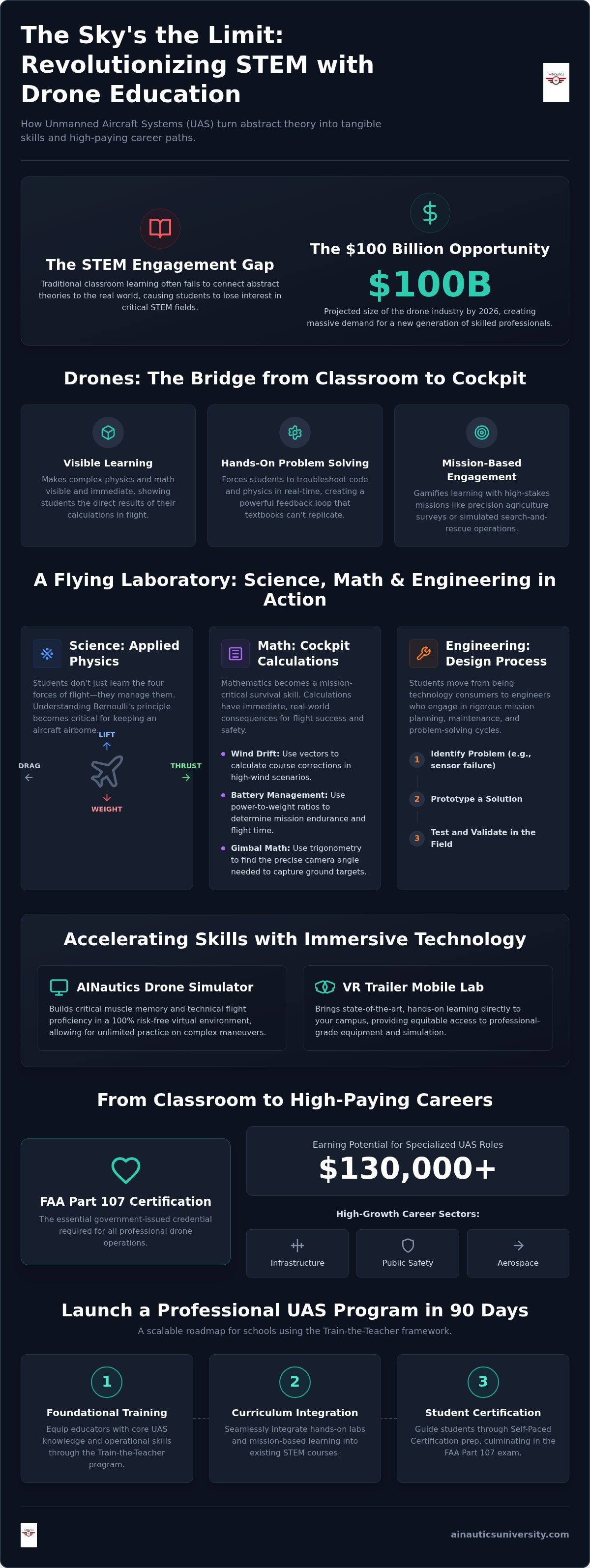
- Calculating Wind Drift: Students use vectors to ensure their aircraft stays on course during high-wind scenarios.
- Battery Management: Calculating power-to-weight ratios becomes a critical skill for mission endurance.
- Telemetry Analysis: Interpreting real-time sensor data turns raw numbers into actionable insights for infrastructure inspections.
By moving the classroom into the cockpit, educators can transform students from passive consumers of information into active creators of technical solutions.
The Interdisciplinary Impact: Science, Math, and Engineering in Flight
Drones serve as a flying laboratory where abstract scientific theories meet real-world physics. One of the most significant benefits of drone education in STEM is how it forces students to master the four forces of flight: lift, weight, thrust, and drag. Understanding Bernoulli’s principle isn't just about passing a test anymore. It's about knowing why an aircraft stays airborne. Students analyze how air pressure differences over a propeller blade create lift, providing a hands-on, practical approach to teaching and learning STEM that sticks far longer than a lecture.
The Engineering Design Process is equally vital. In a UAS curriculum, students don't just "fly." They engage in rigorous mission planning and maintenance cycles. If a sensor fails or a payload is unbalanced, they must identify the problem, prototype a solution, and test it in the field. This methodical approach aligns perfectly with modern Career and Technical Education (CTE) standards. It moves the student from a consumer of technology to an engineer who understands the mechanics of autonomous systems. This technical depth is why many schools are now looking toward specialized Part 107 Training to ground their programs in professional standards.
Applied Mathematics in the Cockpit
Mathematics becomes a survival skill in the cockpit. We use trigonometry to solve "Gimbal math" problems, where students calculate the exact camera angle needed to capture a specific ground coordinate based on the drone's altitude. Algebra is used every day for battery management. Pilots must calculate "time to station" and "return to home" thresholds, accounting for wind resistance and payload weight. Even statistics play a role; students use probability to conduct risk assessments and interpret weather forecasting data to ensure mission success. These aren't just exercises. They're the exact calculations professional pilots perform in the field.
Environmental Science and Aerial Data
The science doesn't stop at the airframe. UAS education introduces students to the power of aerial data. In environmental science, drones are used for precision agricultural monitoring, allowing students to identify crop stress before it's visible to the naked eye. We teach the role of photogrammetry, which is the science of making measurements from photographs. By creating orthomosaic maps, students learn about geography and earth science through a 3D lens. This data-driven approach is essential for modern conservation and federal compliance studies, proving that the benefits of drone education in STEM extend far beyond the flight itself. It prepares the next generation to handle the complex data demands of the 2026 workforce.
Immersive Learning: How Simulators and VR Accelerate Skill Acquisition
The transition from classroom theory to actual flight can be intimidating for both students and educators. High-tech tools like the AINautics Drone Simulator bridge this gap by allowing learners to build essential muscle memory in a risk-free environment. This immersive drone training technology is a cornerstone of the 2026 classroom, providing a platform where mistakes lead to lessons rather than expensive repair bills. By mastering flight controls digitally, students gain the confidence needed to handle sophisticated hardware during live operations.
Virtual reality takes this a step further through scenario-based training. In a VR environment, we can simulate challenging conditions like night operations or high-velocity winds that would be too dangerous for a novice pilot in the real world. These simulations ensure students are prepared for the complexities of FAA regulations for educational drone use and professional standards. One of the primary benefits of drone education in STEM is this ability to replicate high-stakes scenarios, ensuring that when students eventually take to the skies, they do so with a seasoned pilot's mindset.
Safety and Risk Mitigation in Virtual Spaces
Simulators aren't just a luxury; they're a necessity for professional preparation. Before a student ever touches a physical controller, they spend hours in the virtual cockpit. This approach drastically reduces hardware maintenance costs for schools. It also allows students to experiment with the physics of flight without the fear of a crash. By the time they transition to live flight, the controls feel like an extension of their own hands. This safety-first methodology is a key reason why the benefits of drone education in STEM are so scalable across diverse school districts.
The VR Trailer Mobile Lab Experience
Not every school has the dedicated square footage for a permanent flight lab. The VR Trailer Mobile Lab solves this logistical hurdle by bringing advanced technology directly to the district. These mobile units are packed with state-of-the-art gear that engages students through immersive storytelling and simulated flight missions. Inside, learners can work through Self-Paced Certification modules at their own speed. This flexibility ensures that every student, regardless of their starting point, has a clear path to mastery. It turns a standard school day into an aspirational journey toward a high-tech career.
Workforce Readiness: Moving from Classroom Theory to FAA Certification
The ultimate goal of any technical curriculum is to transform a student's interest into a viable, high-paying career. In the UAS industry, this transition is marked by a single, critical milestone: obtaining the Remote Pilot Certificate. Professional Part 107 drone training serves as the essential credential for 2026 graduates, moving them beyond the status of hobbyists and into the ranks of certified aviation professionals. This certification isn't just a piece of paper; it's a validation of a student's ability to operate within the National Airspace System safely and legally.
One of the primary benefits of drone education in STEM is the development of "soft skills" that are often missing from traditional science tracks. Students learn checklist discipline, crew resource management, and strict safety compliance. These habits are the backbone of professional aviation. By the time a student enters the workforce, they've already mastered the accountability required to manage expensive equipment and public safety risks. This professional maturity is exactly what employers in the projected $100 billion drone market are looking for.
Navigating FAA Part 107 Compliance
Understanding airspace regulations and operational safety is a complex task that requires methodical study. School programs play a vital role in de-mystifying these rules and preparing students for the FAA Remote Pilot Knowledge Test. It's a rigorous exam that covers everything from weather patterns to radio communications. Using a structured path for drone training for beginners ensures that students don't just memorize answers but actually internalize a safety-first culture. This foundation is necessary for anyone looking to stay ahead of upcoming regulatory shifts, such as the anticipated Part 108 rules for beyond visual line of sight operations.
The Career Pipeline: Learn to Work
The future of drone careers is incredibly diverse. We're seeing massive demand for certified pilots in infrastructure inspection, emergency management, and precision agriculture. In 2026, a full-time commercial drone pilot can expect a typical salary range between $57,000 and $95,000 per year. Those who specialize in high-tech fields like LiDAR or aerospace can see earnings exceed $130,000. AINautics University provides the bridge to these opportunities by connecting classroom success to the iFlyDrone pilot marketplace. This direct link between certification and employment turns educational ROI into a reality for students and parents alike.
Ready to turn your technical skills into a professional career? Explore our Self-Paced Certification options to start your journey today.
Implementing a Scalable Drone Program with AINautics University
Building a professional aviation program from the ground up can feel like a daunting task for many school administrators. The AINautics 90-Day Program Launch framework simplifies this process by providing a clear, structured path to implementation. One of the primary benefits of drone education in STEM is that it doesn't require a complete overhaul of existing schedules. Instead, our drone curriculum for educators is designed to align seamlessly with current state standards and Career and Technical Education (CTE) requirements. We focus on sustainability, ensuring that once a program starts, it has the resources to thrive for years to come.
Success depends on more than just having the right equipment. It requires a commitment to professional standards and a roadmap that accounts for everything from airspace authorization to student certification. By leveraging our established framework, districts can bypass the common pitfalls of technology adoption and move straight to delivering high-value instruction. This methodical approach ensures that the benefits of drone education in STEM are felt by every student, regardless of their prior experience with robotics or aviation.
The Train-the-Teacher Model
We recognize that most educators aren't certified pilots. Our Train-the-Teacher Program is specifically designed to empower teachers who may not have a background in aviation. We provide the technical training, instructional resources, and ongoing support needed to lead a classroom with confidence. This model creates a sustainable, locally-owned ecosystem where schools aren't dependent on outside contractors for their daily operations. Educators also receive regular curriculum updates to match evolving FAA rules, keeping the program current with 2026 industry standards. Joining this community of "Drone Teacher Scholars" nationwide provides a network of peers dedicated to technical excellence.
Step-by-Step Rollout for Districts
Our rollout strategy is divided into three distinct phases to ensure a smooth transition into live flight operations. We handle the complexities of the setup so teachers can focus on their students.
- Phase 1: Planning and Airspace: We assist with the initial program design and help schools secure the necessary airspace authorizations for safe, legal flight.
- Phase 2: Training and Simulator Installation: We implement the AINautics Drone Simulator and provide intensive teacher training to build foundational skills.
- Phase 3: Launch and Certification: Students begin live flight operations and enter the pipeline for Part 107 Training, eventually joining the UAS Student Scholars program.
This phased approach allows districts to scale at their own pace. Whether you're starting with a single classroom or a district-wide initiative, our framework provides the flexibility to grow. Don't wait for the future of the workforce to arrive; start building it today with our Self-Paced Certification and immersive lab options.
Leading the Future of Technical Excellence
Integrating UAS technology into the classroom is no longer a luxury; it's a strategic necessity for the 2026 workforce. We've explored how these systems turn abstract math into tangible success and how immersive tools like the Drone Simulator remove traditional barriers to entry. The benefits of drone education in STEM are clear: higher engagement, mastery of complex physics, and a direct path to professional FAA Part 107 certification.
AINautics University is a Service-Disabled Veteran-Owned Small Business and a proud AUVSI Member registered in SAM.gov. We provide more than just a curriculum. We deliver a complete framework for student success through our comprehensive "Learn to Work" career pipeline. Launch your school's drone program in 90 days with AINautics University and give your students the competitive edge they deserve. The sky isn't the limit; it's just the beginning of their professional journey.
Frequently Asked Questions
What are the primary benefits of using drones in the STEM classroom?
The primary benefits of drone education in STEM include massive gains in student engagement and the transformation of abstract theories into tangible results. Drones act as a "force multiplier" for learning by requiring students to apply physics and math in real-time. This hands-on approach builds critical problem-solving skills and provides a clear pathway to high-growth technical careers. By 2026, these skills will be essential as the global market reaches record valuations.
Is an FAA Part 107 license required for students to fly drones at school?
An FAA Part 107 license isn't strictly required for students flying for purely educational purposes under the FAA exception for limited recreational operations. However, it's the professional standard for any career-focused activity. We recommend that students pursue certification through our Part 107 Training to ensure they meet industry standards. Having this credential allows graduates to legally perform commercial work and access high-paying roles in infrastructure, surveying, and public safety sectors nationwide.
How do drones specifically help students learn mathematics?
Drones provide a three-dimensional environment for students to apply complex calculations. Learners use trigonometry to determine gimbal angles for aerial photography and algebra to manage battery life and flight endurance. They also analyze telemetry data and statistics to conduct mission risk assessments. This practical application reduces math anxiety by giving students a concrete reason to master these concepts. Seeing math work in the cockpit makes the subject matter much more accessible and professionally relevant.
Can a drone program be integrated into existing CTE pathways?
Yes, drone programs align perfectly with modern Career and Technical Education pathways in fields like aerospace, engineering, and agriculture. Our curriculum is specifically designed to meet state and district standards, allowing for seamless integration into existing frameworks. By focusing on workforce readiness, schools can use our Train-the-Teacher Program to build sustainable, locally-owned programs. This ensures students gain the industry-recognized credentials needed for the 2026 technical workforce without disrupting their current academic schedules.
What age is appropriate to start drone education in STEM?
While foundational concepts can be introduced earlier, we find that middle and high school students benefit most from advanced UAS education. At this stage, students have the mathematical background to handle flight physics and the maturity to follow strict safety protocols. Programs like the UAS Student Scholars are specifically designed for high schoolers looking to achieve professional excellence. Starting at this age allows students enough time to master the technology before seeking FAA certification at age 16.
How does AINautics University support teachers with no drone experience?
We empower educators through our specialized Train-the-Teacher Program, which requires no prior aviation or robotics background. AINautics University provides the technical training, instructional resources, and ongoing support needed to lead a classroom with confidence. Our 90-Day Program Launch framework handles the complexities of setup, including airspace authorization and equipment installation. Teachers join a national community of "Drone Teacher Scholars," ensuring they stay updated on evolving FAA regulations and the latest industry trends.
What are the career prospects for a student with a drone certification in 2026?
Career prospects in 2026 are exceptionally strong across sectors like infrastructure, public safety, and precision agriculture. A full-time commercial drone pilot typically earns between $57,000 and $95,000 per year. For those who specialize in technical fields like LiDAR or thermal imaging, salaries can exceed $130,000 annually. Obtaining a certification through our Self-Paced Certification options provides the foundational credential needed to enter the iFlyDrone pilot marketplace and secure high-paying technical roles nationwide.
How much space is needed to start a school drone program?
A standard classroom is sufficient to begin, especially when using the AINautics Drone Simulator to build foundational skills. For live flight, schools can utilize gymnasiums or secured outdoor areas. If space is a significant constraint, our VR Trailer Mobile Lab offers a turnkey solution that brings a high-tech learning environment directly to your district. This flexibility ensures that every school can experience the benefits of drone education in STEM regardless of their physical footprint or facility limitations.

Article by
AINautics University Team
The team behind AINautics University, dedicated to drone education and FAA Part 107 certification prep, VR flight simulation, and STEM training programs for students and educators.


