
What if a simple two-minute habit could save you from a $75,000 fine and protect your professional future? In the 2026 UAS landscape, using a comprehensive drone pre-flight checklist FAA regulations mandate isn't just a suggestion. It's a legal requirement under Part 107.49 that separates hobbyists from elite pilots. You likely feel the weight of navigating complex sectional charts or the fear that a single missed battery latch could result in a catastrophic equipment failure.
We understand that staying compliant with shifting FAA standards can feel overwhelming. This guide empowers you to master every essential pre-flight step to ensure your operations remain safe and professional. You'll learn how to verify airworthiness, interpret airspace data with confidence, and build the pilot-in-command mindset required for a successful UAS career. We'll also explore how immersive tools like the AINautics University Drone Simulator and our Self-Paced AINautics University Certification options help you practice these protocols until they're second nature. From registration basics to advanced safety checks, this is your roadmap to total operational readiness.
Key Takeaways
- Understand why a systematic drone pre-flight checklist FAA requires is a legal mandate under Part 107 to ensure airworthiness and avoid heavy fines.
- Learn to conduct a professional-grade physical inspection of your airframe and power systems to prevent equipment failure during critical missions.
- Master the art of reading sectional charts and checking NOTAMs to navigate complex airspace and maintain full regulatory compliance.
- Discover how to use the AINautics Drone Simulator to build muscle memory for emergency protocols and pre-flight routines in a risk-free environment.
- See how standardized checklists and immersive tools like the VR Trailer Mobile Lab prepare students for high-stakes careers in the UAS industry.
The Legal Necessity of a Drone Pre-Flight Checklist under FAA Part 107
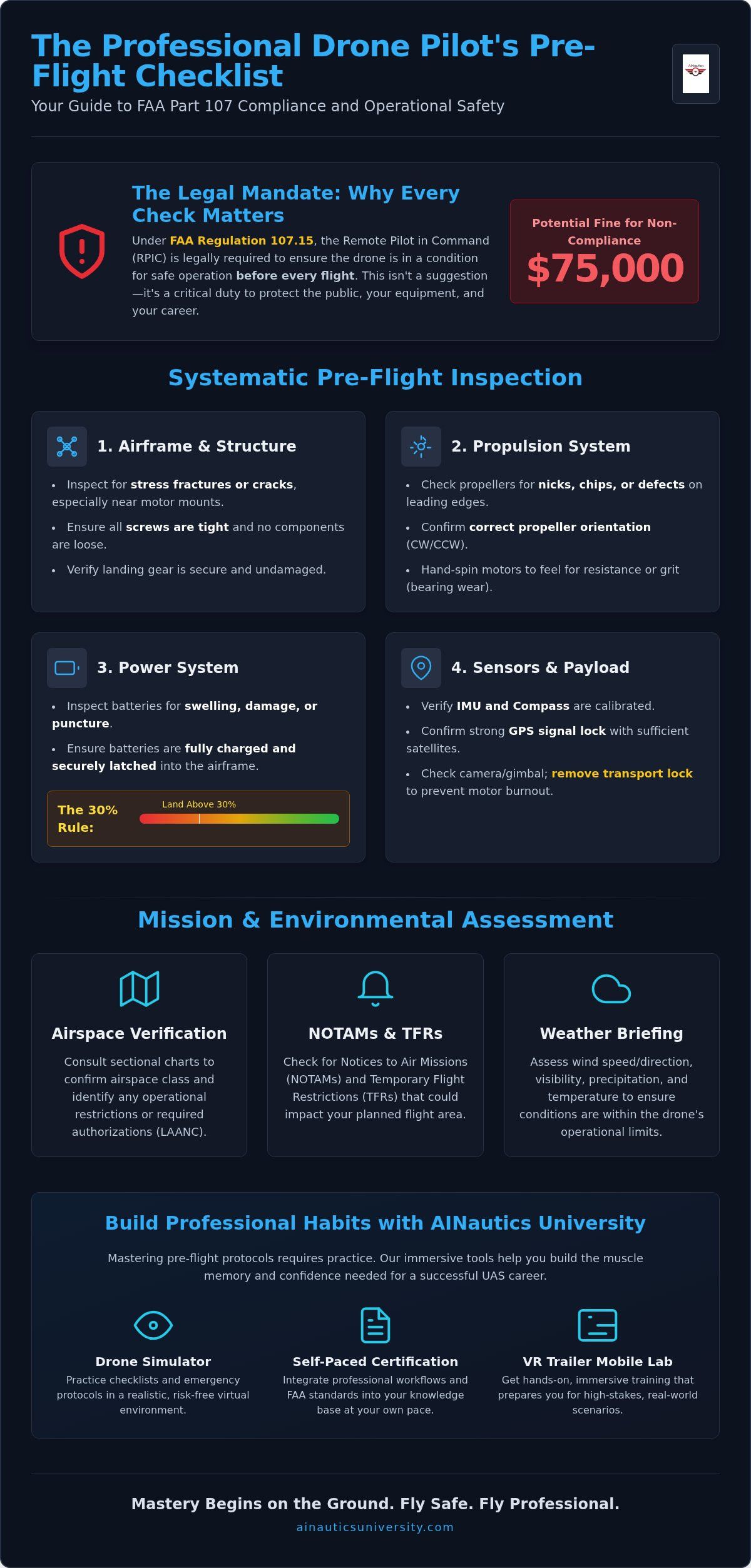
Every professional flight begins on the ground. A drone pre-flight checklist FAA standards require is a systematic process designed to verify that a small Unmanned Aircraft System (sUAS) is ready for safe operation. It's the foundation of airworthiness. Under FAA Regulation 107.15, you're legally prohibited from operating a drone unless you've determined it's in a condition for safe flight. This isn't a suggestion; it's a mandate that protects both the public and your career.
The Remote Pilot in Command (RPIC) carries the ultimate responsibility for this assessment. Whether you're flying a high-end commercial platform or a standard Unmanned Aerial Vehicle (UAV), the RPIC must personally verify every component. Maintaining a digital or physical record of these checks creates a vital paper trail. If you're ever involved in an FAA audit or an insurance claim, your documentation proves you met your legal duty of care. With the FAA's stricter enforcement policies in 2026, the cost of skipping these steps has never been higher.
Understanding the FAA's Condition for Safe Operation
To an FAA inspector, "safe condition" means every system functions exactly as the manufacturer intended. A thorough drone pre-flight checklist FAA guidelines follow helps you catch hairline cracks in propellers or firmware glitches before they become mid-air emergencies. Diligence here is a direct predictor of your success. Students in our Part 107 Training learn that pre-flight mastery is just as important as the flight itself. It builds the discipline needed to protect your license and your professional reputation.
Checklist vs. Maintenance Log: Knowing the Difference
It's easy to confuse daily checks with long-term maintenance. A pre-flight checklist is a "snapshot" of the drone's health right now. In contrast, a maintenance log tracks battery cycles, motor hours, and propeller wear over time. You should integrate these habits into your drone training for beginners routine as early as possible. Consistency is key to professional growth. We recommend using the AINautics Drone Simulator to practice these workflows. It allows you to run through checklists and respond to simulated hardware failures in a risk-free environment. This prepares you for the high-stakes reality of the field without risking your equipment.
Physical Inspection: Ensuring Airframe and Power System Integrity
Physical integrity is the bedrock of flight safety. A drone pre-flight checklist FAA guidelines recommend starts with a tactile and visual assessment of the aircraft. You must examine the airframe for stress fractures or micro-cracks, which often appear near motor mounts or landing gear after repeated use. Ensure all structural components are rigid and that no screws have vibrated loose. This level of detail is a hallmark of professional UAS operations and prevents minor wear from turning into a mid-air crisis.
Sensor health is equally critical to your mission's success. Verify your Inertial Measurement Unit (IMU) and compass are calibrated to avoid "toilet bowling" or fly-away scenarios. A strong GPS signal is non-negotiable for stable flight and accurate return-to-home functions. For a structured approach to these technical checks, many professionals refer to the University of Massachusetts Drone Checklist. Don't forget the camera and gimbal. Removing the transport lock is a simple step, but leaving it on can burn out sensitive gimbal motors within minutes of powering up the system.
The Propeller and Motor Audit
Propellers are your aircraft's wings and tires combined. Inspect the leading edges for tiny nicks or chips. These minor defects cause high-frequency vibrations that can loosen internal electronics or confuse flight controllers. Hand-spin each motor to feel for resistance or a "gritty" sensation, which often indicates sand or bearing wear. Always double-check that clockwise and counter-clockwise props are on the correct motors. A mismatch will prevent takeoff or cause an immediate flip during the arming sequence.
Battery Safety Protocols
Power management is about active risk mitigation. Follow the 30% Rule: never plan a mission that requires landing with less than 30% battery remaining. Use your flight app to monitor internal cell balance during the startup phase. If one cell shows a significantly lower voltage than the others, the battery is failing and should be retired. Lithium Polymer (LiPo) batteries are sensitive to temperature. In extreme cold, keep them in a warm case until just before takeoff to prevent sudden voltage drops that could trigger an emergency landing.
Mastery of these physical checks is a core component of our Self-Paced Certification options. Developing this muscle memory ensures you're ready for the field and fully compliant with professional standards.
Navigating Airspace: Using Sectional Charts and Weather Briefings
A professional drone pre-flight checklist FAA compliance requires must extend beyond the hardware. You need to understand the invisible boundaries of the sky. This begins with reading sectional charts. These complex maps identify Class B, C, D, and E airspaces, each with specific entry requirements. Ignoring these boundaries can lead to mid-air conflicts or severe legal penalties. By mastering these charts, you transform from a casual operator into a true aviation professional who respects the National Airspace System.
Weather assessment is equally vital. You should decode METARs (Meteorological Aerodrome Reports) to understand local visibility, cloud ceilings, and pressure settings. Pay close attention to wind shear. Rapid changes in wind speed or direction can overwhelm a drone's flight controller, especially during critical phases like takeoff and landing. A stable hover in your backyard doesn't guarantee safety if a gust front is moving through your mission area. Always check for NOTAMs (Notices to Air Missions) to ensure no last-minute changes affect your planned path.
Visualizing Your Flight Path on a Sectional Chart
Effective flight planning relies on your ability to spot airports, radio towers, and tall obstacles on a map. When you study Drone Regulations Sectional Charts, you learn to calculate your maximum allowable altitude. While the standard limit is 400 feet above ground level, you can often fly higher if you're within 400 feet of a structure. This skill is a core pillar of our Professional FAA Part 107 Drone Training Guide. It ensures you don't just pass the certification exam but actually possess the situational awareness required for complex field operations.
Real-Time Airspace Authorizations
Modern pilots use LAANC (Low Altitude Authorization and Notification Capability) for near-instant access to controlled airspace. However, digital apps don't replace the need to check for TFRs (Temporary Flight Restrictions). These restrictions often appear near sporting events, wildfire zones, or VIP movements. If you're operating near a towered airport, you should also verify ground-to-air communication frequencies to monitor manned aircraft traffic. For those seeking to deepen their expertise, the FAA UAS Safety Courses provide excellent supplemental materials to help you stay current with evolving airspace protocols.
Best Practices for Implementation: Moving from Theory to Flight
Theory is only useful if it translates into flawless execution in the field. Before you power up your motors, you must establish a "sterile cockpit" environment. This aviation term means eliminating all non-essential conversation and distractions during the critical pre-flight phase. By focusing entirely on your drone pre-flight checklist FAA standards require, you minimize the risk of human error. This is also the time to implement Crew Resource Management (CRM). If you're working with a Visual Observer (VO), brief them on their specific duties, emergency landing zones, and communication protocols. Clear communication ensures that every team member knows exactly what to do if an unexpected obstacle enters your flight path.
Mastering the Checklist with Simulation
Building the discipline for these checks takes time and repetition. We use the AINautics Drone Simulator to bridge the gap between classroom learning and field operations. This tool is essential because it replicates complex hardware failures that you hope never to see in real life. By practicing your response to a failing motor or a lost GPS signal in a virtual environment, you build the muscle memory needed to stay calm under pressure. This rigorous preparation is a key part of the UAS Student Scholar program evaluations. Students who master their checklists in the simulator consistently demonstrate higher safety ratings when they transition to live aircraft.
The Post-Startup Hover Test
Once you've cleared your surroundings and armed the motors, the final step is the hover test. Ascend to an altitude of 5 to 10 feet and let the drone hover for at least 30 seconds. During this time, listen for unusual mechanical noises and check for any unexpected drifting. You must verify the response of all primary controls: pitch, roll, yaw, and throttle. This is your last chance to catch a sensor error or a loose propeller before committing to a mission. Confirm that the "Home Point" has been recorded by your flight software and that you have a solid GPS lock. If the aircraft feels unstable or fails to hold its position, land immediately and re-run your drone pre-flight checklist FAA protocols.
Consistent practice is the only way to achieve professional-grade UAS operations. If you're ready to take the next step in your career, explore our comprehensive Part 107 training programs today to build a foundation of excellence.
Professionalizing Your Operations with AINautics Certification
Developing a professional identity in the UAS industry requires more than just technical skill. It demands a commitment to a safety culture that begins before the propellers even turn. A drone pre-flight checklist FAA compliance mandates serves as your primary tool for mitigating risk and demonstrating expertise to clients and employers. AINautics University specializes in transforming these regulatory requirements into actionable professional standards through immersive training and specialized curriculum designed for the modern workforce.
For schools and vocational programs, the stakes are even higher. Standardizing these safety protocols is a cornerstone of a successful drone curriculum for educators. We provide the structure needed to teach complex aviation concepts to students of all ages. One of our most powerful tools for workforce development is the VR Trailer Mobile Lab. This immersive environment allows students to conduct virtual walk-arounds and system checks in a high-fidelity setting. It provides a level of hands-on mastery that traditional textbooks simply cannot match, ensuring that every student is ready for real-world equipment.
Empowering Educators and Students
Standardizing safety in the classroom starts with the instructors. Our Train-the-Teacher program equips educators with the confidence to lead high-level UAS programs that align with federal safety standards. By teaching students to treat the drone pre-flight checklist FAA requirements as a non-negotiable part of their workflow, we prepare them for the rigors of the modern workforce. These students don't just graduate with a certificate. They enter the industry with the disciplined mindset of a commercial pilot, ready to manage complex missions with professional-grade readiness.
The AINautics Advantage
Transitioning from a curious learner to a Part 107 certified professional is a journey of specialization and growth. We support this transition through our Self-Paced Certification options, which allow you to dive deep into the material at your own speed without compromising on depth. Our programs, including the UAS Student Scholars initiative, focus on long-term career growth and the human element of technological advancement. You'll gain access to a network of reliable experts and fellow innovators who are shaping the technological demands of the future. The specialized knowledge you gain here serves as a bridge to a rewarding career in a rapidly evolving field where safety and precision are the highest currencies.
Start your journey toward Part 107 mastery today by exploring our specialized training modules and immersive learning tools. Our mission is to empower you with the specialized knowledge required to lead in the UAS industry.
Elevating Your Flight Standards for the Future
Mastering the drone pre-flight checklist FAA regulations require is more than a legal hurdle. It's the mark of a dedicated professional. You've learned that a systematic approach to physical inspections and airspace awareness protects your equipment and your license. These habits form the foundation of a safe, successful career in the rapidly growing UAS industry. By moving beyond theory into rigorous practice, you ensure that every takeoff is backed by total operational readiness.
As a Service-Disabled Veteran-Owned Small Business, AINautics University is committed to your professional growth. Our STEM-aligned curriculum and immersive VR and simulator labs provide the practical experience you need to lead with confidence. Whether you're a student starting your journey or an educator building a program, we provide the specialized knowledge required for the technological demands of the future.
Take the next step toward industry leadership today. Enroll in Part 107 Training at AINautics University and join a community of safety-conscious experts. The future of aviation belongs to those who prepare for it with precision. We're here to help you reach new heights with authority and expert guidance.
Frequently Asked Questions
Is a written pre-flight checklist legally required by the FAA?
Yes, performing a pre-flight assessment is a legal requirement under 14 CFR Part 107.49. While the FAA doesn't mandate a specific physical format, you must verify that your sUAS is in a condition for safe operation before every flight. Using a written or digital drone pre-flight checklist FAA standards support is the best way to prove compliance during an audit. Our Part 107 Training emphasizes this discipline to ensure students develop professional habits from day one.
What happens if I fly without performing a pre-flight inspection?
Flying without a proper inspection exposes you to significant civil and criminal penalties. Under the FAA Reauthorization Act of 2024, fines for reckless operations can reach $75,000 per violation. Beyond financial loss, you risk a catastrophic equipment failure that could cause property damage or personal injury. We recommend practicing these protocols in the AINautics Drone Simulator. It helps you understand the mechanical consequences of skipping vital checks before you ever head to the field.
How often should I update my drone pre-flight checklist?
You should review and update your checklist whenever you introduce new hardware, install firmware updates, or after the FAA releases regulatory changes. A checklist is a living document that must reflect your current drone configuration. Staying current is easier when you're part of a professional community. Our UAS Student Scholars program teaches participants how to adapt safety protocols as technology evolves, ensuring they remain at the cutting edge of industry safety standards.
Can I use a digital app for my FAA pre-flight checklist?
Yes, you can use digital applications to complete your drone pre-flight checklist FAA requirements. Many pilots prefer digital tools because they automatically time-stamp inspections and sync with flight logs for a clean paper trail. This is particularly useful for enterprise operations or schools using our Train-the-Teacher Program to track student progress. Whether you use paper or an app, the focus must remain on the accuracy and thoroughness of every individual safety check performed.
What are the most common things missed during a drone pre-flight check?
Pilots frequently overlook propeller micro-cracks, local NOTAMs, and internal battery cell balance. A tiny nick in a blade can cause high-frequency vibrations that lead to mid-air structural failure. Similarly, failing to check for temporary flight restrictions can result in accidental airspace violations. Our VR Trailer Mobile Lab provides a high-fidelity environment where students can practice identifying these subtle issues. This hands-on mastery ensures that nothing is missed when they transition to live commercial missions.
Do I need a different checklist for night operations?
Night operations require additional checks specifically focused on visibility and lighting. You must verify that your anti-collision lights are functioning and visible for at least three statute miles. You also need to assess your landing zone for hazards that are harder to spot in the dark. These specialized protocols are covered extensively in our Self-Paced Certification modules. Mastery of night flight safety is essential for pilots seeking to expand their professional capabilities in the UAS industry.
How do sectional charts help in drone pre-flight planning?
Sectional charts are essential for identifying airspace boundaries, ground hazards, and airport proximity. They tell you exactly where you can fly and what altitude limits apply to your specific location. Without a chart, you can't accurately determine if you need LAANC authorization or if you're encroaching on restricted military zones. We integrate chart reading into all our training programs to ensure every pilot possesses the situational awareness required for safe, professional, and compliant operations.
Does the FAA provide a standard checklist for Part 107 pilots?
The FAA defines the mandatory categories for a pre-flight check under Part 107.49, but they don't issue a one-size-fits-all form. Pilots are responsible for creating a checklist tailored to their specific aircraft and mission profile. AINautics University provides standardized templates through our Part 107 Training to help you meet these federal requirements. These resources ensure your safety protocols align with current industry standards while giving you the flexibility to manage diverse UAS platforms effectively.

Article by
AINautics University Team
The team behind AINautics University, dedicated to drone education and FAA Part 107 certification prep, VR flight simulation, and STEM training programs for students and educators.


