
In 2026, simply holding a Remote Pilot Certificate isn't enough to secure a high-growth career in the unmanned systems industry. You've likely felt the pressure of complex airspace regulations or the fear of failing the FAA exam on your first attempt. Choosing the right Part 107 online course is about more than just checking a box; it's about gaining the confidence to lead missions and launch a successful commercial drone business. It's natural to worry that digital training might lack the practical application required for professional flight operations.
This guide helps you identify training that moves beyond basic memorization toward true professional mastery. We'll show you how to navigate FAA requirements while choosing a program that aligns with your specific career goals. You'll discover how immersive tools like the AINautics Drone Simulator, the VR Trailer Mobile Lab, and our Self-Paced Certification options bridge the gap between theory and the field. We also highlight how our specialized Part 107 Training and Train-the-Teacher Program prepare you for the workforce and ensure future-readiness. By the end of this article, you'll have a clear roadmap to pass your exam and excel in the evolving world of UAS technology.
Key Takeaways
- Understand the 2026 FAA regulatory environment and why obtaining your Remote Pilot Certificate is the essential first step for any commercial Unmanned Aircraft Systems (UAS) operation.
- Identify the core components of a high-quality Part 107 online course, including critical mastery of airspace classifications, weather patterns, and scenario-based safety training.
- Discover how immersive tools like the AINautics Drone Simulator and VR Trailer Mobile Lab bridge the gap between digital theory and real-world flight operations.
- Explore specialized pathways for academic success through the UAS Student Scholars program and the Train-the-Teacher model designed for future-ready educators.
- Learn how to transition from certification to a professional career by leveraging workforce marketplaces and mission-driven instruction that prepares you for the field.
The 2026 FAA Part 107 Landscape: Why Online Certification is Your First Step
The FAA Part 107 Remote Pilot Certificate is the foundational legal requirement for anyone operating a drone for commercial purposes. In 2026, the distinction between a hobbyist and a professional is clearer than ever. While recreational flyers operate under limited safety guidelines, commercial pilots must master complex regulations to ensure the safety of the National Airspace System. This certification isn't just a badge; it's a professional mandate. Whether you're capturing real estate media or conducting high-stakes infrastructure inspections, the law requires this credential to operate legally. Failing to comply can lead to significant civil penalties and restricts your ability to participate in the growing drone economy.
The 2026 regulatory environment emphasizes safety and integration. The FAA has established strict protocols for flying over people, moving vehicles, and operating at night. Mastering these rules through a comprehensive Part 107 online course ensures you can fly with confidence. Professional drone use has moved from a niche hobby to a critical business tool. Major industries now rely on Unmanned Aircraft Systems (UAS) to perform tasks that were previously too dangerous or expensive for human crews. This shift has created a surge in drone-integrated fields, including public safety, environmental monitoring, and media production.
Commercial Opportunities in the 2026 Drone Economy
The demand for certified pilots has exploded across specialized sectors. Vertical structure inspection and wildlife-aware procedures are now industry standards. For instance, professional pilots must understand how to conduct inspections without disturbing local ecosystems, adhering to guidelines like the Migratory Bird Treaty Act. This level of specialization requires more than basic flight skills. It demands a professional mindset that starts with formal certification training. Programs like the UAS Student Scholars are preparing the next generation to enter this workforce with mission-driven expertise. These pilots don't just fly; they manage autonomous systems that drive efficiency in agriculture and construction.
Online vs. In-Person Training: Finding the Right Balance
Choosing a Part 107 online course offers the flexibility needed by students and busy professionals. Digital learning has evolved far beyond static slides. Modern platforms now integrate immersive technology to simulate real-world flight conditions. When evaluating training, credibility is paramount. Look for providers with established industry roots, such as Service-Disabled Veteran-Owned Small Business (SDVOSB) status and active AUVSI membership. AINautics University provides Self-Paced Certification options that allow learners to master technical material without sacrificing their current schedules. This balance of convenience and rigorous standards ensures you're ready for the FAA exam and the professional career that follows.
Anatomy of a High-Quality Part 107 Online Course
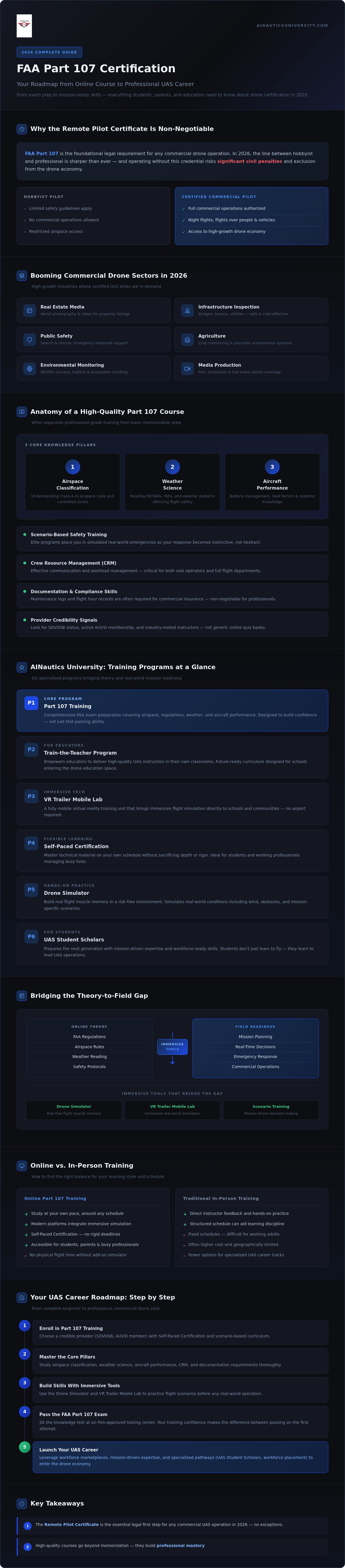
A superior Part 107 online course does more than help you memorize answers for a multiple-choice test. It establishes the professional foundation required for mission success in a complex industry. High-quality training focuses on three core pillars: airspace classification, weather science, and aircraft performance. While basic courses might skim these topics, elite programs use scenario-based training to place you in the pilot's seat before you ever leave the ground. This approach ensures that when you encounter a real-world emergency, your response is instinctive rather than hesitant.
Professional flight departments also prioritize Crew Resource Management (CRM). This discipline focuses on effective communication and workload management within a team. Even if you're a solo operator, CRM principles help you manage the "human machine" interface. Additionally, a robust curriculum teaches you the importance of documentation. Maintaining a clean paper trail for maintenance logs and flight hours isn't just good practice; it's often a requirement for securing commercial insurance. By engaging with Self-Paced Certification options, you can build these skills at your own speed without sacrificing depth.
Mastering FAA Airspace and Regulations
Airspace isn't just a collection of lines on a map. It's a dynamic, three-dimensional environment. You'll learn to decode Class B, C, D, and E airspace using interactive sectional charts. In 2026, the regulatory landscape includes specific requirements for Beyond Visual Line of Sight (BVLOS) and advanced night operations. Understanding how to navigate FAA waivers and airspace authorizations efficiently is a hallmark of a professional pilot. This knowledge allows you to operate in restricted areas where others cannot, opening doors to more lucrative commercial contracts.
Operational Safety and Emergency Procedures
Safety is a culture, not a checklist. It requires rigorous contingency planning and proactive risk mitigation. You'll dive deep into the science of UAS weather, learning to interpret METARs and TAFs to identify stable versus unstable air. These data points are critical for predicting how your aircraft will behave in the field. Equally important are human factors. Recognizing the five hazardous attitudes, such as impulsivity or invulnerability, is essential for maintaining situational awareness. A mission-driven Part 107 online course ensures you have the mental framework to prioritize safety over speed, protecting both your equipment and your professional reputation.
The AINautics Advantage: Immersive Tech and Mission-Driven Mastery
Many students find that a typical Part 107 online course relies heavily on passive video content. While these videos cover the necessary FAA rules, they often fail to prepare pilots for the physical and mental demands of a flight mission. AINautics University changes this dynamic by integrating immersive technology directly into the learning path. This approach ensures that your transition from a student to a professional pilot is seamless and grounded in practical experience. It's about building a bridge between the digital classroom and the flight line.
Simulation-Based Learning for Remote Pilots
Flight simulators are the gold standard for pilot training in both manned and unmanned aviation. The AINautics Drone Simulator allows you to practice complex maneuvers in a risk-free digital environment. You'll face simulated equipment failures, sudden weather shifts, and challenging terrain without the risk of damaging expensive hardware. This builds muscle memory and sharpens your decision-making skills before you ever take off in the real world.
Our VR Trailer Mobile Lab takes this a step further by providing high-fidelity situational awareness. Virtual reality forces you to manage your surroundings just as you would during a commercial mission. You'll learn to maintain a proper visual line of sight while monitoring telemetry data. This level of immersion is a key differentiator for online learners who want to arrive on a job site with the confidence of a veteran pilot. By choosing our Self-Paced Certification, you get access to these advanced tools on a schedule that works for you.
Specialized Training for Industry Standards
A professional pilot's value is often measured by their specialized knowledge. Our curriculum includes mission-specific training that goes beyond the basic FAA requirements. For example, we teach wildlife-aware inspection procedures, ensuring compliance with the Migratory Bird Treaty Act during cell-tower or vertical structure inspections. This knowledge protects both the environment and your client's legal standing. It's a critical component of Part 107 Training that prepares you for high-stakes enterprise and government contracts.
Effective mission planning is another cornerstone of our instruction. You'll learn how to coordinate with stakeholders and manage ground crews safely. For those seeking a comprehensive deep dive into these professional standards, our Professional FAA Part 107 Drone Training Guide provides additional insights into the 2026 certification landscape. This commitment to mission-driven mastery ensures you aren't just a certificate holder, but a workforce-ready professional.
Specialized Pathways: Drone Education for Students and Teachers
Building a successful drone program within a school district requires more than just purchasing hardware. It demands a structured curriculum that aligns with state and district standards to ensure long-term educational value. While a standard Part 107 online course provides the necessary academic foundation, students and educators need a clear roadmap to transition from the classroom to the workforce. AINautics University specializes in this transition, offering a 90-day program launch framework that allows schools to implement a fully functional UAS department with speed and precision.
The UAS Student Scholar Program
Empowering the next generation of pilots begins with early exposure to STEM-aligned technology. The UAS Student Scholars program provides high schoolers with a direct pathway from certification to professional placement. This initiative focuses on building technical mastery through hands-on UAS education, preparing students for the high-growth careers discussed earlier in this guide. For those exploring these opportunities, the UAS Scholarship 2026: High School Career Pathway Guide offers a comprehensive look at how students can fund and navigate their professional journey.
Professional Development for Educators
Educators are the primary drivers of the autonomous revolution in our schools. Our Train-the-Teacher Program equips instructors with the certification and curriculum support they need to lead with confidence. This program ensures that teachers aren't just teaching to a test, but are fostering a safety-first culture in their classrooms. By integrating tools like the VR Trailer Mobile Lab, educators can provide immersive experiences that capture student interest and improve retention of complex regulatory material.
Successful integration requires a balance of theory and practical application. Educators can find specific strategies for classroom implementation in our Drone Curriculum for Educators Guide. This resource helps schools align their training with industry standards, ensuring that every student who completes a Part 107 online course is ready for real-world mission execution. If you're ready to bring this technology to your institution, explore our school program launch framework to get started today.
The transition from a traditional classroom to a high-tech UAS lab doesn't have to be overwhelming. Our 90-day rollout strategy provides the structure necessary to manage everything from FAA compliance to equipment maintenance. This methodical approach allows districts to focus on what matters most: preparing students for the technological demands of the 2026 workforce. By following a proven model, schools can avoid the common pitfalls of early-stage program development and start delivering results in a single semester.
From Certification to Career: Launching Your UAS Professional Journey
Most candidates view the FAA exam as the final hurdle. In reality, it's the starting line. A high-quality Part 107 online course should prepare you for the entire "Learn → Train → Certify → Fly → Work" pipeline. This structured approach ensures you don't just hold a piece of paper, but possess the operational readiness that enterprise clients demand. By mastering the fundamentals and then advancing through specialized training, you position yourself as a reliable asset in the 2026 autonomous economy. Professional success requires a commitment to continuous learning and technical specialization.
Workforce Readiness and Career Paths
The industry outlook for 2026 shows massive growth in logistics, environmental monitoring, and infrastructure. Simply passing the test won't secure these roles. You need a professional portfolio that demonstrates your ability to handle real-world missions. This includes documented flight hours on the Drone Simulator and experience with immersive tools like the VR Trailer Mobile Lab. Government agencies and large corporations often prioritize providers with specialized credentials. Aligning your training with our SDVOSB-certified programs gives you a competitive edge when bidding on municipal or federal contracts. For a deeper look at specific roles, check out our Future of Drone Careers: 2026 Industry Outlook.
The iFlyDrone Marketplace: Your Gateway to Work
Finding your first commercial contract is often the hardest part of the journey. We bridge this gap by connecting our graduates with the iFlyDrone workforce marketplace. This platform serves as a hub for nationwide opportunities, ranging from turnkey data-collection missions to long-term municipal projects. Because you've completed rigorous Part 107 Training, you enter this marketplace with the insurance-ready status that clients require. Whether you're a solo operator or a graduate of the UAS Student Scholars program, this gateway provides a direct line to professional growth. It turns your certification into a tangible career asset.
Maintaining your edge requires more than a one-time course. The 2026 regulatory environment is dynamic, requiring ongoing curriculum updates and expert support. Our Self-Paced Certification model includes access to the latest FAA changes and mission-specific procedures. This ensures your skills remain relevant as the industry evolves. By following this comprehensive path, you move beyond basic flight to become a mission-driven leader in the unmanned systems industry. Success in this field is about preparation, specialization, and the right professional connections. Start your journey with a Part 107 online course that values your long-term career success as much as your exam results.
Secure Your Future in the 2026 Autonomous Economy
Obtaining your certificate is the first step toward a professional career, but true mastery comes from immersive, mission-driven instruction. You've seen how tools like the Drone Simulator and VR Trailer Mobile Lab bridge the gap between theory and the flight line. Whether you're a student in the UAS Student Scholars program or an educator using our Train-the-Teacher Program, your path to success is defined by specialized knowledge and practical application.
As a Service-Disabled Veteran-Owned Small Business, we're committed to your professional growth through a STEM-Aligned Curriculum. Our 99% Student Success Rate reflects a dedication to excellence that goes far beyond a standard Part 107 online course. You have the potential to lead in this high-growth industry, and the right training ensures you're ready for every mission.
Start Your Professional Drone Career with AINautics University and transform your interest into a future-ready profession. The sky isn't the limit; it's your new office. We're here to support you at every stage of your journey.
Frequently Asked Questions
What is the best Part 107 online course for absolute beginners?
AINautics University's training is designed specifically for those with zero aviation experience. It uses a step-by-step approach to demystify complex FAA regulations and technical concepts. Beginners benefit from our Drone Simulator, which allows for risk-free practice before attempting real-world flight missions. This immersive entry point ensures that new pilots build confidence while mastering the curriculum at their own pace through our Self-Paced Certification options.
How long does it take to complete an FAA drone certification course?
Most students complete their Part 107 online course in approximately 15 to 20 hours of focused study. However, the total time depends on your prior knowledge and learning style. Our Self-Paced Certification allows you to move quickly through familiar topics while spending more time on difficult sections like sectional charts or weather theory. We recommend spreading this study over two to three weeks to ensure the information is fully retained.
Is the FAA Part 107 exam difficult to pass in 2026?
The exam is challenging because it requires a deep understanding of aviation safety and national airspace rules. In 2026, the test includes updated questions regarding operations over people and night flight. While the material is technical, our mission-driven instruction prepares you for every scenario. With a focus on practical application rather than just memorization, our students achieve high pass rates by truly understanding the logic behind the regulations.
Can I take the Part 107 test online or do I need to go to a center?
You must visit an FAA-approved Knowledge Testing Center to take the initial aeronautical knowledge exam. While your Part 107 online course is completed digitally, the official certification requires a proctored, in-person environment. You'll need to schedule an appointment through the FAA's testing partner and pay the required testing fee. Once you pass the initial test, your recurrent training and renewals can typically be handled online through the FAA portal.
What is the difference between a standard course and a Train-the-Teacher program?
A standard course focuses on individual pilot certification, while the Train-the-Teacher Program is a professional development track for educators. It provides the curriculum support and instructional strategies needed to lead a school drone program. Teachers learn how to integrate tools like the VR Trailer Mobile Lab into their classrooms. This program ensures that educators can guide students through the UAS Student Scholars path while maintaining high academic standards.
How much does it cost to get a Part 107 license including the course and exam?
The total investment includes the cost of your chosen training program and the FAA testing fee. In 2026, you should verify the current FAA testing fee directly with a Knowledge Testing Center as these prices can fluctuate. Investing in high-quality training ensures you are prepared to pass on your first attempt, avoiding the cost of retaking the exam. Professional training also provides the foundational skills necessary for a lucrative career.
Does AINautics University provide hands-on flight training with the online course?
Yes, we bridge the gap between digital theory and physical flight through our immersive technologies. While the primary instruction is digital, our Drone Simulator and VR Trailer Mobile Lab provide realistic, hands-on experiences. These tools allow you to practice mission-specific maneuvers and situational awareness in a controlled environment. This approach prepares you for real-world flight operations more effectively than standard video lectures, ensuring you arrive at your first mission workforce-ready.
Are there drone scholarships available for high school students in 2026?
The UAS Student Scholars program offers specific pathways for high school students to enter the industry. These opportunities are designed to build STEM skills and provide a direct route from the classroom to the workforce. Many districts also use our 90-day program launch framework to secure funding for student certifications. We encourage students and parents to explore career pathway guides to identify current scholarship opportunities available within their specific school districts.

Article by
AINautics University Team
The team behind AINautics University, dedicated to drone education and FAA Part 107 certification prep, VR flight simulation, and STEM training programs for students and educators.


