
What if the true drone pilot license cost isn't the $175 fee you pay at the testing center, but the potential income lost while navigating a maze of regulatory confusion? In 2026, the barrier to entry for commercial Unmanned Aircraft Systems (UAS) is lower than ever, yet many candidates still struggle to separate mandatory FAA fees from the educational investments that actually drive career growth. Whether you're a student looking for a future-ready career or an educator exploring our Train-the-Teacher Program, understanding the financial landscape is the first step toward professional mastery.
We understand that the uncertainty of hidden fees and the return on investment for training programs can feel like a significant hurdle. This guide promises to clear that confusion by providing a comprehensive line-item breakdown of every expense you'll encounter, from registration to recurrent training. We will preview the difference between recreational TRUST requirements and professional Part 107 Training, while showing how tools like the AINautics Drone Simulator and our Self-Paced Certification options provide a direct, cost-effective path to professional employment in high-growth industries.
Key Takeaways
- Identify the mandatory 2026 expenses, specifically the $175 FAA Knowledge Exam fee and the $5 commercial drone registration.
- Optimize your drone pilot license cost by choosing between Self-Paced Certification or specialized Part 107 Training to ensure a first-time pass.
- Reduce long-term operational risks by utilizing the Drone Simulator for flight mastery before investing in expensive professional hardware.
- Explore institutional growth paths for educators through the Train-the-Teacher Program and the UAS Student Scholars workforce development initiative.
- Analyze the career ROI of certification, where entry-level roles lead to high-value specializations in industrial inspection and aerospace.
The Mandatory FAA Part 107 License Costs in 2026
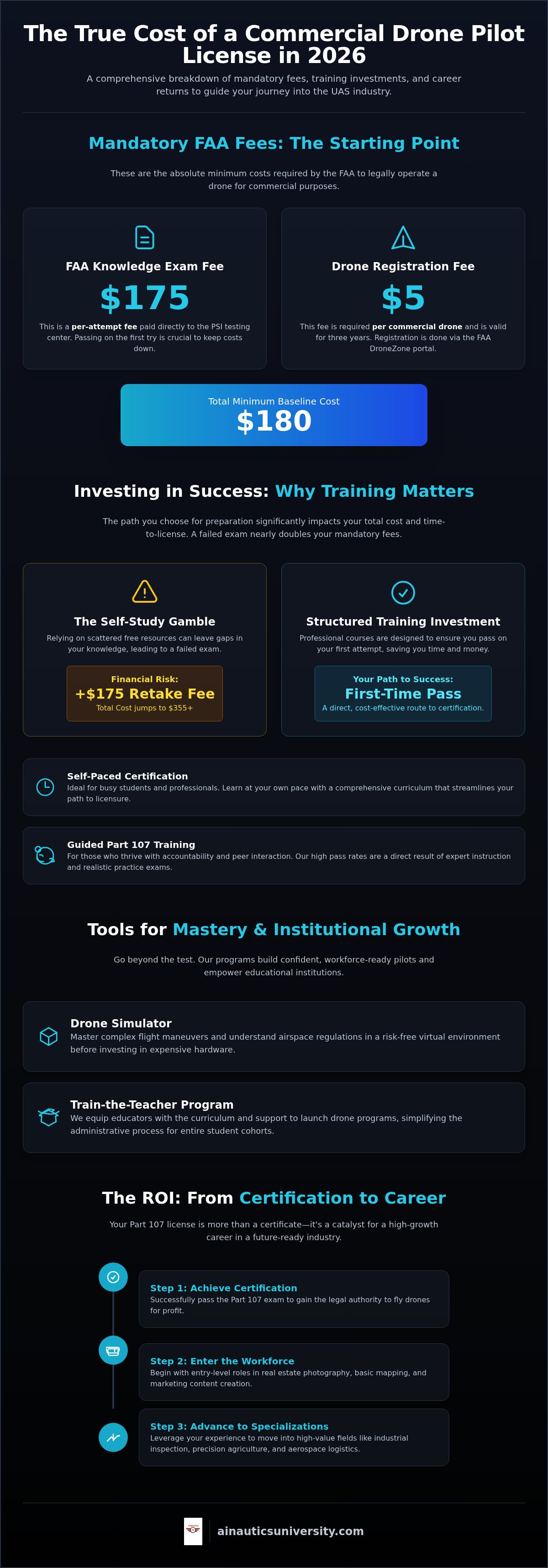
Understanding the drone pilot license cost involves more than just looking at the price of a test; it's about budgeting for every step of the certification process. The absolute minimum hard cost in 2026 is $180. This total includes the mandatory $175 FAA Knowledge Test fee and a $5 registration fee for your primary aircraft. While these are the only fees paid directly to the government or its testing partners, they represent the essential baseline for any professional career.
FAA Knowledge Exam Fees and Scheduling
The Part 107 Knowledge Test is the mandatory written exam for commercial certification and costs $175 per attempt in 2026. You must schedule this through a PSI Services testing center. There are hundreds of authorized locations across the United States, usually located at local airports or dedicated testing facilities. Because the fee is per-attempt, failing the exam immediately doubles your testing budget. This financial risk is why many students opt for our Self-Paced Certification or structured Part 107 Training. These programs ensure you are prepared to pass on your first try, protecting you from the cost of retakes.
When you arrive at the testing center, you'll need government-issued identification that matches your profile exactly. Small discrepancies can lead to being turned away. Mastery of the material is the best way to protect your investment. Our Drone Simulator allows students to visualize complex airspace concepts before they ever step into the testing center, turning abstract regulations into practical knowledge.
Drone Registration and Compliance Fees
Federal law requires all commercial drones to be registered through the FAA DroneZone portal for a $5 fee. This registration stays valid for three years. Once registered, you must mark your aircraft with its unique registration number. This step is essential for legal compliance and professional accountability. If you operate multiple aircraft, each one requires its own $5 registration.
Maintaining your status as a Certificated Remote Pilot requires staying current. Currently, the FAA offers biennial recurrent training for free through their online portal, which must be completed every 24 months. Before you can even sit for your exam, you must create a profile in the Integrated Airman Certification and Rating Application (IACRA) system to receive an FAA Tracking Number (FTN). This unique identifier follows you throughout your career. For school districts, our Train-the-Teacher Program simplifies this administrative process. We help educators guide entire cohorts of students through these initial regulatory hurdles efficiently.
The minimum $180 investment grants you the legal right to fly for profit. However, the difference between a licensed pilot and a professional pilot often comes down to the quality of their initial training. By focusing on workforce-ready mastery, you ensure that your initial drone pilot license cost leads to a sustainable and lucrative career.
Investing in Success: Drone Pilot Training and Certification Courses
While the mandatory FAA fees represent the floor of your investment, the total drone pilot license cost is heavily influenced by your choice of educational path. Many candidates attempt to self-study using free online videos. However, the $175 exam fee is non-refundable. Failing a single time immediately increases your certification cost by nearly 100 percent. Investing in structured drone training for beginners ensures you master the specific aeronautical knowledge required by the official FAA drone pilot certification steps on your first attempt.
Self-Paced vs. Guided Instruction Models
Busy professionals and students often prefer our Self-Paced Certification options. This model allows you to balance a full-time schedule while building a deep understanding of National Airspace System (NAS) regulations. A professional curriculum does more than help you pass a test; it reduces the 'time-to-license' by condensing months of scattered research into a streamlined, logical progression. For those who thrive with peer interaction, our Part 107 Training provides the accountability needed to move from interest to employment quickly. High pass rates are a direct result of comprehensive study materials and practice exams that mirror the actual testing environment.
Advanced Flight Simulation and Immersive Training
True workforce readiness requires skills that go beyond the written exam. One of the most significant hidden costs for new pilots is the repair of expensive hardware during the learning phase. By integrating an advanced drone simulator into your training, you can master complex flight maneuvers without financial risk. This immersive technology allows for scenario-based training, such as emergency procedures and high-wind landings, which are difficult to practice safely in the field.
Our VR Trailer Mobile Lab takes this a step further by providing a turnkey environment for rapid skill acquisition. VR-based UAS training is highly cost-efficient because it builds muscle memory and spatial awareness at a fraction of the cost of traditional flight hours. If you're looking for a way to bridge the gap between certification and a professional career, consider exploring our UAS Student Scholars program to find a community focused on technical mastery. This approach ensures that your initial educational investment translates into the high-value expertise demanded by industrial sectors in 2026.
Hidden Expenses: Operational and Equipment Costs for Professionals
Professionalism in the UAS industry requires looking past the initial drone pilot license cost to consider the long-term operational framework. While the FAA provides the legal authority to fly, your career longevity depends on managing the "hidden" expenses that separate hobbyists from industry experts. These costs include risk mitigation, data processing tools, and technical maintenance. Building a sustainable business model means accounting for these variables before your first commercial mission.
Insurance and Liability Coverage
Insurance isn't just a safety net; it's a prerequisite for enterprise contracts. In 2026, the future of drone careers is tied to high-stakes industries like construction and public safety where third-party liability is non-negotiable. Pilots can choose between on-demand policies, which charge by the hour or mission, and annual policies that offer broader hull coverage for the aircraft itself. While on-demand options might save money for part-time pilots, full-time professionals often find annual premiums more cost-effective. Documenting your safety record through structured Part 107 Training or the AINautics UAS Student Scholars program helps demonstrate the professional standards that insurers value.
Software and Mission Planning Infrastructure
Data is the primary product of a professional drone pilot. To deliver value, you must budget for software subscriptions that handle GIS, orthomosaic mapping, and asset management. These tools transform raw images into actionable intelligence for your clients. Additionally, mission planning requires airspace authorization tools (LAANC). While basic access is often free, enterprise-level mission logging and wildlife-aware inspection tools usually require paid subscriptions. Maintaining a clean paper trail is vital for federal compliance and long-term asset management. Our VR Trailer Mobile Lab provides a controlled environment to learn these complex software interfaces before you deploy in the field.
Meeting the Official FAA Drone Pilot Requirements is only the beginning of your professional journey. Professionals must also account for hardware maintenance. Batteries have limited cycle lives, and propellers require regular replacement to ensure flight safety. Sensor calibration is another recurring task that ensures data accuracy. As the industry moves toward FAA Part 108 rules for Beyond Visual Line of Sight (BVLOS) operations, staying updated through recurrent training becomes a career-saving investment. By using the AINautics Drone Simulator, pilots can practice these advanced maneuvers and mission profiles without risking their physical hardware or increasing their operational overhead. This proactive approach ensures your drone pilot license cost remains a gateway to a profitable career rather than a recurring financial burden.
Institutional Investment: Costs for Launching School Drone Programs
Schools and districts face a different set of financial considerations when integrating Unmanned Aircraft Systems (UAS) into their classrooms. While an individual student focuses on the baseline drone pilot license cost, an institution must budget for instructor certification, curriculum licensing, and specialized equipment. Building a sustainable program requires a shift from viewing drones as toys to treating them as professional workforce development tools. This institutional investment pays dividends by preparing students for high-demand careers in 2026.
Teacher Certification and Professional Development
The first step for any district is building internal expertise. Instead of relying on expensive outside contractors, schools can utilize our Train-the-Teacher Program to certify their own staff. Budgeting for this program includes the cost of the training itself and the mandatory $175 FAA exam fee for each educator. Once certified, these teachers become the foundation of a district's Career and Technical Education (CTE) pathway. Aligning this training with state standards ensures that the program remains eligible for federal STEM funding and grants. We provide ongoing instructor support to keep curriculum materials current with evolving FAA regulations.
Mobile Labs and Classroom Infrastructure
Infrastructure costs can quickly spiral if a district attempts to build a permanent flight lab at every campus. The AINautics VR Trailer Mobile Lab offers a high ROI by serving as a shared, turnkey resource that travels between schools. This mobile solution reduces the need for redundant hardware and provides a professional-grade environment for immersive learning. Within the classroom, educators can deploy a STEM-aligned drone curriculum for educators that utilizes the Drone Simulator to build student skills without the risk of equipment damage.
Scaling a UAS program from a single classroom to a district-wide initiative requires a modular approach. Our '90-Day Program Launch' framework provides a clear roadmap for districts to move from planning to implementation quickly. By equipping students with Self-Paced Certification options and recognizing them through the UAS Student Scholars program, schools create a clear path to professional employment. This structured environment ensures the initial drone pilot license cost is just the beginning of a student's journey toward mastery. If your district is ready to lead in aerospace education, explore our institutional training solutions to start your program launch today.
Evaluating the ROI: Why the Cost of Certification is a Career Catalyst
Viewing the drone pilot license cost through the lens of potential earnings transforms a regulatory hurdle into a strategic career move. In 2026, the demand for specialized UAS operators has outpaced the supply of certified pilots. While the initial investment covers testing and registration, the true value lies in the access it provides to high-growth sectors. Choosing Professional FAA Part 107 Drone Training ensures you aren't just passing a test; you're preparing for the technical rigors of the field.
Commercial Earning Potential in 2026
Specialized industries like cell-tower inspection, public safety, and economic development offer some of the highest returns for new pilots. Full-time commercial pilots in 2026 typically earn between $57,000 and $95,000 annually, while those in specialized fields like surveying can exceed $130,000. For freelance operators, day rates often range from $600 to $2,000 depending on the complexity of the mission and the required sensors. A professional drone license typically pays for itself within the first two or three successful commercial contracts. Municipal and government agencies also represent a stable market, as they increasingly integrate UAS for infrastructure monitoring and emergency response.
The AINautics Workforce Pipeline
We believe that certification is only the beginning of your journey. Our ecosystem supports you from the classroom to the job site. Students often start as UAS Student Scholars, building foundational skills before moving into our advanced Self-Paced Certification programs. Once you have your license in hand, you can leverage the iFlyDrone marketplace to find nationwide career opportunities and connect with clients seeking verified experts. This pipeline ensures that your education leads directly to measurable professional outcomes.
To finalize your budgeting journey, use this checklist to ensure you're ready for 2026:
- Mandatory FAA Knowledge Exam Fee: $175 paid to a PSI testing center.
- Commercial Drone Registration: $5 per aircraft via FAA DroneZone.
- Flight Mastery: Utilizing the Drone Simulator to prevent hardware loss during training.
- Professional Standards: Budgeting for liability insurance and mission-specific software.
- Career Growth: Engaging with the iFlyDrone marketplace for mission opportunities.
The path to becoming a professional pilot is a methodical progression toward specialization. By focusing on workforce readiness rather than just test-taking, you position yourself as a leader in the next generation of aerospace technology. Your investment today builds the expertise required for the missions of tomorrow.
Mastering the Future of Aerospace
Success in the UAS landscape of 2026 requires more than a basic understanding of FAA fees. While the mandatory $180 baseline remains a fixed entry point, your total drone pilot license cost is best optimized through strategic preparation and technical mastery. By utilizing our Red Dot Design Award winning simulator technology and structured Part 107 Training, you eliminate the financial risk of expensive exam retakes and avoidable hardware damage. This proactive approach ensures you're ready for high-value missions in industrial inspection and public safety.
For school districts, our 90-Day Program Launch framework provides a proven roadmap to build sustainable, workforce ready programs that empower the next generation of pilots. As a Service-Disabled Veteran-Owned Small Business, AINautics University remains dedicated to providing the tools and expertise needed to bridge the gap between initial certification and a thriving career. The transition from student to professional is a journey of precision and specialized knowledge. Start your professional UAS career with AINautics University's Part 107 Training today. The future of flight is yours to command.
Frequently Asked Questions
How much does the FAA Part 107 drone exam cost in 2026?
The fee for the FAA Part 107 knowledge test is $175 per attempt in 2026. This mandatory payment is made directly to PSI Services, the FAA's authorized testing partner. Because this is a per-attempt charge, your total drone pilot license cost depends heavily on your preparation level. Utilizing structured Part 107 Training helps ensure you pass on your first try, protecting you from paying the $175 testing fee multiple times.
Are there any hidden fees when getting a drone license?
Beyond the exam, you must budget for the $5 drone registration fee required for all commercial aircraft. You might also encounter travel expenses to reach an authorized PSI testing center. Professional pilots should also consider the cost of liability insurance and mission-specific software. While the FAA biennial recurrent training is currently free, the initial hard costs for the exam and registration are the non-negotiable baseline for your professional journey.
Is the drone license fee a one-time payment or annual?
The FAA Part 107 knowledge test fee is not an annual charge; it's a one-time payment per exam attempt. Once you earn your Remote Pilot Certificate, it doesn't expire. However, you must complete free online recurrent training every 24 months to maintain your flight privileges. Your commercial drone registration is a separate $5 fee that must be renewed every three years through the FAA DroneZone portal to remain compliant.
How much should I budget for drone training courses?
Industry averages for online Part 107 preparation courses typically range from $199 to $299. When evaluating your drone pilot license cost, consider the value of comprehensive resources like Self-Paced Certification or immersive tools like the Drone Simulator. These investments often pay for themselves by reducing the risk of failing the $175 exam and helping you build the technical mastery required for high-paying industrial roles in surveying or inspection.
Do teachers and schools have different license costs?
The FAA mandates the same $175 testing fee for all individuals, including educators. However, school districts can optimize their budgets by using the Train-the-Teacher Program to build internal expertise. This model allows districts to certify their own staff as Remote Pilots, who can then lead UAS Student Scholars programs for their students. This institutional approach is significantly more cost-effective than hiring external contractors for every classroom flight session or curriculum update.
What happens if I fail the drone license test on the first try?
If you fail the knowledge test, you must wait 14 calendar days before you're eligible to retake it. You'll also be required to pay the full $175 exam fee again for every subsequent attempt. This financial penalty is why we emphasize aeronautical mastery during our training. Our programs help students avoid the frustration and added expense of multiple testing attempts, keeping your career path to professional certification both steady and efficient.
Is drone insurance mandatory for commercial pilots in 2026?
The FAA doesn't legally require commercial drone pilots to carry liability insurance under Part 107 regulations. However, most enterprise clients and government agencies won't hire you without proof of coverage. Budgeting for on-demand or annual insurance is a professional standard in 2026. Documenting your safety training through the VR Trailer Mobile Lab or professional certification courses can sometimes help you secure better rates from UAS insurance providers during the underwriting process.
Can I get a drone license for free?
You can't obtain a commercial Remote Pilot Certificate for free because the $175 FAA exam fee is mandatory for everyone. While recreational flyers can take The Recreational UAS Safety Test (TRUST) for free, this doesn't grant the authority to fly for profit. Commercial pilots must invest in the Part 107 exam. You can use free FAA study guides to prepare, though many professionals prefer structured courses to guarantee a first-time pass.

Article by
AINautics University Team
The team behind AINautics University, dedicated to drone education and FAA Part 107 certification prep, VR flight simulation, and STEM training programs for students and educators.


