
According to U.S. Census Bureau data, former military drone operators are among the service members who generate the highest earnings after leaving the military. This isn't a coincidence. The discipline, risk assessment, and leadership you developed in uniform are the exact traits the $100 billion commercial drone industry is searching for right now. Finding specialized drone training for veterans is the first step toward reclaiming your sense of mission in a field that values your unique background.
We understand that translating military codes into a civilian resume feels like a second job. You might worry about falling behind on technology or losing that sense of purpose you had while serving. This guide promises to clear the path. You'll discover how to translate your tactical expertise into a high-growth career in the unmanned aircraft systems (UAS) industry. We'll show you how to move from service to a specialized professional role with confidence.
In the following sections, we'll break down the process of obtaining your FAA Part 107 certification and explain why the upcoming Part 108 regulations will create even more lucrative opportunities. You'll learn about immersive tools like the AINautics University VR Trailer Mobile Lab and Drone Simulator. We'll also explore the UAS Student Scholars program and self-paced certification options that provide a direct path to employment or entrepreneurship in this rapidly evolving field.
Key Takeaways
- Translate your military expertise in mission planning and technical maintenance into a competitive advantage in the Unmanned Aircraft Systems industry.
- Access specialized drone training for veterans that simplifies the FAA Part 107 certification process while preparing you for the 2026 regulatory shift toward Part 108.
- Master complex enterprise flight maneuvers using risk-free immersive technology, including the AINautics Drone Simulator and VR Trailer Mobile Lab.
- Identify high-growth career paths in infrastructure inspection and delivery that utilize your leadership and operational excellence.
- Leverage the "Learn to Work" pipeline at AINautics University to transition from student to certified professional through a veteran-led mentorship program.
From Service to UAS: Why Veterans Excel in the Drone Industry
Veterans often find that the transition to civilian life lacks the structured intensity and clear purpose of military service. Choosing the right drone training for veterans allows you to leverage your military background in a high-tech civilian environment. It's a way to reclaim that sense of mission. Entering the world of an Unmanned Aerial Vehicle (UAV) provides a bridge between two worlds. It's a field where your ability to follow strict checklists and manage high-pressure environments isn't just a bonus; it's the industry standard. Finding a new mission isn't just about a paycheck. It's about applying your expertise to solve critical problems in infrastructure and public safety. Your tactical background is a professional asset that enterprise companies are desperate to hire.
The Skills Translation: Military Roles to Drone Sectors
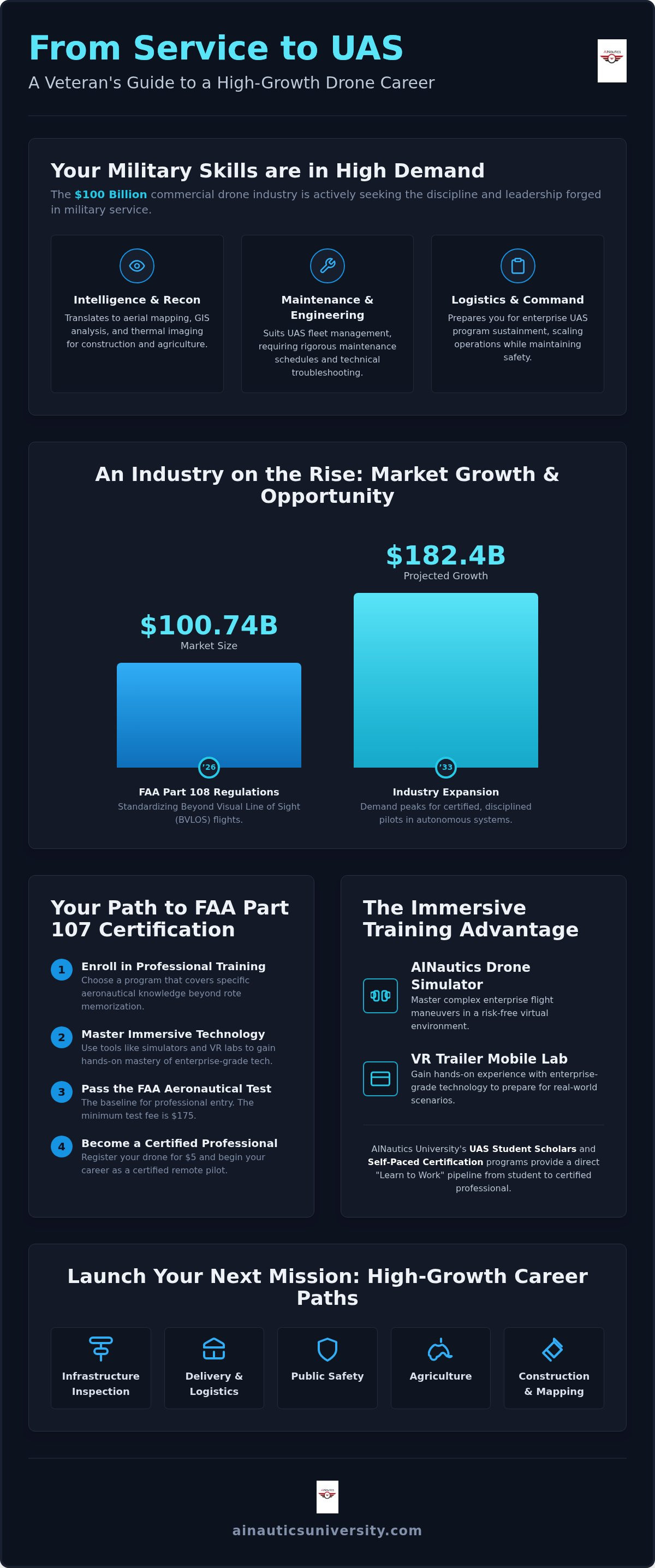
Military roles translate directly to the civilian UAS workforce. The military produces experts in situational awareness and mission planning, which are the foundations of safe flight operations. Consider these specific career mappings:
- Intelligence and Reconnaissance: If you worked in Intel, you're already familiar with gathering and processing data. This translates perfectly to aerial mapping, GIS analysis, and thermal imaging used in construction and agriculture.
- Maintenance and Engineering: Veterans who kept aircraft or ground vehicles running are suited for UAS fleet management. Enterprise-grade drones require rigorous maintenance schedules and technical troubleshooting.
- Logistics and Command: Managing complex movements of people and gear prepares you for enterprise UAS program sustainment. You understand how to scale operations while maintaining safety.
AINautics University facilitates this transition through our UAS Student Scholars program and Self-Paced Certification options. We help you identify which military skills align with specific industry sectors so you can focus your training effectively.
Why 2026 is the Year for Veteran Drone Career Entry
The global drone market is reaching a massive $100.74 billion in 2026. This growth isn't just about more hardware. It's about the regulatory shift toward Part 108. This new framework will standardize Beyond Visual Line of Sight (BVLOS) flights. It moves the industry away from special waivers and toward routine, long-distance operations like automated delivery and pipeline inspection.
The demand for certified, disciplined pilots is peaking right now. AINautics University supports this demand through specialized Part 107 Training. We use immersive tools like our Drone Simulator and VR Trailer Mobile Lab to ensure you aren't just passing a test. You're gaining hands-on mastery of enterprise-grade tech. You're entering a sector projected to grow to $182.4 billion by 2033. This is the ideal time to secure your place in the future of autonomous systems.
Mastering the FAA Part 107 and 2026 Regulatory Landscape
Achieving your commercial license is the baseline for professional entry into the UAS industry. The FAA requires every commercial operator to hold a Remote Pilot Certificate under Part 107. While the minimum out-of-pocket cost is just $180, which includes the $175 test fee and $5 registration fee, the real investment is in your education. High-quality drone training for veterans focuses on more than just rote memorization. It prepares you for the 2026 regulatory shift, where the anticipated Part 108 framework will finally standardize Beyond Visual Line of Sight (BVLOS) operations. Veterans who master these evolving rules now will lead the next generation of autonomous flight units in a market projected to reach over $100 billion this year.
The Path to Your Remote Pilot Certificate
The journey toward a professional career begins with structured preparation. You need a clear roadmap to move from interest to certification.
- Enroll in Professional FAA Part 107 Drone Training. This ensures you cover the specific aeronautical knowledge required by the FAA.
- Master critical topics. You must understand airspace classifications, weather patterns, and emergency procedures to ensure flight safety.
- Schedule your exam. Pass the knowledge test at a certified center to earn your credentials.
Beyond the License: Operational Compliance
A license alone doesn't guarantee a job in the competitive UAS sector. Federal and enterprise contracts require a high standard of operational compliance. You must demonstrate a clean paper trail for insurers and federal regulators. This includes strictly following Remote ID rules enforced since March 16, 2024, and adhering to environmental laws. For instance, understanding the Migratory Bird Treaty Act is vital for wildlife-aware inspection protocols during federal projects. These specialized skills make you a more attractive candidate for drone technology careers for veterans. Mastering these details ensures you are mission-ready for complex operations rather than just being a hobbyist with a certificate. To start building these advanced skills, explore the Part 107 Training programs at AINautics University.
Immersive Training vs. Traditional Learning: VR and Simulation
Traditional classroom environments are no longer sufficient to meet 2026 enterprise drone standards. Sitting in a room looking at slides doesn't prepare a pilot for a sudden motor failure or a 20-knot gust during a cell tower inspection. High-stakes industries require high-fidelity training. This is why effective drone training for veterans has shifted toward simulation and virtual reality. These tools provide a bridge between theory and the flight line. They allow you to fail safely while mastering complex maneuvers that would otherwise risk thousands of dollars in hardware. You gain the confidence to handle emergencies before you ever power up a real aircraft.
The Role of Simulation in Pilot Proficiency
Simulation is the most efficient way to build the muscle memory required for professional operations. The AINautics Drone Simulator places you in hyper-realistic environments where you can practice emergency procedures repeatedly. If you're looking for drone training for beginners, starting on a simulator eliminates the "fear of the crash." This risk-free mastery is crucial for veterans who are used to high-consequence environments but are new to UAS flight controls. You can simulate adverse weather conditions, sensor failures, and loss-of-link scenarios until your response is automatic. This level of preparation significantly reduces hardware costs and insurance premiums for your future business or employer.
Mobile Learning: Bringing the Lab to the Workforce
The AINautics VR Trailer Mobile Lab represents the next step in workforce development. This site-agnostic tool brings immersive drone training technology directly to veteran cohorts. Immersive technology has a profound impact on information retention. Studies in aviation training suggest that VR-based learners often achieve operational confidence faster than those using traditional methods. When you use a mobile lab, you're training in a focused environment designed for technical mastery. Many students discover that VA benefits for drone training make these high-tech programs accessible. By combining mobile labs with specialized drone training for veterans, we ensure you are ready to fly on day one of your new career.
High-Growth Career Paths for Veteran Drone Pilots
The landscape for UAS professionals is shifting rapidly. Veterans are finding that their background in mission-critical operations makes them the preferred choice for complex roles. By exploring the future of drone careers, you'll see a move away from basic aerial shots toward specialized data acquisition. This is where your military discipline pays off. Specialized drone training for veterans prepares you for these technical demands by focusing on precision and safety rather than just basic flight.
Critical Infrastructure and Vertical Inspection
Vertical structure inspection has emerged as a primary revenue driver in the 2026 economy. Telecommunications companies and utility providers require pilots who can inspect cell towers and power lines with extreme accuracy. These roles demand more than just piloting skills. You must be able to integrate captured data into complex Geographic Information Systems (GIS) and asset-management platforms. Veterans excel in this sector because they understand the importance of following standardized reporting procedures and maintaining rigorous safety standards in high-stakes environments.
Public Safety and Emergency Management
Public safety agencies are rapidly expanding their drone units for fire response, law enforcement, and EMS support. Veterans often lead these departments because they possess the composure needed for rapid deployment in disaster zones. The industry is currently transitioning toward autonomous systems in search and rescue operations. This requires pilots who can manage multiple sensors and coordinate with ground teams under pressure. Utilizing tools like our Drone Simulator during your training ensures you're ready for these chaotic, real-world scenarios.
A specialized niche currently exploding in the federal sector is "Wildlife-Aware Inspection." Government contracts often require pilots to follow specific protocols to protect local ecosystems during infrastructure audits. This is a high-demand specialty that many standard training programs overlook. AINautics University integrates these advanced concepts into our curriculum to give you a competitive edge. If you're ready to launch your own unit or join an enterprise team, explore our comprehensive drone training for veterans and start your 90-day career transition today.
Launching Your UAS Career with AINautics University
AINautics University is more than an educational center; it's a Service-Disabled Veteran-Owned Small Business (SDVOSB) built on the foundations of military precision and professional service. We provide a comprehensive "Learn → Train → Certify → Fly → Work" pipeline that addresses every stage of career development. Whether you are a veteran seeking a high-growth career or an educator looking to bring this technology to your school, we provide the resources to bridge the gap between interest and industry-standard operations. Choosing drone training for veterans with a veteran-led institution ensures that your education is grounded in the same discipline you practiced in uniform.
The SDVOSB Advantage for Veteran Students
Training with a veteran-owned firm provides immediate credibility when bidding on federal contracts or seeking enterprise roles. AINautics University is a registered SDVOSB (CAGE Code 9KQH0UEI), which is a significant asset in the commercial sector where clients value the reliability and standards that veterans represent. Mentorship from Chief Pilot Taz Little and our leadership team ensures your training is rooted in practical application rather than academic theory. This connection to an established, nationwide network of FAA-compliant pilots provides a professional safety net as you launch your own flight operations. You aren't just a student; you are joining a community of professionals committed to technical mastery and operational safety.
Expanding the Impact: For Educators and the Workforce
Our Train-the-Teacher Program is specifically designed for educators who want to implement high-quality UAS curricula within their school districts. This program empowers schools to build internal drone programs using the same rigorous standards found in the commercial sector, ensuring students are workforce-ready upon graduation. For those ready to enter the industry immediately, the iFlyDrone marketplace connects certified pilots with verified job opportunities across the country. We also support the families of those who served through our UAS student scholar program, providing a clear trajectory into the high-tech economy for the next generation.
For veteran entrepreneurs, our "Launch a Drone Program in 90 Days" model provides the turnkey framework needed to move from initial planning to live flight operations. This model includes everything from insurance guidance to mission-planning support, allowing you to establish a professional unit quickly. By combining specialized Self-Paced Certification with ongoing curriculum updates and workforce guidance, AINautics University ensures that whether you are flying missions or teaching the next generation, you have the backing of a visionary mentor and a reliable industry expert.
Take Command of Your Future in the Skies
The transition from military service to a civilian career is a strategic maneuver that requires the right tools and mentorship. You've seen how your background in mission planning and situational awareness translates into a competitive advantage in the $100 billion UAS industry. By choosing specialized drone training for veterans, you aren't just earning a certificate. You're building a foundation for a role in critical infrastructure, public safety, or federal contracting. The 2026 landscape is shifting toward complex, long-distance operations. Your disciplined approach is exactly what the market demands.
As a Service-Disabled Veteran-Owned Small Business, AINautics University is committed to your success through our workforce-ready curriculum and nationwide pilot marketplace. We provide the immersive simulation and veteran-led guidance necessary to move from certification to a paycheck with confidence. It's time to apply your expertise to a new field that offers both purpose and professional growth. Start your new mission with AINautics University today and lead the way in the next generation of autonomous flight. The horizon is open. Your skills are ready for takeoff.
Frequently Asked Questions
Can I use the GI Bill for drone training at AINautics University?
AINautics University is a Service-Disabled Veteran-Owned Small Business (SDVOSB) registered with CAGE Code 9KQH0UEI. Veterans and their families should verify specific Post 9/11 GI Bill eligibility with the VA for our specialized programs. Our status as a federal contractor ensures that our drone training for veterans meets the rigorous standards required for professional career transitions. We focus on providing a clear roadmap for families looking to enter the high-growth UAS economy with confidence.
How long does it take to obtain a Part 107 drone license?
Most students and veterans complete their initial training and pass the FAA Knowledge Test within four to six weeks. Our Self-Paced Certification options are designed to accommodate busy schedules, whether you are a full-time student or transitioning out of the military. For school districts, we facilitate a rapid rollout that moves from planning to live flight operations in three months, ensuring that academic programs remain on track with seasonal semester goals.
How can schools implement a drone program for their students?
Educators can utilize our Train-the-Teacher Program to bring professional-grade UAS instruction into the classroom. This initiative provides teachers with the certification and curriculum needed to guide students through the complexities of autonomous systems. By aligning with state and district standards, we help schools establish a "Launch a Drone Program in 90 Days" framework. This ensures that educators are not just teaching theory but are preparing the next generation for high-tech workforce roles.
Is the FAA Part 107 exam difficult for students without aviation experience?
The exam is technical but accessible when using the right educational tools. We simplify complex topics like airspace classifications and weather patterns through the Drone Simulator and immersive VR Trailer Mobile Lab. These resources are specifically tailored to help students and veterans visualize aeronautical concepts without needing prior aviation experience. This hands-on approach ensures that the learning process is informative and supportive rather than purely academic or overwhelming.
What equipment do I need to start drone training for veterans or students?
You do not need to purchase expensive hardware to begin your educational journey. Our programs emphasize simulation and virtual reality to build muscle memory and operational confidence before you ever handle a physical aircraft. This risk-free environment allows students to master complex maneuvers without the fear of hardware damage. Once you have achieved certification, our instructors provide guidance on selecting the right enterprise-grade technology for your specific career path or school program.
What is the "Wildlife-Aware" inspection certification and why does it matter?
Wildlife-Aware inspection is a specialized protocol that ensures compliance with the Migratory Bird Treaty Act during aerial audits. This is vital for projects involving vertical structures like cell towers that may house protected nests. AINautics University provides the training to perform these assessments and attach the necessary documentation to your reports. For students and veterans, this certification provides a major competitive advantage when bidding on federal contracts that require a documented "clean paper trail."
How does AINautics University support career placement after certification?
We provide a direct pipeline to employment through the iFlyDrone workforce marketplace. Once certified, pilots can join this nationwide network to find commercial opportunities in fields like infrastructure and agriculture. For younger learners, the UAS Student Scholars program offers a structured pathway from high school to professional certification. This ecosystem ensures that every student has access to ongoing workforce guidance and the latest curriculum updates to maintain a competitive edge.
What is the benefit of training with an SDVOSB-certified institution?
Training with an SDVOSB like AINautics University provides immediate professional credibility. It signals to enterprise clients and federal agencies that your education meets the most rigorous industry requirements and safety standards. You receive direct mentorship from veteran leaders who understand the importance of discipline and mission planning. This authoritative environment prepares you for the high-stakes demands of the commercial sector, ensuring you are ready to lead in the evolving world of autonomous systems.

Article by
AINautics University Team
The team behind AINautics University, dedicated to drone education and FAA Part 107 certification prep, VR flight simulation, and STEM training programs for students and educators.


