
Did you know that top-tier drone pilots in the aerospace and defense sectors are commanding salaries exceeding $215,000 in 2026? While that figure represents the peak of the industry, it highlights a massive gap between basic operators and specialized professionals. You're likely asking, how much do drone pilots make in the current market, especially if you're just starting out. It's common to feel confused by conflicting salary reports or worried that the field is becoming oversaturated.
The reality is that the demand for skilled pilots is higher than ever, but the rewards are shifting toward those with technical mastery. This guide provides the latest salary data and shows you how to maximize your income through specialized training. Whether you're exploring our Part 107 Training or practicing on a Drone Simulator, the path to a high-paying career is clearer than you think. We'll break down the best-paying industries like utilities and surveying, explain how upcoming Part 108 regulations change the game, and provide actionable steps to future-proof your career in the UAS industry.
Key Takeaways
- Identify the high-growth industries like energy and infrastructure where specialized pilots command the highest annual salaries.
- Gain a realistic understanding of how much do drone pilots make based on their years of experience and technical expertise.
- Discover why foundational Part 107 Training is just the first step toward high-earning potential in enterprise-level roles.
- Learn how immersive tools like a Drone Simulator and the VR Trailer Mobile Lab provide the hands-on mastery required for complex missions.
- Understand the "Learn to Work" pipeline that connects students to professional opportunities through programs like UAS Student Scholars.
The 2026 Drone Pilot Salary Landscape: Benchmarks and Trends
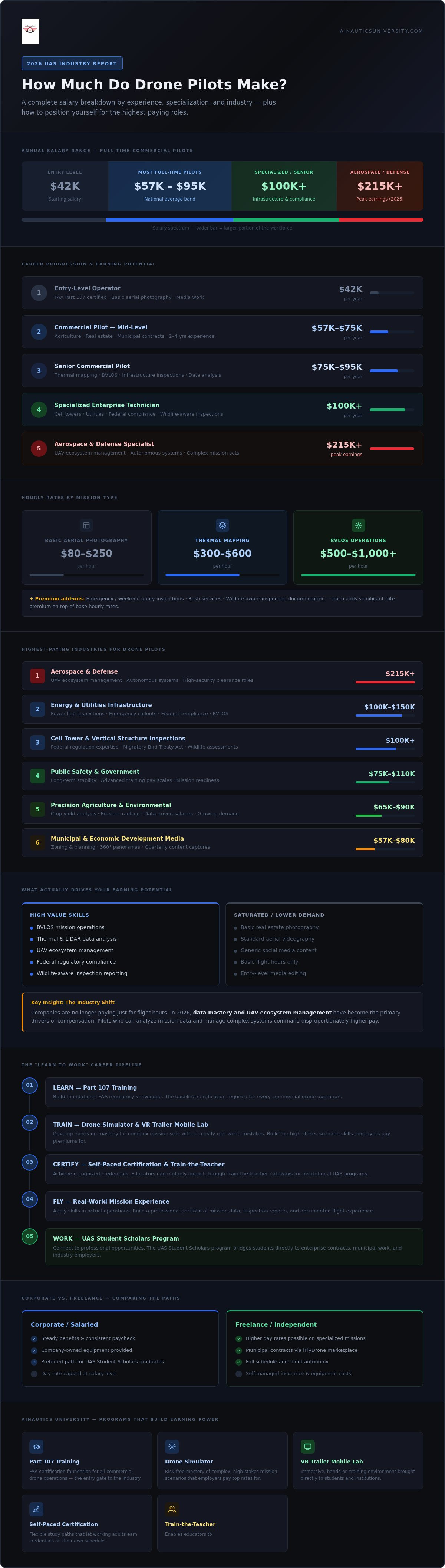
The drone industry has reached a significant maturity point in 2026. What was once a niche hobby has transformed into a critical component of the global economy. If you are researching how much do drone pilots make, you'll find that the answer depends heavily on your technical proficiency. National salary data indicates that most full-time commercial pilots now earn between $57,000 and $95,000 annually. While entry-level positions typically start near $42,000, senior pilots with specialized skills in sectors like aerospace and defense can command salaries exceeding $215,000.
This year represents a turning point for autonomous systems compensation. The industry is moving away from basic flight hours as the primary metric for value. Instead, companies are paying for data mastery and the ability to manage complex Unmanned Aerial Vehicle (UAV) ecosystems. There is a widening gap between entry-level media roles, which often face market saturation, and enterprise UAS technicians who handle industrial inspections. The UAS workforce market is projected to grow substantially over the next five years, creating a high demand for pilots who understand the "Learn, Train, Certify, Fly, Work" pipeline.
Salary vs. Freelance: Which Path Pays Better?
Choosing between a corporate role and a freelance career is a major decision for any new pilot. Corporate positions provide steady benefits, consistent paychecks, and access to company-owned equipment. This path is often preferred by those coming through the UAS Student Scholars program who want immediate stability. On the other hand, freelance operators can charge higher day rates but must manage their own insurance and equipment maintenance. To help bridge this gap, the iFlyDrone marketplace connects certified pilots with municipal contracts and enterprise work, making it easier for independent operators to maintain a steady workflow without traditional marketing overhead.
Hourly Rates for Specialized Mission Sets
Hourly earnings vary based on the complexity of the mission. While basic aerial photography typically ranges from $80 to $250 per hour, specialized missions command a much higher premium. Pilots who can perform thermal mapping or Beyond Visual Line of Sight (BVLOS) operations are in the highest demand. These missions require advanced skills that many students first develop using a Drone Simulator. When you add in factors like rush services or emergency weekend call-outs for utility inspections, the question of how much do drone pilots make becomes even more promising. Mastery of these high-stakes scenarios is exactly what our Part 107 Training prepares you for, ensuring you're ready for the most lucrative opportunities in the field.
High-Growth Industries: Where Drone Pilots Earn the Most
Specialization is the primary driver of income in 2026. When people ask how much do drone pilots make, they often overlook high-compliance niches. Infrastructure and vertical structure inspections offer a potential for earnings over $100,000 because they require technical mastery. Public safety roles and government positions provide long-term stability and specialized pay scales that reward advanced training and readiness.
Precision agriculture and environmental monitoring have become staples of the modern workforce. Pilots in these fields don't just fly; they analyze data to improve crop yields or track erosion. Understanding how much do drone pilots make in these sectors reveals a shift toward data-driven salaries. The rise of 'Wildlife-Aware' inspections has also created a new premium for pilots who understand regulatory compliance beyond the basic flight rules.
Critical Infrastructure and Federal Compliance
Cell tower inspections are a high-stakes environment. Success here requires more than just stick skills. You must understand federal regulations, specifically the Migratory Bird Treaty Act, during vertical inspections. Nesting birds can delay multi-million dollar projects. Pilots who provide documented wildlife assessments within their inspection reports offer a value-add that justifies higher rates. This expertise is why specialized FAA remote pilot certification is the baseline for these enterprise roles.
Aerial Media and Storytelling for Economic Development
The media sector has evolved far beyond basic real estate photography. There's a massive demand for county-level communication partnerships. Municipalities use drone data for planning, zoning, and economic development storytelling. These projects often require quarterly content captures that integrate 360-degree panoramas and ground-camera footage. This comprehensive approach creates a stronger relationship with clients and leads to recurring revenue. Students in our UAS Student Scholars program often start by exploring these diverse industries to find their niche. If you're ready to build these high-value skills, explore the career-ready programs at AINautics University.
Education and Certification: The Foundation of Earning Potential
The FAA Part 107 Remote Pilot Certificate is the legal baseline for any commercial operation. However, holding the license doesn't automatically guarantee a high income. When evaluating how much do drone pilots make, the data shows a clear correlation between advanced education and six-figure salary offers. Enterprise UAS programs aren't just looking for pilots who passed a test; they're looking for professionals who can plan missions, manage risk, and ensure operational safety. Workforce-ready training is what separates a hobbyist from a high-earning technician.
Mastering Part 107 and Beyond
Moving beyond simple test preparation is essential for professional growth. Real-world flight operations involve complex variables that a multiple-choice exam cannot fully cover. Mission-driven instruction prepares you for the high-stakes environments found in industrial inspections or search and rescue. For those ready to start this journey, our Professional FAA Part 107 Drone Training Guide provides a comprehensive roadmap for 2026. This level of preparation ensures you're capable of handling the mission planning and data security protocols that enterprise clients demand.
Self-Paced Certification for Career Transitioners
Many high-earning pilots transition from other industries like construction, engineering, or public safety. Our Self-Paced Certification options allow these professionals to build a UAS portfolio while maintaining their current employment. This flexibility is vital for those looking to pivot into a more lucrative field without financial disruption. For younger individuals, the UAS Student Scholars program offers an early career entry point, providing the foundational skills needed to enter the workforce with confidence.
The industry landscape is shifting again with the anticipated finalization of Part 108 regulations in late 2026. This new framework will standardize Beyond Visual Line of Sight (BVLOS) operations, which are crucial for large-scale inspections and delivery. Certification in these advanced flight modes will be a major factor in how much do drone pilots make in the coming years. Preparing for these rules now through specialized training creates a significant competitive advantage. It positions you as a future-ready expert in an increasingly autonomous economy.
Leveraging Immersive Tech to Boost Your Market Value
Mastering UAS operations in 2026 requires more than just field practice. Immersive technology has become a cornerstone of professional development, directly influencing how much do drone pilots make. By using advanced simulators and virtual reality, pilots can encounter years worth of flight challenges in a matter of weeks. This accelerated learning path reduces the overhead costs of training and ensures that every mission is flown with precision. Employers today prioritize candidates who have already faced high-stress scenarios in a controlled digital environment.
Scenario-based training significantly improves pilot safety records. This leads to lower insurance rates for independent operators and higher trust from enterprise clients. When you can prove your proficiency with data-backed reports from a simulator, your market value increases immediately. This technology effectively eliminates the traditional on-the-job learning curve. It allows you to enter the workforce as a seasoned professional rather than a novice operator, which is a major factor in determining how much do drone pilots make at the start of their careers.
The AINautics Drone Simulator Advantage
Our Drone Simulator provides a risk-free environment to master complex maneuvers. Whether you're practicing emergency procedures or precision inspections, digital mastery translates directly to real-world success. You can find more details on how these tools are shaping the future of UAS education. This technology allows you to perfect your skills before ever touching a physical controller on a high-stakes job site. High-paying clients in the energy and infrastructure sectors value this level of preparation because it minimizes the risk of equipment damage and project delays.
Mobile Labs and On-Demand Mastery
The VR Trailer Mobile Lab brings high-tech training directly to schools and corporate offices. It serves as a mobile hub for workforce development, ensuring that students and professionals nationwide have access to the latest immersive tech. This approach bridges the gap between classroom theory and field application, preparing the next generation for the complexities of autonomous systems. By integrating these tools into the learning process, we ensure that every pilot is ready for the technical demands of the modern workforce. Ready to increase your earning potential? Explore our immersive training programs today and start building your UAS portfolio.
- Accelerate skill acquisition through realistic flight scenarios.
- Reduce training costs by failing safely in a digital environment.
- Provide proof of proficiency to potential enterprise employers.
- Lower insurance premiums through documented safety training.
Navigating the Career Pipeline: From Student to Professional
Success in the UAS industry isn't just about passing a test; it's about following a structured "Learn, Train, Certify, Fly, Work" ecosystem. This pipeline ensures that every step of your journey is geared toward professional application. When students and parents ask how much do drone pilots make, they're often surprised to find that the journey can begin as early as middle school. Early exposure through K-12 drone programs builds the spatial awareness and technical baseline required for high-earning roles in adulthood. By the time these students reach the workforce, they possess a level of flight mastery that puts them years ahead of their peers.
For those already in the workforce, the transition involves moving from basic certification to securing recurring contracts. High-value pilots don't just fly one-off missions. They establish quarterly and annual partnerships with clients in energy, construction, and municipal planning. This consistent workflow provides the financial stability that elevates a pilot's annual income into the top brackets of the industry. Securing these partnerships requires a professional approach to mission planning and data security that is central to our training philosophy.
Train-the-Teacher: Educating the Educators
School districts nationwide are facing a critical shortage of qualified UAS instructors. Teachers who complete our Train-the-Teacher Program become invaluable assets to their institutions. By mastering the UAS curriculum, these educators bridge the gap between STEM standards and career readiness. This specialization often leads to supplemental income and leadership roles within career and technical education (CTE) departments. You can explore more about these evolving roles and the Future of Drone Careers: 2026 Industry Outlook to see how educational leadership impacts the wider workforce.
The iFlyDrone Workforce Marketplace
The final stage of the career pipeline is the transition into active commercial work. The iFlyDrone workforce marketplace provides a turnkey model for certified pilots to find immediate opportunities. Instead of spending months building a client list from scratch, pilots can access a nationwide network of municipal and enterprise contracts. This platform handles the logistics of connecting talent with demand, allowing you to focus on flight operations and data collection.
To truly maximize how much do drone pilots make, you must learn to integrate flight data into GIS and asset-management systems. This turns a simple photo into a high-value digital asset for the client. Our UAS Student Scholars and adult learners use these tools to eliminate the friction between receiving a certification and completing their first commercial flight. By focusing on sophisticated data delivery, you move from being a drone operator to a critical technical partner for your clients.
Your Path to Professional UAS Mastery
The question of how much do drone pilots make is no longer about flight hours alone; it's about technical mastery and industry specialization. In 2026, the shift toward enterprise-level data collection offers significant financial rewards for those who look beyond basic certification. By focusing on high-compliance sectors and leveraging immersive tools like the Drone Simulator, you can bypass entry-level saturation and secure a position in the industry's top earning brackets.
As a Service-Disabled Veteran-Owned Small Business, AINautics University is committed to building a future-ready workforce through our STEM-aligned curriculum and nationwide iFlyDrone marketplace. Whether you're a student exploring the UAS Student Scholars program or a professional seeking Self-Paced Certification, the path to a lucrative career is clear. Your expertise is the bridge to the technological demands of the future. Take the first step toward your new professional reality today.
Start your journey to a high-paying drone career at AINautics University
Frequently Asked Questions
Do I need a college degree to make a high salary as a drone pilot?
You don't need a four-year degree to secure a lucrative position in the UAS industry. Employers prioritize FAA certification, technical mastery, and mission-specific experience over traditional diplomas. By completing professional Part 107 Training and mastering specialized sensors, you can demonstrate the same level of expertise as degree holders. Many high-earning pilots transition from other trades by focusing on workforce-ready skills that translate directly to industrial and government contracts.
How much do entry-level drone pilots make in their first year?
Entry-level drone pilots typically earn around $42,000 during their first year of commercial operation. This figure often reflects roles in aerial photography or basic site monitoring. To increase this starting point, many new pilots utilize the AINautics University "Learn to Work" pipeline. Gaining hands-on experience through the UAS Student Scholars program or practicing complex maneuvers on a Drone Simulator can help you qualify for higher-paying enterprise roles much sooner.
What is the highest-paying industry for drone pilots in 2026?
The aerospace and defense sector remains the highest-paying industry, with some specialized roles commanding salaries over $215,000. For most commercial pilots, the best opportunities are in utilities, energy, and infrastructure inspections, where pay ranges from $80,000 to $100,000. These fields value technical precision and regulatory compliance. Understanding how much do drone pilots make in these sectors highlights the importance of moving beyond basic flight into data-driven industrial applications.
How does having a Part 107 license affect my earning potential?
An FAA Part 107 license is the mandatory legal requirement for any commercial drone work in the United States. Without it, your earning potential is zero. Once certified, you gain access to a market where the average salary ranges from $57,000 to $95,000. AINautics University provides comprehensive Part 107 Training that focuses on operational safety. This foundational step is what allows you to join professional marketplaces and bid on high-value government contracts.
Can I make a full-time living as a freelance drone pilot?
You can certainly make a full-time living as a freelance pilot by securing recurring contracts and using professional marketplaces. Freelance rates typically range from $80 to $250 per hour depending on the mission's complexity. Platforms like the iFlyDrone marketplace help independent operators find steady work with municipalities and corporate clients. Success as a freelancer requires managing your own insurance and equipment while maintaining a high standard of documented safety and compliance.
What specialized skills are currently in highest demand for UAS pilots?
The highest demand is for pilots who can process and interpret complex data rather than just capture images. Skills in thermal imaging, LiDAR mapping, and photogrammetry are essential for high-paying roles in construction and energy. Additionally, mastery of Beyond Visual Line of Sight (BVLOS) operations under upcoming Part 108 rules is becoming a major differentiator. Using tools like the VR Trailer Mobile Lab helps pilots develop these immersive technical skills in a controlled environment.
How much more do drone pilots with thermal or LiDAR certification earn?
Pilots with thermal or LiDAR certifications often earn significantly more, with annual salaries frequently exceeding $95,000. These specialized sensors are critical for inspecting power lines, pipelines, and cell towers. When you combine these technical skills with niche expertise, such as wildlife-aware inspections that follow the Migratory Bird Treaty Act, you become a premium asset. This level of specialization is a primary factor in how much do drone pilots make at the enterprise level.
Is the drone pilot market too crowded to make a good living?
The market for basic aerial photography is competitive, but the enterprise and industrial sectors are far from oversaturated. There is a growing need for qualified pilots in public safety, infrastructure, and education. Programs like the 90-day launch for schools are creating new career pathways for the next generation. By focusing on advanced certifications and mission-driven instruction, you can carve out a stable and profitable career in a high-demand technological field.

Article by
AINautics University Team
The team behind AINautics University, dedicated to drone education and FAA Part 107 certification prep, VR flight simulation, and STEM training programs for students and educators.


