
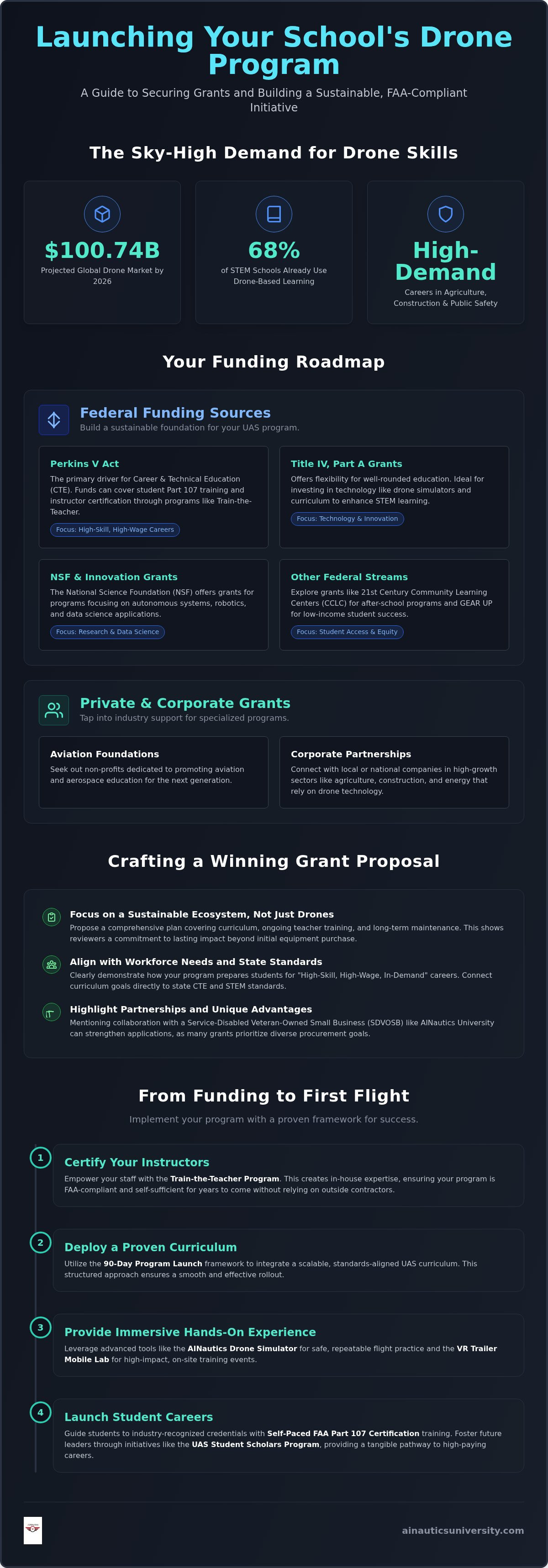
Did you know that 68% of STEM schools have already integrated drone-based learning into their classrooms? As the global drone market is projected to reach $100.74 billion by 2026, the pressure to prepare students for high-demand careers in aviation and data analysis has never been higher. You likely recognize the immense value of this technology, yet you're facing the reality of limited school budgets and the confusion of FAA Part 107 compliance for minors. It's frustrating to see a lack of certified teachers stall a program before it even starts.
This article provides the roadmap you need to secure drone program grants for schools and build a sustainable, FAA-compliant initiative. We'll show you how to access federal Perkins V funding and private 2026 grants to cover everything from equipment to teacher training. You'll gain a clear path to certification through our Train-the-Teacher Program and discover how resources like the AINautics Drone Simulator create a professional learning environment. From 2026 grant deadlines to a curriculum framework that scales, you're about to learn how to turn a vision for flight into a classroom reality.
Key Takeaways
- Identify federal funding streams like Perkins V and Title IV Part A that prioritize workforce-ready STEM skills for the 2026 academic year.
- Master the art of drafting professional proposals for drone program grants for schools by aligning your project with specific state standards and student outcomes.
- Explore private funding avenues through aviation foundations and corporate partnerships in high-growth industries like agriculture and construction.
- Build a sustainable model using the AINautics 90-Day Program Launch framework to ensure long-term curriculum success and teacher certification.
- Leverage immersive tools like the VR Trailer Mobile Lab and Drone Simulator to provide students with high-impact, hands-on flight experience.
Navigating the 2026 Landscape of Drone Program Grants for Schools
Securing drone program grants for schools involves more than just buying hardware. These specialized funding streams are designed to support a comprehensive ecosystem that includes Unmanned Aircraft Systems (UAS) curriculum, flight training, and instructor certification. In 2026, the focus of educational funding has shifted. Grantors are no longer looking for simple technology demonstrations. They want to see programs that produce workforce-ready graduates capable of entering a global market projected to reach $100.74 billion this year.
Success in this arena requires understanding three primary funding buckets: federal, state, and private or corporate. Each source has its own set of priorities. Federal funds often target workforce development, while private grants might focus on local community impact or specific industry needs. To build a compelling case, educators must explain the future of drone careers. Highlighting roles in infrastructure inspection, agriculture, and public safety transforms a "drone club" request into a vital career pathway proposal.
Why Schools are Prioritizing UAS Education Now
The demand for certified drone pilots is outpacing the current supply. Industries like construction now see 67% adoption of drone technology for site surveying. This creates a significant gap in the autonomous systems workforce. Schools are stepping in to fill this void by using drones as a powerful hook for broader engagement in educational technology and robotics. Beyond engagement, these programs help districts meet state-mandated Career and Technical Education (CTE) goals. By offering a direct path to FAA Part 107 certification, schools provide students with a tangible, high-paying skill set before they even graduate high school.
Common Funding Barriers and How to Overcome Them
Many districts struggle with the "one-and-done" funding trap. They secure a grant for a fleet of drones but lack the resources for long-term maintenance or teacher training. You can overcome this by requesting funds for a sustainable curriculum rather than just equipment. Partnering with a Service-Disabled Veteran-Owned Small Business (SDVOSB) like AINautics University can also strengthen your application. Many grants prioritize diversity and veteran-owned procurement goals. Don't overlook hidden funds either. General STEM or technology budgets often have room for innovative tools like the AINautics Drone Simulator or the Train-the-Teacher Program. These resources ensure your program remains operational and FAA-compliant for years to come, making your drone program grants for schools application much more attractive to reviewers.
Primary Federal Funding Sources for Drone Education
Federal funding provides the most reliable foundation for long-term UAS programs. These grants aren't just for equipment. They're designed to build sustainable pathways that lead directly to careers. The most common drone program grants for schools come from established Department of Education and FAA initiatives. These include the 21st Century Community Learning Centers (CCLC) for after-school programs and GEAR UP grants, which focus on increasing the success of low-income and underrepresented students in high-growth fields like aviation. Title IV, Part A grants also offer flexibility, allowing districts to invest in well-rounded education and the effective use of technology.
Maximizing Perkins V Funding for UAS Pathways
The Perkins V Act is a primary driver for Career and Technical Education (CTE). To access these funds, you must demonstrate that your drone program meets "High-Skill, High-Wage, and In-Demand" criteria. Drone technology fits this perfectly. You can use these funds to cover Part 107 drone training for students. It's also smart to budget for instructor certifications using Train-the-Teacher models. This ensures your staff can lead the program without relying on outside contractors every year. Aligning your curriculum with these workforce standards makes your grant application much more competitive.
STEM and Innovative Technology Grants
Beyond CTE-specific funds, schools can tap into broader innovation grants. The National Science Foundation (NSF) offers opportunities for programs focused on autonomous systems and data science. The Department of Education’s Education Innovation and Research (EIR) program supports the field-testing and scaling of tech-driven models. Additionally, the FAA Aviation Workforce Development Grants are specifically tailored to prepare the next generation of pilots and UAS operators. These grants are highly sought after because they directly address the pilot shortage in the United States.
State-level "Innovation Zone" funds also prioritize immersive technology. These grants often favor programs that integrate advanced tools like the VR Trailer Mobile Lab or the AINautics Drone Simulator. Using these resources makes your application stand out. It shows a commitment to industry-standard training rather than just hobbyist flight. If you're looking for a partner to help align your curriculum with these federal requirements, exploring the AINautics University 90-Day Program Launch framework is an excellent next step. This methodology ensures your program remains compliant while meeting the rigorous demands of federal grantors.
Securing Private and Corporate Grants for Aviation
While federal funds provide a steady foundation, private and corporate drone program grants for schools offer unique flexibility and localized impact. These organizations often move faster than government agencies and are deeply invested in building a specific talent pipeline. Industry leaders in telecommunications, agriculture, and construction are currently the most active donors. They recognize that today's students are the future workforce who will manage their autonomous fleets. Aviation-specific foundations, such as the Aircraft Owners and Pilots Association (AOPA) and the Experimental Aircraft Association (EAA), also provide dedicated support for programs that introduce youth to flight careers.
Tech giants like Google, Amazon, and Microsoft frequently offer grants specifically for rural and underserved STEM programs. These companies aim to bridge the digital divide by funding innovative technology initiatives. To prove your school has a ready and eager student body, you can leverage the UAS scholarship for high school students as a benchmark for student interest and commitment. Demonstrating that your students are already pursuing these pathways makes your school a much lower risk for corporate donors.
The Role of Corporate Social Responsibility (CSR)
Corporate Social Responsibility is a strategic priority for many local utility and infrastructure companies. They use drones for power line inspections and progress monitoring; therefore, they have a vested interest in your students' success. When you pitch your school, position it as a regional "Workforce Development Hub." This shifts the conversation from a request for a donation to a strategic investment in the local economy. Partnering with AUVSI members can help you identify donors who are looking for industry-aligned programs. Including professional tools like the AINautics Drone Simulator in your proposal shows these donors that you're serious about providing high-fidelity, professional-grade training.
Writing for Private Foundations
Success with private foundations requires a narrative shift. Instead of focusing on the hardware, focus on the human impact. You aren't just "buying drones." You're empowering future pilots and data analysts. Foundations are particularly interested in how your program supports underrepresented groups in aviation. Use drone training for beginners as a scalable entry point to show foundations how you will grow the program over time. To ensure long-term sustainability, include the Train-the-Teacher Program in your grant budget. This proves to the foundation that their investment won't vanish if a single staff member leaves, as you'll have a certified, internal team ready to lead the UAS Student Scholars toward their Part 107 certification.
How to Write a Winning Grant Proposal for a Drone Program
Writing a successful proposal for drone program grants for schools requires moving beyond a simple list of hardware. Reviewers want to see a strategic vision that integrates into the school's existing educational goals. Start by conducting a thorough needs assessment. This should identify the specific workforce gaps in your local area and how a UAS program will fill them. If your region has a strong construction or agriculture sector, explain how drone pilots will support those industries. This local relevance makes your application stand out to both federal and private donors.
Your proposal must define measurable outcomes with precision. Instead of saying students will "learn about drones," state exactly how many students will sit for the FAA Part 107 exam and what percentage you expect to pass. A detailed budget is equally critical. It should cover the entire ecosystem: curriculum, teacher training, and flight simulation. Finally, address FAA compliance and safety protocols explicitly. Showing that you have a plan for drone registration, insurance, and air traffic coordination proves your program is professional, organized, and low-risk.
Aligning with State and District Standards
Grantors prioritize programs that reinforce core academic subjects. You can strengthen your application by mapping UAS skills to existing math, science, and physics standards. For example, calculating flight paths involves geometry, while understanding lift and drag relates directly to physics. Utilizing a pre-vetted drone curriculum for educators allows you to present a ready-made instructional plan. This ensures your program meets Career and Technical Education (CTE) "Program of Study" requirements, making it eligible for a wider range of state and federal funds.
Demonstrating Long-Term Program Sustainability
Sustainability is the most scrutinized part of any grant application. You must prove that operations will continue after the initial funding is spent. One of the most effective ways to do this is through a "Train-the-Teacher" model. By certifying your own staff, you eliminate the need for expensive external contractors. Additionally, integrating immersive drone training technology like high-fidelity simulators can significantly lower recurring costs. Simulators allow students to master flight maneuvers in a risk-free environment. This reduces the frequency of hardware repairs and keeps your fleet in the air longer.
A clear roadmap is the final piece of the puzzle. Using a structured framework like the AINautics 90-Day Program Launch methodology demonstrates to grantors that you have a proven path to implementation. This roadmap ensures your program is up and running quickly, safely, and with a focus on student certification from day one. It transforms your proposal from a hopeful request into a professional, actionable plan that promises a high return on investment for the grantor.
Implementing Your Funded Program with AINautics University
Securing drone program grants for schools is a major milestone, but the true impact begins during the implementation phase. AINautics University provides a structured 90-Day Program Launch framework designed to help school districts move from a funded proposal to an active, FAA-compliant classroom. This methodology ensures your program isn't just a collection of hardware, but a fully integrated career pathway that meets state and district standards. By following a proven roadmap, you can avoid common startup pitfalls and focus on student achievement from day one.
Execution requires the right tools to bridge the gap between theory and flight. Immersive resources like the VR Trailer Mobile Lab provide students with high-impact, hands-on learning that simulates complex real-world environments. To maximize safety and minimize equipment damage, schools deploy the AINautics Drone Simulator. This tool allows students to log critical flight hours in a controlled setting before they ever touch a physical aircraft. For students seeking to go beyond basic operations, the UAS Student Scholars program offers a path to advanced specialization and industry recognition, ensuring they are prepared for the technological demands of the future.
Teacher Empowerment: The Train-the-Teacher Program
Successful programs start with confident, certified educators. Our Train-the-Teacher Program prepares your staff for the FAA Part 107 exam using professional-grade resources and guided instruction. We don't just help them pass the test. We provide ongoing instructor support and regular curriculum updates to keep pace with evolving aviation regulations. This model builds a sustainable community of UAS Teacher Scholars across your district. It ensures your program remains self-sufficient and reduces the long-term costs associated with hiring external consultants or contractors.
Scalable Certifications and Career Readiness
Flexibility is essential in a busy school environment. AINautics provides Self-Paced Certification modules that fit into any student's schedule, whether in a traditional classroom or a remote setting. These modules use scenario-based training to prepare students for real-world missions, such as thermal imaging or precision agriculture. Once students earn their Part 107 certificate, we help them bridge the gap to employment. By connecting certified students to the iFlyDrone workforce marketplace, we ensure that their education leads directly to professional opportunities. This full-circle approach proves to grantors that your program is a high-value investment in the future of the autonomous systems workforce.
Launching the Next Generation of Aviation Leaders
The path to a successful Unmanned Aircraft Systems initiative is now clearer than ever. By identifying federal Perkins V streams and private corporate partnerships, your district can overcome budget barriers and build a high-impact learning environment. Success requires shifting from simple equipment purchases to a sustainable, curriculum-first model that prioritizes student certification. Securing drone program grants for schools is the first step toward preparing students for a global market that demands professional, FAA-compliant pilots.
As a mission-driven SDVOSB and AUVSI member, AINautics University is your dedicated partner in this journey. We provide a STEM-aligned curriculum supported by nationwide mobile lab and simulator technology. Our framework ensures your educators are empowered and your students are workforce-ready. Don't let the complexity of regulations or funding stall your progress. You have the tools and the roadmap to transform your classroom into a hub of innovation. Launch your school's drone program in 90 days with AINautics University and give your students the competitive edge they deserve. The future of flight is waiting for them.
Frequently Asked Questions
Can middle schools apply for drone program grants, or are they only for high schools?
Middle schools are eligible for many drone program grants for schools, especially those focused on STEM and robotics engagement. While high schools often target workforce certification, middle school programs prioritize building foundational skills and interest in aviation. Funding sources like Title IV, Part A and private corporate grants frequently support middle school initiatives to create a pipeline for future Career and Technical Education pathways. These programs often serve as the hook for advanced learning.
Do drone grants cover the cost of FAA Part 107 exam fees for students?
Many federal and private grants specifically allow for student certification costs. Programs like Perkins V and the Elevate Scholarship are designed to remove financial barriers to entry for students aged 16 to 24. When drafting your proposal, you should include the $175 FAA knowledge test fee as a specific line item. Integrating these costs ensures your students can transition from the classroom to the workforce with their professional credentials fully funded.
What is the most common reason drone grant applications are rejected?
The most frequent reason for rejection is a lack of a clear sustainability plan. Grantors want to see that the program will continue after the initial funding is spent. Applications that only request hardware without mentioning curriculum, teacher training, or safety protocols often fail. Using a structured framework like the AINautics 90-Day Program Launch proves to reviewers that you have a professional, long-term implementation strategy in place for your district.
Are there specific grants for rural school districts to start UAS programs?
Rural school districts can access specialized funding through USDA Distance Learning and Telemedicine grants and tech giant initiatives. Companies like Google and Amazon often prioritize rural areas to bridge the digital divide. These drone program grants for schools frequently support immersive technology that brings advanced aviation training to remote locations. Highlighting your district's unique geographic needs and workforce gaps can make your application highly competitive for these specific rural funding opportunities.
How do I prove the 'sustainability' of a drone program in a grant proposal?
Sustainability is proven by showing you have internal expertise and a recurring curriculum. Instead of relying on outside contractors, you should propose a Train-the-Teacher Program to certify your own staff as Part 107 pilots. This ensures the program remains operational year after year. Additionally, including tools like the AINautics Drone Simulator reduces long-term costs by allowing students to master flight skills in a risk-free environment before they ever use physical hardware.
Can grant funds be used for teacher professional development and certification?
Teacher professional development is a primary fundable component of most educational grants. Federal streams like Title II and Perkins V actively encourage using funds to upskill educators in high-demand fields like autonomous systems. Investing in a Train-the-Teacher model ensures your instructors are legally compliant and confident in leading the classroom. This approach transforms a one-time technology purchase into a lasting educational asset that benefits multiple cohorts of students over several years.
Do I need to have a drone pilot license before applying for a grant?
You don't need a pilot license to apply, but you must demonstrate a clear plan to obtain one. Grantors look for a commitment to FAA compliance and safety standards. Your proposal should outline how you or your staff will complete professional Part 107 Training and pass the certification exam. Showing that you have identified a professional training partner and a clear path to licensure adds significant credibility and authority to your grant application.
What types of equipment are typically covered by federal STEM grants?
Federal STEM grants cover a wide range of instructional technology beyond the aircraft itself. This includes flight controllers, maintenance tools, and data processing software. Many grants also fund immersive learning environments like the VR Trailer Mobile Lab and high-fidelity simulators. When building your budget, you should focus on equipment that directly supports student certification and hands-on learning, as these items are most likely to receive approval from federal grant reviewers.

Article by
AINautics University Team
The team behind AINautics University, dedicated to drone education and FAA Part 107 certification prep, VR flight simulation, and STEM training programs for students and educators.


