
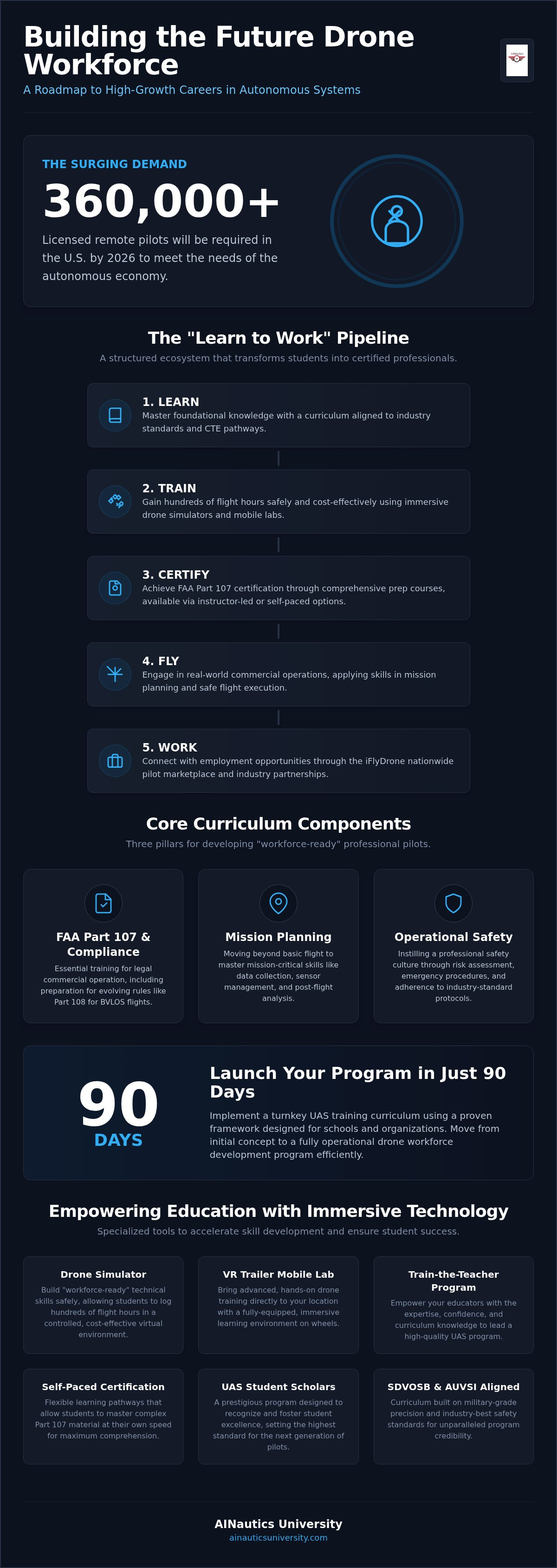
The FAA predicts that by 2026, the United States will require more than 360,000 licensed remote pilots to meet the demands of a rapidly evolving autonomous economy. This massive shift creates a unique opportunity for educators and organizations to build a drone workforce development program that prepares the next generation of technical leaders. However, the path from classroom learning to commercial employment is often blocked by complex FAA Part 107 regulations and a lack of specialized CTE curriculum.
You likely recognize that simply buying hardware isn't enough to bridge the skills gap. You need a structured ecosystem that transforms students into professionals. This article provides a comprehensive roadmap for implementing drone training that leads directly to high-growth careers in autonomous systems. We'll show you how to move from initial concept to a fully operational program in just 90 days.
We'll examine how to integrate industry-aligned tools like the Drone Simulator and the VR Trailer Mobile Lab into your curriculum. You'll also discover how the Train-the-Teacher Program empowers educators to lead with confidence while UAS Student Scholars sets the standard for student excellence. From self-paced certification to accessing a nationwide pilot marketplace, this guide covers the essential components of a sustainable, future-ready UAS initiative.
Key Takeaways
- Understand the critical demand for over 360,000 licensed remote pilots by 2026 and how a drone workforce development program bridges the gap between education and high-growth careers.
- Learn how to implement a turnkey UAS training curriculum in just 90 days using a proven framework designed for schools and organizations.
- Discover the role of immersive technology, such as the AINautics Drone Simulator and VR Trailer Mobile Lab, in building "workforce-ready" technical skills safely and cost-effectively.
- Explore the "Learn to Work" pipeline that connects student certification to real-world opportunities through the iFlyDrone nationwide pilot marketplace.
- Identify the essential building blocks for student excellence, including FAA Part 107 preparation and the prestigious UAS Student Scholars program.
What is a Drone Workforce Development Program?
A drone workforce development program is far more than a basic flight school. It's a comprehensive educational ecosystem designed to bridge the gap between classroom theory and commercial application. Instead of simply teaching students how to hover, these programs provide a structured roadmap that leads from initial curiosity to FAA Part 107 certification and high-growth employment. Whether students utilize instructor-led sessions or Self-Paced Certification options, the goal remains the same: professional mastery and industry readiness.
The demand for this specialized training is surging. The FAA projects a need for over 360,000 licensed remote pilots by 2026 to support the growing autonomous systems economy. This shift requires a transition from hobbyist flight to mission-driven commercial operations. Implementing a robust drone workforce development program ensures that your organization stays ahead of these technological shifts. AINautics acts as your visionary mentor in this journey, providing the authoritative guidance needed to build a sustainable, future-ready workforce.
The Economic Impact of Autonomous Systems Education
Drone technology now fuels critical sectors like infrastructure inspection, precision agriculture, and emergency response. A well-structured program creates a direct "Learn → Train → Certify → Fly → Work" pipeline. This ensures students aren't just certified; they're prepared for the specific technical demands of the modern industry. By focusing on the future of drone careers, institutions can provide a high long-term ROI for their students and local economies. Utilizing tools like the Drone Simulator allows students to gain hundreds of flight hours in a controlled environment, preparing them for the complexities of real-world missions.
The Role of SDVOSB and AUVSI in Workforce Standards
Credibility is the foundation of any successful training initiative. AINautics is a Service-Disabled Veteran-Owned Small Business (SDVOSB), bringing military-grade precision and discipline to civilian education. This veteran-led expertise ensures that programs like our Part 107 Training and Train-the-Teacher Program meet the highest professional standards. As a member of AUVSI, we ensure that every curriculum adheres to industry-standard safety protocols and ethical guidelines. AINautics maintains federal-contracting standards to ensure your institution delivers educational excellence that meets the most rigorous professional requirements.
Core Components of a Professional UAS Training Curriculum
A high-quality drone workforce development program rests on three specific pillars: FAA Part 107 preparation, mission planning, and operational safety. It's not enough for students to simply fly. They must understand the technical specialization required for high-growth careers. This means moving beyond basic flight skills to master data collection, sensor management, and post-flight analysis. These "workforce-ready" skills are what differentiate a casual hobbyist from a professional pilot who can provide value to a commercial enterprise.
For K-12 and CTE pathways, alignment with state and district standards is non-negotiable. Programs must be rigorous enough to meet educational requirements while remains flexible enough for diverse learning environments. AINautics University provides Self-Paced Certification options that allow students to progress through complex material at their own speed. This modular approach ensures that every learner achieves mastery before moving to live flight operations, creating a safer and more effective learning environment.
FAA Part 107 and Regulatory Compliance
Commercial success starts with Part 107 drone training. It's the legal baseline for every pilot. However, a professional curriculum must look ahead. It needs to account for evolving Part 108 rules regarding Beyond Visual Line of Sight (BVLOS) operations, which are becoming the standard for long-range inspection and delivery. Maintaining a clean paper trail isn't just about passing a test; it's essential for insurance eligibility and long-term regulatory compliance. Students must learn to document every flight, maintenance check, and safety briefing with precision.
Train-the-Teacher: Empowering Educators
Schools often struggle with a lack of specialized curriculum for autonomous systems. The "UAS Teacher Scholars" (Train-the-Teacher) program solves this by acting as a catalyst for school-wide success. It gives educators the professional development tools they need to integrate drones into their existing STEM curriculum. This creates a sustainable model where teachers act as visionary mentors. The ultimate goal for students is the "UAS Student Scholars" program, which serves as a gold standard for excellence and workforce readiness. You can explore these pathways further through the resources at AINautics University to see how they fit your institution's goals.
Immersive Technology: Simulators and Mobile Labs
Simulation isn't just a luxury; it's a critical safety layer for any modern educational initiative. A successful drone workforce development program integrates these tools to ensure students don't touch live hardware until they've proven their competence in a virtual environment. This approach significantly reduces equipment damage and accelerates the learning curve. By mastering flight physics virtually, students build the confidence needed for high-stakes commercial missions. It's the most cost-effective way to transition from theoretical knowledge to operational mastery.
When students train on the AINautics Drone Simulator, they're engaging with professional-grade software designed for the commercial world. Crashing a virtual aircraft costs nothing. However, crashing a commercial-grade drone in the field can stall a program's momentum and budget. Immersive technology allows for infinite repetitions of difficult maneuvers. This ensures that when students finally step onto the flight line, they do so with a level of precision that traditional classroom methods simply can't match.
Simulation-Based Training and Scenario Mastery
The AINautics Drone Simulator mimics the exact conditions of professional inspection and media missions. This high-fidelity environment allows students to practice complex maneuvers without the financial risk of a real-world crash. Utilizing immersive drone training technology is essential for developing the reflexive muscle memory required for precision flight. Scenario-based training specifically prepares pilots to execute emergency maneuvers safely during unexpected hardware failures or weather shifts. This mission-driven approach ensures that students aren't just flying; they're solving real-world problems in a controlled, data-rich environment.
The Mobile Lab Advantage for School Districts
Equipping every classroom with high-end tech can be a financial challenge. The VR Trailer Mobile Lab offers a scalable solution by bringing a state-of-the-art learning environment directly to school sites. This is particularly effective for rural or underserved districts that may lack dedicated lab space. The mobile lab serves as a powerful trust-builder for parents and administrators. It provides a tangible, hands-on experience that demonstrates the program's commitment to cutting-edge STEM education. By rotating the lab through multiple schools, districts can maximize their investment while ensuring every student has access to a professional drone workforce development program. This mobile approach democratizes access to high-growth career pathways, ensuring that geography is never a barrier to technological mastery.
The 90-Day Program Launch: Implementing UAS in Your Institution
Implementing a drone workforce development program doesn't have to be a multi-year project. With a structured framework, your institution can move from initial planning to live flight operations within a single academic semester. This turnkey approach focuses on mission planning and operational safety from day one. It ensures that every step is purposeful and aligned with industry needs. By following a proven timeline, you eliminate the guesswork and technical hurdles that often stall new CTE initiatives.
Success requires a shift in mindset from simple hobbyist flight to professional mission execution. This transition is supported by ongoing curriculum updates and dedicated instructor support. AINautics provides the roadmap to ensure your program remains compliant and cutting-edge. We focus on the "Learn to Work" pipeline, ensuring that every hour spent in the classroom translates to a marketable skill in the autonomous systems economy.
Phase 1: Planning and Standards Alignment (Days 1-30)
The first month focuses on building a solid foundation. You'll align your UAS initiatives with existing CTE and STEM pathways to ensure long-term sustainability and funding eligibility. This phase utilizes the UAS Teacher Scholars model to provide educators with the specialized knowledge they need to lead with authority. We assist with establishing rigorous safety protocols and preparing necessary FAA waivers. This proactive approach ensures your program meets federal standards before the first battery is ever charged.
Phase 2: Equipment and Simulation Integration (Days 31-60)
Once the groundwork is set, focus shifts to immersive technology. You'll set up the AINautics Drone Simulator lab, allowing students to log virtual hours safely and cost-effectively. During this time, you can schedule the VR Trailer Mobile Lab for high-impact student kick-off sessions. These experiences build momentum and community interest. You'll also develop flight scenarios that reflect local industry needs, such as agricultural mapping or structural inspections, making the training immediately relevant to the local workforce.
Phase 3: Certification and Career Readiness (Days 61-90)
The final phase targets professional results. Students and staff undergo intensive FAA Part 107 exam preparation to secure their commercial licenses. We also launch the UAS student scholar program to recognize and reward top-performing talent. Finally, certified pilots are onboarded into the iFlyDrone workforce marketplace. This connects your graduates directly to commercial opportunities, completing the loop from education to employment. Ready to start your rollout? Explore our program implementation resources to download your 90-day checklist.
From Certification to Career: The Workforce Marketplace
The final stage of a successful drone workforce development program is the seamless transition from the classroom to the commercial marketplace. This is where the "Learn → Train → Certify → Fly → Work" ecosystem becomes a self-sustaining loop. By connecting education to real-world earnings, institutions provide students with a clear return on their investment. This isn't just about passing a test; it's about entering a high-growth economy that values professional standards and operational safety. When students see a direct path to employment, their engagement and commitment to the curriculum increase significantly.
There is currently a massive demand for Part 107-certified pilots in government, media, and infrastructure inspection sectors. These organizations require more than just basic flight skill. They need a "clean paper trail" that documents a pilot's training history, safety compliance, and certification status. This documentation is vital for insurance eligibility and regulatory oversight. When pilots come through a structured program, they enter the workforce with the professional credentials that enterprises trust. This level of preparation ensures they are ready to handle the responsibilities of commercial flight from day one.
IFlyDrone: A Turnkey Workforce Solution
The iFlyDrone platform serves as the ultimate goal for program graduates. This marketplace connects certified pilots with municipalities and enterprises that need aerial data. Unlike traditional job boards, it utilizes a "Managed Drone Service" model. This allows organizations to receive high-quality data without the complexity of managing an internal flight department. Starting with drone training for beginners is the first step toward accessing these professional opportunities. It ensures that every pilot on the platform meets the rigorous standards required by modern industry clients.
Specialized Career Paths: Inspection and Media
Modern pilots must specialize to remain competitive in a crowded market. High-tier roles now include wildlife-aware structure inspection and economic-development media. For example, a professional inspection report often requires Migratory Bird Treaty Act (MBTA) compliance to ensure operations don't disturb protected species. This level of detail is what separates a student from a professional. AINautics University prepares pilots for these mission-critical roles by integrating regulatory expertise with advanced flight training. This specialized knowledge allows graduates to command higher rates and work on more complex, high-impact projects. By focusing on these specialized paths, a drone workforce development program ensures its graduates are not just pilots, but essential technical experts.
Scale the Future of Autonomous Flight
The demand for over 360,000 licensed remote pilots by 2026 represents a massive shift in the global economy. To meet this challenge, institutions must move beyond basic flight instruction. A successful drone workforce development program requires an integrated approach that combines immersive technology with industry-aligned standards. By utilizing tools like the AINautics Drone Simulator and the VR Trailer Mobile Lab, you ensure that students gain the technical specialization needed for high-growth careers without unnecessary risk or equipment costs.
Establishing a "Learn to Work" pipeline is the key to long-term sustainability. As a Service-Disabled Veteran-Owned Small Business (SDVOSB), we bring military-grade precision to every classroom and training field. Our 90-Day Program Launch framework and Certified FAA Part 107 Instructors provide the professional foundation your organization needs to lead. It's time to bridge the gap between classroom learning and commercial success. Launch your drone workforce program in 90 days with AINautics University and empower your community to master the skies. The future of autonomous systems is waiting for those ready to lead it.
Frequently Asked Questions
What is a drone workforce development program?
A drone workforce development program is a structured educational pathway that prepares individuals for commercial careers through FAA certification and mission-driven training. It bridges the gap between classroom learning and the autonomous systems economy. AINautics University focuses on a "Learn to Work" pipeline, ensuring students gain technical skills for industries like inspection and public safety. This comprehensive approach transforms a student's interest into a professional career path with long-term growth potential.
How long does it take to launch a drone program in a school?
You can launch a fully operational drone workforce development program in just 90 days. Our "Launch a Drone Program in 90 Days" framework provides a step-by-step rollout that covers everything from initial planning and standards alignment to live flight operations. This turnkey solution allows schools to move from concept to classroom implementation within a single semester, ensuring students start their training quickly without facing unnecessary administrative delays or technical hurdles.
Are AINautics University programs aligned with STEM and CTE standards?
Yes, all AINautics University curricula are specifically customized to align with state and district standards for K-12 education. We focus on integrating drone technology into existing STEM and CTE pathways to ensure students receive high-quality, rigorous instruction. This alignment helps schools meet educational requirements while providing students with a clear roadmap toward specialized technical careers in the rapidly growing autonomous systems market. It's a professional foundation built for long-term student success.
Do I need a Part 107 license to work in the drone industry?
You must hold an FAA Part 107 remote pilot certificate to operate drones for any commercial purpose. This certification is the legal baseline for anyone seeking employment in the UAS sector. AINautics University provides comprehensive Part 107 Training and Self-Paced Certification options to ensure students are fully prepared for the exam. Beyond the license, our programs emphasize operational safety and mission planning to make pilots truly workforce-ready for high-tier roles.
What technology is used in AINautics workforce training?
We utilize a sophisticated blend of immersive technology to accelerate student mastery. This includes the AINautics Drone Simulator, which allows students to practice complex scenarios in a safe virtual environment. We also deploy the VR Trailer Mobile Lab to bring high-tech STEM equipment directly to school sites. These tools help students build essential muscle memory and technical expertise before they transition to live flight operations with real hardware, reducing equipment damage and costs.
Can teachers without drone experience lead these programs?
Yes, educators can lead successful programs by participating in our UAS Teacher Scholars (Train-the-Teacher) model. This program provides teachers with the professional development and curriculum resources they need to instruct students with confidence. We offer ongoing instructor support and curriculum updates to ensure that even those new to the industry can act as visionary mentors for their students. This approach empowers schools to build sustainable programs using their existing talented faculty.
What career opportunities are available for UAS Student Scholars?
Graduates of the drone workforce development program can pursue diverse roles in government, media, and technical inspection sectors. Specific career paths include vertical structure inspection, wildlife-aware reporting, and economic development media. By achieving the UAS Student Scholars designation, students demonstrate a gold standard of excellence. This preparation makes them highly competitive for positions that require precision, regulatory compliance, and a deep understanding of how autonomous systems solve real-world problems.
How does the iFlyDrone marketplace help graduates find work?
The iFlyDrone platform acts as a nationwide workforce marketplace that connects certified, insured pilots with municipal and enterprise clients. It eliminates the need for organizations to build internal flight departments by providing a turnkey "we fly, you receive data" model. Graduates can join this marketplace to find commercial opportunities immediately after certification. This creates a direct link between their educational journey and real-world earnings, completing the loop within the autonomous economy.

Article by
AINautics University Team
The team behind AINautics University, dedicated to drone education and FAA Part 107 certification prep, VR flight simulation, and STEM training programs for students and educators.


