
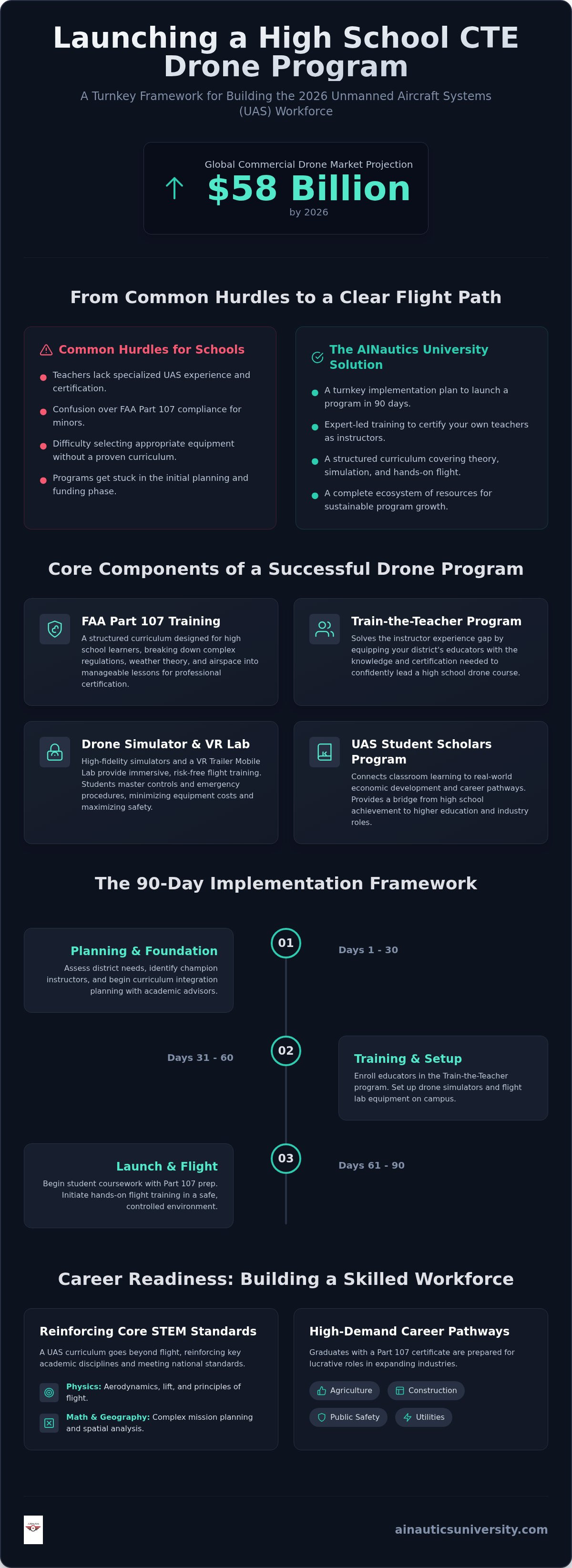
The global commercial drone market is projected to reach $58 billion by 2026, yet many districts are still searching for the right flight path. Launching a CTE drone program for high schools often feels like a daunting task. You're likely facing common hurdles: teachers who lack UAS experience, confusion over FAA Part 107 compliance for minors, and the challenge of selecting equipment without a proven curriculum. It's frustrating to see a massive career opportunity for your students while feeling stuck in the planning phase.
You can bridge this gap and launch a high-impact, career-aligned drone program in your school district within 90 days. This article provides a turnkey implementation plan that moves from classroom theory to professional readiness. We'll show you how to leverage resources like our Train-the-Teacher Program and UAS Student Scholars to build a sustainable ecosystem. From mastering the Drone Simulator to utilizing our VR Trailer Mobile Lab, you'll discover how to provide students with industry-recognized certifications and clear career pathways in the evolving aviation landscape. We'll also cover how our Self-Paced Certification and Part 107 Training ensure your students and staff are ready for the workforce.
Key Takeaways
- Learn how a modern CTE drone program for high schools bridges the gap between STEM theory and the industry's $58 billion market potential.
- Discover how to use high-fidelity Drone Simulators and the VR Trailer Mobile Lab to provide students with hands-on flight experience while minimizing equipment costs.
- Solve the instructor experience gap by utilizing a Train-the-Teacher model; it's the most efficient way to prepare staff for FAA Part 107 courses.
- Follow a structured 90-day implementation framework that guides your district from initial planning to a fully operational flight lab.
- Prepare students for the 2026 workforce by integrating specialized training in wildlife-aware inspection procedures and MBTA compliance.
What is a CTE Drone Program for High Schools?
Career and Technical Education (CTE) provides students with the academic and technical skills needed to succeed in the knowledge-based economy. In the context of an Unmanned aerial vehicle (UAV), a CTE program is a structured pathway that transforms a student's interest in flight into a professional career. It's more than just an after-school club; it's a rigorous curriculum designed to meet the evolving needs of the modern workforce. A CTE drone program for high schools moves students from basic recreational flying to mastering professional autonomous systems.
By 2026, the focus has shifted entirely from "toy" drones to sophisticated platforms used for critical data collection and infrastructure inspection. The core objective of these programs is to prepare students for the FAA Part 107 Remote Pilot Certificate. This certification is the legal requirement for commercial operation and serves as the industry's baseline for professional competence. Schools implementing a CTE drone program for high schools find that students engage more deeply with technical subjects when they see a direct link to a high-paying career.
The Workforce Demand for UAS Professionals
The global commercial drone market is expanding rapidly and is projected to reach $58 billion by 2026. This growth creates a high demand for skilled operators across multiple sectors. High school graduates with a Part 107 certificate can enter lucrative roles in industries such as agriculture, construction, public safety, and utilities. There's currently a documented pilot shortage in autonomous systems as companies struggle to find personnel who understand both flight operations and data management. Exploring the future of drone careers reveals a landscape where operators aren't just pilots; they're technicians and analysts. Our UAS Student Scholars program helps bridge this gap by connecting classroom learning to real-world economic development.
Meeting State and District STEM Standards
A robust UAS curriculum does more than teach flight; it reinforces core academic disciplines. Students apply physics through the study of aerodynamics and lift. They use math and geography for complex flight mission planning and spatial analysis. This alignment helps districts meet national standards like those from ASTM and NCATE. To encourage student excellence, programs often highlight the UAS scholarship for high school students as a pathway to higher education. By utilizing our Drone Simulator and Part 107 Training, schools can ensure students meet these standards in a safe, controlled environment. Programs can even scale their reach using our VR Trailer Mobile Lab, bringing high-tech training directly to the campus.
Core Components of a Successful High School Drone Curriculum
A high-impact CTE drone program for high schools isn't built on hardware alone. It's built on a structured pedagogical framework that translates complex aviation concepts into actionable career skills. Students need a roadmap that starts with foundational knowledge and ends with a professional credential recognized by the FAA and industry leaders.
We provide Part 107 Training modules designed specifically for high school learners. These modules break down complex FAA regulations, weather theory, and airspace into manageable, punchy lessons. Before students ever touch a real aircraft, they log hours on a high-fidelity Drone Simulator. This approach reduces equipment damage and builds confidence. For districts lacking permanent flight facilities, the VR Trailer Mobile Lab offers an immersive solution that travels to any campus, ensuring no student is left behind due to location.
The Role of Immersive Technology
Immersive technology is changing the game for vocational training. By using immersive drone training technology, students master spatial awareness much faster than with traditional methods. VR allows them to practice emergency procedures in high-stakes environments, such as vertical inspections of cell towers or public safety search-and-rescue missions, without any real-world risk. This scenario-based simulation is essential for teaching minors how to stay calm and follow protocols during a hardware failure.
State-level initiatives are already proving this model's worth. For example, recent partnerships have significantly improved career prospects for North Carolina's high school students by aligning school programs with industry needs. These programs demonstrate that when students use professional-grade tools, they achieve professional-grade results.
UAS Student Scholars: A Tiered Learning Model
Our UAS Student Scholars program follows a proven "Learn → Train → Certify → Fly" pipeline. This tiered model ensures every student progresses at a pace that suits their individual learning style. With Self-Paced Certification options, learners can revisit challenging topics like sectional charts or radio communications until they achieve true mastery. This process culminates in a professional portfolio of documented flight hours, giving graduates a significant competitive edge in the job market.
Launching a CTE drone program for high schools also requires prepared educators. Our Train-the-Teacher Program empowers your existing staff to become certified remote pilots and confident instructors, regardless of their prior aviation experience. If you're ready to see how these components fit your district, explore our comprehensive curriculum solutions today.
Solving Implementation Hurdles: Funding and Instructor Readiness
The decision to launch a CTE drone program for high schools is often met with two immediate questions: who will teach it and how will we pay for it? These are valid concerns. Most districts don't have staff with prior aviation experience, and equipment costs can seem prohibitive. However, these hurdles are easily cleared with a strategic approach to professional development and grant acquisition. By shifting the focus from "buying drones" to "building a workforce pipeline," schools can unlock significant resources and support.
The Train-the-Teacher Program
The most common objection we hear is that existing teachers aren't pilots. We solve this through our Train-the-Teacher Program, which empowers STEM educators to become certified UAS instructors. This model provides "UAS Teacher Scholars" with the mission planning and execution support they need to lead a classroom with confidence. By providing structured, ready-to-teach lesson plans and access to a high-fidelity Drone Simulator, we reduce teacher anxiety and prevent burnout. Educators don't need to be experts on day one; they just need the right tools to guide their students through our Self-Paced Certification modules.
Navigating Grants and State Funding
Budget constraints shouldn't ground your program's ambitions. There are numerous Grants and Funding for Drone Programs available, specifically through Perkins V and state-level workforce development initiatives. These funds are intended to support training for autonomous systems and high-demand technical careers. Because AINautics is a Service-Disabled Veteran-Owned Small Business (SDVOSB), we can help districts align their CTE drone program for high schools with diversity and inclusion goals, making grant applications more competitive. Utilizing mobile resources like our VR Trailer Mobile Lab also allows districts to share costs across multiple campuses, maximizing the impact of every dollar spent.
Compliance is the final piece of the puzzle. Students must be at least 16 years old to earn their FAA Remote Pilot Certificate, a milestone our Part 107 Training is designed to help them reach. We ensure your curriculum stays current with 2026 regulations, including Remote ID requirements and the anticipated Part 108 rules for Beyond Visual Line of Sight (BVLOS) operations. Our UAS Student Scholars program provides the framework for students to navigate these complexities, ensuring they graduate with a professional credential that is ready for immediate use in the workforce.
The 90-Day Rollout: How to Start a Drone Program in Your School
The most significant barrier to launching a CTE drone program for high schools is often the perceived timeline. Many administrators assume that building a professional aviation pathway takes years of planning and bureaucratic negotiation. That isn't the case. With a turnkey support system, your district can move from an empty classroom to a fully operational flight lab in just one academic quarter. The secret lies in a phased, 90-day implementation framework that prioritizes instructor readiness and standards alignment.
Step 1: Planning and Standards Alignment (Days 1-30)
The first month focuses on the structural foundation. Selecting the right drone curriculum for educators is your primary objective. This choice dictates how well your program aligns with state STEM standards and workforce requirements. During this phase, you'll audit your existing infrastructure. Do you have a dedicated space for Drone Simulators? Is there a safe, unobstructed outdoor area for live flight operations? You'll also establish safety protocols and insurance requirements to ensure the program meets district risk management standards. By the end of day 30, your instructor selection should be finalized and your curriculum roadmap should be clear.
Step 2: Training and Equipment Integration (Days 31-60)
Month two is the "engine room" of the rollout. You'll enroll your selected staff in the Train-the-Teacher Program, allowing them to earn their own remote pilot credentials while learning how to manage a UAS classroom. Simultaneously, you'll set up the hardware and software. We deploy the Drone Simulator stations and coordinate the arrival of the VR Trailer Mobile Lab. This immersive technology allows students to practice in complex environments without risk to physical equipment. During these 30 days, teachers develop mission-driven scenarios that will form the backbone of student flight labs, ensuring that every lesson has a practical, career-focused outcome.
The final 30 days focus on execution. You'll open enrollment for the UAS Student Scholars program and begin the Part 107 Training modules. By day 90, your students are logging their first supervised flight hours and working through Self-Paced Certification paths. This rapid deployment ensures your district remains at the cutting edge of technical education without the typical delays of program development. Ready to bring this framework to your campus? Explore our 90-day launch solutions and start your countdown today.
Career Readiness: Building the 2026 UAS Workforce
A successful CTE drone program for high schools doesn't end with a diploma. It ends with a paycheck. We utilize a comprehensive "Learn → Train → Certify → Fly → Work" pipeline to ensure students move seamlessly from the classroom to the commercial sector. By 2026, the industry demands more than just basic flight skills. Employers and insurers look for a "clean paper trail" that documents a pilot's training, flight hours, and strict adherence to regulatory standards. Our UAS Student Scholars program provides this vital documentation, proving that graduates have mastered the complexities of the National Airspace System and professional data management.
Specialized Missions: Wildlife-Aware Inspections
High-value niches, such as cell tower and utility inspections, require specialized knowledge that goes beyond standard Part 107 Training. We teach students "Wildlife-Aware" procedures, specifically focusing on Migratory Bird Treaty Act (MBTA) compliance. When inspecting vertical structures, pilots must identify and document nesting activity to avoid federal violations and environmental impact. By training students to conduct these assessments during their flight labs, we position them as elite candidates for specialized missions. This level of detail ensures that your graduates aren't just pilots; they're environmental compliance specialists who understand the legal stakes of commercial data collection. This mastery is often what separates a hobbyist from a professional UAS technician.
Connecting Students to the iFlyDrone Marketplace
The final stage of our pipeline connects certified students to the iFlyDrone marketplace. This turnkey workforce platform provides real-world data collection opportunities, allowing young pilots to gain experience on municipal and government UAS contracts. Whether they're using our Self-Paced Certification to brush up on specific mission types or practicing in the VR Trailer Mobile Lab, students are prepared for the rigors of professional work. Transitioning from a Drone Simulator to a paid contract is the ultimate validation of a student's hard work and your district's investment.
AINautics University is committed to building the 2026 workforce by providing the tools—from the Train-the-Teacher Program to advanced flight simulations—that schools need to succeed. Investing in a CTE drone program for high schools is an investment in the future of autonomous systems and the next generation of technical leaders. The path to a high-demand career is clear; it starts with the right training and ends with a pilot who is ready to fly, lead, and work on day one.
Empowering the Next Generation of UAS Leaders
Launching a successful CTE drone program for high schools is a strategic investment in your students' professional futures. By leveraging a proven 90-day implementation framework, your district can bypass common technical hurdles and move straight to workforce readiness. Immersive tools like the Drone Simulator and VR Trailer Mobile Lab create a safe, professional learning environment. These resources, combined with our Train-the-Teacher Program, ensure your staff is fully prepared for the 2026 aviation landscape alongside their students.
As a Service-Disabled Veteran-Owned Small Business (SDVOSB) and proud AUVSI member, AINautics University is dedicated to bridging the gap between classroom theory and high-demand careers. Whether your students are completing Part 107 Training or joining the UAS Student Scholars program, they're gaining the specialized skills needed for elite industry roles. The opportunity to lead in autonomous systems is here now. It's time to provide your community with the tools to succeed in this rapidly expanding market.
Launch your school's drone program in 90 days—contact AINautics today. The future of flight is waiting for your students; let's help them reach it.
Frequently Asked Questions
What is a CTE drone program for high schools?
A CTE drone program for high schools is a structured educational pathway that prepares students for professional careers in the UAS industry. It's more than flying drones; it's about mastering mission planning, data collection, and regulatory compliance. Programs often use a Learn, Train, Certify, Fly, Work pipeline. AINautics University supports these initiatives with specialized curriculum and our UAS Student Scholars program to ensure students are workforce-ready upon graduation with professional credentials.
How much does it cost to start a high school drone program?
Costs vary based on the scale of the rollout, but essential expenses include the FAA's Part 107 knowledge test fee of $175 and a $5 drone registration fee per aircraft. Schools also invest in professional development and curriculum. Districts often utilize Perkins V or state-level workforce development grants to fund these initiatives. AINautics University offers scalable solutions like the VR Trailer Mobile Lab to help districts share resources across multiple campuses efficiently.
Can high school students get a Part 107 drone license?
Yes, students can receive an FAA Remote Pilot Certificate once they reach the age of 16. Our Part 107 Training is specifically designed to help high schoolers master the complex aviation concepts needed to pass the exam. By integrating Self-Paced Certification options, students can study at their own speed. Earning this credential while still in school gives them a significant head start in the labor market, allowing them to perform commercial work legally upon graduation.
How long does it take to implement a drone curriculum in a school district?
A full implementation takes approximately 90 days when using a structured rollout framework. This timeline covers planning, instructor selection, and the setup of tools like our high-fidelity Drone Simulator. By the end of this three-month period, schools can transition from initial curriculum alignment to live flight operations. This rapid deployment ensures that districts can begin offering the CTE drone program for high schools without long bureaucratic delays or uncertainty about the launch timeline.
What equipment is needed for a high school drone lab?
A professional lab requires more than just aircraft; it needs a mix of hardware and immersive software. Essential components include high-fidelity Drone Simulator stations for safe skill-building and the VR Trailer Mobile Lab for complex scenario training. Schools also need mission planning software and safety equipment. We focus on providing educational tools and curriculum instead of hardware sales. This approach ensures schools have the right software to document student flight hours and maintain compliance.
Do teachers need to be pilots to teach a drone course?
No, teachers don't need prior aviation experience to lead a successful course. Our Train-the-Teacher Program is designed to empower existing STEM educators with the knowledge and certifications they need. We provide UAS Teacher Scholars with ready-to-teach lesson plans and mission planning support. This model reduces instructor anxiety by providing a structured path to becoming a certified remote pilot while managing a classroom of future UAS professionals who are eager to explore the industry.
How do drone programs align with STEM and CTE standards?
UAS programs naturally integrate physics, mathematics, and geography through flight mission planning and data analysis. A CTE drone program for high schools aligns with state and district standards by providing measurable technical skills and industry certifications. We customize our curriculum to meet local educational requirements and STEM/STEAM initiatives. This ensures that every lesson contributes to a student's academic progress while preparing them for high-demand technical roles that require precise spatial awareness and analytical thinking.
What career paths are available for students after completing a drone program?
Graduates can enter diverse fields such as agriculture, public safety, construction, and utility inspection. Specialized skills like wildlife-aware procedures for cell tower inspections make them elite candidates for government contracts. Many students find opportunities through the iFlyDrone marketplace, which connects certified pilots to real-world data collection jobs. With the anticipated Part 108 rules, new roles like Operations Supervisors and Flight Coordinators are emerging, creating even more advanced career pathways for certified students.

Article by
AINautics University Team
The team behind AINautics University, dedicated to drone education and FAA Part 107 certification prep, VR flight simulation, and STEM training programs for students and educators.


