
The flight school closest to your front door might be the worst choice for your long-term career. While searching for "drone training near me" is a natural starting point, geographic proximity shouldn't be your primary filter. You're likely feeling the pressure of mastering FAA Part 107 requirements or worrying about whether a local course offers enough hands-on experience to actually get you hired. It's a common concern for students and educators who need more than just a certificate to succeed.
This article shows you how to evaluate drone programs based on advanced technology, national certification standards, and real-world career outcomes. We'll explore how immersive tools like the VR Trailer Mobile Lab and high-fidelity Drone Simulator provide more value than a traditional nearby classroom. You'll learn how to identify programs with national credibility, such as the UAS Student Scholars initiative. This ensures you don't just pass the exam on your first try, but also gain specialized skills in mapping and Migratory Bird Treaty Act compliance to become workforce-ready.
Key Takeaways
- Learn why searching for "drone training near me" should only be your first step in finding a program that prioritizes technical mastery and national standards over simple proximity.
- Discover how immersive tools like the VR Trailer Mobile Lab and high-fidelity Drone Simulator provide superior preparation for commercial careers compared to traditional flight schools.
- Identify the critical criteria for evaluating schools, including instructor credentials and the availability of comprehensive Part 107 Training to ensure you pass your exam on the first attempt.
- Explore sustainable pathways for schools through the Train-the-Teacher Program, which empowers educators to launch and manage their own UAS programs effectively.
- Understand the "Learn, Train, Certify, Fly, Work" pipeline that connects your training directly to the workforce through initiatives like the UAS Student Scholars program.
What is Professional Drone Training and Why Does It Matter?
Professional drone training is the intersection of regulatory compliance and technical flight mastery. It's no longer enough to simply know how to take off and land. In 2026, the Unmanned Aircraft Systems (UAS) industry is moving rapidly toward autonomous flight, AI-driven data collection, and complex sensor integration. A simple flight lesson might teach you the basic controls, but it won't prepare you for a high-stakes commercial career. When you search for drone training near me, you're looking for a path to professional credibility. This requires a curriculum that aligns with national standards like those set by AUVSI, ensuring your skills are recognized across the country.
Choosing a professional program means shifting your focus from hobbyist flying to workforce-ready operations. Modern employers don't just want pilots; they want technicians who can manage data and maintain safety protocols in challenging environments. AINautics University bridges this gap by offering a comprehensive pipeline that moves from initial learning to professional placement.
The Role of FAA Part 107 Certification
The Remote Pilot Certificate is your legal license to operate commercially. Under FAA rules, any flight that isn't strictly for recreational purposes requires this certification. The exam is rigorous, covering critical topics such as aviation weather, national airspace classes, and emergency procedures. Most drone training for beginners starts here because you cannot work without it. AINautics provides specialized Part 107 Training and Self-Paced Certification options to ensure you master these regulations. Passing the test proves you understand the rules of the sky, but it is only the first step in your professional journey.
Beyond the License: Workforce Readiness
There's a significant difference between passing a multiple-choice test and being mission-ready for a vertical structure inspection. Professional training must include scenario-based challenges that mimic real-world job sites. This is where tools like the Drone Simulator and the VR Trailer Mobile Lab become essential. They allow students to practice complex maneuvers without the risk of hardware damage. Gaining specialized skills is what makes a pilot valuable. These include:
- High-resolution mapping and 3D modeling.
- Thermal imaging for infrastructure inspections.
- Wildlife-aware flight procedures, including Migratory Bird Treaty Act compliance.
- Autonomous mission planning for large-scale agricultural or industrial sites.
Programs like the UAS Student Scholars initiative focus on these advanced competencies. They prepare individuals to enter the workforce with a portfolio of proven skills. By prioritizing these outcomes over simple geographic proximity, you ensure your drone training near me search leads to a career rather than just a certificate.
How to Evaluate a Drone School: 5 Essential Criteria
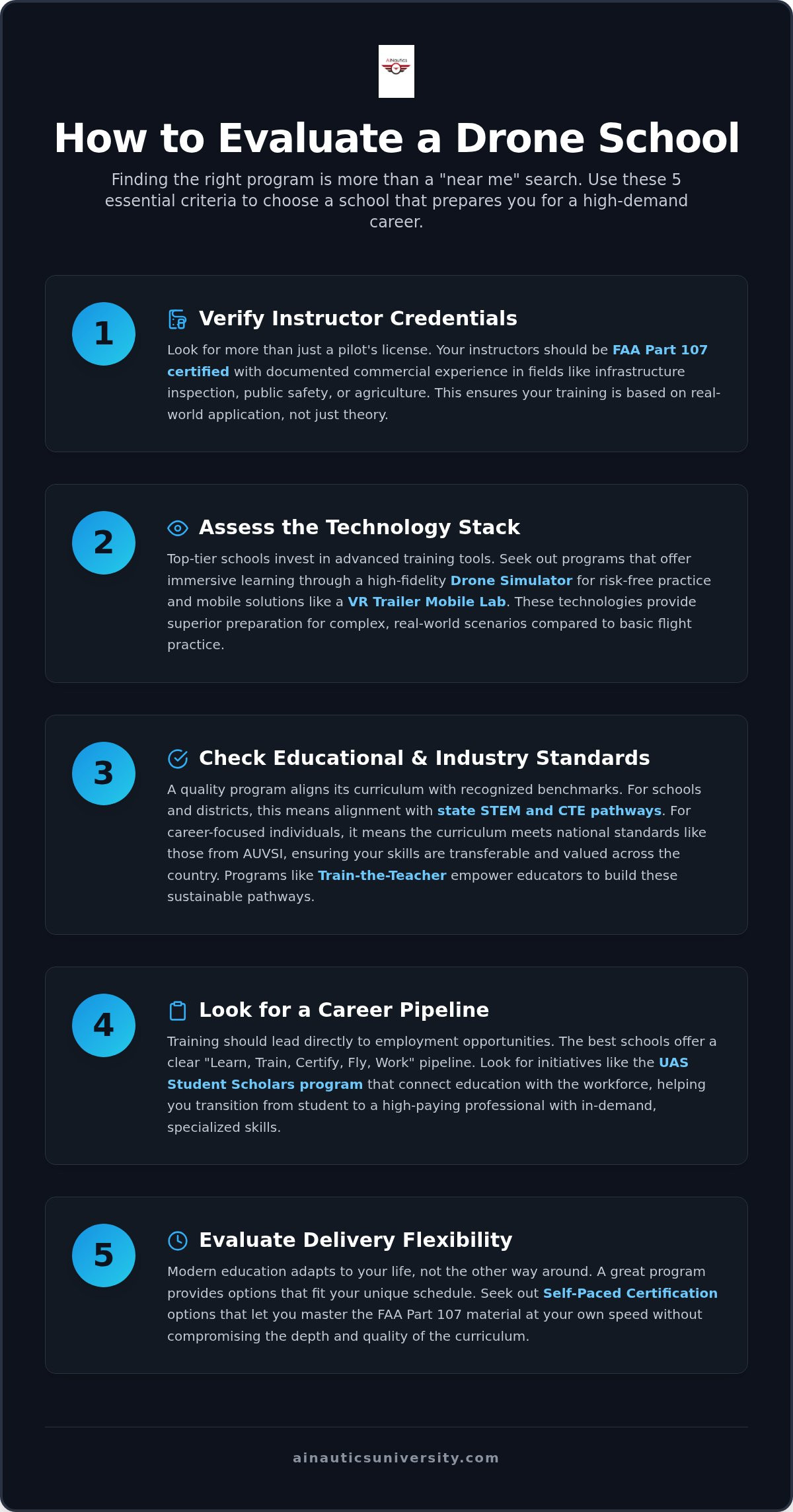
Finding drone training near me is the easy part. The challenge lies in distinguishing a high-quality academy from a basic test-prep site. You deserve a program that treats your education as a career investment rather than a one-time transaction. To find a school that actually prepares you for the workforce, follow these five evaluation steps:
- Verify Instructor Credentials: Ensure your teachers are FAA Part 107 certified and have documented experience in commercial sectors like infrastructure inspection or public safety.
- Assess the Technology Stack: High-tier schools utilize immersive tools like the VR Trailer Mobile Lab to provide realistic flight environments before you ever touch a physical controller.
- Check Educational Standards: For educators and districts, it's vital to confirm the program aligns with state STEM and Career and Technical Education (CTE) pathways.
- Look for a Career Pipeline: A school shouldn't just hand you a certificate. Programs like the UAS Student Scholars initiative help bridge the gap between learning and landing a high-paying job.
- Evaluate Delivery Flexibility: Your schedule is unique. Look for Self-Paced Certification options that allow you to master the material at your own speed without sacrificing depth.
Curriculum Standards and STEM Alignment
Schools and districts face unique challenges when integrating new technology into the classroom. It's essential to find drone curriculum for educators that meets rigorous academic standards while remaining engaging for students. AINautics University focuses on workforce-ready training that goes beyond theoretical slide decks. We prioritize hands-on, mission-driven instruction that prepares students for real-world applications. This alignment ensures that the time spent in the classroom translates directly into usable credits and professional readiness.
The Importance of Simulation in Flight Mastery
Mastering complex maneuvers takes time and repetition. The Drone Simulator is a critical component of professional training because it offers a risk-free environment for mastery. Crashing a physical drone is expensive and can be discouraging for beginners. Simulators allow you to practice emergency procedures and high-stress scenarios repeatedly until they become second nature. This cost-effective approach ensures that when you finally take to the sky, you're flying with the confidence of a seasoned pilot. It's a smart way to build muscle memory while protecting your hardware investment.
Choosing the right school means looking past the map and focusing on these quality markers. If you're ready to move beyond basic flight, explore our professional training pathways to see how we can support your journey. Don't let your search for drone training near me end at the closest zip code; prioritize the program that offers the best future-ready skills.
Online vs. Immersive vs. Local Flight Training
Traditional online courses are effective for memorizing regulations, but they often fail to provide the physical context needed for flight. Conversely, local flight schools offer basic stick time but frequently lack the sophisticated curriculum required for industrial-grade operations. When you start your search for drone training near me, you'll likely find these two options dominate the market. However, neither alone is sufficient for a professional career in 2026. You need a model that combines digital flexibility with deep, hands-on engagement.
Immersive training has become the gold standard because it bridges the gap between both worlds. By utilizing immersive drone training technology, students can experience high-stakes scenarios in a controlled environment. This approach ensures that theoretical knowledge translates directly into field mastery. It allows you to practice complex missions dozens of times in a simulated space before you ever step onto a real-world job site, reducing risk and increasing confidence.
The VR Trailer Mobile Lab Experience
The VR Trailer Mobile Lab brings an elite learning experience to any location in the nation. It functions as a portable center of excellence for schools and organizations that want to offer top-tier UAS education. Inside, students use virtual reality to develop deep situational awareness, learning to anticipate hazards and plan missions with precision. This model is superior to traditional local flight schools because it offers a consistent, high-tech curriculum that isn't dependent on local weather or limited instructor availability. It allows districts to launch professional programs quickly and effectively without building new infrastructure.
Self-Paced Certification for Busy Professionals
Transitioning into the UAS industry shouldn't require you to quit your current job or sacrifice your personal schedule. Self-Paced Certification options provide the modular flexibility needed for career changers and busy professionals. These programs use a structured Learning Management System to guide you through complex topics like airspace classes and emergency protocols. This approach is essential for Part 107 drone training, where a deep understanding of FAA rules is mandatory for safety and legal compliance. You can master each concept at your own speed, ensuring you're fully prepared for advanced flight stages. This flexibility means that drone training near me is no longer defined by a physical commute, but by how well the training integrates into your daily life.
Specialized Pathways: Educators and Students
Launching a sustainable drone program within a K-12 district requires more than just buying hardware. Educators often start by looking for drone training near me to find local workshops, but institutional success depends on a structured, national framework. AINautics University specializes in helping districts navigate this complexity through our 90-Day Drone Program Launch strategy. This comprehensive approach ensures that schools don't just start a club; they build a recognized Career and Technical Education (CTE) pathway that lasts for years.
The core of this sustainability is our Train-the-Teacher Program. Instead of relying on outside contractors, we empower your existing staff to become the experts. By training teachers to lead these courses, districts maintain control over their curriculum while significantly reducing long-term costs. This model transforms the classroom into a high-tech lab where students learn the same skills used by professional infrastructure inspectors and emergency responders.
UAS Teacher Scholars: Empowering Educators
Effective professional development must result in tangible outcomes. Through the UAS Teacher Scholars initiative, we guide educators through the rigors of Part 107 Training so they can earn their Remote Pilot Certificate. This certification provides the legal foundation needed to oversee student flight operations safely. Once certified, teachers learn how to integrate autonomous systems and AI-driven data collection into existing STEM and STEAM curricula. We provide ongoing instructor support and regular curriculum updates to keep pace with the rapidly evolving UAS industry. This ensures that your staff always has access to the latest regulatory information and technical procedures.
The UAS Student Scholars Program
Students who enter the UAS workforce early gain a massive competitive advantage. Our program focuses on certifying high schoolers as workforce-ready before they even receive their diplomas. We help schools establish a UAS scholarship for high school students, opening doors for learners from all backgrounds to pursue high-paying roles. By mastering flight maneuvers on the Drone Simulator and gaining field experience, these students are prepared for the future of drone careers in sectors like precision agriculture and public safety. This pathway doesn't just teach a hobby; it builds a professional future. If you're ready to bring this technology to your district, contact us to start your 90-day launch today.
Finding Your Path with AINautics University
Success in the UAS industry isn't just about passing a test; it's about entering a sustainable professional ecosystem. AINautics University offers a seamless "Learn, Train, Certify, Fly, Work" pipeline designed to move you from curiosity to a career. As a Service-Disabled Veteran-Owned Small Business (SDVOSB), our institution brings real-world infrastructure inspection experience and military-grade precision to our curriculum. While many search for drone training near me, they often find programs that end the moment the certificate is printed. We focus on what happens after you get your license.
Our training model leverages the same technology used by top-tier industrial firms. Whether you're using the Drone Simulator to perfect your flight maneuvers or engaging with our Self-Paced Certification modules, you're building a foundation of mastery. We don't just teach you how to fly; we teach you how to work. This workforce-ready focus is why we are members of AUVSI and why our graduates are prepared for the technical demands of the 2026 job market.
The iFlyDrone Workforce Connection
The biggest hurdle for new pilots is often landing that first commercial contract. We bridge this gap through the iFlyDrone marketplace, a nationwide network that connects certified pilots with real job opportunities. Graduates of our Part 107 Training and UAS Student Scholars programs gain access to this platform, providing an immediate career destination. Working within this marketplace means you're part of a firm that understands federal compliance, insurance requirements, and complex safety standards. It takes the guesswork out of starting a business or finding employment, allowing you to focus on the mission at hand.
Ready to Launch? Your 2026 Drone Career Starts Here
The UAS industry is evolving rapidly. The demand for specialized skills like mapping and infrastructure inspection is at an all-time high. Choosing the right educational partner is the most important decision you'll make this year. Don't settle for the most convenient option just because it appears first in a search for drone training near me. Instead, choose the program that offers national credibility and a proven path to employment.
Educators can utilize our Train-the-Teacher Program to bring this future-ready curriculum to their students, while individuals can start their journey through our immersive VR Trailer Mobile Lab sessions. Your career shouldn't be limited by your geography. Take the first step toward professional mastery today and join a community dedicated to the human element of technological advancement. If you are interested in how professional training standards apply to other complex behavioral fields, such as canine development, you can learn more about Alan's K9 Academy.
Finding the right path in the UAS industry requires looking past the simple results for drone training near me and focusing on specialized mastery. You've learned that professional success depends on a strategic blend of FAA Part 107 certification and technical flight skills. High-quality programs prioritize immersive technology like the VR Trailer Mobile Lab and advanced simulators to ensure you're workforce-ready from day one. It's about choosing a partner that connects your education directly to a career destination.
AINautics University stands as a national leader in this space. As an SDVOSB certified institution and proud member of AUVSI, we provide the credibility you need to excel. For educators, our 90-Day Drone Program Launch guarantee ensures a seamless transition into the classroom. Whether you're a student exploring new career paths or an administrator building a STEM legacy, the right training is about future-readiness. Explore AINautics University Drone Training Programs today to start your journey toward the top of the industry. The sky isn't the limit; it's your workplace.
Frequently Asked Questions
How do I find drone training that is actually near me?
While searching for drone training near me is common, you should prioritize programs with a national reach or mobile delivery options. AINautics brings the classroom to you through the VR Trailer Mobile Lab. This mobile unit provides a high-tech learning environment regardless of your location. You can also utilize Self-Paced Certification options to study from home. Focus on the quality of technology and instructor credentials rather than just the physical distance to a building.
Can I take the FAA Part 107 exam online?
No, you cannot take the FAA Part 107 initial knowledge test online. The FAA requires this exam to be taken in person at an authorized Knowledge Testing Center. While your Part 107 Training and prep courses can be completed entirely online through self-paced modules, the actual exam requires a proctored environment. You'll need to schedule an appointment at a local testing facility. Once you pass, you can apply for your certificate through the FAA portal.
How much does professional drone training typically cost in 2026?
Costs for drone education vary based on the depth of the curriculum and the technology provided. Basic online test prep is generally the most affordable option. Immersive programs featuring a Drone Simulator or hands-on flight labs represent a higher investment because they provide workforce-ready skills. Institutional programs for schools often involve comprehensive packages for staff and students. You should check with specific providers for current rates, as prices reflect the level of technical mastery offered.
What is the difference between a drone simulator and a VR drone lab?
A Drone Simulator typically uses a computer screen and a physical controller to mimic flight physics in a 2D or 3D environment. In contrast, a VR Trailer Mobile Lab uses virtual reality headsets to provide a fully immersive 360-degree experience. VR labs offer superior situational awareness by placing you inside a virtual cockpit or job site. Both tools are essential for risk-free mastery, but VR provides a deeper level of realism for complex mission planning.
Do I need my own drone to start a training program?
You don't necessarily need your own hardware to begin your journey. Many professional programs, including the UAS Student Scholars initiative, provide the equipment or use simulators for initial training. Starting with a Drone Simulator allows you to build muscle memory without the risk of damaging expensive gear. This approach is cost-effective for beginners and schools. It ensures you develop proper safety habits and technical proficiency before you invest in a specific commercial drone model.
How long does it take to become a certified commercial drone pilot?
Most students can prepare for the FAA Part 107 exam in two to four weeks using Self-Paced Certification options. The time required depends on your prior aviation knowledge and how much time you dedicate to studying each day. After you pass the exam, the FAA typically processes your certificate within a few weeks. However, gaining workforce-ready skills in specialized fields like infrastructure inspection or thermal mapping may require additional months of advanced, hands-on training.
Are there specific drone programs for K-12 teachers?
Yes, the Train-the-Teacher Program is specifically designed to help educators launch sustainable UAS pathways in their schools. This program provides teachers with the regulatory knowledge and technical skills needed to lead a classroom. It includes professional development focused on earning a Part 107 certificate and integrating autonomous systems into STEM curricula. These institutional programs often include a 90-Day Drone Program Launch strategy to help districts implement technology quickly and effectively for their students.
What industries are currently hiring Part 107 certified pilots?
Demand is growing rapidly across several high-tech sectors. Infrastructure firms hire pilots for vertical structure and bridge inspections. Agricultural companies use drones for crop health monitoring. Public safety agencies utilize UAS for search and rescue missions. Additionally, construction and environmental agencies require certified pilots for mapping and site surveys. Graduates often find work through marketplaces like iFlyDrone, which connects skilled pilots with diverse commercial contracts across the country to jumpstart their professional careers.

Article by
AINautics University Team
The team behind AINautics University, dedicated to drone education and FAA Part 107 certification prep, VR flight simulation, and STEM training programs for students and educators.


