
What if your next certificate renewal wasn't just a regulatory hurdle, but a strategic upgrade to your professional flight status? Mastering the FAA remote pilot certificate renewal process often feels like chasing a moving target, especially as Remote ID and BVLOS regulations continue to evolve in 2026. It's common to feel some friction when managing the differences between FAASafety.gov and IACRA portals. No pilot wants to risk a lapse in certification that could ground their commercial operations and stall their professional momentum.
At AINautics University, we believe recurrency is a professional checkpoint designed to align your skills with the modern autonomous systems landscape. This guide provides a clear, step-by-step roadmap to completing your renewal with zero downtime. You'll discover how to leverage the latest regulatory updates to your advantage while sharpening your technical proficiency. From utilizing our Drone Simulator to maintain muscle memory to exploring how our Self-Paced Certification options support continuous growth, we're here to help you turn a mandatory requirement into a distinct competitive edge.
Key Takeaways
- Navigate the FAASafety.gov portal to master the FAA remote pilot certificate renewal process without the need for expensive in-person testing.
- Calculate your expiration date accurately using the 24-calendar-month rule to ensure your commercial flight privileges never lapse.
- Align your operations with 2026 regulatory updates, including Remote ID and advanced flight categories over people and moving vehicles.
- Maintain true flight proficiency between renewal cycles by practicing complex maneuvers with the AINautics Drone Simulator.
- Leverage your renewal to enter the Train-the-Teacher Program, transforming your technical expertise into a career as a specialized UAS educator.
Understanding the FAA Remote Pilot Recurrency Requirements in 2026
The FAA remote pilot certificate renewal process has evolved into a streamlined, digital-first experience. In previous years, pilots had to schedule proctored exams at testing centers and pay significant fees to maintain their status. Today, the FAA provides free online recurrency training through the FAASafety.gov portal. This shift reflects the growing complexity and ubiquity of unmanned aerial vehicles in the national airspace. By moving to an online model, the FAA ensures that every pilot has immediate access to updated safety protocols without financial barriers.
Staying current does more than keep you legal; it grants you modern operational privileges. Under the 2026 standards, maintaining your recurrency allows you to conduct night operations and flight over people without needing specific waivers, provided you meet the necessary equipment and category requirements. If you let your certificate expire, you lose all commercial privileges. You can still fly recreationally, but you can't fly for any business purpose or "furtherance of a business." This includes tasks like real estate photography, roof inspections, or emergency response for a department.
Who Needs to Renew?
Commercial drone pilots operating under Part 107 must maintain currency to accept paid assignments and maintain insurance coverage. Public safety and government UAS operators also fall under these requirements to ensure standardized safety across agencies. Finally, teachers implementing a drone curriculum for educators in K-12 settings need to stay current to lead students effectively. AINautics University supports these professionals through our Part 107 Training and our specialized Train-the-Teacher Program, ensuring instructors remain industry-ready and compliant.
The 24-Calendar-Month Window
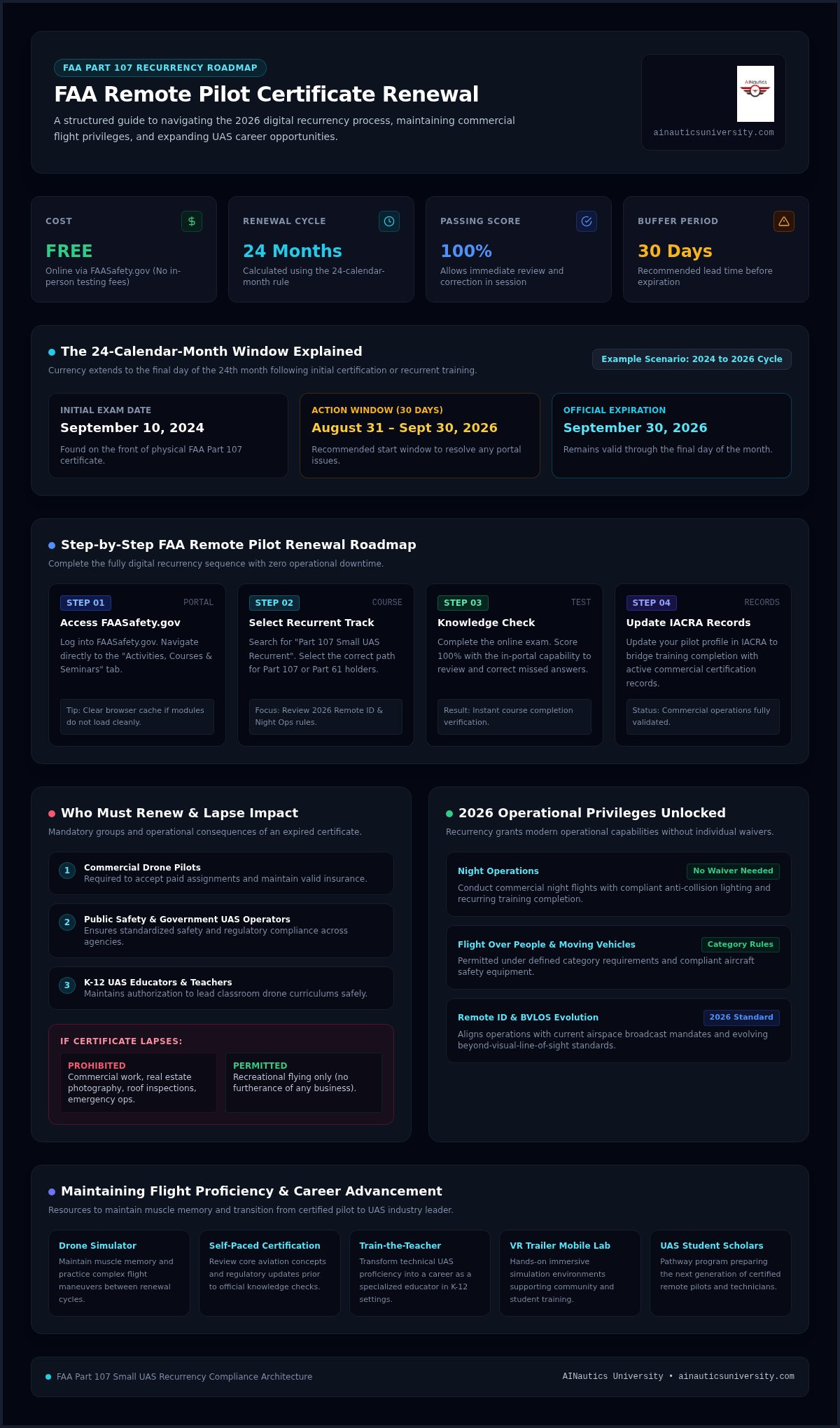
The "24-calendar-month" rule is a specific regulatory term that pilots must calculate correctly to avoid grounded operations. A calendar month means your currency lasts until the final day of the month, 24 months after your last knowledge check or training completion. For example, if you passed your initial exam on September 10th, 2024, your certificate remains valid until September 30th, 2026. This grace period to the end of the month provides a small buffer, but it's not a reason to delay.
You can find your original issue date on the front of your physical Part 107 certificate. We recommend starting the FAA remote pilot certificate renewal process at least 30 days before your window closes. This lead time ensures you have space to troubleshoot portal access issues or review new 2026 regulatory updates without the pressure of an imminent deadline. For those looking for a structured refresher, our Self-Paced Certification options provide an excellent environment to review core concepts before taking the official FAA knowledge check.
Step-by-Step Guide to the FAA Remote Pilot Certificate Renewal Process
The FAA remote pilot certificate renewal process is a streamlined, digital journey designed to keep your skills sharp and your operations legal. Unlike the initial certification exam, this recurrency training happens entirely online through the FAASafety.gov portal. It's a structured path that ensures every pilot stays aligned with the latest FAA remote pilot certification requirements. By completing this training, you demonstrate your commitment to safety and professional standards in an increasingly busy national airspace.
Accessing the Correct FAA Training Course
Log into your account at FAASafety.gov and navigate to the "Activities, Courses & Seminars" tab. Search specifically for "Part 107 Small UAS Recurrent." Ensure you select the version relevant to your current status, as there are different paths for existing Part 107 pilots and those who also hold a Part 61 manned pilot certificate. The system uses a learning management interface that works best on updated browsers. Clear your cache if the modules don't load correctly. To pass the knowledge check on your first attempt, pay close attention to the 2026 updates regarding Remote ID and night operations. The test requires a 100% score, but the portal allows you to review and correct any missed questions during the session.
Updating Your Records in IACRA
Completing the FAA remote pilot certificate renewal process correctly in IACRA is the final bridge between training and long-term record management. While your completion certificate provides immediate legal currency, your Integrated Airman Certification and Rating Application (IACRA) profile remains your permanent pilot record. Log in to verify that your email and physical address are current. This ensures you receive critical safety alerts and regulatory updates directly from the FAA. For Part 61 certificate holders, this step is vital to linking your training completion to your existing airman records, maintaining a seamless professional history.
You won't receive a new physical card after completing the renewal. Instead, you must carry your printed or digital completion certificate whenever you fly. This document serves as legal proof of your currency during ramp inspections or when requested by local law enforcement. While the FAA modules cover the mandatory basics, true mastery comes from consistent practice. If you find the regulatory language dense or want to sharpen your technical edge, our Self-Paced Certification options offer a supportive environment to reinforce these concepts before you tackle the official FAA portal.
Beyond Compliance: Aligning with 2026 Operational Standards
Completing the FAA remote pilot certificate renewal process ensures you stay legal, but true professional growth requires mastering the operational nuances of the 2026 landscape. The latest FAA remote pilot certification requirements emphasize technical integration over simple rule memorization. This shift prepares pilots for high-stakes environments where hardware compliance and safety protocols are inseparable. By treating recurrency as a strategic upgrade, you position yourself to handle complex missions that demand more than just basic flight skills.
Remote ID and Hardware Compliance
In 2026, verifying your drone’s Remote ID status is a non-negotiable part of every pre-flight checklist. Pilots must distinguish between Standard Remote ID, which is built into the aircraft, and broadcast modules that attach to older equipment. During your renewal window, report any equipment changes to the FAA via the DroneZone to ensure your registration matches your current fleet. This hardware audit prevents regulatory friction and ensures your digital footprint remains transparent to authorities. Accurate record-keeping is the hallmark of a professional aviator.
Advanced Operational Safety
Mastering flight over people and moving vehicles requires a deep understanding of the four distinct categories of risk mitigation. Professional pilots now use advanced strategies to manage complex urban environments where signal interference and pedestrian traffic are constant factors. Beyond human safety, "Wildlife-Aware" procedures have become a standard in high-level inspection reports, particularly concerning the Migratory Bird Treaty Act. Documenting potential avian impacts during structure inspections demonstrates a level of professional maturity that distinguishes lead pilots from hobbyists. Documented wildlife assessments serve as critical evidence for insurance providers to prove that the pilot exercised due diligence in mitigating environmental risks.
Staying proactive with the FAA remote pilot certificate renewal process allows you to pivot quickly as new flight categories open up. These advanced skills directly feed into the future drone careers emerging in infrastructure, agriculture, and public safety. At AINautics University, we use tools like our VR Trailer Mobile Lab and Drone Simulator to help pilots bridge the gap between basic currency and professional mastery. Whether you are a participant in our UAS Student Scholars program or an experienced educator, aligning with these 2026 standards transforms your certificate from a piece of paper into a powerful career asset.
Maintaining Flight Proficiency Between Renewal Cycles
Completing the FAA remote pilot certificate renewal process ensures you stay within the letter of the law. However, having a current certificate doesn't guarantee you're ready for a sudden equipment failure or a complex mission in a high-wind environment. We call this "paper currency." It's the gap between knowing the rules and having the muscle memory to react instantly. Professional pilots maintain their edge by flying regularly, not just once every two years. Skill rust is a real threat to safety and commercial success.
Simulation-Based Skill Building
Our Drone Simulator provides a risk-free environment to push your limits. You can practice emergency procedures that are too dangerous to attempt with a real aircraft, such as motor failures or lost-link scenarios. High-wind operations and low-light missions become manageable when you've already mastered them virtually. This type of immersive drone training technology is essential for reducing real-world crash risks. It turns abstract concepts from your Part 107 renewal into concrete, repeatable skills. Scenario-based training allows you to fly in restricted airspaces virtually, building confidence before you ever arrive on-site.
Hands-On Workshops and Mobile Labs
The AINautics VR Trailer Mobile Lab brings this immersive technology directly to schools and communities. It's a space where theory meets practice. Transitioning from simulator mastery to real-world mission planning is a critical step for any aspiring professional. Our UAS Student Scholars program emphasizes this through peer-to-peer flight checks. Learning alongside others helps you spot errors you might miss on your own. It builds a culture of safety that lasts far longer than a renewal cycle. Peer-to-peer checks ensure that every pilot in the network maintains the high standards required for commercial operations in 2026.
Consistency is the key to longevity in the UAS industry. We recommend structuring a personal training schedule that includes at least one hour of simulator time per week. This keeps your reflexes sharp and your technical knowledge fresh. Don't wait for your next renewal to sharpen your skills. Explore our Drone Simulator and take control of your professional development today.
Advancing Your Career: From Remote Pilot to UAS Educator
The FAA remote pilot certificate renewal process serves as a strategic pivot point for professionals looking to transition into leadership roles. Staying current with your Part 107 certification is the first step toward becoming a mentor in the rapidly expanding autonomous systems sector. As schools and districts look to integrate technology into their STEM-aligned curriculum, the demand for certified pilots who can teach has never been higher. You aren't just maintaining a license; you're maintaining the authority to shape the next generation of aviators.
The Train-the-Teacher Model
Certified pilots are uniquely positioned to fill the gap in UAS education. Through our Train-the-Teacher Program, we help professionals translate their flight experience into a classroom setting. This pathway allows you to align drone curriculum with state and district standards, ensuring that students receive industry-relevant instruction. Many educators use this specialization to apply for professional development credits, further cementing their value within their school systems. By mastering the FAA remote pilot certificate renewal process, you prove your commitment to the rigorous safety standards required to guide students through complex flight operations.
For administrators looking to build a sustainable drone program, we offer a 90-day program launch for schools. This accelerated strategy provides the tools and curriculum needed to go from zero to an active flight lab in a single semester. It’s a comprehensive approach that includes everything from equipment checklists to safety protocols. Educators who hold a current Part 107 certificate are the backbone of these programs, providing the expert oversight necessary for student success.
Workforce Readiness and Industry Impact
The goal of UAS education is to create a clear "Learn → Train → Certify → Fly → Work" pipeline. Our UAS Student Scholars program exemplifies this by connecting learners with professional mentors who understand the realities of the commercial field. As a renewed pilot, you can offer specialized insights that a textbook cannot provide. You might also consider expanding your own resume through our Self-Paced Certification options. Adding specialized skills, such as aerial infrastructure inspection or advanced mapping, makes you a more versatile instructor and a more competitive professional.
Your journey doesn't end with a simple knowledge check on a government portal. It’s about leveraging your expertise to build a high-tech workforce ready for the challenges of 2026 and beyond. Whether you're teaching in a traditional classroom or leading a specialized workshop, your certification is the foundation of your credibility. Explore our Part 107 Training and Professional Development programs today.
Elevate Your Professional Standing in the 2026 Drone Industry
The FAA remote pilot certificate renewal process is more than a regulatory requirement; it's a strategic opportunity to validate your expertise in an evolving field. By navigating the 2026 recurrency standards, you secure your commercial flight privileges and align your skills with modern safety protocols. True mastery requires a commitment to continuous improvement that extends far beyond a knowledge check. Utilizing resources like the AINautics Drone Simulator or the immersive VR Trailer Mobile Lab ensures that your technical proficiency remains sharp between certification cycles.
As a Service-Disabled Veteran-Owned Small Business, AINautics University provides the STEM-aligned hands-on training needed to excel. Whether you're advancing through our Train-the-Teacher Program or participating as one of our UAS Student Scholars, we offer the tools to bridge the gap between basic currency and career leadership. Our network provides nationwide pilot marketplace access to help you turn your certification into a thriving professional path. Take the next step in your journey and lead the way in the autonomous systems landscape.
Master Your Future with AINautics University Drone Training. Your next professional milestone is within reach.
Frequently Asked Questions
Is there a fee for the FAA remote pilot certificate renewal process in 2026?
There is no fee for the FAA remote pilot certificate renewal process when completed through the official FAASafety.gov portal. The FAA shifted to this free online model to ensure all commercial pilots have access to updated safety information without financial barriers. While the training is free, pilots often invest in specialized resources like our Self-Paced Certification modules to ensure they fully grasp 2026 regulatory changes before starting the official FAA modules.
How long does the online recurrent training course take to complete?
Most pilots complete the online recurrent training course in approximately two hours. This timeframe includes reviewing the instructional modules and passing the mandatory end-of-course knowledge check. Because the system allows you to review and correct answers during the session, it's designed for educational mastery rather than high-pressure testing. If you want to move faster, practicing core concepts on the AINautics Drone Simulator beforehand can help you breeze through the technical sections.
Do I get a new physical certificate after I renew my drone license?
You won't receive a new physical plastic card from the FAA after completing your renewal. Instead, the system generates a digital completion certificate that you must print or save to your mobile device. You are legally required to carry this certificate alongside your original permanent remote pilot certificate during all flight operations. This documentation proves your currency to FAA inspectors or law enforcement officers during a ramp inspection or site visit.
What happens if I fly with an expired Part 107 certificate?
Flying for commercial purposes with an expired certificate is a violation of federal law. You immediately lose the legal right to operate in the furtherance of a business, and your commercial liability insurance will likely be voided in the event of an accident. This risk can ground your career and lead to significant civil penalties. We recommend starting your FAA remote pilot certificate renewal process at least 30 days early to avoid any operational downtime.
Can I renew my certificate if I haven’t flown a drone in two years?
You can absolutely renew your certificate even if you haven't logged any flight hours in the last two years. The FAA doesn't require a minimum number of flights to maintain legal currency; you only need to pass the online training. However, legal currency is different from flight proficiency. If you're returning after a long break, using our Drone Simulator or joining the UAS Student Scholars for a refresher is vital for safety.
Is the recurrent training exam the same as the initial Part 107 test?
The recurrent training is significantly different from the initial Part 107 knowledge test. While the initial exam is a proctored, 60-question test at a physical center, the renewal is an unproctored online course. It focuses heavily on 2026 updates such as Remote ID compliance, night operations, and flight over people. It's designed to refresh your existing knowledge while introducing new operational categories that didn't exist when you first certified through the FAA.
How do I prove to a client that my recurrency is up to date?
You can prove your current status by presenting your original Part 107 card along with your latest training completion certificate. Many professional pilots also provide a digital copy of these documents in their initial project proposals to build trust. If you're part of our nationwide pilot marketplace, maintaining these records is essential for securing high-tier contracts. Documentation of your wildlife-aware procedures also adds a layer of professionalism that clients in the inspection industry value.
Does the FAA renewal cover night flight and Remote ID requirements?
Yes, the 2026 recurrent training course specifically covers night flight and Remote ID requirements. Completing this training grants you the privileges to fly at night without a separate waiver, provided your aircraft has the required anti-collision lighting. It also ensures you understand the hardware standards for standard Remote ID and broadcast modules. This integration makes the renewal process a powerful tool for aligning your flight operations with the most current national airspace standards.

Article by
AINautics University Team
The team behind AINautics University, dedicated to drone education and FAA Part 107 certification prep, VR flight simulation, and STEM training programs for students and educators.


