
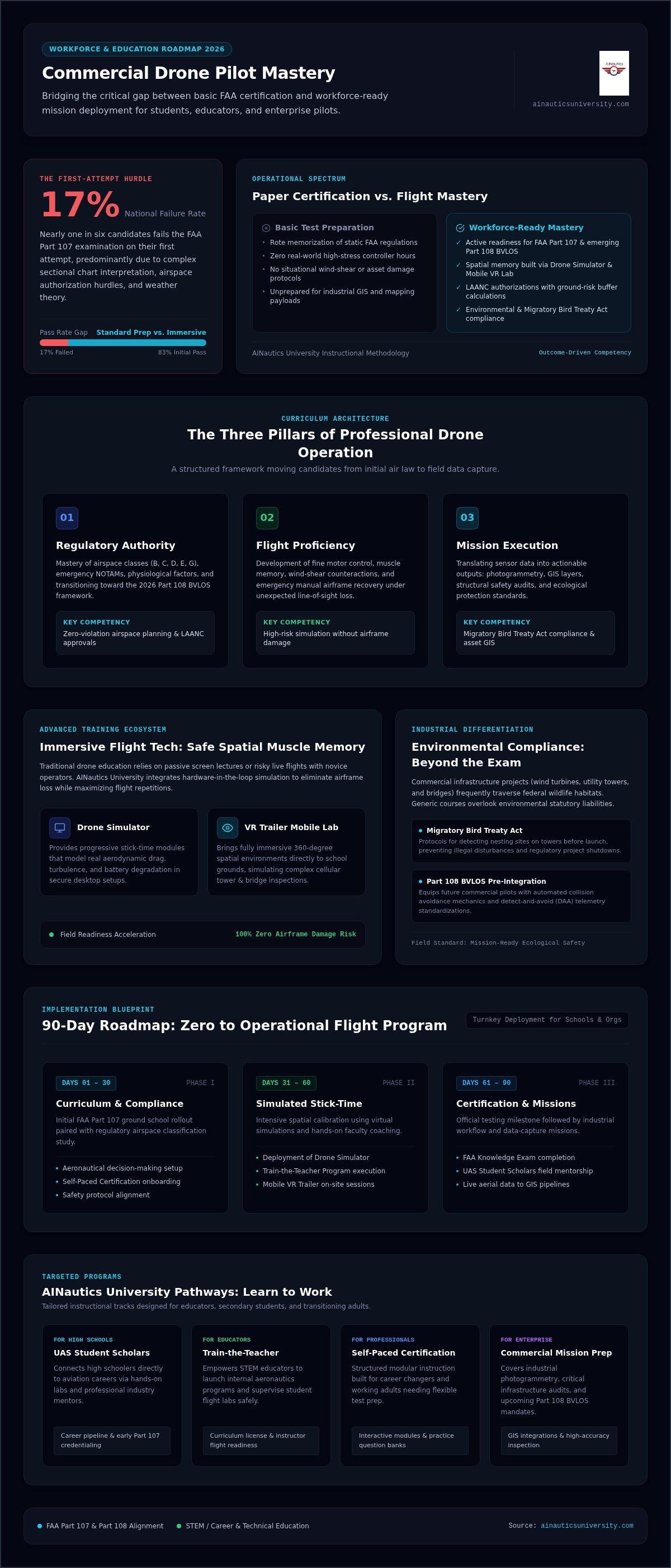
Nearly 17% of aspiring pilots fail the FAA Part 107 exam on their first attempt; many others pass the test but lack the hands-on flight experience to handle a professional job site. It's common to feel overwhelmed by the shift toward Part 108 (BVLOS) proposals or the technical demands of high-accuracy mapping. You deserve a commercial drone pilot training program that moves beyond theory to provide actionable, mission-ready expertise.
This guide delivers the 2026 roadmap to UAS mastery, ensuring you pass your exam on the first try while gaining specialized skills. We'll show you how AINautics University uses tools like the VR Trailer Mobile Lab and Drone Simulator to build spatial awareness safely. Whether you're interested in our Train-the-Teacher Program or the career mentorship of the UAS Student Scholars, you'll find a clear path to professional employment. We'll break down the latest regulatory updates and the "Learn to Work" pipeline that defines a modern drone career. By the end of this article, you'll have a strategy to master the technical and regulatory hurdles of the current industry and launch your career with confidence.
Key Takeaways
- Learn how a comprehensive commercial drone pilot training program bridges the gap between simply passing the FAA exam and executing complex professional missions.
- Discover the 2026 regulatory landscape, including mastery of FAA Part 107 standards and preparation for the emerging Part 108 framework for Beyond Visual Line of Sight operations.
- Explore how immersive technology like the Drone Simulator and VR Trailer Mobile Lab builds flight muscle memory and spatial awareness without the risk of airframe damage.
- Understand the 90-day roadmap for schools and organizations to transition from initial curriculum planning to fully operational, certified flight teams.
- Gain insights into specialized industry requirements, such as Migratory Bird Treaty Act compliance, that provide a competitive edge in professional infrastructure inspections.
What is a Commercial Drone Pilot Training Program?
A commercial drone pilot training program is a comprehensive educational framework designed to transform a novice into a professional operator. While many people view drone flight as a hobby, the professional sector operates under a strict commercial drone regulation framework. A professional program moves beyond basic Part 107 drone training by focusing on three core pillars:
- Regulatory Knowledge: Mastery of FAA rules, airspace classes, and safety protocols.
- Flight Proficiency: Technical control and spatial awareness in varied environments.
- Mission Execution: The ability to capture and process data for specific industry needs.
Choosing a program that aligns with the future of drone careers ensures you aren't just learning today's skills, but the autonomous systems of 2026. This structure provides a foundation for long-term career growth rather than just short-term test preparation.
The Distinction Between Certification and Mastery
Passing the FAA aeronautical knowledge exam is the floor, not the ceiling. A certificate proves you know the rules; mastery proves you can safely handle an expensive airframe in a high-stakes environment. We focus on mission-driven instruction that simulates real-world commercial tasks. A certified hobbyist might know how to avoid restricted airspace, but a workforce-ready pilot knows how to capture high-accuracy data while managing battery life and wind shear. Immersive tools like our VR Trailer Mobile Lab bridge this gap. It offers scenarios that build true competence before you ever touch a physical controller in the field.
Who Should Enroll in a Commercial UAS Program?
This training serves a wide range of professionals looking to leverage unmanned systems. Career changers and emergency responders are prime candidates for a commercial drone pilot training program. If you are starting from scratch, our drone training for beginners provides a structured path for those with zero flight hours. Educators also find immense value in our Train-the-Teacher Program, which empowers them to build internal drone programs for their schools. High school students can jumpstart their professional journey through the UAS Student Scholars program, creating a direct pipeline from the classroom to the workforce.
Essential Components of an Industry-Leading Curriculum
A premier commercial drone pilot training program must prepare you for the regulatory environment of today and the operational standards of tomorrow. While foundational knowledge focuses on current FAA Remote Pilot Certificate requirements, 2026 requires a deeper understanding of the upcoming Part 108 framework for Beyond Visual Line of Sight (BVLOS) operations. Mastery involves more than memorizing aircharts; it requires integrating operational safety, risk management, and ethical flight standards into every mission. Mission planning is the systematic preparation for aerial data collection.
Specialized modules distinguish a professional curriculum from basic test prep. For example, vertical infrastructure inspections often occur in sensitive habitats. Our curriculum includes federal compliance training for the Migratory Bird Treaty Act. This ensures pilots can conduct wildlife-aware inspections without violating environmental protections. These niche skills are what make a pilot truly workforce-ready and competitive in the industrial sector.
Advanced Mission Planning and Execution
Navigating complex urban environments requires precise airspace authorizations through systems like LAANC. A professional commercial drone pilot training program teaches you to secure these approvals while managing ground-risk buffers. Beyond the flight itself, modern UAS roles demand data integration skills. You'll learn how to feed aerial imagery directly into GIS and asset-management systems for immediate industrial use. For infrastructure projects, we emphasize documented wildlife assessments. This level of detail protects the operator and the client from legal liability during high-value inspections.
Self-Paced vs. Instructor-Led Learning
Choosing the right format depends on your schedule and learning style. Our Self-Paced Certification offers the flexibility needed for working professionals and students with busy academic loads. However, instructor-led sessions provide the depth and immediate feedback necessary for mastering complex maneuvers. AINautics University combines these approaches through a scalable Learning Management System (LMS). This hybrid model ensures you receive ongoing instructor support and curriculum updates as regulations evolve. Students in our UAS Student Scholars program benefit from this dual approach, gaining both theoretical knowledge and mentorship. If you're ready to start your journey, you can explore our comprehensive training options to find the best fit for your career goals.
Immersive Technology: The Future of Flight Training
Traditional flight training often hits a wall when hardware costs and weather delays interfere with progress. A modern commercial drone pilot training program overcomes these hurdles by utilizing immersive learning environments. This shift solves the "high cost of failure" that often plagues traditional programs. Instead of risking an expensive airframe on a student's first flight, we use the AINautics Drone Simulator to build essential muscle memory. This approach ensures that while you meet the FAA Remote Pilot certification requirements, you also develop the reflexes needed for complex industrial work. You'll find more details on how we use immersive drone training technology to redefine UAS education in our technical pillar.
Scenario-Based Training in a Virtual Environment
Virtual environments allow us to simulate high-stakes variables that would be too dangerous or expensive to test in the real world. Pilots can practice responding to sudden equipment failures, shifting wind patterns, or emergency procedures without any physical risk. This is particularly vital for missions involving critical infrastructure like cell towers or utility lines where precision is mandatory. By mastering these scenarios virtually, students transition seamlessly to real-world "Tier 1" raw data capture. They arrive on-site with the confidence to execute the mission accurately on the first attempt, regardless of environmental stressors.
The Mobile Lab Advantage for Schools
For many school districts, the barrier to entry for UAS programs is the risk of hardware damage and the lack of specialized lab space. Our VR Trailer Mobile Lab removes these obstacles by bringing a high-tech learning environment directly to the students. This lab allows K-12 and CTE pathways to offer hands-on autonomous systems education in a controlled, risk-free setting. It's an effective way to engage students in STEM, providing them with the same immersive tools used by industry professionals. This mobile approach ensures that every student has access to the cutting-edge training required for a professional career without the school district incurring the costs of crashed hardware or frequent repairs.
Building a Career Path: From Student to Professional Pilot
The "Learn → Train → Certify → Fly → Work" pipeline serves as a seamless career arc for anyone entering the UAS industry. For most candidates, a professional commercial drone pilot training program provides the structure needed to move from curiosity to a paycheck within a 90-day trajectory. This path is especially critical for younger generations. Utilizing a UAS scholarship for high school students helps build a sustainable talent pipeline, ensuring the next generation of pilots is ready for the technical demands of 2026. By connecting certified talent with workforce marketplaces like iFlyDrone, we ensure that specialized skills translate directly into municipal contracts and industrial roles.
The 90-Day Program Launch for Organizations
Building a drone program for a school district or enterprise doesn't have to take years. We use a structured three-step process to reduce program launch time to just 90 days. Step 1 involves strategic planning and standards alignment to ensure the curriculum meets K-12 or corporate goals. Step 2 focuses on instructor certification through our Train-the-Teacher Program, which equips educators with the credentials needed to build internal programs. Finally, Step 3 implements the Drone Simulator and live flight operations. This rapid deployment model ensures that organizations can begin training students or employees without long delays.
Workforce Development and Industry Standards
Professional credibility in the federal and municipal space depends on more than just flight skills. Our status as a Service-Disabled Veteran-Owned Small Business (SDVOSB) and AUVSI membership provides a unique advantage in the federal contracting space. Preparing as a licensed drone pilot isn't just about the initial job; it's about building recurring annual communications partnerships. To succeed in this market, pilots must understand the necessity of commercial liability insurance and certified safety protocols. These standards protect both the operator and the client during high-stakes missions. By adhering to these rigorous industry benchmarks, our graduates position themselves as reliable experts in a competitive field. If you're ready to bridge the gap between education and employment, you can explore our workforce development programs today.
Why AINautics University is the Premier Choice for Drone Training
AINautics University positions itself as a visionary mentor and a reliable expert in the field of autonomous systems. We don't just teach you how to pass a test; we prepare you for the technological demands of the future. Our commercial drone pilot training program serves as a bridge between current skill sets and professional mastery. The UAS Student Scholars program stands as our model for excellence, blending flight theory with real-world industry pathways. This STEM-aligned approach ensures that students are prepared for high-value media and infrastructure inspection work from day one. We focus on the human element of technological advancement, ensuring every learner feels supported and empowered.
Educators looking to bring these opportunities into the classroom can utilize our specialized Train-the-Teacher Program. It provides a comprehensive drone curriculum for educators, allowing schools to build internal programs that are both sustainable and compliant with national standards. By equipping teachers with curriculum-aligned credentials, we help districts launch their own flight operations in as little as 90 days.
A Commitment to Compliance and Safety
We prioritize a commitment to compliance and safety that exceeds basic regulatory requirements. This includes teaching wildlife-aware procedures, such as compliance with the Migratory Bird Treaty Act, which is essential for vertical structure inspections. We help you maintain clean paper trails for regulators, ensuring your operations are always above board. Our ongoing support and curriculum updates provide the program sustainment needed to keep your operations running smoothly as technology evolves. We invite you to join a community of professional aviators focused on the future of flight and the highest standards of safety.
Taking the Next Step in Your UAS Journey
Taking the next step in your UAS journey means choosing a path that offers a clear return on investment. Choosing the right commercial drone pilot training program means choosing a path that offers more than just a certificate. While basic test-prep gets you a license, mission-ready skills get you a career. Whether you explore our specialized Self-Paced Certification or engage in immersive lab experiences with our Drone Simulator, you're investing in your professional future. We address the primary objection of training costs by demonstrating the immediate value of being able to execute complex missions on a job site. It's time to master the skies with AINautics University.
Master Your Professional Future in the Skies
Achieving mastery in the unmanned systems industry requires more than just a certificate; it demands a commitment to mission-specific skills and safety standards. You've seen how immersive technology like the Drone Simulator and VR Trailer Mobile Lab builds the reflexes needed for high-stakes inspections. You also understand that the 90-day roadmap provides a clear, actionable path for schools and organizations to launch successful programs. By focusing on workforce readiness and upcoming Part 108 regulations, you position yourself as a leader in a rapidly evolving field.
As an SDVOSB certified institution and a proud AUVSI member, AINautics University is dedicated to your long-term success. Our commercial drone pilot training program is designed to bridge the gap between classroom theory and real-world employment. We stand by our 90-Day Program Launch Guarantee to help districts and enterprises scale quickly. Don't wait for the future to arrive. Launch your drone career with AINautics University today and join a community of expert aviators. The horizon is wide, and your journey toward professional UAS mastery starts with a single, decisive step.
Frequently Asked Questions
What is included in a commercial drone pilot training program?
A professional commercial drone pilot training program includes more than just test preparation for the FAA exam. It features a structured curriculum covering flight physics, national airspace regulations, and mission-driven instruction. At AINautics University, we integrate operational safety, risk management, and compliance services into our courses. This ensures students gain the technical skills needed for real-world missions, such as infrastructure inspection or aerial mapping, rather than just memorizing facts for a certificate.
How long does it take to become a certified commercial drone pilot?
The timeline depends on your learning style and background. Most candidates require 20 to 30 hours of structured ground school study to master aeronautical knowledge. For organizations, our structured rollout can launch a complete drone program in 90 days. Individual learners often choose our Self-Paced Certification to balance training with other commitments. Once you pass the 60-question FAA exam, you can begin your professional career as a certified remote pilot.
Can I use a drone simulator to fulfill FAA flight requirements?
While the FAA doesn't mandate specific flight hours for Part 107 certification, simulators are essential for professional mastery. The AINautics Drone Simulator allows you to build muscle memory and practice emergency procedures in a risk-free environment. This virtual training ensures you're prepared for high-stakes missions before you ever handle physical hardware. It's a critical tool for developing the spatial orientation and reflexes required for complex commercial flight operations in 2026.
Is the Part 107 certification enough to get a job in 2026?
A Part 107 certificate is the legal floor, but it's rarely enough for high-value contracts in 2026. Employers look for pilots who can integrate data into GIS or asset-management systems. Our commercial drone pilot training program emphasizes these advanced skills to make you workforce-ready. By joining marketplaces like iFlyDrone, certified pilots can find opportunities with municipalities and enterprise clients that require documented safety protocols and specialized aerial data collection expertise.
How does the Train-the-Teacher program help schools start drone programs?
Our Train-the-Teacher Program equips educators with the curriculum-aligned credentials and instructional tools necessary to lead their own classrooms. We provide ongoing updates and instructor support to ensure school programs remain compliant with evolving FAA standards. This model allows districts to build sustainable internal departments that offer students direct pathways to UAS careers. It simplifies the implementation process by aligning training with state and district standards for K-12 and CTE initiatives.
What are the benefits of a VR-based drone training lab?
A VR-based lab like our VR Trailer Mobile Lab offers an immersive, hands-on learning experience without the risk of airframe damage. It allows students to simulate equipment failures or adverse weather conditions safely. This technology is particularly effective for K-12 and CTE pathways, as it maintains high engagement levels while teaching complex autonomous systems concepts. It provides a scalable way for school districts to offer professional-grade training across multiple locations.
Are there specific drone training programs for high school students?
The UAS Student Scholars program is specifically designed to guide high school students toward professional careers in unmanned systems. This program focuses on STEM-aligned, mission-driven instruction that connects classroom learning with industry standards. Students gain experience in aerial media and inspection while preparing for their FAA certification. It's a key part of our "Learn to Work" pipeline, helping young aviators build a professional portfolio before they even graduate.
What is the role of wildlife compliance in commercial drone inspections?
Wildlife compliance is a critical requirement for vertical structure inspections, especially at sites with protected bird nests. Our training includes instruction on the Migratory Bird Treaty Act to ensure pilots avoid legal violations during missions. We teach you how to attach documented wildlife assessments to every report. This creates a clean paper trail for regulators and insurers, demonstrating that your operations meet the highest ethical and federal environmental standards.

Article by
AINautics University Team
The team behind AINautics University, dedicated to drone education and FAA Part 107 certification prep, VR flight simulation, and STEM training programs for students and educators.


